
Homework Answers
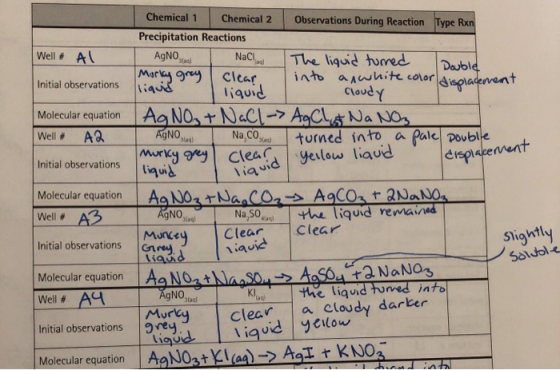
Ans:- In A1
AgNO3 (aq)+ NaCl(aq) ----->AgCl(s) + NaNO3 (aq)
Agcl is white ppt . This formation of ppt is a test for presence of chloride ion and even test of group 1 cations in salt analysis .
Agcl is non -polar because of big size of silver ion with chlorine ion and so it's deform the electrons shells,so this gives its non polar nature so agcl insoluble in water .
In A2 Ag2CO3 is in water considered insoluble in watee but small amount of it 0.032g/l is soluble at 25°C.
In A3 Ag2SO4 is also marginally soluble in water
In A4 AgI is nearly insoluble in water for 3×10^-6 g/l in water at 20°C
So A1 gives most ppt.
Add Answer to:
the first four reactions are provided
i
need help explaining how i can determine for certain...
Name: Lab Partner's name Lab 11 Reactions and Equations: Double Displacement Reactions AUN A. OBSERVATIONS / QUES...
 Name: Lab Partner's name Lab 11 Reactions and Equations: Double Displacement Reactions AUN A. OBSERVATIONS / QUESTIONS: 1. For each of the following reactions, record the evidence you observe that indicates a chemical change has occurred and provide a balanced molecular equation, complete ionic equation and net ionic equation a) Silver nitrate + Sodium chloride Evidence of chemical change: Souly Turning into a solida turned white and cloudly Slowly disoiving Shrunk into one bail Molecular Equation: AgNO3 + NaCl ->...
i need help with this lab please. can i get someone to answer the entire thing....
 i need help with this lab please. can i get someone to answer
the entire thing. thank you
Instructor Equilibria of Coordination Compounds OBSERVATIONS AND DATA 1. The formation of complex ions with ammonia The net ionic equation for the reaction of excess Cuso, with NH, is 24 Cu2+ + 4NH3 [cu (NH3)4] The predicted effect on the reaction above of adding excess NH, (based on Le Châtelier's principle) is The reaction will shift to the night and product formation...
i need help with this lab please. can i get someone to answer
the entire thing. thank you
Instructor Equilibria of Coordination Compounds OBSERVATIONS AND DATA 1. The formation of complex ions with ammonia The net ionic equation for the reaction of excess Cuso, with NH, is 24 Cu2+ + 4NH3 [cu (NH3)4] The predicted effect on the reaction above of adding excess NH, (based on Le Châtelier's principle) is The reaction will shift to the night and product formation...
I just need the blank data table with all the reactions shown. I need ALL 36...
 I just need the blank data table with
all the reactions shown. I need ALL 36 spaces for reacting
solutions. I don't need the observations. Please
help.
ARE hem 310 LAB EXPERIMENT #6 Chemical Reactions: Double Replacements I. OBJECTIVES 1. To perform and record observations of some chemical reactions. 2. To gain skill in writing balanced equations from observations of chemical reactions using known reactants. 3. To look for ions that, if present, may cause the compounds to be insoluble...
I just need the blank data table with
all the reactions shown. I need ALL 36 spaces for reacting
solutions. I don't need the observations. Please
help.
ARE hem 310 LAB EXPERIMENT #6 Chemical Reactions: Double Replacements I. OBJECTIVES 1. To perform and record observations of some chemical reactions. 2. To gain skill in writing balanced equations from observations of chemical reactions using known reactants. 3. To look for ions that, if present, may cause the compounds to be insoluble...
I really just need all the equations, please and thank you. MATERIALS: cene nitric acid, HNO,...
 I really just need all the equations, please and thank you.
MATERIALS: cene nitric acid, HNO, 3.0M sodium hydroxide, NaOH 6.0 M sulfuric acid, H2SO4 zine metal DI water PROCEDURE: Make sure you record detailed observations after almost every step. You will also need to write the balanced chemical equations for almost every step. Make sure you answer any questions associated with a step 1. Weigh approximately 0.5 g of copper metal and record the weight. Place the copper in...
I really just need all the equations, please and thank you.
MATERIALS: cene nitric acid, HNO, 3.0M sodium hydroxide, NaOH 6.0 M sulfuric acid, H2SO4 zine metal DI water PROCEDURE: Make sure you record detailed observations after almost every step. You will also need to write the balanced chemical equations for almost every step. Make sure you answer any questions associated with a step 1. Weigh approximately 0.5 g of copper metal and record the weight. Place the copper in...
hello, i need help with the questions in the second photo Experiment 6. the reduction of...
 hello, i need help with the questions in the second photo
Experiment 6. the reduction of bencil (March 2020) Your name Sodium borohydride is a convert recent for the reduction of dehydes and ketones to 1" and 2 alcohols, respectively. The mechanism of the reaction (below) is straightforward and is driven by boron's affinity for oxygen. In addition, given borohydride's remarkably low reactivity with OH groups under neutral and especially basic conditions, this reaction can be done in alcohol solvents....
hello, i need help with the questions in the second photo
Experiment 6. the reduction of bencil (March 2020) Your name Sodium borohydride is a convert recent for the reduction of dehydes and ketones to 1" and 2 alcohols, respectively. The mechanism of the reaction (below) is straightforward and is driven by boron's affinity for oxygen. In addition, given borohydride's remarkably low reactivity with OH groups under neutral and especially basic conditions, this reaction can be done in alcohol solvents....
Hi, can anyone please help me with this? i have no clue how to define if...
 Hi,
can anyone please help me with this? i have no clue how to define
if a reaction is Oxidation reduction or not. Thanks a lot
OXIDATION-REDUCTION Introduction Chemists refer to reactions which involve a transfer of electrons from one reactant to another as oxidation reduction reactions of just "redox" reactions. Oxidation is defined as a loss of electron and reduction as a gain of electron by a substance during a chemical reaction. The loss of electrons by one substance...
Hi,
can anyone please help me with this? i have no clue how to define
if a reaction is Oxidation reduction or not. Thanks a lot
OXIDATION-REDUCTION Introduction Chemists refer to reactions which involve a transfer of electrons from one reactant to another as oxidation reduction reactions of just "redox" reactions. Oxidation is defined as a loss of electron and reduction as a gain of electron by a substance during a chemical reaction. The loss of electrons by one substance...
i need help on question 2a,b,c and 3a,b,c on the post lab. Experiment EQ-309 Post-Lab Questions...
 i
need help on question 2a,b,c and 3a,b,c on the post lab.
Experiment EQ-309 Post-Lab Questions Determination Of An Equilibrium Constant (To be answered in the "Analysis" section of your lab report) 1 a) Calculate the molarity of the silver nitrate solution provided. b) Calculate the molarity of the sodium chloride solution provided. 2 a) Use the data from each titration to calculate the value of K for the reaction, Ag(NH)2+ + Cl" - AgCl, + 2 NH, b) Calculate...
i
need help on question 2a,b,c and 3a,b,c on the post lab.
Experiment EQ-309 Post-Lab Questions Determination Of An Equilibrium Constant (To be answered in the "Analysis" section of your lab report) 1 a) Calculate the molarity of the silver nitrate solution provided. b) Calculate the molarity of the sodium chloride solution provided. 2 a) Use the data from each titration to calculate the value of K for the reaction, Ag(NH)2+ + Cl" - AgCl, + 2 NH, b) Calculate...
Microscale techniques: In today's experiment we will be using very small amounts of chemical reactants. This...
 Microscale techniques: In today's experiment we will be using very small amounts of chemical reactants. This method is generally less expensive and more environmentally-friendly than traditional "test tube" chemistry. Some of the waste products produced in today's experiment, particularly those containing lead and barium, are harmful to the environment. By using such small amounts of chemical reactants we generate far less waste than by using larger scale methods. Procedure 1. Put on your safety goggles. Be sure to wear them...
 Name: Lab Partner's name Lab 11 Reactions and Equations: Double Displacement Reactions AUN A. OBSERVATIONS / QUESTIONS: 1. For each of the following reactions, record the evidence you observe that indicates a chemical change has occurred and provide a balanced molecular equation, complete ionic equation and net ionic equation a) Silver nitrate + Sodium chloride Evidence of chemical change: Souly Turning into a solida turned white and cloudly Slowly disoiving Shrunk into one bail Molecular Equation: AgNO3 + NaCl ->...
 i need help with this lab please. can i get someone to answer
the entire thing. thank you
Instructor Equilibria of Coordination Compounds OBSERVATIONS AND DATA 1. The formation of complex ions with ammonia The net ionic equation for the reaction of excess Cuso, with NH, is 24 Cu2+ + 4NH3 [cu (NH3)4] The predicted effect on the reaction above of adding excess NH, (based on Le Châtelier's principle) is The reaction will shift to the night and product formation...
i need help with this lab please. can i get someone to answer
the entire thing. thank you
Instructor Equilibria of Coordination Compounds OBSERVATIONS AND DATA 1. The formation of complex ions with ammonia The net ionic equation for the reaction of excess Cuso, with NH, is 24 Cu2+ + 4NH3 [cu (NH3)4] The predicted effect on the reaction above of adding excess NH, (based on Le Châtelier's principle) is The reaction will shift to the night and product formation...
 I just need the blank data table with
all the reactions shown. I need ALL 36 spaces for reacting
solutions. I don't need the observations. Please
help.
ARE hem 310 LAB EXPERIMENT #6 Chemical Reactions: Double Replacements I. OBJECTIVES 1. To perform and record observations of some chemical reactions. 2. To gain skill in writing balanced equations from observations of chemical reactions using known reactants. 3. To look for ions that, if present, may cause the compounds to be insoluble...
I just need the blank data table with
all the reactions shown. I need ALL 36 spaces for reacting
solutions. I don't need the observations. Please
help.
ARE hem 310 LAB EXPERIMENT #6 Chemical Reactions: Double Replacements I. OBJECTIVES 1. To perform and record observations of some chemical reactions. 2. To gain skill in writing balanced equations from observations of chemical reactions using known reactants. 3. To look for ions that, if present, may cause the compounds to be insoluble...
 I really just need all the equations, please and thank you.
MATERIALS: cene nitric acid, HNO, 3.0M sodium hydroxide, NaOH 6.0 M sulfuric acid, H2SO4 zine metal DI water PROCEDURE: Make sure you record detailed observations after almost every step. You will also need to write the balanced chemical equations for almost every step. Make sure you answer any questions associated with a step 1. Weigh approximately 0.5 g of copper metal and record the weight. Place the copper in...
I really just need all the equations, please and thank you.
MATERIALS: cene nitric acid, HNO, 3.0M sodium hydroxide, NaOH 6.0 M sulfuric acid, H2SO4 zine metal DI water PROCEDURE: Make sure you record detailed observations after almost every step. You will also need to write the balanced chemical equations for almost every step. Make sure you answer any questions associated with a step 1. Weigh approximately 0.5 g of copper metal and record the weight. Place the copper in...
 hello, i need help with the questions in the second photo
Experiment 6. the reduction of bencil (March 2020) Your name Sodium borohydride is a convert recent for the reduction of dehydes and ketones to 1" and 2 alcohols, respectively. The mechanism of the reaction (below) is straightforward and is driven by boron's affinity for oxygen. In addition, given borohydride's remarkably low reactivity with OH groups under neutral and especially basic conditions, this reaction can be done in alcohol solvents....
hello, i need help with the questions in the second photo
Experiment 6. the reduction of bencil (March 2020) Your name Sodium borohydride is a convert recent for the reduction of dehydes and ketones to 1" and 2 alcohols, respectively. The mechanism of the reaction (below) is straightforward and is driven by boron's affinity for oxygen. In addition, given borohydride's remarkably low reactivity with OH groups under neutral and especially basic conditions, this reaction can be done in alcohol solvents....
 Hi,
can anyone please help me with this? i have no clue how to define
if a reaction is Oxidation reduction or not. Thanks a lot
OXIDATION-REDUCTION Introduction Chemists refer to reactions which involve a transfer of electrons from one reactant to another as oxidation reduction reactions of just "redox" reactions. Oxidation is defined as a loss of electron and reduction as a gain of electron by a substance during a chemical reaction. The loss of electrons by one substance...
Hi,
can anyone please help me with this? i have no clue how to define
if a reaction is Oxidation reduction or not. Thanks a lot
OXIDATION-REDUCTION Introduction Chemists refer to reactions which involve a transfer of electrons from one reactant to another as oxidation reduction reactions of just "redox" reactions. Oxidation is defined as a loss of electron and reduction as a gain of electron by a substance during a chemical reaction. The loss of electrons by one substance...
 i
need help on question 2a,b,c and 3a,b,c on the post lab.
Experiment EQ-309 Post-Lab Questions Determination Of An Equilibrium Constant (To be answered in the "Analysis" section of your lab report) 1 a) Calculate the molarity of the silver nitrate solution provided. b) Calculate the molarity of the sodium chloride solution provided. 2 a) Use the data from each titration to calculate the value of K for the reaction, Ag(NH)2+ + Cl" - AgCl, + 2 NH, b) Calculate...
i
need help on question 2a,b,c and 3a,b,c on the post lab.
Experiment EQ-309 Post-Lab Questions Determination Of An Equilibrium Constant (To be answered in the "Analysis" section of your lab report) 1 a) Calculate the molarity of the silver nitrate solution provided. b) Calculate the molarity of the sodium chloride solution provided. 2 a) Use the data from each titration to calculate the value of K for the reaction, Ag(NH)2+ + Cl" - AgCl, + 2 NH, b) Calculate...
 Microscale techniques: In today's experiment we will be using very small amounts of chemical reactants. This method is generally less expensive and more environmentally-friendly than traditional "test tube" chemistry. Some of the waste products produced in today's experiment, particularly those containing lead and barium, are harmful to the environment. By using such small amounts of chemical reactants we generate far less waste than by using larger scale methods. Procedure 1. Put on your safety goggles. Be sure to wear them...
Most questions answered within 3 hours.
-
Where is the error in this code sequence?
String s1 = "Hello";
String s2 = "ello";...
asked 10 months ago -
Financial data for Joel de Paris, Inc., for last year
follow:
Joel de Paris, Inc.
Balance...
asked 10 months ago -
Consider this reaction:
Al2(SO4)3 (aq)+ BaCl3
(aq) Al2Cl6 (aq)- +
3BaSO4(s) . What is the...
asked 10 months ago -
Suppose that Savneet is considering increasing her
recent random sample from 20 car rentals to 40...
asked 10 months ago -
Trucks arrive at an unloading terminal at an average rate of 120
per hour.
Trucks arrive...
asked 10 months ago -
Why are methanol and ethanol completely soluble in water while
octanol is not very little soluble....
asked 10 months ago -
A facilities manager at a university reads in a research report
that the mean amount of...
asked 10 months ago -
When the CuSO4 is rehydrated by adding water to the anhydrous
compound, is this an endothermic...
asked 10 months ago -
A ray of sunlight is passing from diamond into crown glass; the
angle of incidence is...
asked 10 months ago -
A block of mass 0.249 kg is placed on top of a light, vertical
spring of...
asked 10 months ago -
how do the kidneys compensate in the presences of acidosis
a) trigger hyperventilate
b) reserve acid...
asked 10 months ago -
Question 501 pts
The rental rate of capital to the firm increases. Which of the
following...
asked 10 months ago