

Homework Answers
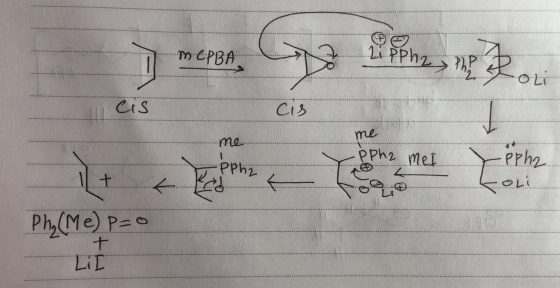
Phosphine has very high affinity towards oxygen. Once phosphorous will undergo nucleophilic addition to the epoxide the oxygen and phosphorous will go to the opposite orientation. The single bond in between this two atom will rotate and bring the oxygen and phosphorous atom close to each oher and make bond in betwwen. Finally this phosphorous oxide will be eliminated and alkene will changed to trans from cis or cis from trans because of the rotation took place in the mid way of the reaction. Here Methyl Iodide has no role except to quaternize phophorous atom (see reaction mechanism below)
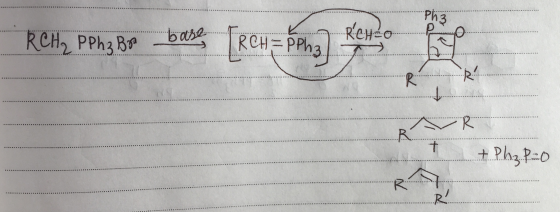
In wittig reaction a mixture of cis/trans isomer will be observed. Here also phosphonium oxide will be elliminated.
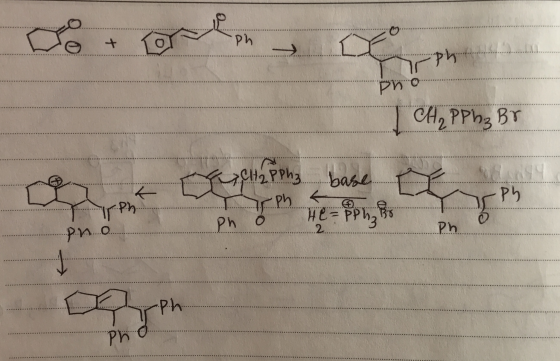
For the reaction mechanism of second part see below:
Add Answer to:
2.6. a. A stereospecific method for deoxygenating epoxides to alkenes involves reaction of the epoxide with...
QUESTION 4 [1,2- versus 1,4-Addition Reactions] 4.1 Propose a detailed mechanism for the reaction of 2-butenal...
 QUESTION 4 [1,2- versus 1,4-Addition Reactions] 4.1 Propose a detailed mechanism for the reaction of 2-butenal with ethynylmagnesium bromide in dry THF followed by quenching with dilute aqueous acid. (5) 4.2 Propose a plausible mechanism for the reaction of 1,3-diphenyl-2-propen-1- one with potassium cyanide in ethanol followed by aqueous work-up. 1 (5) 4.3 Predict and draw the structure of the product of the reaction of 2-methyl-1,3- cyclohexanedione with methyl vinyl ketone (3-buten-2-one) in methanol in the presence of potassium hydroxide....
Look up and draw the mechanism for the addition of Br2 to double bonds. Reference the...
 Look up and draw the mechanism for the addition of Br2 to
double bonds. Reference the source from which you acquired the
mechanism.
Give the IUPAC name of the major product in the above-mentioned
reaction.
Draw the major product of obtained in the addition of Br2 to
stilbene.
Is this isomer chiral? What would be the optical rotation if
this sample was placed in a polarimeter?
Would a student obtain the same product if you started with
cis-stilbene instead of...
Look up and draw the mechanism for the addition of Br2 to
double bonds. Reference the source from which you acquired the
mechanism.
Give the IUPAC name of the major product in the above-mentioned
reaction.
Draw the major product of obtained in the addition of Br2 to
stilbene.
Is this isomer chiral? What would be the optical rotation if
this sample was placed in a polarimeter?
Would a student obtain the same product if you started with
cis-stilbene instead of...
1. (10 marks the wol 1. (10 marks) The Wolff-Kishner reduction is a method to transform...
 1. (10 marks the wol 1. (10 marks) The Wolff-Kishner reduction is a method to transform ketones into alkanes. An example is provided below. step 1 step 2 NH oh oh oh oon HẠN-NH, KOH/H20 A mechanism for the Wolff-Kishner reduction is proposed online at the following website: However, all steps and all electron-pushing arrows are not clearly illustrated in this mechanism. Propose a detailed mechanism with all electron-pushing arrows for both steps of the Wolff-Kishner reduction. Notice the first...
(C) Protonation of alkene to form a carbocation followed by addition of bromide ion (D) Addition...
 (C) Protonation of alkene to form a carbocation followed by addition of bromide ion (D) Addition of the proton to one face of the alkene with simultaneous delivery of a bromide ion from a different molecule of H-Br. 11. Which compound is the strongest nmucleophile for reaction of methane methanesulfonate (CHOS0.CH) in methanol at room temperature? (You may assume that everything is soluble in methanol) (A) potassium bromide (B) cesium iodide (C) sodiam chloride (D) lithium flaoride 12. Which proton...
How to solve alkene and alkyne reactions - Merdanym i Act antalyzod Hrdian ca Come Lazarmistry...
 How to solve alkene and alkyne reactions
- Merdanym i Act antalyzod Hrdian ca Come Lazarmistry I V WORKSHOP #9 Alkenes, Alkynes, Reactions 1. Give a reasonable mechanism for the following reaction. Clearly show intermediates and show the movement of electron pairs with curved arrows. all сна H20. (H2SO4) H₃C CH₂ нас он H3CX сна 2. The addition of HBr to 2-methylpropene can, in principle, give either 1-bromo-2- methylpropane or 2-bromo-2-methylpropane. In reality, only the latter is formed. Show mechanisms...
How to solve alkene and alkyne reactions
- Merdanym i Act antalyzod Hrdian ca Come Lazarmistry I V WORKSHOP #9 Alkenes, Alkynes, Reactions 1. Give a reasonable mechanism for the following reaction. Clearly show intermediates and show the movement of electron pairs with curved arrows. all сна H20. (H2SO4) H₃C CH₂ нас он H3CX сна 2. The addition of HBr to 2-methylpropene can, in principle, give either 1-bromo-2- methylpropane or 2-bromo-2-methylpropane. In reality, only the latter is formed. Show mechanisms...
 QUESTION 4 [1,2- versus 1,4-Addition Reactions] 4.1 Propose a detailed mechanism for the reaction of 2-butenal with ethynylmagnesium bromide in dry THF followed by quenching with dilute aqueous acid. (5) 4.2 Propose a plausible mechanism for the reaction of 1,3-diphenyl-2-propen-1- one with potassium cyanide in ethanol followed by aqueous work-up. 1 (5) 4.3 Predict and draw the structure of the product of the reaction of 2-methyl-1,3- cyclohexanedione with methyl vinyl ketone (3-buten-2-one) in methanol in the presence of potassium hydroxide....
 Look up and draw the mechanism for the addition of Br2 to
double bonds. Reference the source from which you acquired the
mechanism.
Give the IUPAC name of the major product in the above-mentioned
reaction.
Draw the major product of obtained in the addition of Br2 to
stilbene.
Is this isomer chiral? What would be the optical rotation if
this sample was placed in a polarimeter?
Would a student obtain the same product if you started with
cis-stilbene instead of...
Look up and draw the mechanism for the addition of Br2 to
double bonds. Reference the source from which you acquired the
mechanism.
Give the IUPAC name of the major product in the above-mentioned
reaction.
Draw the major product of obtained in the addition of Br2 to
stilbene.
Is this isomer chiral? What would be the optical rotation if
this sample was placed in a polarimeter?
Would a student obtain the same product if you started with
cis-stilbene instead of...
 1. (10 marks the wol 1. (10 marks) The Wolff-Kishner reduction is a method to transform ketones into alkanes. An example is provided below. step 1 step 2 NH oh oh oh oon HẠN-NH, KOH/H20 A mechanism for the Wolff-Kishner reduction is proposed online at the following website: However, all steps and all electron-pushing arrows are not clearly illustrated in this mechanism. Propose a detailed mechanism with all electron-pushing arrows for both steps of the Wolff-Kishner reduction. Notice the first...
 (C) Protonation of alkene to form a carbocation followed by addition of bromide ion (D) Addition of the proton to one face of the alkene with simultaneous delivery of a bromide ion from a different molecule of H-Br. 11. Which compound is the strongest nmucleophile for reaction of methane methanesulfonate (CHOS0.CH) in methanol at room temperature? (You may assume that everything is soluble in methanol) (A) potassium bromide (B) cesium iodide (C) sodiam chloride (D) lithium flaoride 12. Which proton...
 How to solve alkene and alkyne reactions
- Merdanym i Act antalyzod Hrdian ca Come Lazarmistry I V WORKSHOP #9 Alkenes, Alkynes, Reactions 1. Give a reasonable mechanism for the following reaction. Clearly show intermediates and show the movement of electron pairs with curved arrows. all сна H20. (H2SO4) H₃C CH₂ нас он H3CX сна 2. The addition of HBr to 2-methylpropene can, in principle, give either 1-bromo-2- methylpropane or 2-bromo-2-methylpropane. In reality, only the latter is formed. Show mechanisms...
How to solve alkene and alkyne reactions
- Merdanym i Act antalyzod Hrdian ca Come Lazarmistry I V WORKSHOP #9 Alkenes, Alkynes, Reactions 1. Give a reasonable mechanism for the following reaction. Clearly show intermediates and show the movement of electron pairs with curved arrows. all сна H20. (H2SO4) H₃C CH₂ нас он H3CX сна 2. The addition of HBr to 2-methylpropene can, in principle, give either 1-bromo-2- methylpropane or 2-bromo-2-methylpropane. In reality, only the latter is formed. Show mechanisms...
Most questions answered within 3 hours.
-
Where is the error in this code sequence?
String s1 = "Hello";
String s2 = "ello";...
asked 10 months ago -
Financial data for Joel de Paris, Inc., for last year
follow:
Joel de Paris, Inc.
Balance...
asked 10 months ago -
Consider this reaction:
Al2(SO4)3 (aq)+ BaCl3
(aq) Al2Cl6 (aq)- +
3BaSO4(s) . What is the...
asked 10 months ago -
Suppose that Savneet is considering increasing her
recent random sample from 20 car rentals to 40...
asked 10 months ago -
Trucks arrive at an unloading terminal at an average rate of 120
per hour.
Trucks arrive...
asked 10 months ago -
Why are methanol and ethanol completely soluble in water while
octanol is not very little soluble....
asked 10 months ago -
A facilities manager at a university reads in a research report
that the mean amount of...
asked 10 months ago -
When the CuSO4 is rehydrated by adding water to the anhydrous
compound, is this an endothermic...
asked 10 months ago -
A ray of sunlight is passing from diamond into crown glass; the
angle of incidence is...
asked 10 months ago -
A block of mass 0.249 kg is placed on top of a light, vertical
spring of...
asked 10 months ago -
how do the kidneys compensate in the presences of acidosis
a) trigger hyperventilate
b) reserve acid...
asked 10 months ago -
Question 501 pts
The rental rate of capital to the firm increases. Which of the
following...
asked 10 months ago