Be sure to answer all parts. The equilibrium constant Kc for the reaction H2(g) + CO2(g)...
Be sure to answer all parts. The equilibrium constant Kc for the reaction H2(g) + CO2(g) ⇌ H2O(g) + CO(g) is 4.2 at 1650°C. Initially 0.72 mol H2 and 0.72 mol CO2 are injected into a 4.5−L flask. Calculate the concentration of each species at equilibrium. Equilibrium concentration of H2: M Equilibrium concentration of CO2: M Equilibrium concentration of H2O: M Equilibrium concentration of CO: M
Homework Answers
For the general reaction:
aA + bB <-> cC + dD ,
where a,b,c and d are the stoichiometric coefficients, A and B are reactants and C and D are products;
Kc = ![[c][D]d [A]a[B]6](http://img.homeworklib.com/questions/799e5170-ddaa-11eb-86a6-95265d765de4.png?x-oss-process=image/resize,w_560)
Only compounds in gaseous (g) or aqueous (aq) state are included in the expression.
[…] denotes concentration in molarity
For the given equation :
H2 (g) + CO2(g) ↔H2O (g) + CO(g)
Kc = ![[H, 0][co] [HQ][002]](http://img.homeworklib.com/questions/79fb5990-ddaa-11eb-a9b1-9fa2c3eaaaec.png?x-oss-process=image/resize,w_560) =
4.2
=
4.2
The volume of flask = 4.5 L
Molarity = No. of moles/volume (in L)
So, molarity of H2 = 0.72 moles/ 4.5 L = 0.16 M
Molarity of CO2 = 0.72 moles/ 4.5 L = 0.16 M
Let x M H2 and CO2 react to reach equilibrium.
We can construct the following ICE (Initial, Change, Equilibrium) table :
| Concentration (in Molarity) | H2 | CO2 | H2O | CO |
| Intial | 0.16 | 0.16 | 0 | 0 |
| change | -x | -x | +x | +x |
| equilibrium | 0.16 - x | 0.16 -x | x | x |
Thus, to get molarity of the species present at equilibrium, we need to find x.
Putting the concentration of the three species at equilibrium into equation for Kc , and solving for x:
Kc = ![[H, 0][co] [HQ][002]](http://img.homeworklib.com/questions/7a5371c0-ddaa-11eb-a916-01ae8095c4c0.png?x-oss-process=image/resize,w_560) =
4.2
=
4.2
Or,  =
4.2
=
4.2
or, 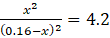
Taking square root on both sides:
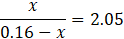
Or, x = 0.328 – 2.05x
Or, x = 0.107
Thus, concentration of H2 at equilibrium = 0.16 – x = 0.16 – 0.107 = 0.053 M
concentration of CO2 at equilibrium = 0.16 – x = 0.16 – 0.107 = 0.053 M
concentration of H2O at equilibrium = x = 0.107 M
concentration of CO at equilibrium = x = 0.107 M
Add Answer to:
Be sure to answer all parts. The equilibrium constant Kc for the
reaction H2(g) + CO2(g)...
Be sure to answer all parts. The equilibrium constant K, for the reaction Hz() + CO2() H2O(g) + CO(g) 1s 4.2 at 165...
 Be sure to answer all parts. The equilibrium constant K, for the reaction Hz() + CO2() H2O(g) + CO(g) 1s 4.2 at 1650°C. Initially 0.76 mol H2 and 0.76 mol CO2 are injected into a 4.5-L flask. Calculate the concentration of each species at equilibrium. Equilibrium concentration of H2: Equilibrium concentration of CO2: Equilibrium concentration of H20: Equilibrium concentration of CO:
The equilibrium constant Kc for the reaction H2(g) + CO2(g) ⇌ H2O(g) + CO(g) is 4.2...
The equilibrium constant Kc for the reaction H2(g) + CO2(g) ⇌ H2O(g) + CO(g) is 4.2 at 1650°C. Initially 0.71 mol H2 and 0.71 mol CO2 are injected into a 5.0−L flask. Calculate the concentration of each species at equilibrium.
1:Consider the following equilibrium process at 686°C: CO2(g) + H2(g) ⇌ CO(g) + H2O(g) The equilibrium...
1:Consider the following equilibrium process at 686°C: CO2(g) + H2(g) ⇌ CO(g) + H2O(g) The equilibrium concentrations of the reacting species are [CO] = 0.0570 M, [H2] = 0.0420 M, [CO2] = 0.0860 M, and [H2O] = 0.0430 M. (a) Calculate Kc for the reaction at 686°C. (b)If we add CO2 to increase its concentration to 0.440 mol / L, what will the concentrations of all the gases be when equilibrium is reestablished? (c) CO2: H2: CO: H2O: 2:The following...
The equilibrium constant Kc for the following reaction is 8.30. H2(g) + CO2(g) ↔ H2O(g) +...
The equilibrium constant Kc for the following reaction is 8.30. H2(g) + CO2(g) ↔ H2O(g) + CO(g) Initially, 0.40 moles each of H2 and CO2 are injected into a 9.00 L flask. Calculate the concentration of the CO(g) at equilibrium.
The equilibrium constant Kc for the following reaction is 6.40. H2(g) + CO2(g) ↔ H2O(g) +...
The equilibrium constant Kc for the following reaction is 6.40. H2(g) + CO2(g) ↔ H2O(g) + CO(g) Initially, 0.70 moles each of H2 and CO2 are injected into a 3.50 L flask. Calculate the concentration of the CO(g) at equilibrium.
Be sure to answer all parts. The equilibrium constant Kc for the reaction H2(g) + Br2(g)...
Be sure to answer all parts. The equilibrium constant Kc for the reaction H2(g) + Br2(g) ⇆ 2HBr(g) is 2.180 × 10⁶ at 730°C. Starting with 2.20 moles of HBr in a 18.1−L reaction vessel, calculate the concentrations of H2, Br2, and HBr at equilibrium. [H2] =___ M Br2] = ___M [HBr] = ____M
the equilibrium constant kc for the reaction: h2(g) + co2(g) <--> h2o(g) + co(g) is 4.2...
the equilibrium constant kc for the reaction: h2(g) + co2(g) <--> h2o(g) + co(g) is 4.2 at 2000k. (a) calculate delta G for the reaction
Consider the following equilibrium process at 686°C: CO2(g) + H2(g) ⇌ CO(g) + H2O(g) The equilibrium...
Consider the following equilibrium process at 686°C: CO2(g) + H2(g) ⇌ CO(g) + H2O(g) The equilibrium concentrations of the reacting species are [CO] = 0.0580 M, [H2] = 0.0430 M, [CO2] = 0.0830 M, and [H2O] = 0.0370 M. (a) Calculate Kc for the reaction at 686°C. (b) If we add CO2 to increase its concentration to 0.460 mol / L, what will the concentrations of all the gases be when equilibrium is reestablished? CO2: M H2: M CO: M...
Consider the following equilibrium process at 686 ° C: CO2(g) + H2(g) ⇌ CO(g) + H2O(g)...
Consider the following equilibrium process at 686 ° C: CO2(g) + H2(g) ⇌ CO(g) + H2O(g) The equilibrium concentrations of the reacting species are [CO] = 0.0480 M, [H2] = 0.0400 M, [CO2] = 0.0880 M, and [H2O] = 0.0430 M. (a) Calculate Kc for the reaction at 686 ° C. (b) If we add CO2 to increase its concentration to 0.510 mol / L, what will the concentrations of all the gases be when equilibrium is reestablished? CO2: M...
4. Consider the following reaction at equilibrium CO(g) + H2O(g) + CO2(g) + H2(g) 2.50 mole...
 4. Consider the following reaction at equilibrium CO(g) + H2O(g) + CO2(g) + H2(g) 2.50 mole of CO(g) and 2.50 mole of H2O(g) gas at 588 K are mixed in a 10.00 L container. (Kc = 31.4 at 588 K) Calculate the concentration of CO(g), H2O(g), CO (g), and H.(g) at equilibrium. 5. Consider the following reaction: CO(g) + H2O(g) + CO2(g) + H2(g) (a) If a 10.00L container has 2.50 mole of CO(g), 2.50 mole of H2O(g), 5.00 mole...
 Be sure to answer all parts. The equilibrium constant K, for the reaction Hz() + CO2() H2O(g) + CO(g) 1s 4.2 at 1650°C. Initially 0.76 mol H2 and 0.76 mol CO2 are injected into a 4.5-L flask. Calculate the concentration of each species at equilibrium. Equilibrium concentration of H2: Equilibrium concentration of CO2: Equilibrium concentration of H20: Equilibrium concentration of CO:
 4. Consider the following reaction at equilibrium CO(g) + H2O(g) + CO2(g) + H2(g) 2.50 mole of CO(g) and 2.50 mole of H2O(g) gas at 588 K are mixed in a 10.00 L container. (Kc = 31.4 at 588 K) Calculate the concentration of CO(g), H2O(g), CO (g), and H.(g) at equilibrium. 5. Consider the following reaction: CO(g) + H2O(g) + CO2(g) + H2(g) (a) If a 10.00L container has 2.50 mole of CO(g), 2.50 mole of H2O(g), 5.00 mole...
Most questions answered within 3 hours.
-
Where is the error in this code sequence?
String s1 = "Hello";
String s2 = "ello";...
asked 10 months ago -
Financial data for Joel de Paris, Inc., for last year
follow:
Joel de Paris, Inc.
Balance...
asked 10 months ago -
Consider this reaction:
Al2(SO4)3 (aq)+ BaCl3
(aq) Al2Cl6 (aq)- +
3BaSO4(s) . What is the...
asked 10 months ago -
Suppose that Savneet is considering increasing her
recent random sample from 20 car rentals to 40...
asked 10 months ago -
Trucks arrive at an unloading terminal at an average rate of 120
per hour.
Trucks arrive...
asked 10 months ago -
Why are methanol and ethanol completely soluble in water while
octanol is not very little soluble....
asked 10 months ago -
A facilities manager at a university reads in a research report
that the mean amount of...
asked 10 months ago -
When the CuSO4 is rehydrated by adding water to the anhydrous
compound, is this an endothermic...
asked 10 months ago -
A ray of sunlight is passing from diamond into crown glass; the
angle of incidence is...
asked 10 months ago -
A block of mass 0.249 kg is placed on top of a light, vertical
spring of...
asked 10 months ago -
how do the kidneys compensate in the presences of acidosis
a) trigger hyperventilate
b) reserve acid...
asked 10 months ago -
Question 501 pts
The rental rate of capital to the firm increases. Which of the
following...
asked 10 months ago