
Homework Answers
The dipole moment for d6-d9 is found to be more than only spin
dipole moment value due to orbital contribution. Dipole moment for
d1-d5 is found to be almost same as only spin dipole moment. Hence
only (a) & (b) will have spin only dipole moment and (c) will
have a little orbital contribution. So (a) &(b) will have spin
only dipole moment.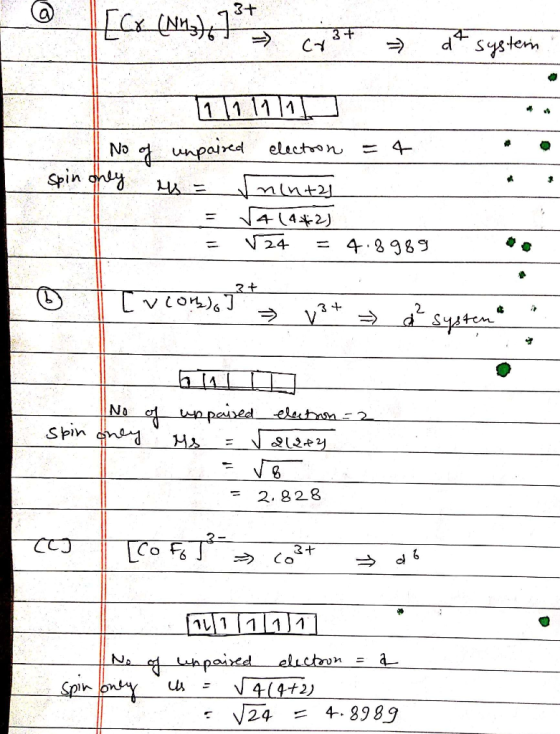
Add Answer to:
20.30 For which of the following ions would you expect the spin-only formula to give reasonable...
what would you expect the spin-only magnetic susceptibility of [Fe(OH2)6]2+ to be? uld you expect the spin-only mag...
 what would you expect the spin-only magnetic susceptibility of
[Fe(OH2)6]2+ to be?
uld you expect the spin-only magnetic susceptibility of [Fe(OH2)6]2+ to be? a) 5.9 B.M. b) 4.9 B.M. c) 3.9 B.M. d) 2.8 B.M. e) 1.7 B.M. 10. Which of the following statements coordination geometries is best? a) none of the below b) HS ds complexes are always octahedral as this arrangement gives them a large amount of CFSE cd3 complexes are always octahedral as this arrangement gives them...
what would you expect the spin-only magnetic susceptibility of
[Fe(OH2)6]2+ to be?
uld you expect the spin-only magnetic susceptibility of [Fe(OH2)6]2+ to be? a) 5.9 B.M. b) 4.9 B.M. c) 3.9 B.M. d) 2.8 B.M. e) 1.7 B.M. 10. Which of the following statements coordination geometries is best? a) none of the below b) HS ds complexes are always octahedral as this arrangement gives them a large amount of CFSE cd3 complexes are always octahedral as this arrangement gives them...
Give the point group, LFSE, spin-only magnetic moment, Jahn-Teller activity (i.e. will the complex distort and...
 Give the point group, LFSE, spin-only magnetic moment,
Jahn-Teller activity (i.e. will the complex distort and how), and
predicted stability for:
a. diaquasilver(I) (CN = 2, use Oh rules)
b. fac-[CoF3I3]3-
c. [Ru(ox)3]3-
d. Os(NH3)5 (CN = 5, use Oh
rules)
Give the point group, LFSE, spin-only magnetic moment,
Jahn-Teller activity (i.e. will the complex distort and how), and
predicted stability for:
a. diaquasilver(I) (CN = 2, use Oh rules)
b. fac-[CoF3I3]3-
c. [Ru(ox)3]3-
d. Os(NH3)5 (CN = 5, use Oh
rules)
From the following list of metal ions and ligands, construct metal complexes with properties which match...
 From the following list of metal ions and ligands, construct metal complexes with properties which match that described in each part of the question and provide a brief explanation. (Only one example is required for each part of the question, e.g. [Fe(H20)6]21). Metal ions Ligands (in order of increasing ligand field strength) [ < Br< <C1° <NO3 <OH <ox?- <H2O< Ti(IV), V(III), V(IV), Cr(II), Cr(III), Mn(II), NH3 <en <bpy < PPh3< CN=CO Mn(III), Mn(IV), Fe(II), Fe(III), Co(II), Co(III), en =...
Part A (2 marks) In the following pairs of complexes, which do you expect to have...
 Part A (2 marks) In the following pairs of complexes, which do you expect to have a larger ligand field splitting parameter Ao? Why? Explain? i) [Fe(NH3)612+ or [Fe(NH3). 13+ ii) (Co(CN)613- or [Rh(CN)613- Part B (3 maks) In the following pairs of complexes, which do you expect to be more labile? Why? Explain? ) [Cr(NH3)613+ or [Mn(NH3)6]3+ ii) (Co(CN)613- or [Rh(CN)613- ii) [Cr(NH3).]3+ or [V(NH3).]2+
3 What spin only magnetic moment (uso) expected for each of the following complexes. (a) [MnBr.]...
 3 What spin only magnetic moment (uso) expected for each of the following complexes. (a) [MnBr.] (C) [V(H2O)]2+ (b) [Ni(H20)]2+ (e) [CoBraj? (d) [FeC16] (f) Mo(CO)6
3 What spin only magnetic moment (uso) expected for each of the following complexes. (a) [MnBra]...
 3 What spin only magnetic moment (uso) expected for each of the following complexes. (a) [MnBra] (d) [FeC16] 19 NICOW" (c) [V(H2O)]2+ (b) [Ni(H2O)]2+ (e) [CoBraj? TAROT (1) Mo(CO)6
With which of the following ions would you expect a color change after the addition of...
With which of the following ions would you expect a color change after the addition of acidified potassium permanaganate? Select all that apply. nitrite nitrate carbonate sulfite sulfate phosphate chromate
What type of bonding would you expect to find in the following compounds? Draw a reasonable struc...
 What type of bonding would you expect to find in the following compounds? Draw a reasonable structure for each compound. Do NOT use abbreviations in your structures, i.e. show all the atoms and do not just write the functional groups. (a) (EtLi)4 (b) Pr'MgI.(OEt2)2 (c) B2Hs (e) (Et2HSİ)(Prn3Sİ)2Ge(Bu) (f) NaBu (g) GaMes (h) (3-Me-C6H4)2Sr.(tmeda)
What type of bonding would you expect to find in the following compounds? Draw a reasonable structure for each compound. Do NOT use abbreviations in your...
What type of bonding would you expect to find in the following compounds? Draw a reasonable structure for each compound. Do NOT use abbreviations in your structures, i.e. show all the atoms and do not just write the functional groups. (a) (EtLi)4 (b) Pr'MgI.(OEt2)2 (c) B2Hs (e) (Et2HSİ)(Prn3Sİ)2Ge(Bu) (f) NaBu (g) GaMes (h) (3-Me-C6H4)2Sr.(tmeda)
What type of bonding would you expect to find in the following compounds? Draw a reasonable structure for each compound. Do NOT use abbreviations in your...
For which molecule in each of the following pairs would you expect hydrogen bonding, in a...
For which molecule in each of the following pairs would you expect hydrogen bonding, in a sample of the pure substance, to be more significant as a contributing factor to the attractive intermolecular interactions? a) (CH2OH)2 and CH3CH2OH (My answer: (CH2OH)2) b) CH3CHO and CH3CO2H (My answer: CH3CHO) c) H20 and NH3 (My answer: H20) d) NH3 and NH2OH (My answer: NH2OH) I've provided my original answers, which are incorrect and I'm confused as to why they're incorrect.
5. Which of the following would you expect to have significant resonance stabilization energy? a) I...
 5. Which of the following would you expect to have significant resonance stabilization energy? a) I b) II c) III d) all three of them I II IL e) II and III Z -I z 6. Of the following C-10 compounds, which is expected to possess the greatest resonance (delocalization) energy? II III IV 7. Which of the following would you expect to be antiaromatic? v I III IV e 9. Which of the following would NOT be aromatic? II...
 what would you expect the spin-only magnetic susceptibility of
[Fe(OH2)6]2+ to be?
uld you expect the spin-only magnetic susceptibility of [Fe(OH2)6]2+ to be? a) 5.9 B.M. b) 4.9 B.M. c) 3.9 B.M. d) 2.8 B.M. e) 1.7 B.M. 10. Which of the following statements coordination geometries is best? a) none of the below b) HS ds complexes are always octahedral as this arrangement gives them a large amount of CFSE cd3 complexes are always octahedral as this arrangement gives them...
what would you expect the spin-only magnetic susceptibility of
[Fe(OH2)6]2+ to be?
uld you expect the spin-only magnetic susceptibility of [Fe(OH2)6]2+ to be? a) 5.9 B.M. b) 4.9 B.M. c) 3.9 B.M. d) 2.8 B.M. e) 1.7 B.M. 10. Which of the following statements coordination geometries is best? a) none of the below b) HS ds complexes are always octahedral as this arrangement gives them a large amount of CFSE cd3 complexes are always octahedral as this arrangement gives them...
 Give the point group, LFSE, spin-only magnetic moment,
Jahn-Teller activity (i.e. will the complex distort and how), and
predicted stability for:
a. diaquasilver(I) (CN = 2, use Oh rules)
b. fac-[CoF3I3]3-
c. [Ru(ox)3]3-
d. Os(NH3)5 (CN = 5, use Oh
rules)
Give the point group, LFSE, spin-only magnetic moment,
Jahn-Teller activity (i.e. will the complex distort and how), and
predicted stability for:
a. diaquasilver(I) (CN = 2, use Oh rules)
b. fac-[CoF3I3]3-
c. [Ru(ox)3]3-
d. Os(NH3)5 (CN = 5, use Oh
rules)
 From the following list of metal ions and ligands, construct metal complexes with properties which match that described in each part of the question and provide a brief explanation. (Only one example is required for each part of the question, e.g. [Fe(H20)6]21). Metal ions Ligands (in order of increasing ligand field strength) [ < Br< <C1° <NO3 <OH <ox?- <H2O< Ti(IV), V(III), V(IV), Cr(II), Cr(III), Mn(II), NH3 <en <bpy < PPh3< CN=CO Mn(III), Mn(IV), Fe(II), Fe(III), Co(II), Co(III), en =...
 Part A (2 marks) In the following pairs of complexes, which do you expect to have a larger ligand field splitting parameter Ao? Why? Explain? i) [Fe(NH3)612+ or [Fe(NH3). 13+ ii) (Co(CN)613- or [Rh(CN)613- Part B (3 maks) In the following pairs of complexes, which do you expect to be more labile? Why? Explain? ) [Cr(NH3)613+ or [Mn(NH3)6]3+ ii) (Co(CN)613- or [Rh(CN)613- ii) [Cr(NH3).]3+ or [V(NH3).]2+
 3 What spin only magnetic moment (uso) expected for each of the following complexes. (a) [MnBr.] (C) [V(H2O)]2+ (b) [Ni(H20)]2+ (e) [CoBraj? (d) [FeC16] (f) Mo(CO)6
 3 What spin only magnetic moment (uso) expected for each of the following complexes. (a) [MnBra] (d) [FeC16] 19 NICOW" (c) [V(H2O)]2+ (b) [Ni(H2O)]2+ (e) [CoBraj? TAROT (1) Mo(CO)6
 What type of bonding would you expect to find in the following compounds? Draw a reasonable structure for each compound. Do NOT use abbreviations in your structures, i.e. show all the atoms and do not just write the functional groups. (a) (EtLi)4 (b) Pr'MgI.(OEt2)2 (c) B2Hs (e) (Et2HSİ)(Prn3Sİ)2Ge(Bu) (f) NaBu (g) GaMes (h) (3-Me-C6H4)2Sr.(tmeda)
What type of bonding would you expect to find in the following compounds? Draw a reasonable structure for each compound. Do NOT use abbreviations in your...
What type of bonding would you expect to find in the following compounds? Draw a reasonable structure for each compound. Do NOT use abbreviations in your structures, i.e. show all the atoms and do not just write the functional groups. (a) (EtLi)4 (b) Pr'MgI.(OEt2)2 (c) B2Hs (e) (Et2HSİ)(Prn3Sİ)2Ge(Bu) (f) NaBu (g) GaMes (h) (3-Me-C6H4)2Sr.(tmeda)
What type of bonding would you expect to find in the following compounds? Draw a reasonable structure for each compound. Do NOT use abbreviations in your...
 5. Which of the following would you expect to have significant resonance stabilization energy? a) I b) II c) III d) all three of them I II IL e) II and III Z -I z 6. Of the following C-10 compounds, which is expected to possess the greatest resonance (delocalization) energy? II III IV 7. Which of the following would you expect to be antiaromatic? v I III IV e 9. Which of the following would NOT be aromatic? II...
Most questions answered within 3 hours.
-
Where is the error in this code sequence?
String s1 = "Hello";
String s2 = "ello";...
asked 11 months ago -
Financial data for Joel de Paris, Inc., for last year
follow:
Joel de Paris, Inc.
Balance...
asked 11 months ago -
Consider this reaction:
Al2(SO4)3 (aq)+ BaCl3
(aq) Al2Cl6 (aq)- +
3BaSO4(s) . What is the...
asked 11 months ago -
Suppose that Savneet is considering increasing her
recent random sample from 20 car rentals to 40...
asked 11 months ago -
Trucks arrive at an unloading terminal at an average rate of 120
per hour.
Trucks arrive...
asked 11 months ago -
Why are methanol and ethanol completely soluble in water while
octanol is not very little soluble....
asked 11 months ago -
A facilities manager at a university reads in a research report
that the mean amount of...
asked 11 months ago -
When the CuSO4 is rehydrated by adding water to the anhydrous
compound, is this an endothermic...
asked 11 months ago -
A ray of sunlight is passing from diamond into crown glass; the
angle of incidence is...
asked 11 months ago -
A block of mass 0.249 kg is placed on top of a light, vertical
spring of...
asked 11 months ago -
how do the kidneys compensate in the presences of acidosis
a) trigger hyperventilate
b) reserve acid...
asked 11 months ago -
Question 501 pts
The rental rate of capital to the firm increases. Which of the
following...
asked 11 months ago