
Homework Answers
Add Answer to:
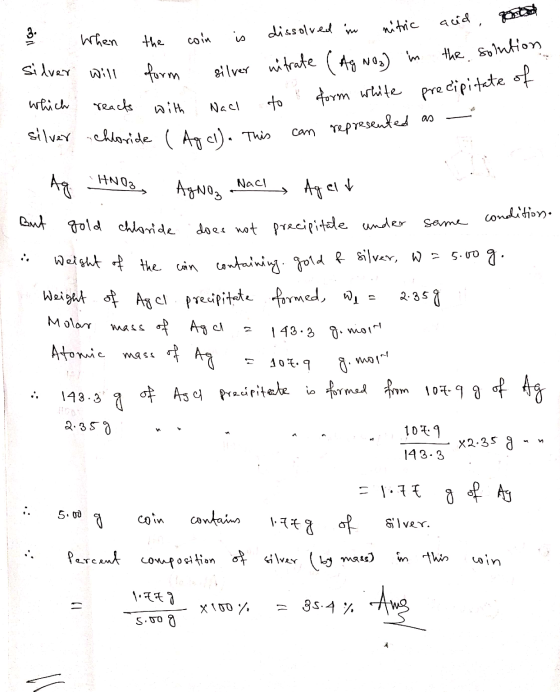
3. A coin is composed of gold and silver. The 5.00 g coin is dissolved in...
Help 2. What color was the solution filtrate after you filtered the cuprous thiocyanate precipitate? What...
 Help
2. What color was the solution filtrate after you filtered the cuprous thiocyanate precipitate? What ion in solution caused this color? Fne Pmu 1sh- wmte NHuSCN 3. A coin is composed of gold and silver. The 5.00 a coin is dissolved in nitric acid and the solution treated with NaCI to precipitate out 2.35 g of AgCl. Gold chlorides do not precipitate under the same conditions. What is the percent composition of silver (by mass) in this coin? 4....
Help
2. What color was the solution filtrate after you filtered the cuprous thiocyanate precipitate? What ion in solution caused this color? Fne Pmu 1sh- wmte NHuSCN 3. A coin is composed of gold and silver. The 5.00 a coin is dissolved in nitric acid and the solution treated with NaCI to precipitate out 2.35 g of AgCl. Gold chlorides do not precipitate under the same conditions. What is the percent composition of silver (by mass) in this coin? 4....
Q7) A 1.23 g sample, which contains gold (Au), silver (Ag) and metal oxides, is treated...
 Q7) A 1.23 g sample, which contains gold (Au), silver (Ag) and metal oxides, is treated with concentrated nitric acid (HNO;), which dissolves all the metals and metal oxides with the exception of the gold. The mass of yellow metal remaining is 7.4 x 10 g. The solution is then treated with aqueous sodium chloride (NaCI), which precipitates silver chloride (AgCI) and nothing else. A total of 0.196 g of AgCl is obtained. What is the percent gold and silver...
A chloride unknown sample weighing 0.4213 g is dissolved in acidic solution and is treated with...
A chloride unknown sample weighing 0.4213 g is dissolved in acidic solution and is treated with the precipitating solution. The silver chloride precipitate that forms is filtered, washed, dried and weighed. The mass of the silver chloride obtained is 0.5915 g. Calculate the % Cl in this unknown sample. Molar Masses: AgCl = 143.35 g/mol, Cl– = 35.45 g/mol
A 0.8690 g sample of a mixture of NaCl and KCl is dissolved in water, and...
A 0.8690 g sample of a mixture of NaCl and KCl is dissolved in water, and the solution is then treated with an excess of AgNO3 to yield 1.933 g of AgCl. Calculate the percent by mass of each compound in the mixture. % mass NaCl = ? % mass KCl = ?
Suppose a box contains 12 silver coins (S) and 3 gold coins (G). (a) If you...
Suppose a box contains 12 silver coins (S) and 3 gold coins (G). (a) If you randomly select 2 coins without replacement, determine the probability that you obtain exactly 1 gold coin (G). (b) If you randomly select 3 coins without replacement, determine the probability that you obtain exactly 1 gold coin (G).
3. (Problem 5) Each of the following metal chlorides can be reacted with silver nitrate to...
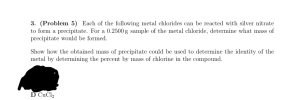 3. (Problem 5) Each of the following metal chlorides can be reacted with silver nitrate to form a precipitate. For a 0.2500 g sample of the metal chloride, determine what mass of precipitate would be formed Show how the obtained mass of precipitate could be used to determine the identity of the metal by determining the percent by mass of chlorine in the compound D CuCl2
A 5.00 g quantity of a diprotic acid (H2A) was dissolved in water and made up...
A 5.00 g quantity of a diprotic acid (H2A) was dissolved in water and made up to exactly 250 mL. Calculate the molar mass (in g/mol) of the acid if 25.0 mL of this solution reuired 11.1 mL of 1.00 M KOH for neutralization.
A 5.00 g quantity of a diprotic acid was dissolved in water and made up exactly...
A 5.00 g quantity of a diprotic acid was dissolved in water and made up exactly to 225 mL. Calculate the molar mass of the acid is 25.0mL of this solution required 11.6 mL of 1.00 M KOH for neutralization. Assume that both protons of the acid were titrated.
A silver cube with an edge length of 2.25 cm and a gold cube with an...
 A silver cube with an edge length of 2.25 cm and a gold cube with an edge length of 2.72 cm are both heated to 88.8C and placed in 101.5 mL of water at 19.6'C. What is the final temperature of the water when thermal equilibrium is reached? Substance gold silver water Specific heat (J/g.°C) 0.1256 0.2386 4.184 Density (g/cm) 19.3 10.5 1.00 Tonal 11 'C Using the standard enthalpies of formation, what is the standard enthalpy of reaction? CO(g)...
I need help with questions 3 and 4!! 3. Calculate the normality of the silver nitrate...
 I need help with questions 3 and 4!!
3. Calculate the normality of the silver nitrate solution and percent chloride in the sample: 352.4 mg pure KCl require 48.33 ml AgNO3 solution 323.3 mg of unknown requires 32.02 ml AgNO3 solution Calculate the titration error. 4. A sample of silver alloy weighing 984.6 mg was dissolved in nitric acid. The solution was neutralized, and 252.2 mg of pure NaCl added. The excess chloride required 19.09 ml of 0.0935 N AgNO3...
I need help with questions 3 and 4!!
3. Calculate the normality of the silver nitrate solution and percent chloride in the sample: 352.4 mg pure KCl require 48.33 ml AgNO3 solution 323.3 mg of unknown requires 32.02 ml AgNO3 solution Calculate the titration error. 4. A sample of silver alloy weighing 984.6 mg was dissolved in nitric acid. The solution was neutralized, and 252.2 mg of pure NaCl added. The excess chloride required 19.09 ml of 0.0935 N AgNO3...
 Help
2. What color was the solution filtrate after you filtered the cuprous thiocyanate precipitate? What ion in solution caused this color? Fne Pmu 1sh- wmte NHuSCN 3. A coin is composed of gold and silver. The 5.00 a coin is dissolved in nitric acid and the solution treated with NaCI to precipitate out 2.35 g of AgCl. Gold chlorides do not precipitate under the same conditions. What is the percent composition of silver (by mass) in this coin? 4....
Help
2. What color was the solution filtrate after you filtered the cuprous thiocyanate precipitate? What ion in solution caused this color? Fne Pmu 1sh- wmte NHuSCN 3. A coin is composed of gold and silver. The 5.00 a coin is dissolved in nitric acid and the solution treated with NaCI to precipitate out 2.35 g of AgCl. Gold chlorides do not precipitate under the same conditions. What is the percent composition of silver (by mass) in this coin? 4....
 Q7) A 1.23 g sample, which contains gold (Au), silver (Ag) and metal oxides, is treated with concentrated nitric acid (HNO;), which dissolves all the metals and metal oxides with the exception of the gold. The mass of yellow metal remaining is 7.4 x 10 g. The solution is then treated with aqueous sodium chloride (NaCI), which precipitates silver chloride (AgCI) and nothing else. A total of 0.196 g of AgCl is obtained. What is the percent gold and silver...
 3. (Problem 5) Each of the following metal chlorides can be reacted with silver nitrate to form a precipitate. For a 0.2500 g sample of the metal chloride, determine what mass of precipitate would be formed Show how the obtained mass of precipitate could be used to determine the identity of the metal by determining the percent by mass of chlorine in the compound D CuCl2
 A silver cube with an edge length of 2.25 cm and a gold cube with an edge length of 2.72 cm are both heated to 88.8C and placed in 101.5 mL of water at 19.6'C. What is the final temperature of the water when thermal equilibrium is reached? Substance gold silver water Specific heat (J/g.°C) 0.1256 0.2386 4.184 Density (g/cm) 19.3 10.5 1.00 Tonal 11 'C Using the standard enthalpies of formation, what is the standard enthalpy of reaction? CO(g)...
 I need help with questions 3 and 4!!
3. Calculate the normality of the silver nitrate solution and percent chloride in the sample: 352.4 mg pure KCl require 48.33 ml AgNO3 solution 323.3 mg of unknown requires 32.02 ml AgNO3 solution Calculate the titration error. 4. A sample of silver alloy weighing 984.6 mg was dissolved in nitric acid. The solution was neutralized, and 252.2 mg of pure NaCl added. The excess chloride required 19.09 ml of 0.0935 N AgNO3...
I need help with questions 3 and 4!!
3. Calculate the normality of the silver nitrate solution and percent chloride in the sample: 352.4 mg pure KCl require 48.33 ml AgNO3 solution 323.3 mg of unknown requires 32.02 ml AgNO3 solution Calculate the titration error. 4. A sample of silver alloy weighing 984.6 mg was dissolved in nitric acid. The solution was neutralized, and 252.2 mg of pure NaCl added. The excess chloride required 19.09 ml of 0.0935 N AgNO3...
Most questions answered within 3 hours.
-
Where is the error in this code sequence?
String s1 = "Hello";
String s2 = "ello";...
asked 11 months ago -
Financial data for Joel de Paris, Inc., for last year
follow:
Joel de Paris, Inc.
Balance...
asked 11 months ago -
Consider this reaction:
Al2(SO4)3 (aq)+ BaCl3
(aq) Al2Cl6 (aq)- +
3BaSO4(s) . What is the...
asked 11 months ago -
Suppose that Savneet is considering increasing her
recent random sample from 20 car rentals to 40...
asked 11 months ago -
Trucks arrive at an unloading terminal at an average rate of 120
per hour.
Trucks arrive...
asked 11 months ago -
Why are methanol and ethanol completely soluble in water while
octanol is not very little soluble....
asked 11 months ago -
A facilities manager at a university reads in a research report
that the mean amount of...
asked 11 months ago -
When the CuSO4 is rehydrated by adding water to the anhydrous
compound, is this an endothermic...
asked 11 months ago -
A ray of sunlight is passing from diamond into crown glass; the
angle of incidence is...
asked 11 months ago -
A block of mass 0.249 kg is placed on top of a light, vertical
spring of...
asked 11 months ago -
how do the kidneys compensate in the presences of acidosis
a) trigger hyperventilate
b) reserve acid...
asked 11 months ago -
Question 501 pts
The rental rate of capital to the firm increases. Which of the
following...
asked 11 months ago