The allowed UV symmetry transitions for PF5 (a D3h molecule) are A1g, B1g, and B2g. Explain...
The allowed UV symmetry transitions for PF5 (a D3h molecule) are A1g, B1g, and B2g. Explain why these three are allowed.
Homework Answers
There are actully two main slection rules for electronic transmissions,
1) spin selection rule:- delta S=0 i.e transition to same state ( both spins having same sign) is forbidden.
2) laporte selection rule:- for any molecule posessing a centre of inversion, transition between two "g" states or two "u"states are forbidden. threre should be a change in parity. i.e g-u or u-g transitions are allowed and g-g or u-u are forbidden.
the structure of PF5 is trigonal bipyramidal and has D3h symmetry. and has an inversion centre,the possible transitions are pi-pi* and n-pi* transitions. the allowed symmetry trnsitions are A1g,B1g and B2g. because,
1) In case of molecules without centre of inversion, the electronic transition should give symmetric irreducible representations Ag for allowed trasitions
2)there is a term called transition moment and transition moment integral. transition moment is usually denoted as the electric dipole moment associated with initial and final states,if it is zero then the transition is forbidden.
3) if transition moment integral is zero then the transition are not allowed.
here only A1g,B1g nad B2g yeild non zero transition moment and transition moment integral.
Add Answer to:
The allowed UV symmetry transitions for PF5 (a D3h molecule) are
A1g, B1g, and B2g. Explain...
what are the allowed symmetry transitions for PF5 for UV (3) and raman (6)?
what are the allowed symmetry transitions for PF5 for UV (3) and raman (6)?
Could someone explain to me what UV-visible transitions are ?
Could someone explain to me what UV-visible transitions are ?
for molecule HOOH (C2h symmetry), please find all vibrational modes with allowed fundamental transition.
for molecule HOOH (C2h symmetry), please find all vibrational modes with allowed fundamental transition.
Use Web Mo for (pyrazine (C4H4N2)) Point group is D2h (a) Identify and clearly sketch by hand the symmetry elements...
 Use Web Mo for (pyrazine (C4H4N2)) Point group
is D2h
(a) Identify and clearly sketch by hand the symmetry elements of the molecule. (b) Calculate the number of degrees of freedom and number of vibrations for the molecule. (c) Determine how the degrees of freedom of the molecule are distributed amongst the irreducible representations of the point group show clearly all your working. (d) Subtract the translations and rotations and hence determine how the normal vibrations of the molecule are...
Use Web Mo for (pyrazine (C4H4N2)) Point group
is D2h
(a) Identify and clearly sketch by hand the symmetry elements of the molecule. (b) Calculate the number of degrees of freedom and number of vibrations for the molecule. (c) Determine how the degrees of freedom of the molecule are distributed amongst the irreducible representations of the point group show clearly all your working. (d) Subtract the translations and rotations and hence determine how the normal vibrations of the molecule are...
The polarity of a molecule is determined by the electronegativity difference in bonds and the symmetry...
The polarity of a molecule is determined by the electronegativity difference in bonds and the symmetry of the overall molecule. Explain why. A. True B. False
1. The molecules PF5 and AsF5 exist, but the analogous molecule NF5 does not. Why not?...
1. The molecules PF5 and AsF5 exist, but the analogous molecule NF5 does not. Why not? 2. For the molecule N2O there are five unique Lewis structures that satisfy the octet rule. Three have the N-N-O bond skeleton and two would have the N-O-N skeleton. a) Draw the five UNIQUE Lewis structures. b) By considering the formal charges, can you suggest which structures could be eliminated due to low stability (i.e. have like charges next to each other). c) Which...
5. PF5, shown below, is a trigonal bipyramidal molecule that has been described as “hypervalent” because...
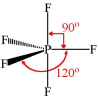 5. PF5, shown below, is a trigonal bipyramidal molecule that has
been described as “hypervalent” because it exceeds its valence
octet. It has been observed that the axial ligands in such
molecules must be electronegative. One molecular orbital
description for this behaviour invokes the concept of a
“three-centre four-electron bond” connecting the axial ligands. Is
this model concept consistent with the requirement for
electronegative axial ligands? Explain. (Hint: a molecular orbital
diagram might help).
900 120°
5. PF5, shown below, is a trigonal bipyramidal molecule that has
been described as “hypervalent” because it exceeds its valence
octet. It has been observed that the axial ligands in such
molecules must be electronegative. One molecular orbital
description for this behaviour invokes the concept of a
“three-centre four-electron bond” connecting the axial ligands. Is
this model concept consistent with the requirement for
electronegative axial ligands? Explain. (Hint: a molecular orbital
diagram might help).
900 120°
Question 5 (2 marks) (a) Explain the relationship between UV-Vis Spectroscopy and Fluorescence using the Riboflavin...
 Question 5 (2 marks) (a) Explain the relationship between UV-Vis Spectroscopy and Fluorescence using the Riboflavin molecule shown below: 0.025 0.02 0.015 absorption CH Ads 0.005 fluorescence LOH 250350450550650750850 OH (b) Why must a molecule that fluoresces also have an absorption spectrum?
Please help me with a clear explanation. ! Thanks 1.For the bent molecule, explain why the 2a1 an...
Please help me with a clear explanation. ! Thanks 1.For the bent molecule, explain why the 2a1 and 1b2 orbitals have tho se symmetry designations. 2. Outline a procedure for determining the effect of hydrogen bonding on the structure of OH2 using Walsh diagrams.
symmetry nected in a line of 9. Explain why only three types of regular polygons tessellate...
 symmetry nected in a line of 9. Explain why only three types of regular polygons tessellate the plane. Choose the correct answer below. O A. In order for a regular polygon to tessellate the plane, its angle bisectors must intersect at 90, angles. OB. In order for a regular polygon to tessellate the plane, Its exterior angle measure must be a divisor of 360 Only three regular polygons have exterior angles that divide 360 Those polygons are the equilateral triangle,...
 Use Web Mo for (pyrazine (C4H4N2)) Point group
is D2h
(a) Identify and clearly sketch by hand the symmetry elements of the molecule. (b) Calculate the number of degrees of freedom and number of vibrations for the molecule. (c) Determine how the degrees of freedom of the molecule are distributed amongst the irreducible representations of the point group show clearly all your working. (d) Subtract the translations and rotations and hence determine how the normal vibrations of the molecule are...
Use Web Mo for (pyrazine (C4H4N2)) Point group
is D2h
(a) Identify and clearly sketch by hand the symmetry elements of the molecule. (b) Calculate the number of degrees of freedom and number of vibrations for the molecule. (c) Determine how the degrees of freedom of the molecule are distributed amongst the irreducible representations of the point group show clearly all your working. (d) Subtract the translations and rotations and hence determine how the normal vibrations of the molecule are...
 5. PF5, shown below, is a trigonal bipyramidal molecule that has
been described as “hypervalent” because it exceeds its valence
octet. It has been observed that the axial ligands in such
molecules must be electronegative. One molecular orbital
description for this behaviour invokes the concept of a
“three-centre four-electron bond” connecting the axial ligands. Is
this model concept consistent with the requirement for
electronegative axial ligands? Explain. (Hint: a molecular orbital
diagram might help).
900 120°
5. PF5, shown below, is a trigonal bipyramidal molecule that has
been described as “hypervalent” because it exceeds its valence
octet. It has been observed that the axial ligands in such
molecules must be electronegative. One molecular orbital
description for this behaviour invokes the concept of a
“three-centre four-electron bond” connecting the axial ligands. Is
this model concept consistent with the requirement for
electronegative axial ligands? Explain. (Hint: a molecular orbital
diagram might help).
900 120°
 Question 5 (2 marks) (a) Explain the relationship between UV-Vis Spectroscopy and Fluorescence using the Riboflavin molecule shown below: 0.025 0.02 0.015 absorption CH Ads 0.005 fluorescence LOH 250350450550650750850 OH (b) Why must a molecule that fluoresces also have an absorption spectrum?
 symmetry nected in a line of 9. Explain why only three types of regular polygons tessellate the plane. Choose the correct answer below. O A. In order for a regular polygon to tessellate the plane, its angle bisectors must intersect at 90, angles. OB. In order for a regular polygon to tessellate the plane, Its exterior angle measure must be a divisor of 360 Only three regular polygons have exterior angles that divide 360 Those polygons are the equilateral triangle,...
Most questions answered within 3 hours.
-
Where is the error in this code sequence?
String s1 = "Hello";
String s2 = "ello";...
asked 10 months ago -
Financial data for Joel de Paris, Inc., for last year
follow:
Joel de Paris, Inc.
Balance...
asked 10 months ago -
Consider this reaction:
Al2(SO4)3 (aq)+ BaCl3
(aq) Al2Cl6 (aq)- +
3BaSO4(s) . What is the...
asked 10 months ago -
Suppose that Savneet is considering increasing her
recent random sample from 20 car rentals to 40...
asked 10 months ago -
Trucks arrive at an unloading terminal at an average rate of 120
per hour.
Trucks arrive...
asked 10 months ago -
Why are methanol and ethanol completely soluble in water while
octanol is not very little soluble....
asked 10 months ago -
A facilities manager at a university reads in a research report
that the mean amount of...
asked 10 months ago -
When the CuSO4 is rehydrated by adding water to the anhydrous
compound, is this an endothermic...
asked 10 months ago -
A ray of sunlight is passing from diamond into crown glass; the
angle of incidence is...
asked 10 months ago -
A block of mass 0.249 kg is placed on top of a light, vertical
spring of...
asked 10 months ago -
how do the kidneys compensate in the presences of acidosis
a) trigger hyperventilate
b) reserve acid...
asked 10 months ago -
Question 501 pts
The rental rate of capital to the firm increases. Which of the
following...
asked 10 months ago