
Homework Answers

Add Answer to:
consider the hypothetical reaction. X+2Y yields XY when
delta[Y] / delta t =-5.0 x 10 to...
Consider the hypothetical reaction XY₂(g) --> X(s) + Y₂(g) with ΔG° = +30 kJ/mol XY₂. If...
Consider the hypothetical reaction XY₂(g) --> X(s) + Y₂(g) with ΔG° = +30 kJ/mol XY₂. If you start with 1 atm of XY₂(g), will the reaction occur?
Three kinetics questions. Consider the following reaction and experimental data: X+Y-XY Trial [X] (mol/L) [Y] (mol/L)...
 Three kinetics questions.
Consider the following reaction and experimental data: X+Y-XY Trial [X] (mol/L) [Y] (mol/L) Rate (moll's) 0.180 0.0250 0.0640 0.0450 0.0250 0.0160 0.0450 0.0750 0.0480 Using the information above, determine the rate of this reaction when [X] = 1.15 mol/L and [Y] = 0.667 mol/L. Rate = _mollis 2 Given the following reaction and experimental data: A+B+C Trial [A] (mol/L) [B] (mol/L) Rate (moll's) 0.40 0.20 0.038 0.80 0.20 0.077 0.80 0.40 0.31 What is the rate constant...
Three kinetics questions.
Consider the following reaction and experimental data: X+Y-XY Trial [X] (mol/L) [Y] (mol/L) Rate (moll's) 0.180 0.0250 0.0640 0.0450 0.0250 0.0160 0.0450 0.0750 0.0480 Using the information above, determine the rate of this reaction when [X] = 1.15 mol/L and [Y] = 0.667 mol/L. Rate = _mollis 2 Given the following reaction and experimental data: A+B+C Trial [A] (mol/L) [B] (mol/L) Rate (moll's) 0.40 0.20 0.038 0.80 0.20 0.077 0.80 0.40 0.31 What is the rate constant...
Consider the following reaction: 4NO(g) + O2(g) 2N2O3(9) What is the rate of disappearance of Oz...
 Consider the following reaction: 4NO(g) + O2(g) 2N2O3(9) What is the rate of disappearance of Oz when the rate of disappearance of NO is 1.60 x 10⁻⁴ mol L sec -1 O 6.4 x 10⁻⁴ mol L 'sec1 O 8.0 x 10⁻⁵ mol L 'sec1 O 3.2 x 10⁻⁴ mol L sec1 1.6 x 10⁻⁴ mol L''sec 1 O 4.0 x 10⁻⁵ mol L''sec1
Consider the following reaction: 4NO(g) + O2(g) + 2N203(9) What is the rate of disappearance of...
 Consider the following reaction: 4NO(g) + O2(g) + 2N203(9) What is the rate of disappearance of O2 when the rate of disappearance of NO is 1.60 x 10⁻⁴ mol L 'sec 1 O 1.6 x 10⁻⁴ mol L sec1 O 6.4 x 10⁻⁴ mol L 'sec1 O 4.0 x 10⁻⁵ mol Lºsec1 O 3.2 x 10⁻⁴ mol L 'sec1 O 8.0 x 10⁻⁵ mol L''sec 1
For a hypothetical chemical reaction that has the stoichiometry 2X + Y -----Z the following initial...
For a hypothetical chemical reaction that has the stoichiometry 2X + Y -----Z the following initial data were obtained X (Mol/L Y(Mol/L) rate of formation of Z (Mol/L s .4 .2 1.4 x 10^-3 .4 .4 2.8 x 10^-3 .2 .1 7.0 x 10^-4 .6 .6 4.2 x 10^-3 Give rate Law for this reaction Callculate rate constant and specify units How long must reaction proceed to produce concentration of Z =to .2 molar if initial concentrations of x=.8M and...
If the delta G' value for an isomerization reaction, A --> A' is 8.0 kJ/mole at...
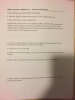 If the delta G' value for an isomerization reaction, A --> A'
is 8.0 kJ/mole at 37 degrees C
BCH351 Rec. 304 Problem set 1-1 Due Jan. 18, 2018 Name: These problems worth 2 points (of the bonus points) J/mole at 37 C, a) what is the ratio of A' and A at equilibrium? b) What is AG' for the reaction if A' is reacted soon after it is formed and its concen reduced to 1/50 x the normal equilibrium...
If the delta G' value for an isomerization reaction, A --> A'
is 8.0 kJ/mole at 37 degrees C
BCH351 Rec. 304 Problem set 1-1 Due Jan. 18, 2018 Name: These problems worth 2 points (of the bonus points) J/mole at 37 C, a) what is the ratio of A' and A at equilibrium? b) What is AG' for the reaction if A' is reacted soon after it is formed and its concen reduced to 1/50 x the normal equilibrium...
10. Consider the reaction A + 2B → C ne rate law for this reaction is...
 10. Consider the reaction A + 2B → C ne rate law for this reaction is on der in and and order in B if the rate constant at 25°C is 1.25x 10⁵ , find the rate of reaction when the concentration of A is 0.27M and the concentration of B is 0.32 M UMA 21 11. Consider the reaction A +2B C + D. The rate law for this reaction is first order in A and zeroth order in...
Consider the reaction X Y +Z Which of the following is a possible rate law? a)...
 Consider the reaction X Y +Z Which of the following is a possible rate law? a) Rate = k[X] b) Rate = K[Y] c) Rate = k[Y][Z] Rate = k[X][Y] Rate = k[Z] e) Rate 3. What are the units for the rate constant for an overall third order reaction? a) L/mol:s b) LP/mol.s mol/L'S e) L2 For which order reaction is the half-life of the reaction inversely proportional to k, the rate constant? a) zero order b) first order...
Consider the hypothetical reaction: 2 X + Y → Z and its general rate law Rate...
Consider the hypothetical reaction: 2 X + Y → Z and its general rate law Rate = k[X]m[Y]n The following data was obtained when the reaction studied at –10°C: [X], M [Y], M Rate, M/min 0.10 0.10 0.18 0.10 0.20 0.36 0.20 0.20 1.45 (a) What is the order of reaction with respect to X? (2 points) (b) What is the order of reaction with respect to Y? (2 points) (c) What is the overall order of reaction?...
1: Consider the following set of data ccollected for a reaction of the form A -->...
1: Consider the following set of data ccollected for a reaction of the form A --> products. time (seconds) [A] (M) 0 1.000 10 0.641 20 0.472 30 0.373 40 0.309 50 0.263 A: What is the average rate of the reaction for the first 10 seconds? rate = ___ M/s B: What is the average rate of the reaction between 30 and 40 seconds? rate = ___ M/s 2: Consider the dimerization of C4H6: 2 C4H6 --> C8H12 for...
 Three kinetics questions.
Consider the following reaction and experimental data: X+Y-XY Trial [X] (mol/L) [Y] (mol/L) Rate (moll's) 0.180 0.0250 0.0640 0.0450 0.0250 0.0160 0.0450 0.0750 0.0480 Using the information above, determine the rate of this reaction when [X] = 1.15 mol/L and [Y] = 0.667 mol/L. Rate = _mollis 2 Given the following reaction and experimental data: A+B+C Trial [A] (mol/L) [B] (mol/L) Rate (moll's) 0.40 0.20 0.038 0.80 0.20 0.077 0.80 0.40 0.31 What is the rate constant...
Three kinetics questions.
Consider the following reaction and experimental data: X+Y-XY Trial [X] (mol/L) [Y] (mol/L) Rate (moll's) 0.180 0.0250 0.0640 0.0450 0.0250 0.0160 0.0450 0.0750 0.0480 Using the information above, determine the rate of this reaction when [X] = 1.15 mol/L and [Y] = 0.667 mol/L. Rate = _mollis 2 Given the following reaction and experimental data: A+B+C Trial [A] (mol/L) [B] (mol/L) Rate (moll's) 0.40 0.20 0.038 0.80 0.20 0.077 0.80 0.40 0.31 What is the rate constant...
 Consider the following reaction: 4NO(g) + O2(g) 2N2O3(9) What is the rate of disappearance of Oz when the rate of disappearance of NO is 1.60 x 10⁻⁴ mol L sec -1 O 6.4 x 10⁻⁴ mol L 'sec1 O 8.0 x 10⁻⁵ mol L 'sec1 O 3.2 x 10⁻⁴ mol L sec1 1.6 x 10⁻⁴ mol L''sec 1 O 4.0 x 10⁻⁵ mol L''sec1
 Consider the following reaction: 4NO(g) + O2(g) + 2N203(9) What is the rate of disappearance of O2 when the rate of disappearance of NO is 1.60 x 10⁻⁴ mol L 'sec 1 O 1.6 x 10⁻⁴ mol L sec1 O 6.4 x 10⁻⁴ mol L 'sec1 O 4.0 x 10⁻⁵ mol Lºsec1 O 3.2 x 10⁻⁴ mol L 'sec1 O 8.0 x 10⁻⁵ mol L''sec 1
 If the delta G' value for an isomerization reaction, A --> A'
is 8.0 kJ/mole at 37 degrees C
BCH351 Rec. 304 Problem set 1-1 Due Jan. 18, 2018 Name: These problems worth 2 points (of the bonus points) J/mole at 37 C, a) what is the ratio of A' and A at equilibrium? b) What is AG' for the reaction if A' is reacted soon after it is formed and its concen reduced to 1/50 x the normal equilibrium...
If the delta G' value for an isomerization reaction, A --> A'
is 8.0 kJ/mole at 37 degrees C
BCH351 Rec. 304 Problem set 1-1 Due Jan. 18, 2018 Name: These problems worth 2 points (of the bonus points) J/mole at 37 C, a) what is the ratio of A' and A at equilibrium? b) What is AG' for the reaction if A' is reacted soon after it is formed and its concen reduced to 1/50 x the normal equilibrium...
 10. Consider the reaction A + 2B → C ne rate law for this reaction is on der in and and order in B if the rate constant at 25°C is 1.25x 10⁵ , find the rate of reaction when the concentration of A is 0.27M and the concentration of B is 0.32 M UMA 21 11. Consider the reaction A +2B C + D. The rate law for this reaction is first order in A and zeroth order in...
 Consider the reaction X Y +Z Which of the following is a possible rate law? a) Rate = k[X] b) Rate = K[Y] c) Rate = k[Y][Z] Rate = k[X][Y] Rate = k[Z] e) Rate 3. What are the units for the rate constant for an overall third order reaction? a) L/mol:s b) LP/mol.s mol/L'S e) L2 For which order reaction is the half-life of the reaction inversely proportional to k, the rate constant? a) zero order b) first order...
Most questions answered within 3 hours.
-
Where is the error in this code sequence?
String s1 = "Hello";
String s2 = "ello";...
asked 10 months ago -
Financial data for Joel de Paris, Inc., for last year
follow:
Joel de Paris, Inc.
Balance...
asked 10 months ago -
Consider this reaction:
Al2(SO4)3 (aq)+ BaCl3
(aq) Al2Cl6 (aq)- +
3BaSO4(s) . What is the...
asked 10 months ago -
Suppose that Savneet is considering increasing her
recent random sample from 20 car rentals to 40...
asked 10 months ago -
Trucks arrive at an unloading terminal at an average rate of 120
per hour.
Trucks arrive...
asked 10 months ago -
Why are methanol and ethanol completely soluble in water while
octanol is not very little soluble....
asked 10 months ago -
A facilities manager at a university reads in a research report
that the mean amount of...
asked 10 months ago -
When the CuSO4 is rehydrated by adding water to the anhydrous
compound, is this an endothermic...
asked 10 months ago -
A ray of sunlight is passing from diamond into crown glass; the
angle of incidence is...
asked 10 months ago -
A block of mass 0.249 kg is placed on top of a light, vertical
spring of...
asked 10 months ago -
how do the kidneys compensate in the presences of acidosis
a) trigger hyperventilate
b) reserve acid...
asked 10 months ago -
Question 501 pts
The rental rate of capital to the firm increases. Which of the
following...
asked 10 months ago