

Homework Answers

Add Answer to:
part b need help thank
This question has multiple parts. Work all the parts to get...
15. This question has multiple parts. Work all the parts to get the most points. At...
 15.
This question has multiple parts. Work all the parts to get the most points. At 35°C, K-1.1 x 10° for the reaction 2 NOCI(g) 근 2N0(g) + Cl2 (g) Calculate the concentrations of all species at equilibrium for each of the following original mixtures a3.8 moles of pure NOCl in a 2.0-L flask [NOCI] = NO] [C12] = b1.0 mole of NOCI and 1.0 mole of NO in a 1.0-L flask NOCI NO Numeric input field 3.8 mole of...
15.
This question has multiple parts. Work all the parts to get the most points. At 35°C, K-1.1 x 10° for the reaction 2 NOCI(g) 근 2N0(g) + Cl2 (g) Calculate the concentrations of all species at equilibrium for each of the following original mixtures a3.8 moles of pure NOCl in a 2.0-L flask [NOCI] = NO] [C12] = b1.0 mole of NOCI and 1.0 mole of NO in a 1.0-L flask NOCI NO Numeric input field 3.8 mole of...
This question has multiple parts. Work all the parts to get the most points. At 25°C,...
 This question has multiple parts. Work all the parts to get the most points. At 25°C, K 0.090 for the reaction H, 0(g) + C,O(g) ? 2 HOCl(g) Calculate the concentrations of all species at equilibrium for each of the following cases. aL0g H0 and 2.0 g Cl,O are mixed in a 1.0-L flask. H2O] C20 [HOC?]- b 1.0 mole of pure HOCl is placed in a 20-L flask. [H20] = [C101 =
just b please thank you. This question has multiple parts. Work all the parts to get...
 just b please thank you.
This question has multiple parts. Work all the parts to get the most points. A titration of 21.7 mL of a solution of the weak base aniline, CH NH, (K) = 4.0 x 10⁻¹), requires 24.35 mL of 0.175 M HCl to reach the equivalence point. C.H NH, (aq) + H, 0+ (aq) = CH NH,+ (aq) + H, 0(1) a What was the concentration of aniline in the original solution? Concentration - 196 MV...
just b please thank you.
This question has multiple parts. Work all the parts to get the most points. A titration of 21.7 mL of a solution of the weak base aniline, CH NH, (K) = 4.0 x 10⁻¹), requires 24.35 mL of 0.175 M HCl to reach the equivalence point. C.H NH, (aq) + H, 0+ (aq) = CH NH,+ (aq) + H, 0(1) a What was the concentration of aniline in the original solution? Concentration - 196 MV...
three parts to this question PART A Ammonium hydrogen sulfide decomposes on heating. If for this reaction...
three parts to this question PART A Ammonium hydrogen sulfide decomposes on heating. If for this reaction is 0.18 at 55 °C (when the partial pressures are measured in atmospheres), what is the total pressure in the flask at equilibrium? Total pressure = ?? ATM PART TWO Equal numbers of moles of h2 gas and I2 vapor are mixed in a flask and heated to 700 °C. The initial concentration of each gas is 0.0075 mol/L, and 78.7% of I2 the is...
please help me This question has multiple parts. Work all the parts to get the most...
 please help me
This question has multiple parts. Work all the parts to get the most points. Calculate the solubility (in moles per liter) of Fe(OH)3 (Ksp = 4 x 10-58) in each of the following. a water Solubility = mol/L b a solution buffered at pH 6.0 mol/L Solubility C a solution buffered at pH = 10.0 Solubility = mol/L A 55.0-ml sample of 0.00150 M AgNO, is added to 55.0 ml. of 0.0300 M Nalog. What is the...
please help me
This question has multiple parts. Work all the parts to get the most points. Calculate the solubility (in moles per liter) of Fe(OH)3 (Ksp = 4 x 10-58) in each of the following. a water Solubility = mol/L b a solution buffered at pH 6.0 mol/L Solubility C a solution buffered at pH = 10.0 Solubility = mol/L A 55.0-ml sample of 0.00150 M AgNO, is added to 55.0 ml. of 0.0300 M Nalog. What is the...
This question has multiple parts. Work all the parts to get the most points. The average...
 This question has multiple parts. Work all the parts to get the most points. The average lung capacity of a human is 59 L. How many moles of air are in your lungs when you are in the following situations? Asume air behaves ideally and has an average moler mass of 29.0 g/mol. At sea level (T-298 K, P - 1.00 atm). Moles b The average lung capacity of a human is 59 L. How many moles of air are...
This question has multiple parts. Work all the parts to get the most points. A 0.054...
This question has multiple parts. Work all the parts to get the most points. A 0.054 L sample of 0.0160 M Ag2SO4 s added to 0.015 L of 0.0110 M PbCl2 a What is the net ionic equation for the reaction that occurs? (Use the lowest possible coefficients. Use the pull-down boxes to specify states such as (aq) or (s). If a box is not needed, leave it blank.) + + + + --> + ...
(References) This question has multiple parts. Work all the parts to get the most points. The...
 (References) This question has multiple parts. Work all the parts to get the most points. The reaction 2NO() + 2H2(g) → N (9) + 2H20(9) was studied at 904°C, and the data in the table were collected, Reaction Rate of Trial Concentration Appearance of Ne (mol/L) (mol/L-s) [NO] [H.] 1 0.420 0.122 0.136 2 0.210 0.122 0.0339 3 0.210 0.244 0.0678 4 0.106 0.488 0.0339 a which two reaction trials can be used to determine the order of the reaction...
This question has multiple parts. Work all the parts to get the most points. a The average lung capacity of a human is...
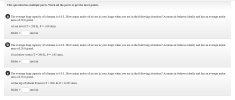 This question has multiple parts. Work all the parts to get the most points. a The average lung capacity of a human is 6.0 L. How many moles of air are in your lungs when you are in the following situations? Assume air behaves ideally and has an average molar mass of 29.0 g/mol. At sea level (T = 298 K, P= 1.00 atm). Moles = mol air b The average lung capacity of a human is 6.0 L. How...
All work and answers should be written on your own paper. 1. (6 Pts) Write the...
 All work and answers should be written on your own paper. 1. (6 Pts) Write the equilibrium expression, Kc, for the following reactions. a. 2 SO2(g) + O2(g) = 2 SO3(g) b. Cl(g) + O3(g) = CIO(g) + O2(g) c. 4 KO2() + 2 H2O(g) = 4 KOH(s) + 3 O2(g) 2. (6 Pts) Write the equilibrium expression, Kr, for the reactions in problem 1. 3. (8 Pts) At 127°C, Kc = 2.6 x 10- for the reaction: 2 NH3(g)...
 15.
This question has multiple parts. Work all the parts to get the most points. At 35°C, K-1.1 x 10° for the reaction 2 NOCI(g) 근 2N0(g) + Cl2 (g) Calculate the concentrations of all species at equilibrium for each of the following original mixtures a3.8 moles of pure NOCl in a 2.0-L flask [NOCI] = NO] [C12] = b1.0 mole of NOCI and 1.0 mole of NO in a 1.0-L flask NOCI NO Numeric input field 3.8 mole of...
15.
This question has multiple parts. Work all the parts to get the most points. At 35°C, K-1.1 x 10° for the reaction 2 NOCI(g) 근 2N0(g) + Cl2 (g) Calculate the concentrations of all species at equilibrium for each of the following original mixtures a3.8 moles of pure NOCl in a 2.0-L flask [NOCI] = NO] [C12] = b1.0 mole of NOCI and 1.0 mole of NO in a 1.0-L flask NOCI NO Numeric input field 3.8 mole of...
 This question has multiple parts. Work all the parts to get the most points. At 25°C, K 0.090 for the reaction H, 0(g) + C,O(g) ? 2 HOCl(g) Calculate the concentrations of all species at equilibrium for each of the following cases. aL0g H0 and 2.0 g Cl,O are mixed in a 1.0-L flask. H2O] C20 [HOC?]- b 1.0 mole of pure HOCl is placed in a 20-L flask. [H20] = [C101 =
 just b please thank you.
This question has multiple parts. Work all the parts to get the most points. A titration of 21.7 mL of a solution of the weak base aniline, CH NH, (K) = 4.0 x 10⁻¹), requires 24.35 mL of 0.175 M HCl to reach the equivalence point. C.H NH, (aq) + H, 0+ (aq) = CH NH,+ (aq) + H, 0(1) a What was the concentration of aniline in the original solution? Concentration - 196 MV...
just b please thank you.
This question has multiple parts. Work all the parts to get the most points. A titration of 21.7 mL of a solution of the weak base aniline, CH NH, (K) = 4.0 x 10⁻¹), requires 24.35 mL of 0.175 M HCl to reach the equivalence point. C.H NH, (aq) + H, 0+ (aq) = CH NH,+ (aq) + H, 0(1) a What was the concentration of aniline in the original solution? Concentration - 196 MV...
 please help me
This question has multiple parts. Work all the parts to get the most points. Calculate the solubility (in moles per liter) of Fe(OH)3 (Ksp = 4 x 10-58) in each of the following. a water Solubility = mol/L b a solution buffered at pH 6.0 mol/L Solubility C a solution buffered at pH = 10.0 Solubility = mol/L A 55.0-ml sample of 0.00150 M AgNO, is added to 55.0 ml. of 0.0300 M Nalog. What is the...
please help me
This question has multiple parts. Work all the parts to get the most points. Calculate the solubility (in moles per liter) of Fe(OH)3 (Ksp = 4 x 10-58) in each of the following. a water Solubility = mol/L b a solution buffered at pH 6.0 mol/L Solubility C a solution buffered at pH = 10.0 Solubility = mol/L A 55.0-ml sample of 0.00150 M AgNO, is added to 55.0 ml. of 0.0300 M Nalog. What is the...
 This question has multiple parts. Work all the parts to get the most points. The average lung capacity of a human is 59 L. How many moles of air are in your lungs when you are in the following situations? Asume air behaves ideally and has an average moler mass of 29.0 g/mol. At sea level (T-298 K, P - 1.00 atm). Moles b The average lung capacity of a human is 59 L. How many moles of air are...
 (References) This question has multiple parts. Work all the parts to get the most points. The reaction 2NO() + 2H2(g) → N (9) + 2H20(9) was studied at 904°C, and the data in the table were collected, Reaction Rate of Trial Concentration Appearance of Ne (mol/L) (mol/L-s) [NO] [H.] 1 0.420 0.122 0.136 2 0.210 0.122 0.0339 3 0.210 0.244 0.0678 4 0.106 0.488 0.0339 a which two reaction trials can be used to determine the order of the reaction...
 This question has multiple parts. Work all the parts to get the most points. a The average lung capacity of a human is 6.0 L. How many moles of air are in your lungs when you are in the following situations? Assume air behaves ideally and has an average molar mass of 29.0 g/mol. At sea level (T = 298 K, P= 1.00 atm). Moles = mol air b The average lung capacity of a human is 6.0 L. How...
 All work and answers should be written on your own paper. 1. (6 Pts) Write the equilibrium expression, Kc, for the following reactions. a. 2 SO2(g) + O2(g) = 2 SO3(g) b. Cl(g) + O3(g) = CIO(g) + O2(g) c. 4 KO2() + 2 H2O(g) = 4 KOH(s) + 3 O2(g) 2. (6 Pts) Write the equilibrium expression, Kr, for the reactions in problem 1. 3. (8 Pts) At 127°C, Kc = 2.6 x 10- for the reaction: 2 NH3(g)...
Most questions answered within 3 hours.
-
Where is the error in this code sequence?
String s1 = "Hello";
String s2 = "ello";...
asked 10 months ago -
Financial data for Joel de Paris, Inc., for last year
follow:
Joel de Paris, Inc.
Balance...
asked 10 months ago -
Consider this reaction:
Al2(SO4)3 (aq)+ BaCl3
(aq) Al2Cl6 (aq)- +
3BaSO4(s) . What is the...
asked 10 months ago -
Suppose that Savneet is considering increasing her
recent random sample from 20 car rentals to 40...
asked 10 months ago -
Trucks arrive at an unloading terminal at an average rate of 120
per hour.
Trucks arrive...
asked 10 months ago -
Why are methanol and ethanol completely soluble in water while
octanol is not very little soluble....
asked 10 months ago -
A facilities manager at a university reads in a research report
that the mean amount of...
asked 10 months ago -
When the CuSO4 is rehydrated by adding water to the anhydrous
compound, is this an endothermic...
asked 10 months ago -
A ray of sunlight is passing from diamond into crown glass; the
angle of incidence is...
asked 10 months ago -
A block of mass 0.249 kg is placed on top of a light, vertical
spring of...
asked 10 months ago -
how do the kidneys compensate in the presences of acidosis
a) trigger hyperventilate
b) reserve acid...
asked 10 months ago -
Question 501 pts
The rental rate of capital to the firm increases. Which of the
following...
asked 10 months ago