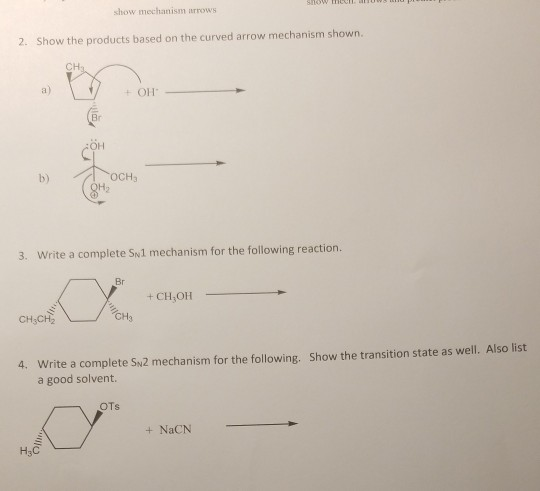
Show the products based on the curved arrow mechanism shown
(It's question #2 in the picture, but if you wanted to answer #3/4 too that'd be awesome!)
Homework Answers

Add Answer to:
Show the products based on the curved arrow mechanism
shown
(It's question #2 in the picture,...
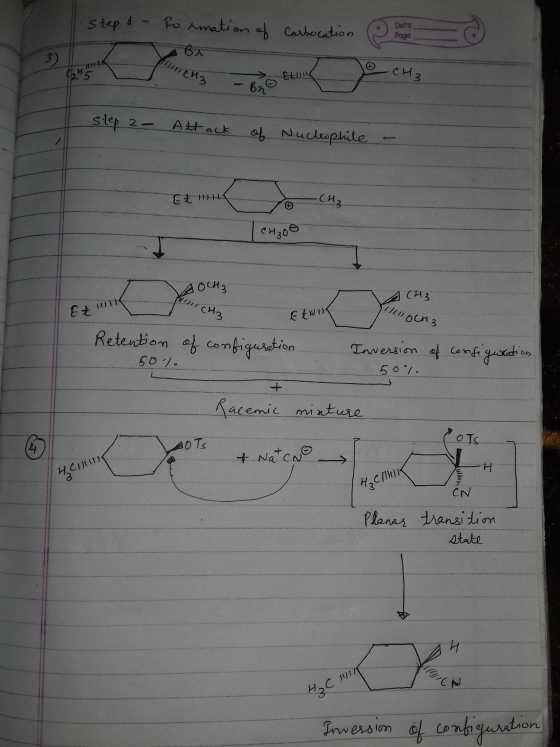
3) Write a complete Sn1 mechanism for the following reaction Also, 4) Write a complete Sn2...
 3) Write a complete Sn1 mechanism for the following
reaction
Also,
4) Write a complete Sn2 mechanism for the following.
Please show transition state and list a good solvent as well.
Thank you!
3. Write a complete Sn1 mechanism for the following reaction. Вт + CH3OH CH₃CH2 CH3 4. Write a complete SN2 mechanism for the following. Show the transition state as well. Also list a good solvent. OTS + NaCN H3C 3. Write a complete sul mechanism for the...
3) Write a complete Sn1 mechanism for the following
reaction
Also,
4) Write a complete Sn2 mechanism for the following.
Please show transition state and list a good solvent as well.
Thank you!
3. Write a complete Sn1 mechanism for the following reaction. Вт + CH3OH CH₃CH2 CH3 4. Write a complete SN2 mechanism for the following. Show the transition state as well. Also list a good solvent. OTS + NaCN H3C 3. Write a complete sul mechanism for the...
describe each as Sn1, Sn2, E1 and E2 then draw a curved arrow mechanism for each reaction. NaSH DMSO SH KOH HO DMSO...
 describe each as Sn1, Sn2, E1 and E2 then draw a
curved arrow mechanism for each reaction.
NaSH DMSO SH KOH HO DMSO Br NANH NH3 OTs NH TsO TsO CHs CH3 Nal CH3 acetone CH O O
describe each as Sn1, Sn2, E1 and E2 then draw a
curved arrow mechanism for each reaction.
NaSH DMSO SH KOH HO DMSO Br NANH NH3 OTs NH TsO TsO CHs CH3 Nal CH3 acetone CH O O
Please show arrow pushing reaction mechanism and products. A) proceeds by SN1, B) proceeds by SN2....
 Please show arrow pushing reaction mechanism and
products. A) proceeds by SN1, B) proceeds by SN2.
a) + OH Br NaI +
Please show arrow pushing reaction mechanism and
products. A) proceeds by SN1, B) proceeds by SN2.
a) + OH Br NaI +
2. Predict the product(s) of each of the reaction conditions below. Specify the substrate type (primary,...
 2. Predict the product(s) of each of the reaction conditions
below. Specify the substrate type (primary, secondary, or tertiary
alkyl halide), nucleophile (strong or poor), and the solvent type
(protic or aptrotic). Specify the type of reaction mechanism (SN1
or SN2), show the curved arrow mechanism and draw the products as
3D structures to illustrate stereochemistry.
Predict the product(s) of each of the reaction conditions below. Specify the substrate type (1º, 2º, or 3 alkyl halide). mucleophile (strong or poor),...
2. Predict the product(s) of each of the reaction conditions
below. Specify the substrate type (primary, secondary, or tertiary
alkyl halide), nucleophile (strong or poor), and the solvent type
(protic or aptrotic). Specify the type of reaction mechanism (SN1
or SN2), show the curved arrow mechanism and draw the products as
3D structures to illustrate stereochemistry.
Predict the product(s) of each of the reaction conditions below. Specify the substrate type (1º, 2º, or 3 alkyl halide). mucleophile (strong or poor),...
Show the curved arrow mechanism for the reaction...
 1.2.3.4.5.6.7.8.Show the curved arrow mechanism for the reaction between ethoxide and methanol to give ethanol and the methoxide ion. 1st attempt Jual See Periodic Table See Hint OH-Ö: Add the missing curved arrow notation.The carbon-metal bond in organometallic Grignard reagents exhibits significant covalent character. However, we can treat these compounds as electron-rich carbanions because of the large difference in electronegativity between carbon and magnesium. These reagents are great to form carbon-carbon bonds but must be kept in an anhydrous environment...
4. For each of the following transformations: a) Show all Products formed b) State whether the...
 4. For each of the following transformations: a) Show all Products formed b) State whether the mechanism favors SN1 or SN2. c) Show stereochemistry (R/S) where applicable. d) Show an arrow that indicates which side of the reaction is favored, products or reactants. cetone + NaCN CH,CH,CH2NH2 HCI
Complete answers with mechanism and products, with picture details. Determine, based on the identity of the...
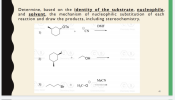 Complete answers with mechanism and products, with
picture details.
Determine, based on the identity of the substrate, nucleophile and solvent, the mechanism of nucleophilic substitution of each reaction and draw the products, including stereochemistry. DMF OTs Y Steps nistry Steps Chemistry Steps 1) Chemistry t OHmby Ste 2) Chemistry Steps MECN н.с-о — 3) + Br istry Steps Chemistry Steps Chemistry Steps Chemistry Steps
Complete answers with mechanism and products, with
picture details.
Determine, based on the identity of the substrate, nucleophile and solvent, the mechanism of nucleophilic substitution of each reaction and draw the products, including stereochemistry. DMF OTs Y Steps nistry Steps Chemistry Steps 1) Chemistry t OHmby Ste 2) Chemistry Steps MECN н.с-о — 3) + Br istry Steps Chemistry Steps Chemistry Steps Chemistry Steps
a) complete the curved arrow electron-pushing mechanism and predict the major organic product of the reaction...
 a) complete the curved arrow electron-pushing mechanism and
predict the major organic product of the reaction when
1-chloropentane is treated with hydroxide in ethanol as shown
below.
a) Complete the curved arrow electron-pushing mechanism and predict the major organic product of the reaction when 1-chloropentane is treated with hydroxide in ethanol as shown below. Use curved arrows to show the Draw the structure of the organic product formed in the reaction. Draw lone pairs. conversion to the product. CH3CH2OH -CI...
a) complete the curved arrow electron-pushing mechanism and
predict the major organic product of the reaction when
1-chloropentane is treated with hydroxide in ethanol as shown
below.
a) Complete the curved arrow electron-pushing mechanism and predict the major organic product of the reaction when 1-chloropentane is treated with hydroxide in ethanol as shown below. Use curved arrows to show the Draw the structure of the organic product formed in the reaction. Draw lone pairs. conversion to the product. CH3CH2OH -CI...
Question 1 a) Draw the mechanism for the following E2 reaction. Use a chair conformation to...
 Question 1 a) Draw the mechanism for the following E2 reaction. Use a chair conformation to illustrate the correct geometry between the leaving group and the hydrogen being eliminated. Tso NaOCHz + CH,OH + NaOTs b) Draw the 5-coordinate transition state that occurs during the Sn2 reaction below. NaCN DMSO c) Draw a complete mechanism for the transformation below. Be sure to include all curved arrows, intermediates, and by-products. H2SO4 (aq) OH OH الميم
For each of the following transformations: a) Show all Products formed State whether the mechanism favors...
 For each of the following transformations: a) Show all Products formed State whether the mechanism favors SN1 or SN2 b) c) Show stereochemistry (*R/S) where applicable. d) Show an arrow that indicates which side of the reaction is favored, products or reactants. Br acetone + NaCN CH3CH2CH2NH2 ш HСІ он
 3) Write a complete Sn1 mechanism for the following
reaction
Also,
4) Write a complete Sn2 mechanism for the following.
Please show transition state and list a good solvent as well.
Thank you!
3. Write a complete Sn1 mechanism for the following reaction. Вт + CH3OH CH₃CH2 CH3 4. Write a complete SN2 mechanism for the following. Show the transition state as well. Also list a good solvent. OTS + NaCN H3C 3. Write a complete sul mechanism for the...
3) Write a complete Sn1 mechanism for the following
reaction
Also,
4) Write a complete Sn2 mechanism for the following.
Please show transition state and list a good solvent as well.
Thank you!
3. Write a complete Sn1 mechanism for the following reaction. Вт + CH3OH CH₃CH2 CH3 4. Write a complete SN2 mechanism for the following. Show the transition state as well. Also list a good solvent. OTS + NaCN H3C 3. Write a complete sul mechanism for the...
 describe each as Sn1, Sn2, E1 and E2 then draw a
curved arrow mechanism for each reaction.
NaSH DMSO SH KOH HO DMSO Br NANH NH3 OTs NH TsO TsO CHs CH3 Nal CH3 acetone CH O O
describe each as Sn1, Sn2, E1 and E2 then draw a
curved arrow mechanism for each reaction.
NaSH DMSO SH KOH HO DMSO Br NANH NH3 OTs NH TsO TsO CHs CH3 Nal CH3 acetone CH O O
 Please show arrow pushing reaction mechanism and
products. A) proceeds by SN1, B) proceeds by SN2.
a) + OH Br NaI +
Please show arrow pushing reaction mechanism and
products. A) proceeds by SN1, B) proceeds by SN2.
a) + OH Br NaI +
 2. Predict the product(s) of each of the reaction conditions
below. Specify the substrate type (primary, secondary, or tertiary
alkyl halide), nucleophile (strong or poor), and the solvent type
(protic or aptrotic). Specify the type of reaction mechanism (SN1
or SN2), show the curved arrow mechanism and draw the products as
3D structures to illustrate stereochemistry.
Predict the product(s) of each of the reaction conditions below. Specify the substrate type (1º, 2º, or 3 alkyl halide). mucleophile (strong or poor),...
2. Predict the product(s) of each of the reaction conditions
below. Specify the substrate type (primary, secondary, or tertiary
alkyl halide), nucleophile (strong or poor), and the solvent type
(protic or aptrotic). Specify the type of reaction mechanism (SN1
or SN2), show the curved arrow mechanism and draw the products as
3D structures to illustrate stereochemistry.
Predict the product(s) of each of the reaction conditions below. Specify the substrate type (1º, 2º, or 3 alkyl halide). mucleophile (strong or poor),...
 1.2.3.4.5.6.7.8.Show the curved arrow mechanism for the reaction between ethoxide and methanol to give ethanol and the methoxide ion. 1st attempt Jual See Periodic Table See Hint OH-Ö: Add the missing curved arrow notation.The carbon-metal bond in organometallic Grignard reagents exhibits significant covalent character. However, we can treat these compounds as electron-rich carbanions because of the large difference in electronegativity between carbon and magnesium. These reagents are great to form carbon-carbon bonds but must be kept in an anhydrous environment...
 4. For each of the following transformations: a) Show all Products formed b) State whether the mechanism favors SN1 or SN2. c) Show stereochemistry (R/S) where applicable. d) Show an arrow that indicates which side of the reaction is favored, products or reactants. cetone + NaCN CH,CH,CH2NH2 HCI
 Complete answers with mechanism and products, with
picture details.
Determine, based on the identity of the substrate, nucleophile and solvent, the mechanism of nucleophilic substitution of each reaction and draw the products, including stereochemistry. DMF OTs Y Steps nistry Steps Chemistry Steps 1) Chemistry t OHmby Ste 2) Chemistry Steps MECN н.с-о — 3) + Br istry Steps Chemistry Steps Chemistry Steps Chemistry Steps
Complete answers with mechanism and products, with
picture details.
Determine, based on the identity of the substrate, nucleophile and solvent, the mechanism of nucleophilic substitution of each reaction and draw the products, including stereochemistry. DMF OTs Y Steps nistry Steps Chemistry Steps 1) Chemistry t OHmby Ste 2) Chemistry Steps MECN н.с-о — 3) + Br istry Steps Chemistry Steps Chemistry Steps Chemistry Steps
 a) complete the curved arrow electron-pushing mechanism and
predict the major organic product of the reaction when
1-chloropentane is treated with hydroxide in ethanol as shown
below.
a) Complete the curved arrow electron-pushing mechanism and predict the major organic product of the reaction when 1-chloropentane is treated with hydroxide in ethanol as shown below. Use curved arrows to show the Draw the structure of the organic product formed in the reaction. Draw lone pairs. conversion to the product. CH3CH2OH -CI...
a) complete the curved arrow electron-pushing mechanism and
predict the major organic product of the reaction when
1-chloropentane is treated with hydroxide in ethanol as shown
below.
a) Complete the curved arrow electron-pushing mechanism and predict the major organic product of the reaction when 1-chloropentane is treated with hydroxide in ethanol as shown below. Use curved arrows to show the Draw the structure of the organic product formed in the reaction. Draw lone pairs. conversion to the product. CH3CH2OH -CI...
 Question 1 a) Draw the mechanism for the following E2 reaction. Use a chair conformation to illustrate the correct geometry between the leaving group and the hydrogen being eliminated. Tso NaOCHz + CH,OH + NaOTs b) Draw the 5-coordinate transition state that occurs during the Sn2 reaction below. NaCN DMSO c) Draw a complete mechanism for the transformation below. Be sure to include all curved arrows, intermediates, and by-products. H2SO4 (aq) OH OH الميم
 For each of the following transformations: a) Show all Products formed State whether the mechanism favors SN1 or SN2 b) c) Show stereochemistry (*R/S) where applicable. d) Show an arrow that indicates which side of the reaction is favored, products or reactants. Br acetone + NaCN CH3CH2CH2NH2 ш HСІ он
Most questions answered within 3 hours.
-
Where is the error in this code sequence?
String s1 = "Hello";
String s2 = "ello";...
asked 10 months ago -
Financial data for Joel de Paris, Inc., for last year
follow:
Joel de Paris, Inc.
Balance...
asked 10 months ago -
Consider this reaction:
Al2(SO4)3 (aq)+ BaCl3
(aq) Al2Cl6 (aq)- +
3BaSO4(s) . What is the...
asked 10 months ago -
Suppose that Savneet is considering increasing her
recent random sample from 20 car rentals to 40...
asked 10 months ago -
Trucks arrive at an unloading terminal at an average rate of 120
per hour.
Trucks arrive...
asked 10 months ago -
Why are methanol and ethanol completely soluble in water while
octanol is not very little soluble....
asked 10 months ago -
A facilities manager at a university reads in a research report
that the mean amount of...
asked 10 months ago -
When the CuSO4 is rehydrated by adding water to the anhydrous
compound, is this an endothermic...
asked 10 months ago -
A ray of sunlight is passing from diamond into crown glass; the
angle of incidence is...
asked 10 months ago -
A block of mass 0.249 kg is placed on top of a light, vertical
spring of...
asked 10 months ago -
how do the kidneys compensate in the presences of acidosis
a) trigger hyperventilate
b) reserve acid...
asked 10 months ago -
Question 501 pts
The rental rate of capital to the firm increases. Which of the
following...
asked 10 months ago