Consider a homonuclear diatomic molecule built from atoms in the second row of the periodic table....
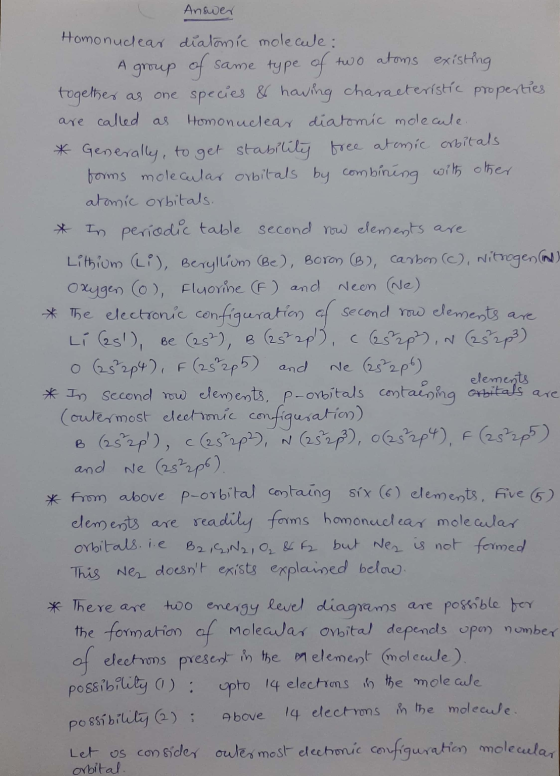
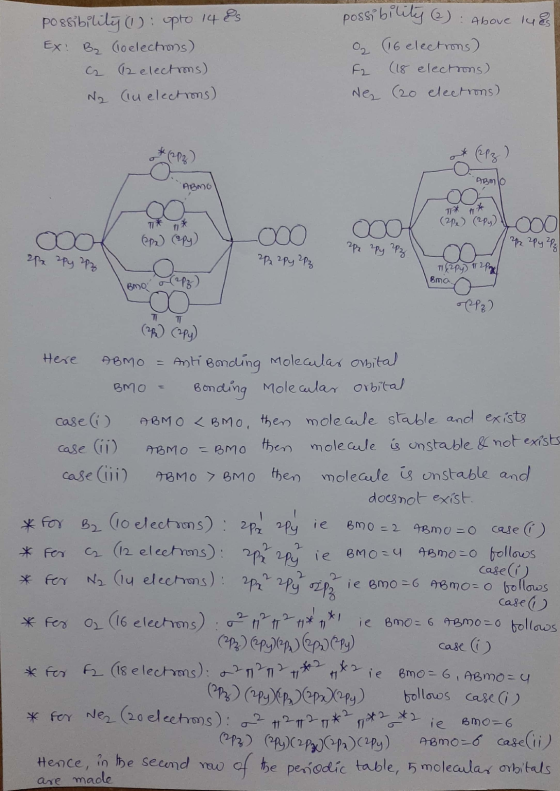
Consider a homonuclear diatomic molecule built from atoms in the second row of the periodic table. When the p orbitals from the two atoms are combined to make molecular orbitals, how many molecular orbitals are made?
Homework Answers
Add Answer to:
Consider a homonuclear diatomic molecule built from atoms in the
second row of the periodic table....
5. Suppose that photoelectron spectroscopy is done on a 2nd-row homonuclear diatomic molecule. Photons with energy...
 5. Suppose that photoelectron spectroscopy is done on a 2nd-row homonuclear diatomic molecule. Photons with energy 21.21 eV are used, and electrons are ejected with kinetic energies of 11.01 eV, 8.23 eV, and 15.22 eV. (a) Sketch the molecular orbital energy level diagram for the molecule, showing the ionization energies of the three orbitals. Assume that these are the only three filled or partially-filled orbitals and that the molecule is in the ground state. (b) What are the possible identities...
1. For the homonuclear diatomic molecules across the periodic table from H2 to Nez (10 molecules...
 1. For the homonuclear diatomic molecules across the periodic table from H2 to Nez (10 molecules in all), make a MO diagram like the figure, and fill in the electrons. Be sure to get the order of the orbitals correct (see Fig. 11.14 of textbook). For each molecule, give the bond order and whether or not it's paramagnetic (unpaired spins). I know this seems like a pretty basic question, but it's important for chemists to have this model embedded in...
Using the molecular orbital energy ordering for second-row homonuclear diatomic molecules in which the π2p orbitals...
Using the molecular orbital energy ordering for second-row homonuclear diatomic molecules in which the π2p orbitals lie at lower energy than the σ2p, predict the bond order in a molecule or ion with each of the following numbers of total valence electrons.(Use the drawing MO energy diagrams) Will the molecule or ion be diamagnetic or paramagnetic? Part A Determine the bond order in a molecule or ion with 4 valence electrons. Part B Will this molecule or ion be diamagnetic...
5.A homonuclear diatomic molecule in its molecular ground state has the following electronic configuration: a) What...
 5.A homonuclear diatomic molecule in its molecular
ground state has the following electronic configuration:
a) What is the link order?
b) What is the multiplicity of spin?
c) What is the difference in the stability of the molecule, when
ionizing it, removing an electron from the 1π_g molecular orbital
or doing it from the 3Sigma_g molecular orbital
i'll give you a like so please explain step by
step
thank you!
N a 1o21022032011143017 09 bo
5.A homonuclear diatomic molecule in its molecular
ground state has the following electronic configuration:
a) What is the link order?
b) What is the multiplicity of spin?
c) What is the difference in the stability of the molecule, when
ionizing it, removing an electron from the 1π_g molecular orbital
or doing it from the 3Sigma_g molecular orbital
i'll give you a like so please explain step by
step
thank you!
N a 1o21022032011143017 09 bo
P9D.2 (a) Suppose that a molecular orbital of a heteronuclear diatomic molecule is built from the...
 P9D.2 (a) Suppose that a molecular orbital of a heteronuclear diatomic molecule is built from the orbital basis A, B, and C, where B and C are both on one atom. Set up the secular equations for the values of the coefficients and the corresponding secular determinant.
P9D.2 (a) Suppose that a molecular orbital of a heteronuclear diatomic molecule is built from the orbital basis A, B, and C, where B and C are both on one atom. Set up...
P9D.2 (a) Suppose that a molecular orbital of a heteronuclear diatomic molecule is built from the orbital basis A, B, and C, where B and C are both on one atom. Set up the secular equations for the values of the coefficients and the corresponding secular determinant.
P9D.2 (a) Suppose that a molecular orbital of a heteronuclear diatomic molecule is built from the orbital basis A, B, and C, where B and C are both on one atom. Set up...
2. (40 points) The MO diagrams for homonuclear diatomic molecules are given below. LUMO Lowes Unceaupiad...
 2. (40 points) The MO diagrams for homonuclear diatomic molecules are given below. LUMO Lowes Unceaupiad 2P HOMD (tHighast ocaupied No No mixing Mixing of og orbitals (a) (b) Bo BongNon 8-2 Va) (15 pts) Choose the appropriate diagram for the N2 molecule and place the right number of electrons. Indicate the frontier orbitals (HOMO and LUMO) and the bond order. b) (20 pts) Sketch a qualitative MO diagram for the heteronuclear diatomic anion CN; place the right number of...
Consider the diatomic molecule NF. (a) Draw the shape of the 2 pz orbital on N....
 Consider the diatomic molecule NF. (a) Draw the shape of the 2 pz orbital on N. How many nodes does this orbital have? Show the nodes in your diagram. (b) Construct a molecular orbital energy diagram for NF. For this drawing consider both the s and p valence orbitals on each atom, but do not include orbital mixing. Show how the electrons are placed in the MO's. (c) How would orbital mixing alter the MO energy diagram you just constructed?...
Compute the interatomic distance between two atoms inside a diatomic molecule given spectroscopic data (the rotational t...
Compute the interatomic distance between two atoms inside a diatomic molecule given spectroscopic data (the rotational temperature) Θ r o t This problem has two questions. The first is for a real molecule . The second is a hypothetical molecule (made up atomic masses and Θ r o t ) 1) compute the internuclear separation for 35Cl2 in picometers (pm). For consistent mass data use values from: 2) Consider a hypothetical diatomic molecule where the mass of atom 1 =...
Mixing of s and p orbitals can lead to some strange effects and very unstable structures...
Mixing of s and p orbitals can lead to some strange effects and very unstable structures that cannot be accurately described using Lewis structures. We can even predict properties of molecules that have never been and may never be made! For each part, name a 2p homonuclear diatomic (e.g. Li2, N2, Ne2, etc.) that each statement represents. Draw an MO diagram supporting your choice. a) A molecule that has a double bond formed from two π molecular orbitals and zero...
When the 1s orbitals of two hydrogen atoms combine to form a hydrogen molecule, how are the...
When the 1s orbitals of two hydrogen atoms combine to form a hydrogen molecule, how are the electrons distributed in the resulting molecular orbitals
 5. Suppose that photoelectron spectroscopy is done on a 2nd-row homonuclear diatomic molecule. Photons with energy 21.21 eV are used, and electrons are ejected with kinetic energies of 11.01 eV, 8.23 eV, and 15.22 eV. (a) Sketch the molecular orbital energy level diagram for the molecule, showing the ionization energies of the three orbitals. Assume that these are the only three filled or partially-filled orbitals and that the molecule is in the ground state. (b) What are the possible identities...
 1. For the homonuclear diatomic molecules across the periodic table from H2 to Nez (10 molecules in all), make a MO diagram like the figure, and fill in the electrons. Be sure to get the order of the orbitals correct (see Fig. 11.14 of textbook). For each molecule, give the bond order and whether or not it's paramagnetic (unpaired spins). I know this seems like a pretty basic question, but it's important for chemists to have this model embedded in...
 5.A homonuclear diatomic molecule in its molecular
ground state has the following electronic configuration:
a) What is the link order?
b) What is the multiplicity of spin?
c) What is the difference in the stability of the molecule, when
ionizing it, removing an electron from the 1π_g molecular orbital
or doing it from the 3Sigma_g molecular orbital
i'll give you a like so please explain step by
step
thank you!
N a 1o21022032011143017 09 bo
5.A homonuclear diatomic molecule in its molecular
ground state has the following electronic configuration:
a) What is the link order?
b) What is the multiplicity of spin?
c) What is the difference in the stability of the molecule, when
ionizing it, removing an electron from the 1π_g molecular orbital
or doing it from the 3Sigma_g molecular orbital
i'll give you a like so please explain step by
step
thank you!
N a 1o21022032011143017 09 bo
 P9D.2 (a) Suppose that a molecular orbital of a heteronuclear diatomic molecule is built from the orbital basis A, B, and C, where B and C are both on one atom. Set up the secular equations for the values of the coefficients and the corresponding secular determinant.
P9D.2 (a) Suppose that a molecular orbital of a heteronuclear diatomic molecule is built from the orbital basis A, B, and C, where B and C are both on one atom. Set up...
P9D.2 (a) Suppose that a molecular orbital of a heteronuclear diatomic molecule is built from the orbital basis A, B, and C, where B and C are both on one atom. Set up the secular equations for the values of the coefficients and the corresponding secular determinant.
P9D.2 (a) Suppose that a molecular orbital of a heteronuclear diatomic molecule is built from the orbital basis A, B, and C, where B and C are both on one atom. Set up...
 2. (40 points) The MO diagrams for homonuclear diatomic molecules are given below. LUMO Lowes Unceaupiad 2P HOMD (tHighast ocaupied No No mixing Mixing of og orbitals (a) (b) Bo BongNon 8-2 Va) (15 pts) Choose the appropriate diagram for the N2 molecule and place the right number of electrons. Indicate the frontier orbitals (HOMO and LUMO) and the bond order. b) (20 pts) Sketch a qualitative MO diagram for the heteronuclear diatomic anion CN; place the right number of...
 Consider the diatomic molecule NF. (a) Draw the shape of the 2 pz orbital on N. How many nodes does this orbital have? Show the nodes in your diagram. (b) Construct a molecular orbital energy diagram for NF. For this drawing consider both the s and p valence orbitals on each atom, but do not include orbital mixing. Show how the electrons are placed in the MO's. (c) How would orbital mixing alter the MO energy diagram you just constructed?...
Most questions answered within 3 hours.
-
Where is the error in this code sequence?
String s1 = "Hello";
String s2 = "ello";...
asked 10 months ago -
Financial data for Joel de Paris, Inc., for last year
follow:
Joel de Paris, Inc.
Balance...
asked 10 months ago -
Consider this reaction:
Al2(SO4)3 (aq)+ BaCl3
(aq) Al2Cl6 (aq)- +
3BaSO4(s) . What is the...
asked 10 months ago -
Suppose that Savneet is considering increasing her
recent random sample from 20 car rentals to 40...
asked 10 months ago -
Trucks arrive at an unloading terminal at an average rate of 120
per hour.
Trucks arrive...
asked 10 months ago -
Why are methanol and ethanol completely soluble in water while
octanol is not very little soluble....
asked 10 months ago -
A facilities manager at a university reads in a research report
that the mean amount of...
asked 10 months ago -
When the CuSO4 is rehydrated by adding water to the anhydrous
compound, is this an endothermic...
asked 10 months ago -
A ray of sunlight is passing from diamond into crown glass; the
angle of incidence is...
asked 10 months ago -
A block of mass 0.249 kg is placed on top of a light, vertical
spring of...
asked 10 months ago -
how do the kidneys compensate in the presences of acidosis
a) trigger hyperventilate
b) reserve acid...
asked 10 months ago -
Question 501 pts
The rental rate of capital to the firm increases. Which of the
following...
asked 10 months ago