

Homework Answers

Add Answer to:
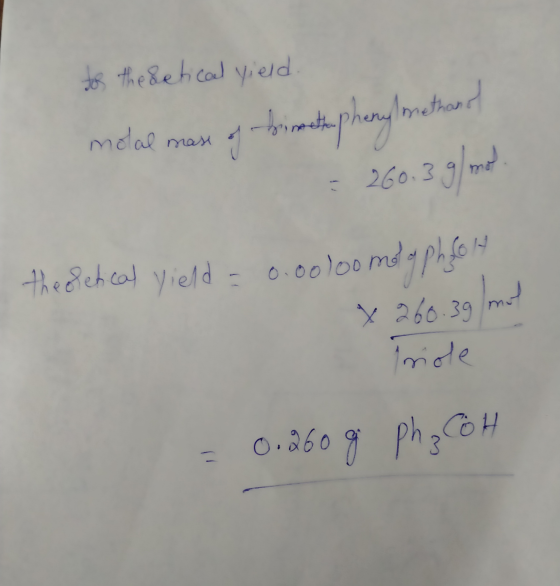
I need help finding the theoretical yield (in grams) of
triphenyl methanol product in this experiment....
What is the theoretical yield (in grams) and percent yield of your triphenylmethanol product in this...
 What is the theoretical yield (in grams) and percent yield of your
triphenylmethanol product in this experiment? (Weight of
triphenylmethanol: 0.060g)
BACKGROUND AND THEORY The Grignard reaction was one of the first organometallic reactions discovered and is still one of the most useful synthetically. By reacting an organohalide (usually a bromide) with magnesium in ethereal solvent, carbon becomes a nucleophile. Grignard reagents are the starting points for the syntheses of many alkanes, primary, secondary, and tertiary alcohols, alkenes, and carboxylic...
What is the theoretical yield (in grams) and percent yield of your
triphenylmethanol product in this experiment? (Weight of
triphenylmethanol: 0.060g)
BACKGROUND AND THEORY The Grignard reaction was one of the first organometallic reactions discovered and is still one of the most useful synthetically. By reacting an organohalide (usually a bromide) with magnesium in ethereal solvent, carbon becomes a nucleophile. Grignard reagents are the starting points for the syntheses of many alkanes, primary, secondary, and tertiary alcohols, alkenes, and carboxylic...
What is the theoretical yield (in grams) and percent yield of your triphenylmethanol product in this...
 What is the theoretical yield (in grams) and percent yield of
your triphenylmethanol product in this experiment?
Assume that you have collected 0.15g of Triphenylmethanol for
the question.
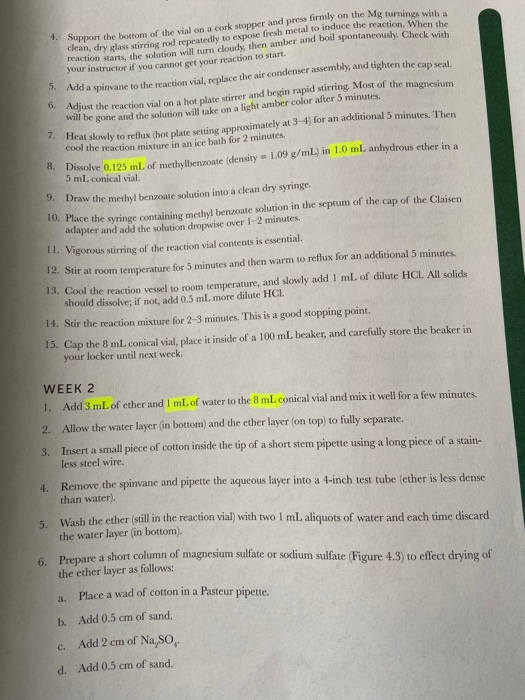
Reaction Set Up ---- ALL glassware NEEDS to be DRY!!! Anhydrous CaCl2 -Drying tube 53 mg Mg turnings Claisen adapter + 2 mL anhydrous ether + 260 ul bromobenzene Air condenser Stir until reaction amber. Heat slowly to reflux for 10 min. Cool the reaction in ice bath for 5 min. Use...
What is the theoretical yield (in grams) and percent yield of
your triphenylmethanol product in this experiment?
Assume that you have collected 0.15g of Triphenylmethanol for
the question.
Reaction Set Up ---- ALL glassware NEEDS to be DRY!!! Anhydrous CaCl2 -Drying tube 53 mg Mg turnings Claisen adapter + 2 mL anhydrous ether + 260 ul bromobenzene Air condenser Stir until reaction amber. Heat slowly to reflux for 10 min. Cool the reaction in ice bath for 5 min. Use...
The weight of triphenylmethanol is 0.060g QUESTIONS 1. (4 Points) What is the theoretical yield (in...
 The weight of triphenylmethanol is 0.060g
QUESTIONS 1. (4 Points) What is the theoretical yield (in grams) and percent yield of your triphenyl- methanol product in this experiment? EXPERIMENTAL PROCEDURE All glassware used in a Grignard reaction must be scrupulously dried. Dry the following glassware in an oven at 110°C for at least 20 minutes: drying tube, Claisen adapter, 8 mL conical vial, 5 mL conical vial, air condenser, glass stirring rod, and a magnetic spinvane. DO NOT PLACE O-RINGS...
The weight of triphenylmethanol is 0.060g
QUESTIONS 1. (4 Points) What is the theoretical yield (in grams) and percent yield of your triphenyl- methanol product in this experiment? EXPERIMENTAL PROCEDURE All glassware used in a Grignard reaction must be scrupulously dried. Dry the following glassware in an oven at 110°C for at least 20 minutes: drying tube, Claisen adapter, 8 mL conical vial, 5 mL conical vial, air condenser, glass stirring rod, and a magnetic spinvane. DO NOT PLACE O-RINGS...
i need help with post questions, thanks Product Isolation After stirring the reaction for 5 minutes...
 i need help with post questions, thanks
Product Isolation After stirring the reaction for 5 minutes and allowing the reaction mixture to cool (the reaction can be exothermic), remove the Claisen head from the conical vial. Slowly add 3 M HCl(aq) drop-wise. The solid may need to be broken up with a stirring rod or a pipet. Continue to add acid until the aqueous phase (bottom layer) tests positive with pH paper. Extractions can be done using the conical funnel...
i need help with post questions, thanks
Product Isolation After stirring the reaction for 5 minutes and allowing the reaction mixture to cool (the reaction can be exothermic), remove the Claisen head from the conical vial. Slowly add 3 M HCl(aq) drop-wise. The solid may need to be broken up with a stirring rod or a pipet. Continue to add acid until the aqueous phase (bottom layer) tests positive with pH paper. Extractions can be done using the conical funnel...
using pictures and a maximum of 10 words, explain why an oven-dried 5-ml conical vial and...
 using pictures and a maximum of 10 words, explain why an oven-dried
5-ml conical vial and drying tube(step 1 and 2 of part 1) are used
in the reaction. do both please! also the notebook pages are the
procedure
(1) Using pictures and a maximum of 10 words, explain why an oven-dried 5-ml conical vial and drying tube (step 1 and 2 of Part 1) are used in the reaction. (2) After the addition of benzophenone to the mixture of...
using pictures and a maximum of 10 words, explain why an oven-dried
5-ml conical vial and drying tube(step 1 and 2 of part 1) are used
in the reaction. do both please! also the notebook pages are the
procedure
(1) Using pictures and a maximum of 10 words, explain why an oven-dried 5-ml conical vial and drying tube (step 1 and 2 of Part 1) are used in the reaction. (2) After the addition of benzophenone to the mixture of...
Grignard Reaction with a Ketone: Triphenylmethanol Introduction: The purpose of this lab is to prepare phenylmagnesium...
Grignard Reaction with a Ketone: Triphenylmethanol Introduction: The purpose of this lab is to prepare phenylmagnesium bromide, a Grignard reagent, and react it with benzophenone to give triphenylmethanol. Grignard reagents are very reactive and must be synthesized in an environment free of water or any other source of potential proton donor. Once made, the Grignard reagent will do a nucleophilic attack on the carbonyl carbon of the ketone, benzophenone. The result is an alkoxide that is then protonated to give...
please find the purpse, Discussion, conclusion un 27 Phoenix June 20 8:10 PM a 35AEXPERIMENT 35A...
 please find the purpse, Discussion, conclusion
un 27 Phoenix June 20 8:10 PM a 35AEXPERIMENT 35A Triphenylmethanol PROCEDURE ether MgBr+ C-OH + MgBr(OH) OMgBr 0 Addct Addition of Benzophenone While the phenylmagnesium bromide solution is being heated and stirred under reflux, make a solution of 1.09 g benzophenone in 2 mL of anhrudrous ether in a 5-mL conical vial. Cap the vial until the reflux period is over. Once the Grignard reagent is cooled to room temperature, draw some of...
please find the purpse, Discussion, conclusion
un 27 Phoenix June 20 8:10 PM a 35AEXPERIMENT 35A Triphenylmethanol PROCEDURE ether MgBr+ C-OH + MgBr(OH) OMgBr 0 Addct Addition of Benzophenone While the phenylmagnesium bromide solution is being heated and stirred under reflux, make a solution of 1.09 g benzophenone in 2 mL of anhrudrous ether in a 5-mL conical vial. Cap the vial until the reflux period is over. Once the Grignard reagent is cooled to room temperature, draw some of...
QUESTIONS TO ANSWER: Prepare a table of all chemicals used with the structure and purpose of...
 QUESTIONS TO ANSWER:
Prepare a table of all chemicals used with the structure and
purpose of each.
Calculate the theoretical yield by finding limiting reactant of
the experiment by converting reactants to product (remember to show
all calculations used)
Calculate the percent yield using the limiting reactant
Calculate the Rf for triphenylmethanol. If there are two dots,
determine which one is triphenylmethanol.. ( I did not provide
data. Please let me know how I Would do this if I did)...
QUESTIONS TO ANSWER:
Prepare a table of all chemicals used with the structure and
purpose of each.
Calculate the theoretical yield by finding limiting reactant of
the experiment by converting reactants to product (remember to show
all calculations used)
Calculate the percent yield using the limiting reactant
Calculate the Rf for triphenylmethanol. If there are two dots,
determine which one is triphenylmethanol.. ( I did not provide
data. Please let me know how I Would do this if I did)...
Hydroboration-Oxidation (Organic Chemistry Laboratory) 1.Explain the mechanism of the reaction. 2.What was the most important piece...
Hydroboration-Oxidation (Organic Chemistry Laboratory) 1.Explain the mechanism of the reaction. 2.What was the most important piece of equipment for the success of the reaction? 3.Was there a rate determining step in the reaction? 4.Explain the purpose of the key reagent(s) in the reaction. Experiment Procedure Flame dry a 5.0 mL conical vial and a Claisen head at the start of the lab period. Place a dry spin vane in the dried conical vial. Assemble these pieces with a calcium chloride...
please answer the prelab excercise:) I tried doing it but I did not get very far Experiment 7: Grignard Reactio...
 please answer the prelab excercise:) I tried doing it but I did not
get very far
Experiment 7: Grignard Reaction. Introduction Discovered by French chemist Victor Grignard, the reaction that now bears his name is an example of the preparation of an organometallic reagent. In this lab, phenylmagnesium bromide is the Grignard of interest, and it will be added to an aldehyde to produce an alcohol. Lab Objectives 1. To study organometallic reagents in general. benzophenone. 2. To prepare phenylmagnesium...
please answer the prelab excercise:) I tried doing it but I did not
get very far
Experiment 7: Grignard Reaction. Introduction Discovered by French chemist Victor Grignard, the reaction that now bears his name is an example of the preparation of an organometallic reagent. In this lab, phenylmagnesium bromide is the Grignard of interest, and it will be added to an aldehyde to produce an alcohol. Lab Objectives 1. To study organometallic reagents in general. benzophenone. 2. To prepare phenylmagnesium...
 What is the theoretical yield (in grams) and percent yield of your
triphenylmethanol product in this experiment? (Weight of
triphenylmethanol: 0.060g)
BACKGROUND AND THEORY The Grignard reaction was one of the first organometallic reactions discovered and is still one of the most useful synthetically. By reacting an organohalide (usually a bromide) with magnesium in ethereal solvent, carbon becomes a nucleophile. Grignard reagents are the starting points for the syntheses of many alkanes, primary, secondary, and tertiary alcohols, alkenes, and carboxylic...
What is the theoretical yield (in grams) and percent yield of your
triphenylmethanol product in this experiment? (Weight of
triphenylmethanol: 0.060g)
BACKGROUND AND THEORY The Grignard reaction was one of the first organometallic reactions discovered and is still one of the most useful synthetically. By reacting an organohalide (usually a bromide) with magnesium in ethereal solvent, carbon becomes a nucleophile. Grignard reagents are the starting points for the syntheses of many alkanes, primary, secondary, and tertiary alcohols, alkenes, and carboxylic...
 What is the theoretical yield (in grams) and percent yield of
your triphenylmethanol product in this experiment?
Assume that you have collected 0.15g of Triphenylmethanol for
the question.
Reaction Set Up ---- ALL glassware NEEDS to be DRY!!! Anhydrous CaCl2 -Drying tube 53 mg Mg turnings Claisen adapter + 2 mL anhydrous ether + 260 ul bromobenzene Air condenser Stir until reaction amber. Heat slowly to reflux for 10 min. Cool the reaction in ice bath for 5 min. Use...
What is the theoretical yield (in grams) and percent yield of
your triphenylmethanol product in this experiment?
Assume that you have collected 0.15g of Triphenylmethanol for
the question.
Reaction Set Up ---- ALL glassware NEEDS to be DRY!!! Anhydrous CaCl2 -Drying tube 53 mg Mg turnings Claisen adapter + 2 mL anhydrous ether + 260 ul bromobenzene Air condenser Stir until reaction amber. Heat slowly to reflux for 10 min. Cool the reaction in ice bath for 5 min. Use...
 The weight of triphenylmethanol is 0.060g
QUESTIONS 1. (4 Points) What is the theoretical yield (in grams) and percent yield of your triphenyl- methanol product in this experiment? EXPERIMENTAL PROCEDURE All glassware used in a Grignard reaction must be scrupulously dried. Dry the following glassware in an oven at 110°C for at least 20 minutes: drying tube, Claisen adapter, 8 mL conical vial, 5 mL conical vial, air condenser, glass stirring rod, and a magnetic spinvane. DO NOT PLACE O-RINGS...
The weight of triphenylmethanol is 0.060g
QUESTIONS 1. (4 Points) What is the theoretical yield (in grams) and percent yield of your triphenyl- methanol product in this experiment? EXPERIMENTAL PROCEDURE All glassware used in a Grignard reaction must be scrupulously dried. Dry the following glassware in an oven at 110°C for at least 20 minutes: drying tube, Claisen adapter, 8 mL conical vial, 5 mL conical vial, air condenser, glass stirring rod, and a magnetic spinvane. DO NOT PLACE O-RINGS...
 i need help with post questions, thanks
Product Isolation After stirring the reaction for 5 minutes and allowing the reaction mixture to cool (the reaction can be exothermic), remove the Claisen head from the conical vial. Slowly add 3 M HCl(aq) drop-wise. The solid may need to be broken up with a stirring rod or a pipet. Continue to add acid until the aqueous phase (bottom layer) tests positive with pH paper. Extractions can be done using the conical funnel...
i need help with post questions, thanks
Product Isolation After stirring the reaction for 5 minutes and allowing the reaction mixture to cool (the reaction can be exothermic), remove the Claisen head from the conical vial. Slowly add 3 M HCl(aq) drop-wise. The solid may need to be broken up with a stirring rod or a pipet. Continue to add acid until the aqueous phase (bottom layer) tests positive with pH paper. Extractions can be done using the conical funnel...
 using pictures and a maximum of 10 words, explain why an oven-dried
5-ml conical vial and drying tube(step 1 and 2 of part 1) are used
in the reaction. do both please! also the notebook pages are the
procedure
(1) Using pictures and a maximum of 10 words, explain why an oven-dried 5-ml conical vial and drying tube (step 1 and 2 of Part 1) are used in the reaction. (2) After the addition of benzophenone to the mixture of...
using pictures and a maximum of 10 words, explain why an oven-dried
5-ml conical vial and drying tube(step 1 and 2 of part 1) are used
in the reaction. do both please! also the notebook pages are the
procedure
(1) Using pictures and a maximum of 10 words, explain why an oven-dried 5-ml conical vial and drying tube (step 1 and 2 of Part 1) are used in the reaction. (2) After the addition of benzophenone to the mixture of...
 please find the purpse, Discussion, conclusion
un 27 Phoenix June 20 8:10 PM a 35AEXPERIMENT 35A Triphenylmethanol PROCEDURE ether MgBr+ C-OH + MgBr(OH) OMgBr 0 Addct Addition of Benzophenone While the phenylmagnesium bromide solution is being heated and stirred under reflux, make a solution of 1.09 g benzophenone in 2 mL of anhrudrous ether in a 5-mL conical vial. Cap the vial until the reflux period is over. Once the Grignard reagent is cooled to room temperature, draw some of...
please find the purpse, Discussion, conclusion
un 27 Phoenix June 20 8:10 PM a 35AEXPERIMENT 35A Triphenylmethanol PROCEDURE ether MgBr+ C-OH + MgBr(OH) OMgBr 0 Addct Addition of Benzophenone While the phenylmagnesium bromide solution is being heated and stirred under reflux, make a solution of 1.09 g benzophenone in 2 mL of anhrudrous ether in a 5-mL conical vial. Cap the vial until the reflux period is over. Once the Grignard reagent is cooled to room temperature, draw some of...
 QUESTIONS TO ANSWER:
Prepare a table of all chemicals used with the structure and
purpose of each.
Calculate the theoretical yield by finding limiting reactant of
the experiment by converting reactants to product (remember to show
all calculations used)
Calculate the percent yield using the limiting reactant
Calculate the Rf for triphenylmethanol. If there are two dots,
determine which one is triphenylmethanol.. ( I did not provide
data. Please let me know how I Would do this if I did)...
QUESTIONS TO ANSWER:
Prepare a table of all chemicals used with the structure and
purpose of each.
Calculate the theoretical yield by finding limiting reactant of
the experiment by converting reactants to product (remember to show
all calculations used)
Calculate the percent yield using the limiting reactant
Calculate the Rf for triphenylmethanol. If there are two dots,
determine which one is triphenylmethanol.. ( I did not provide
data. Please let me know how I Would do this if I did)...
 please answer the prelab excercise:) I tried doing it but I did not
get very far
Experiment 7: Grignard Reaction. Introduction Discovered by French chemist Victor Grignard, the reaction that now bears his name is an example of the preparation of an organometallic reagent. In this lab, phenylmagnesium bromide is the Grignard of interest, and it will be added to an aldehyde to produce an alcohol. Lab Objectives 1. To study organometallic reagents in general. benzophenone. 2. To prepare phenylmagnesium...
please answer the prelab excercise:) I tried doing it but I did not
get very far
Experiment 7: Grignard Reaction. Introduction Discovered by French chemist Victor Grignard, the reaction that now bears his name is an example of the preparation of an organometallic reagent. In this lab, phenylmagnesium bromide is the Grignard of interest, and it will be added to an aldehyde to produce an alcohol. Lab Objectives 1. To study organometallic reagents in general. benzophenone. 2. To prepare phenylmagnesium...
Most questions answered within 3 hours.
-
Where is the error in this code sequence?
String s1 = "Hello";
String s2 = "ello";...
asked 11 months ago -
Financial data for Joel de Paris, Inc., for last year
follow:
Joel de Paris, Inc.
Balance...
asked 11 months ago -
Consider this reaction:
Al2(SO4)3 (aq)+ BaCl3
(aq) Al2Cl6 (aq)- +
3BaSO4(s) . What is the...
asked 11 months ago -
Suppose that Savneet is considering increasing her
recent random sample from 20 car rentals to 40...
asked 11 months ago -
Trucks arrive at an unloading terminal at an average rate of 120
per hour.
Trucks arrive...
asked 11 months ago -
Why are methanol and ethanol completely soluble in water while
octanol is not very little soluble....
asked 11 months ago -
A facilities manager at a university reads in a research report
that the mean amount of...
asked 11 months ago -
When the CuSO4 is rehydrated by adding water to the anhydrous
compound, is this an endothermic...
asked 11 months ago -
A ray of sunlight is passing from diamond into crown glass; the
angle of incidence is...
asked 11 months ago -
A block of mass 0.249 kg is placed on top of a light, vertical
spring of...
asked 11 months ago -
how do the kidneys compensate in the presences of acidosis
a) trigger hyperventilate
b) reserve acid...
asked 11 months ago -
Question 501 pts
The rental rate of capital to the firm increases. Which of the
following...
asked 11 months ago