
Homework Answers
Add Answer to:
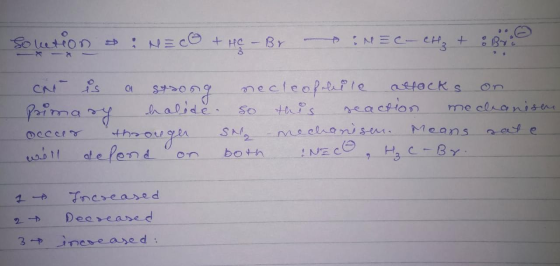
Question 9 4 pts Consider this reaction: : NEC: + C-Br- NEC-CH3 + Br: When the...
QUESTION 6 Br CH,0 + + CH,OH + Br THF For this E2 reaction, indicate the effect that each change will have on the R...
 QUESTION 6 Br CH,0 + + CH,OH + Br THF For this E2 reaction, indicate the effect that each change will have on the RATE of the reaction. (Do not consider yield of product.) Answers are either: rate will increase (1), rate will decreasse (D), or reaction rate will show no change (NC). Enter I, D. or NC in each blank. 1. The alkyl halide is changed to 2-flourobutane. 2. The concentration of the base is increased. 3. The base...
Consider the single-step, bimolecular reaction. CH, Br + NaOH CH, OH + NaBr When the concentrations...
 Consider the single-step, bimolecular reaction. CH, Br + NaOH CH, OH + NaBr When the concentrations of CH, Brand NaOH are both 0.160 M, the rate of the reaction is 0.0060 M/s. What is the rate of the reaction if the concentration of CH Br is doubled? Tat What is the rate of the reaction if the concentration of NaOH is halved? rate: 0.25 What is the rate of the reaction if the concentrations of CH, Brand NaOH are both...
4. Consider the following reaction: OC(CH3); (CH3)3COH Draw the byproducts of the reactions and use curved...
 4. Consider the following reaction: OC(CH3); (CH3)3COH Draw the byproducts of the reactions and use curved arrows to show the movement of electrons. a) b) What happens to the reaction ra i. The solvent is changed to DMF The concentration of-OC(CH3)3 is decreased ii. The base is changed to OH iv. The halide is changed to CHaCH2CH2CH2CH(Br)CH3 v. The leaving group is changed to
consider the Sn1 reaction shown below and answer the following questions. Br Br + CH3OH CH3...
 consider the Sn1 reaction shown below and answer the following questions. Br Br + CH3OH CH3 + HBO A. Write the rate law for the reaction. B. Identify the nucleophile, the electrophile, and the reaction solvent. C. State how each of the following factors would affect the rate of the reaction. a. Increasing the concentration of the alkyl halide. b. Increasing the concentration of CH3OH. c. Replacing HOCH3 with NaOCH3. d. Changing the alkyl halide from a bromide to an...
CH3 For the following reaction sequence draw products A,B,C, and D. (4 pts) 5. Cн-CH, Br...
 CH3 For the following reaction sequence draw products A,B,C, and D. (4 pts) 5. Cн-CH, Br KOC(CH3)3 Br2 A В cocCt DMSO C CCH3 CH2Br NaH D С 3
Draw the major product of the following reaction. Question 9 Br O-CH3 H3C CH3 Create OscerSketch Answer 9 Draw the majo...
 Draw the major product of the following reaction. Question 9 Br O-CH3 H3C CH3 Create OscerSketch Answer 9 Draw the major product of the following reaction. Question 10 H3CH HO CH3 Create OscerSketch Answer 10
5 pts Question 9 The reaction CHCl3(g) + Cl2(g) —— CC14(g) + HCl(g) has the rate...
 5 pts Question 9 The reaction CHCl3(g) + Cl2(g) —— CC14(g) + HCl(g) has the rate law: Rate = k[CHCl3][C12] If the concentration of CHCl3 is increased by a factor of five while the concentration of Cl2 is kept the same, the reaction rate will O double triple increase by a factor of five decreased by a factor of one-fifth
The following reaction is a single-step, bimolecular reaction: CH, Br+ NaOH → CH,OH + NaBr When...
 The following reaction is a single-step, bimolecular reaction: CH, Br+ NaOH → CH,OH + NaBr When the concentrations of CH3Br and NaOH are both 0.200 M, the rate of the reaction is 0.0040 M/s. (a) What is the rate of the reaction if the concentration of CH3Br is doubled? Number MIS (b) What is the rate of the reaction if the concentration of NaOH is halved? Number M/s (c) What is the rate of the reaction if the concentrations of...
Exit Question 2 1 pts 4 Consider the balanced reaction 3 A +6 B C +5...
 Exit Question 2 1 pts 4 Consider the balanced reaction 3 A +6 B C +5 D and the enthalpies of formation provided in the table below. ΔΗ, Compound (kJ/mol) 314.5 - 166.5 -81.3 Suppose that the AH of the overall reaction is 250.2 kJ/molrxn. Calculate the value of the AH of B in kJ/mol. Report your answer to three decimal places (ignore significant figures). 9:32 Exit Question 3 1 pts 6 Consider the balanced reaction 8 A+ 5 B...
Question 19 3.33 pts The reaction of tert-butyl bromide. (CH3),CBr with methanol proceeds by an S1...
 Question 19 3.33 pts The reaction of tert-butyl bromide. (CH3),CBr with methanol proceeds by an S1 mechanism. What is the effect of doubling the concentration of t- butyl bromide on the reaction rate? The rate remains the same The rate decreases by a factor of 2 The rate increases by a factor of 2 d.) The rate increases by a factor of 4 3.33 pts Question 20 U The reaction of t-butyl bromide (CH3),CBr with azide (N34) proceeds by an...
 QUESTION 6 Br CH,0 + + CH,OH + Br THF For this E2 reaction, indicate the effect that each change will have on the RATE of the reaction. (Do not consider yield of product.) Answers are either: rate will increase (1), rate will decreasse (D), or reaction rate will show no change (NC). Enter I, D. or NC in each blank. 1. The alkyl halide is changed to 2-flourobutane. 2. The concentration of the base is increased. 3. The base...
 Consider the single-step, bimolecular reaction. CH, Br + NaOH CH, OH + NaBr When the concentrations of CH, Brand NaOH are both 0.160 M, the rate of the reaction is 0.0060 M/s. What is the rate of the reaction if the concentration of CH Br is doubled? Tat What is the rate of the reaction if the concentration of NaOH is halved? rate: 0.25 What is the rate of the reaction if the concentrations of CH, Brand NaOH are both...
 4. Consider the following reaction: OC(CH3); (CH3)3COH Draw the byproducts of the reactions and use curved arrows to show the movement of electrons. a) b) What happens to the reaction ra i. The solvent is changed to DMF The concentration of-OC(CH3)3 is decreased ii. The base is changed to OH iv. The halide is changed to CHaCH2CH2CH2CH(Br)CH3 v. The leaving group is changed to
 consider the Sn1 reaction shown below and answer the following questions. Br Br + CH3OH CH3 + HBO A. Write the rate law for the reaction. B. Identify the nucleophile, the electrophile, and the reaction solvent. C. State how each of the following factors would affect the rate of the reaction. a. Increasing the concentration of the alkyl halide. b. Increasing the concentration of CH3OH. c. Replacing HOCH3 with NaOCH3. d. Changing the alkyl halide from a bromide to an...
 CH3 For the following reaction sequence draw products A,B,C, and D. (4 pts) 5. Cн-CH, Br KOC(CH3)3 Br2 A В cocCt DMSO C CCH3 CH2Br NaH D С 3
 Draw the major product of the following reaction. Question 9 Br O-CH3 H3C CH3 Create OscerSketch Answer 9 Draw the major product of the following reaction. Question 10 H3CH HO CH3 Create OscerSketch Answer 10
 5 pts Question 9 The reaction CHCl3(g) + Cl2(g) —— CC14(g) + HCl(g) has the rate law: Rate = k[CHCl3][C12] If the concentration of CHCl3 is increased by a factor of five while the concentration of Cl2 is kept the same, the reaction rate will O double triple increase by a factor of five decreased by a factor of one-fifth
 The following reaction is a single-step, bimolecular reaction: CH, Br+ NaOH → CH,OH + NaBr When the concentrations of CH3Br and NaOH are both 0.200 M, the rate of the reaction is 0.0040 M/s. (a) What is the rate of the reaction if the concentration of CH3Br is doubled? Number MIS (b) What is the rate of the reaction if the concentration of NaOH is halved? Number M/s (c) What is the rate of the reaction if the concentrations of...
 Exit Question 2 1 pts 4 Consider the balanced reaction 3 A +6 B C +5 D and the enthalpies of formation provided in the table below. ΔΗ, Compound (kJ/mol) 314.5 - 166.5 -81.3 Suppose that the AH of the overall reaction is 250.2 kJ/molrxn. Calculate the value of the AH of B in kJ/mol. Report your answer to three decimal places (ignore significant figures). 9:32 Exit Question 3 1 pts 6 Consider the balanced reaction 8 A+ 5 B...
 Question 19 3.33 pts The reaction of tert-butyl bromide. (CH3),CBr with methanol proceeds by an S1 mechanism. What is the effect of doubling the concentration of t- butyl bromide on the reaction rate? The rate remains the same The rate decreases by a factor of 2 The rate increases by a factor of 2 d.) The rate increases by a factor of 4 3.33 pts Question 20 U The reaction of t-butyl bromide (CH3),CBr with azide (N34) proceeds by an...
Most questions answered within 3 hours.
-
Where is the error in this code sequence?
String s1 = "Hello";
String s2 = "ello";...
asked 10 months ago -
Financial data for Joel de Paris, Inc., for last year
follow:
Joel de Paris, Inc.
Balance...
asked 10 months ago -
Consider this reaction:
Al2(SO4)3 (aq)+ BaCl3
(aq) Al2Cl6 (aq)- +
3BaSO4(s) . What is the...
asked 10 months ago -
Suppose that Savneet is considering increasing her
recent random sample from 20 car rentals to 40...
asked 10 months ago -
Trucks arrive at an unloading terminal at an average rate of 120
per hour.
Trucks arrive...
asked 10 months ago -
Why are methanol and ethanol completely soluble in water while
octanol is not very little soluble....
asked 10 months ago -
A facilities manager at a university reads in a research report
that the mean amount of...
asked 10 months ago -
When the CuSO4 is rehydrated by adding water to the anhydrous
compound, is this an endothermic...
asked 10 months ago -
A ray of sunlight is passing from diamond into crown glass; the
angle of incidence is...
asked 10 months ago -
A block of mass 0.249 kg is placed on top of a light, vertical
spring of...
asked 10 months ago -
how do the kidneys compensate in the presences of acidosis
a) trigger hyperventilate
b) reserve acid...
asked 10 months ago -
Question 501 pts
The rental rate of capital to the firm increases. Which of the
following...
asked 10 months ago