If you add a metal piece with a temperature of 78 0C and a mass of...
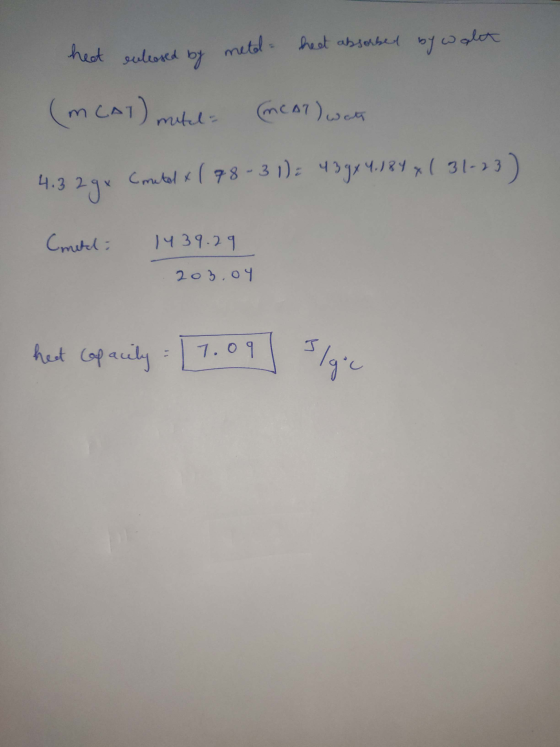
If you add a metal piece with a temperature of 78 0C and a mass of 4.32 g to 43 g of 23 0C water in a calorimeter that absorbs no heat, what is the heat capacity of the unknown metal piece in J/g 0C , if the final temperature of the aqueous solution is 31 0C ?
Homework Answers
Add Answer to:
If you add a metal piece with a temperature of 78 0C
and a mass of...
If you add a 950C gold piece with a mass of 2.34 g (c = 0.129...
If you add a 950C gold piece with a mass of 2.34 g (c = 0.129 J/g 0C) to 50 g of 22.20C water in a calorimeter that will absorb no heat. What is the final temperature of the water?
A 59.7 g piece of metal at an initial temperature of 100 0C is placed in...
A 59.7 g piece of metal at an initial temperature of 100 0C is placed in a calorimeter. The calorimeter contains 60 g of water at 22.0 °C. The final temperature is 28.5 °C. a) Identify the metal. b) Calculate the volume of metal.
A 29.3 g piece of metal is heated to 97 degree C and dropped into a...
 A 29.3 g piece of metal is heated to 97 degree C and dropped into a calorimeter containing 50.0 g of water (specific heat capacity of water is 4.18 J/g degree C) initially at 22.9 degree C. The empty calorimeter has a heat capacity of 125 J/K. the final temperature of the water is 25.96 degree C. Ignoring significant figures., calculate the specific heat of the metal. A) 0.481 J/gK. B) 0.361 J/gK C) 0.120 J/gK D) 0.300 J/gK E)...
A piece of metal of mass 35.0 g at 100.0°C was placed in 150.0 g of...
 A piece of metal of mass 35.0 g at 100.0°C was placed in 150.0 g of water at 20.0 °C. After stirring, the final temperature of the water and the metal is 23.8°C. What is the specific heat capacity of the metal? (specific heat capacity for H2O = 4.184 J/g °C) O-0.89 J 8°C 19.6 J/g °C 1.96J/g °C O 0.89 J/g °C
A piece of copper metal is initially at 83.0°C. It is dropped into a coffee cup...
 A piece of copper metal is initially at 83.0°C. It is dropped into a coffee cup calorimeter containing 30.0 9 of water at a temperature of 10.0°c. After stirring, the final temperature of both copper and water is 25.0°c. Assuming no heat losses, and that the specific heat (capacity) of water is 4.18 J/(g.), what is the heat capacity of the copper in J/K?
The temperature of a piece of silver (specific heat Sag = 0.031j/g.°C) with a mass of...
 The temperature of a piece of silver (specific heat Sag = 0.031j/g.°C) with a mass of 362 g decreased by 58 °C when it was added to a 98.56 g sample of water (specific heat of water Sw = 4.184 j/g °C) in a constant pressure calorimeter of negligible heat capacity. What is the final temperature of water if its initial temperature was 23.4 °C ?
structure.com/courses/1253444/quizzes/2442703/take Calculate the amount of heat water absorbs from a piece of hot metal using the...
 structure.com/courses/1253444/quizzes/2442703/take Calculate the amount of heat water absorbs from a piece of hot metal using the following data: 75.0 g of cold water is placed in a calorimeter. The initial temperature of the water is 21.2°C. To the calorimeter a 29.458 g piece of metal at 98.9 °C is added. The final temperature of the contents of the calorimeter is measured to be 29.5°C. (HINT: the specific heat of water is 4.184 ) heat absorbed by water = Knowing the...
A piece of aluminum (specific heat 0.910kJ/kg 0C) of mass 193g at 71 0C is dropped...
A piece of aluminum (specific heat 0.910kJ/kg 0C) of mass 193g at 71 0C is dropped into a Styrofoam cup filled with 121ml water at 20 0C. What are the final temperatures of the water and the aluminum? Please use C instead of 0C in your answer. Hint 1: because the cup is well-insulated, you can assume that all the heat leaving the aluminum as it cools goes to heating the water. Hint 2: How are the final temperature of...
Question 4 The aluminum cup inside your calorimeter weighs 41.55 g. You add 59.21 g of...
Question 4 The aluminum cup inside your calorimeter weighs 41.55 g. You add 59.21 g of 1.0 M acetic acid solution and 50.03 g of 1.0 M sodium hydroxide solution to the calorimeter. Both solutions have an initial temperature of 19.9 oC, and the final temperature after addition is 26.8 oC. What is the molar enthalpy of neutralization, in units of kJ/mol? Assume that: the calorimeter is completely insulated the heat capacity of the empty calorimeter is the heat capacity...
6. A piece of 155.0 g aluminium metal at 120°C was placed in a constant pressure...
 6. A piece of 155.0 g aluminium metal at 120°C was placed in a constant pressure calorimeter of negligible heat capacity containing 300.0 g of water at 20°C. Calculate the final temperature of the system (the aluminium metal and the water) in °C: given the specific heat of aluminium metal = 0.90 J/g °C, and that of water 4.184 J/g °C
 A 29.3 g piece of metal is heated to 97 degree C and dropped into a calorimeter containing 50.0 g of water (specific heat capacity of water is 4.18 J/g degree C) initially at 22.9 degree C. The empty calorimeter has a heat capacity of 125 J/K. the final temperature of the water is 25.96 degree C. Ignoring significant figures., calculate the specific heat of the metal. A) 0.481 J/gK. B) 0.361 J/gK C) 0.120 J/gK D) 0.300 J/gK E)...
 A piece of metal of mass 35.0 g at 100.0°C was placed in 150.0 g of water at 20.0 °C. After stirring, the final temperature of the water and the metal is 23.8°C. What is the specific heat capacity of the metal? (specific heat capacity for H2O = 4.184 J/g °C) O-0.89 J 8°C 19.6 J/g °C 1.96J/g °C O 0.89 J/g °C
 A piece of copper metal is initially at 83.0°C. It is dropped into a coffee cup calorimeter containing 30.0 9 of water at a temperature of 10.0°c. After stirring, the final temperature of both copper and water is 25.0°c. Assuming no heat losses, and that the specific heat (capacity) of water is 4.18 J/(g.), what is the heat capacity of the copper in J/K?
 The temperature of a piece of silver (specific heat Sag = 0.031j/g.°C) with a mass of 362 g decreased by 58 °C when it was added to a 98.56 g sample of water (specific heat of water Sw = 4.184 j/g °C) in a constant pressure calorimeter of negligible heat capacity. What is the final temperature of water if its initial temperature was 23.4 °C ?
 structure.com/courses/1253444/quizzes/2442703/take Calculate the amount of heat water absorbs from a piece of hot metal using the following data: 75.0 g of cold water is placed in a calorimeter. The initial temperature of the water is 21.2°C. To the calorimeter a 29.458 g piece of metal at 98.9 °C is added. The final temperature of the contents of the calorimeter is measured to be 29.5°C. (HINT: the specific heat of water is 4.184 ) heat absorbed by water = Knowing the...
 6. A piece of 155.0 g aluminium metal at 120°C was placed in a constant pressure calorimeter of negligible heat capacity containing 300.0 g of water at 20°C. Calculate the final temperature of the system (the aluminium metal and the water) in °C: given the specific heat of aluminium metal = 0.90 J/g °C, and that of water 4.184 J/g °C
Most questions answered within 3 hours.
-
Where is the error in this code sequence?
String s1 = "Hello";
String s2 = "ello";...
asked 11 months ago -
Financial data for Joel de Paris, Inc., for last year
follow:
Joel de Paris, Inc.
Balance...
asked 11 months ago -
Consider this reaction:
Al2(SO4)3 (aq)+ BaCl3
(aq) Al2Cl6 (aq)- +
3BaSO4(s) . What is the...
asked 11 months ago -
Suppose that Savneet is considering increasing her
recent random sample from 20 car rentals to 40...
asked 11 months ago -
Trucks arrive at an unloading terminal at an average rate of 120
per hour.
Trucks arrive...
asked 11 months ago -
Why are methanol and ethanol completely soluble in water while
octanol is not very little soluble....
asked 11 months ago -
A facilities manager at a university reads in a research report
that the mean amount of...
asked 11 months ago -
When the CuSO4 is rehydrated by adding water to the anhydrous
compound, is this an endothermic...
asked 11 months ago -
A ray of sunlight is passing from diamond into crown glass; the
angle of incidence is...
asked 11 months ago -
A block of mass 0.249 kg is placed on top of a light, vertical
spring of...
asked 11 months ago -
how do the kidneys compensate in the presences of acidosis
a) trigger hyperventilate
b) reserve acid...
asked 11 months ago -
Question 501 pts
The rental rate of capital to the firm increases. Which of the
following...
asked 11 months ago