
Homework Answers

Add Answer to:
Question 10 Calculate the ppm value of a peak that appears at 300 Hz on a...
2. (1 point) Given the chemical shift (in ppm) and the instrument frequency calculate the shift from TMS in Hz. a....
 2. (1 point) Given the chemical shift (in ppm) and the instrument frequency calculate the shift from TMS in Hz. a. CHg (600 MHz instrument); 6 = 2.7 b. C14H14 (300 MHz instrument); 6 = 7.1
Question 1 of 40 Incorrect X IncorrectX AH NMR signal is observed at 181.0 Hz (downfield...
 Question 1 of 40 Incorrect X IncorrectX AH NMR signal is observed at 181.0 Hz (downfield of TMS) on a 125-MHz instrument. Map a) What is the observed chemical shift in parts per million (ppm)? Number 1.448 ppm b) What is the chemical shift, in parts per million (ppm), if the sample is analyzed with a 200.0-MHz instrument? Number 9.05 x 10 ppm c) Where will the proton signal appear, in hertz, if the sample is analyzed with a 200.0-MHz...
The clock rate of a counter is fo = 10 MHz, its relative error is ho = 10 ppm. The capacity of th...
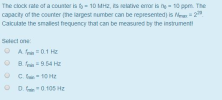 The clock rate of a counter is fo = 10 MHz, its relative error is ho = 10 ppm. The capacity of the counter (the largest number can be represented) is Nmax 220 Calculate the smallest frequency that can be measured by the instrument! Select one: OA. min 0.1 Hz B min 9.54 Hz C.fmin = 10 Hz D.in 0.105 Hz O
The clock rate of a counter is fo = 10 MHz, its relative error is ho = 10...
The clock rate of a counter is fo = 10 MHz, its relative error is ho = 10 ppm. The capacity of the counter (the largest number can be represented) is Nmax 220 Calculate the smallest frequency that can be measured by the instrument! Select one: OA. min 0.1 Hz B min 9.54 Hz C.fmin = 10 Hz D.in 0.105 Hz O
The clock rate of a counter is fo = 10 MHz, its relative error is ho = 10...
4. Using a 100 MHz 1H-NMR spectrometer, a chemist observes a doublet (J-7.00 Hz) at δ 2.00 a) How many hertz from the TMS peak is this absorption? Enter a number with 3 significant figures b) Where w...
 4. Using a 100 MHz 1H-NMR spectrometer, a chemist observes a doublet (J-7.00 Hz) at δ 2.00 a) How many hertz from the TMS peak is this absorption? Enter a number with 3 significant figures b) Where would this peak be located (in ppm) if a 300 MHz 'H-NMR spectrometer is used? Enter a number with 3 significant figures c) Where would this peak be located (in hertz) if a 300 MHz 'H-NMR spectrometer is used? Enter a number with...
3. (1 point) Given the shift from TMS in Hz and the instrument frequency calculate the...
 3. (1 point) Given the shift from TMS in Hz and the instrument frequency calculate the chemical shift, 6, in ppm. a. CH2Cl2 (200 MHz instrument); shift = 1060 Hz b. CHOH (500 MHz instrument); shift = 1730Hz
27.A 300-MHz spectrometer records a proton at 1500 Hz downfield from TMS. Calculate the chemical shift...
 27.A 300-MHz spectrometer records a proton at 1500 Hz downfield from TMS. Calculate the chemical shift in 8 (or ppm). a. 108 & (ppm) b. 88 & (ppm) c. 350 S (ppm) d. 1500 8 (ppm) e. 58 (ppm) 28.Given the molecule below state if the indicated hydrogens below are: CH:CH-CH2C1 a. Unrelated b. homotopic c. enantiotopic d. diastereotopic e. only a and care correct 29. The H NMR signal of 3-methyl-2-butanolo (CH-CH(CH3)CH(OH)CH3) shows_signals: a. 7 b. 6
please help me figure out what the compound is. thanks MASS % of Base Peak 1387...
 please help me figure out what the compound is.
thanks
MASS % of Base Peak 1387 S47 677 957 123 50 60 70 80 90 100 110 120 130 140 awamp % Transmittance -2958 -2870 -16701 -13811 -1246 -903 STS TTT 4000 3000 1000 2000 Wavenumber (cm-') 'H NMR 300 MHz N 1750 1740 Hz 640 Hz 570 560 Hz 300 290 Hz 6.0 5.5 5.0 4.5 4.0 3.5 3.0 2.5 2.0 1.5 ppm 13C/DEPT NMR 75.5 MHz 200 180...
please help me figure out what the compound is.
thanks
MASS % of Base Peak 1387 S47 677 957 123 50 60 70 80 90 100 110 120 130 140 awamp % Transmittance -2958 -2870 -16701 -13811 -1246 -903 STS TTT 4000 3000 1000 2000 Wavenumber (cm-') 'H NMR 300 MHz N 1750 1740 Hz 640 Hz 570 560 Hz 300 290 Hz 6.0 5.5 5.0 4.5 4.0 3.5 3.0 2.5 2.0 1.5 ppm 13C/DEPT NMR 75.5 MHz 200 180...
A H NMR signal is observed at 164.0 Hz (downfield of TMS) on a 1.10 *...
 A H NMR signal is observed at 164.0 Hz (downfield of TMS) on a 1.10 * 102-MHz instrument. a) What is the observed chemical shift in parts per million (ppm)? Number O ppm 200 Omi instrument? b) What is the chemical shift, in parts per million (ppm), if the sample is analyzed with a 300.0-MHz instrument? Number ppm 10 c) Where will the proton signal appear, in hertz, if the sample is analyzed with a 300.0-MHz instrument? Number
QUESTION 3 If a CH3 proton appears in NMR spectroscopy at 1.2 kHz in a 600...
 QUESTION 3 If a CH3 proton appears in NMR spectroscopy at 1.2 kHz in a 600 MHz instrument, where would this signal appear in parts per million (ppm) scale? 0.002 ppm 0.5 ppm 2 ppm 5 ppm QUESTION 5 Predict the NMR spectrum of the following compound: на H2 Hз -NO2 H1 no H1 H2 H3 Hj shows triplet near 1.0 ppm, H2 shows multiplet near 2.0 ppm, H3 shows triplet near 4.5 ppm Hy shows triplet near 1.0 ppm,...
please help me figure out what the compound is. thanks MASS % of Base Peak 1267...
 please help me figure out what the compound is.
thanks
MASS % of Base Peak 1267 TITTI 60 70 80 90 100 110 20 m/z % Transmittance -3344 2958 -2931 2873 -1466L JIEEI- -849 4000 3000 1000 2000 Wavenumber (cm-?) 'H NMR 300 MHZ 3.5 3.0 2.5 1.5 10 ppm 13C/DEPT NMR 75.5 MHz 84 82 80 78 ppm 85 80 75 70 65 60 55 50 45 40 35 30 25 20 ppm
please help me figure out what the compound is.
thanks
MASS % of Base Peak 1267 TITTI 60 70 80 90 100 110 20 m/z % Transmittance -3344 2958 -2931 2873 -1466L JIEEI- -849 4000 3000 1000 2000 Wavenumber (cm-?) 'H NMR 300 MHZ 3.5 3.0 2.5 1.5 10 ppm 13C/DEPT NMR 75.5 MHz 84 82 80 78 ppm 85 80 75 70 65 60 55 50 45 40 35 30 25 20 ppm
 2. (1 point) Given the chemical shift (in ppm) and the instrument frequency calculate the shift from TMS in Hz. a. CHg (600 MHz instrument); 6 = 2.7 b. C14H14 (300 MHz instrument); 6 = 7.1
 Question 1 of 40 Incorrect X IncorrectX AH NMR signal is observed at 181.0 Hz (downfield of TMS) on a 125-MHz instrument. Map a) What is the observed chemical shift in parts per million (ppm)? Number 1.448 ppm b) What is the chemical shift, in parts per million (ppm), if the sample is analyzed with a 200.0-MHz instrument? Number 9.05 x 10 ppm c) Where will the proton signal appear, in hertz, if the sample is analyzed with a 200.0-MHz...
 The clock rate of a counter is fo = 10 MHz, its relative error is ho = 10 ppm. The capacity of the counter (the largest number can be represented) is Nmax 220 Calculate the smallest frequency that can be measured by the instrument! Select one: OA. min 0.1 Hz B min 9.54 Hz C.fmin = 10 Hz D.in 0.105 Hz O
The clock rate of a counter is fo = 10 MHz, its relative error is ho = 10...
The clock rate of a counter is fo = 10 MHz, its relative error is ho = 10 ppm. The capacity of the counter (the largest number can be represented) is Nmax 220 Calculate the smallest frequency that can be measured by the instrument! Select one: OA. min 0.1 Hz B min 9.54 Hz C.fmin = 10 Hz D.in 0.105 Hz O
The clock rate of a counter is fo = 10 MHz, its relative error is ho = 10...
 4. Using a 100 MHz 1H-NMR spectrometer, a chemist observes a doublet (J-7.00 Hz) at δ 2.00 a) How many hertz from the TMS peak is this absorption? Enter a number with 3 significant figures b) Where would this peak be located (in ppm) if a 300 MHz 'H-NMR spectrometer is used? Enter a number with 3 significant figures c) Where would this peak be located (in hertz) if a 300 MHz 'H-NMR spectrometer is used? Enter a number with...
 3. (1 point) Given the shift from TMS in Hz and the instrument frequency calculate the chemical shift, 6, in ppm. a. CH2Cl2 (200 MHz instrument); shift = 1060 Hz b. CHOH (500 MHz instrument); shift = 1730Hz
 27.A 300-MHz spectrometer records a proton at 1500 Hz downfield from TMS. Calculate the chemical shift in 8 (or ppm). a. 108 & (ppm) b. 88 & (ppm) c. 350 S (ppm) d. 1500 8 (ppm) e. 58 (ppm) 28.Given the molecule below state if the indicated hydrogens below are: CH:CH-CH2C1 a. Unrelated b. homotopic c. enantiotopic d. diastereotopic e. only a and care correct 29. The H NMR signal of 3-methyl-2-butanolo (CH-CH(CH3)CH(OH)CH3) shows_signals: a. 7 b. 6
 please help me figure out what the compound is.
thanks
MASS % of Base Peak 1387 S47 677 957 123 50 60 70 80 90 100 110 120 130 140 awamp % Transmittance -2958 -2870 -16701 -13811 -1246 -903 STS TTT 4000 3000 1000 2000 Wavenumber (cm-') 'H NMR 300 MHz N 1750 1740 Hz 640 Hz 570 560 Hz 300 290 Hz 6.0 5.5 5.0 4.5 4.0 3.5 3.0 2.5 2.0 1.5 ppm 13C/DEPT NMR 75.5 MHz 200 180...
please help me figure out what the compound is.
thanks
MASS % of Base Peak 1387 S47 677 957 123 50 60 70 80 90 100 110 120 130 140 awamp % Transmittance -2958 -2870 -16701 -13811 -1246 -903 STS TTT 4000 3000 1000 2000 Wavenumber (cm-') 'H NMR 300 MHz N 1750 1740 Hz 640 Hz 570 560 Hz 300 290 Hz 6.0 5.5 5.0 4.5 4.0 3.5 3.0 2.5 2.0 1.5 ppm 13C/DEPT NMR 75.5 MHz 200 180...
 A H NMR signal is observed at 164.0 Hz (downfield of TMS) on a 1.10 * 102-MHz instrument. a) What is the observed chemical shift in parts per million (ppm)? Number O ppm 200 Omi instrument? b) What is the chemical shift, in parts per million (ppm), if the sample is analyzed with a 300.0-MHz instrument? Number ppm 10 c) Where will the proton signal appear, in hertz, if the sample is analyzed with a 300.0-MHz instrument? Number
 QUESTION 3 If a CH3 proton appears in NMR spectroscopy at 1.2 kHz in a 600 MHz instrument, where would this signal appear in parts per million (ppm) scale? 0.002 ppm 0.5 ppm 2 ppm 5 ppm QUESTION 5 Predict the NMR spectrum of the following compound: на H2 Hз -NO2 H1 no H1 H2 H3 Hj shows triplet near 1.0 ppm, H2 shows multiplet near 2.0 ppm, H3 shows triplet near 4.5 ppm Hy shows triplet near 1.0 ppm,...
 please help me figure out what the compound is.
thanks
MASS % of Base Peak 1267 TITTI 60 70 80 90 100 110 20 m/z % Transmittance -3344 2958 -2931 2873 -1466L JIEEI- -849 4000 3000 1000 2000 Wavenumber (cm-?) 'H NMR 300 MHZ 3.5 3.0 2.5 1.5 10 ppm 13C/DEPT NMR 75.5 MHz 84 82 80 78 ppm 85 80 75 70 65 60 55 50 45 40 35 30 25 20 ppm
please help me figure out what the compound is.
thanks
MASS % of Base Peak 1267 TITTI 60 70 80 90 100 110 20 m/z % Transmittance -3344 2958 -2931 2873 -1466L JIEEI- -849 4000 3000 1000 2000 Wavenumber (cm-?) 'H NMR 300 MHZ 3.5 3.0 2.5 1.5 10 ppm 13C/DEPT NMR 75.5 MHz 84 82 80 78 ppm 85 80 75 70 65 60 55 50 45 40 35 30 25 20 ppm
Most questions answered within 3 hours.
-
Where is the error in this code sequence?
String s1 = "Hello";
String s2 = "ello";...
asked 11 months ago -
Financial data for Joel de Paris, Inc., for last year
follow:
Joel de Paris, Inc.
Balance...
asked 10 months ago -
Consider this reaction:
Al2(SO4)3 (aq)+ BaCl3
(aq) Al2Cl6 (aq)- +
3BaSO4(s) . What is the...
asked 11 months ago -
Suppose that Savneet is considering increasing her
recent random sample from 20 car rentals to 40...
asked 11 months ago -
Trucks arrive at an unloading terminal at an average rate of 120
per hour.
Trucks arrive...
asked 11 months ago -
Why are methanol and ethanol completely soluble in water while
octanol is not very little soluble....
asked 11 months ago -
A facilities manager at a university reads in a research report
that the mean amount of...
asked 11 months ago -
When the CuSO4 is rehydrated by adding water to the anhydrous
compound, is this an endothermic...
asked 11 months ago -
A ray of sunlight is passing from diamond into crown glass; the
angle of incidence is...
asked 11 months ago -
A block of mass 0.249 kg is placed on top of a light, vertical
spring of...
asked 11 months ago -
how do the kidneys compensate in the presences of acidosis
a) trigger hyperventilate
b) reserve acid...
asked 11 months ago -
Question 501 pts
The rental rate of capital to the firm increases. Which of the
following...
asked 11 months ago