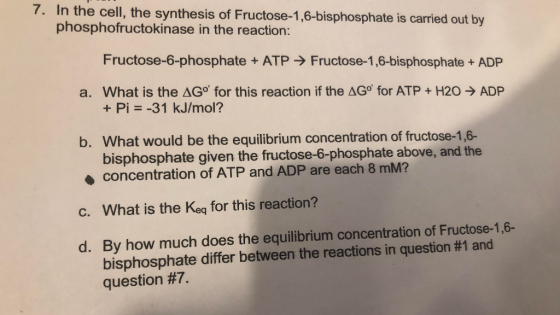
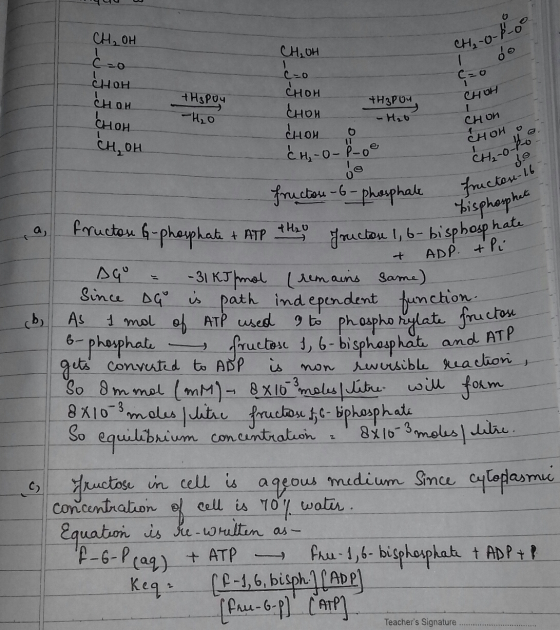
Please help me with number 7! If there is not enough information, please tell me what it needed so that I may add it. I do not need part d. All I I need is part a, b, and c.
Homework Answers
Add Answer to:
Please help me with number 7! If there is not enough
information, please tell me what...
Question 4 Q . OH ATP OH POH ОН Fructose 6-phosphate Fructose 1.6-bisphosphate Figure 1. Reaction...
 Question 4 Q . OH ATP OH POH ОН Fructose 6-phosphate Fructose 1.6-bisphosphate Figure 1. Reaction catalyzed by phosphofructokinase (PFK) during glycolysis Phosphofructokinase (PFK) is an enzyme that catalyzes the conversion of fructose 6- phosphate to fructose 1,6-bisphosphate during glycolysis, as represented in Figure 1. PFK can be allosterically inhibited by ATP at high concentrations. Which of the following is the benefit of regulating glycolysis by the concentration of ATP? Glycolysis proceeds when the intracellular concentration of ATP is low,...
please explain answer Glycolysis. In the third step of glycolysis, the enzyme phosphofructokinase transfers a phosphate...
 please explain answer
Glycolysis. In the third step of glycolysis, the enzyme phosphofructokinase transfers a phosphate group from ATP to fructose-6-phophate to generate fructose- 1,6- bisphosphate. In contrast, in step 10, the enzyme pyruvate kinase transfers a phosphate group from phosphoenolpyruvate to ADP to generate ATP. Using what you know about the standard free energy change associated with phosphate bonds, (briefly) explain why we observe this difference.
please explain answer
Glycolysis. In the third step of glycolysis, the enzyme phosphofructokinase transfers a phosphate group from ATP to fructose-6-phophate to generate fructose- 1,6- bisphosphate. In contrast, in step 10, the enzyme pyruvate kinase transfers a phosphate group from phosphoenolpyruvate to ADP to generate ATP. Using what you know about the standard free energy change associated with phosphate bonds, (briefly) explain why we observe this difference.
A highly regulated reaction in glycolysis involves the addition of a second phosphate to fructose-6-phosphate, which...
 A highly regulated reaction in glycolysis involves the addition
of a second phosphate to fructose-6-phosphate, which could be be
written as:
Fructose-6-phostphate + Pi à Fructose-1,6-bisphosphate + H2O
The ∆Go’ for this reaction is +16.8 kJ/mol
In a muscle cell at 37 oC, assume the concentration of
Fructose-6phosphate is 0.014 mM and the concentration of phosphate
is 1 mM.
a. What would be the equilibrium concentration of
fructose-1,6bisphosphate under these conditions?
b. What is Keq for this reaction?
Show...
A highly regulated reaction in glycolysis involves the addition
of a second phosphate to fructose-6-phosphate, which could be be
written as:
Fructose-6-phostphate + Pi à Fructose-1,6-bisphosphate + H2O
The ∆Go’ for this reaction is +16.8 kJ/mol
In a muscle cell at 37 oC, assume the concentration of
Fructose-6phosphate is 0.014 mM and the concentration of phosphate
is 1 mM.
a. What would be the equilibrium concentration of
fructose-1,6bisphosphate under these conditions?
b. What is Keq for this reaction?
Show...
and Q. Many metabolites are maintained at steady-state concentrations that are far from equilibrium. A comparison...
 and Q. Many metabolites are maintained at steady-state concentrations that are far from equilibrium. A comparison of K the mass-action ratio, can determine whether a metabolic reaction is far from equilibrium. The equation for this equilibrium is, fructose 6-phosphate + ATP fructose 1,6-bisphosphate + ADP Calculate for this reaction at T = 25.0°C. AG = -14.2 kJ/mol K Calculate the mass-action ratio, Q. from the approximate physiological concentrations for rat heart tissue shown in the table. Q Metabolite fructose 6-phosphate...
Can i Get some help on these questions? For each of the following questions, show all...
 Can i Get some help on these questions?
For each of the following questions, show all work 7. Phosphofructokinase reaction The main control step of glycolysis synthesizes fructose-1,6-bisphosphate (F1,6BP) using the enzyme a) phosphofructokinase. The AG°* for this reaction is -17.2 kJ/mol. Based on this standard state free energy, which of the following is true? OKeg 1 OKeq1 O Keg 1 b) Using the AG°" for this reaction and the phosphate hydrolysis standard state free energy changes found in Table...
Can i Get some help on these questions?
For each of the following questions, show all work 7. Phosphofructokinase reaction The main control step of glycolysis synthesizes fructose-1,6-bisphosphate (F1,6BP) using the enzyme a) phosphofructokinase. The AG°* for this reaction is -17.2 kJ/mol. Based on this standard state free energy, which of the following is true? OKeg 1 OKeq1 O Keg 1 b) Using the AG°" for this reaction and the phosphate hydrolysis standard state free energy changes found in Table...
Please help me with ALL of these questions. Thank you so much Question 13 0.4 pts...
 Please help me with ALL of these questions. Thank you so
much
Question 13 0.4 pts For each two carbon molecule (i.e., acetyl) that enters the citric acid cycle, how many molecules of waste CO2 are produced? 0 0 0 0 0 3 Question 14 0.4 pts Which stage of respiration reduces the most electron carriers? citric acid cycle glycolysis acetyl-CoA synthesis Question 16 0.3 pts How is a Carbon atom oxidized during a redox reaction if it has the...
Please help me with ALL of these questions. Thank you so
much
Question 13 0.4 pts For each two carbon molecule (i.e., acetyl) that enters the citric acid cycle, how many molecules of waste CO2 are produced? 0 0 0 0 0 3 Question 14 0.4 pts Which stage of respiration reduces the most electron carriers? citric acid cycle glycolysis acetyl-CoA synthesis Question 16 0.3 pts How is a Carbon atom oxidized during a redox reaction if it has the...
Please answer the question. Please write neatly and also make sure you answer is correct! Thank...
 Please answer the question. Please write neatly and also make
sure you answer is correct! Thank you! If you do not know the
answer to a part, please don’t answer it! I will rate good! Also
please fill in the blank followed by the letter choice.
7. (8 pts) Complete the following statements about glycolysis using terms from the list below. Four of these will not be used. 3-phosphoglycerate aldolase dihydroxyacetone phosphate enolase fructose 1,6-bisphosphate glyceraldehyde 3-phosphate lactate oxidative pyruvate...
Please answer the question. Please write neatly and also make
sure you answer is correct! Thank you! If you do not know the
answer to a part, please don’t answer it! I will rate good! Also
please fill in the blank followed by the letter choice.
7. (8 pts) Complete the following statements about glycolysis using terms from the list below. Four of these will not be used. 3-phosphoglycerate aldolase dihydroxyacetone phosphate enolase fructose 1,6-bisphosphate glyceraldehyde 3-phosphate lactate oxidative pyruvate...
Tautomerization of enolpyruvate to pyruvate occurs in step 10 of glycolysis. If DG°’ = -46 kJ/mol,...
Tautomerization of enolpyruvate to pyruvate occurs in step 10 of glycolysis. If DG°’ = -46 kJ/mol, what is the ratio of pyruvate to enolpyruvate at equilibrium? Steady-State Concentrations of Glycolytic Metabolites in Erythrocytes Metabolite mM Glucose 5.0 Glucose-6-phosphate 0.083 Fructose-6-phosphate 0.014 Fructose-1,6-bisphosphate 0.031 Dihydroxyacetone phosphate 0.14 Glyceraldehyde-3-phosphate 0.019 1,3-Bisphosphoglycerate 0.001 3-Phosphoglycerate 0.12 2-Phosphoglycerate 0.030 Phosphoenolpyruvate 0.023 Pyruvate 0.051 Lactate 2.9 ATP 1.85 ADP 0.14 Pi 1.0
need help with these two questions please A chemist optimizes a chemical reaction such that product...
 need help with these two questions please
A chemist optimizes a chemical reaction such that product concentration exceeds the concentration of the reactants. What conclusion can be drawn about Keq and A G' in this reaction? Keq=1, AG=0 K'eq=1, AG"">0 Keq>1, AGO <O Keq>1, AGC > Question 6 1 pts According to data in Table 13-6 of your textbook, which of the following reactions should be spontaneous under standard conditions? Phosphocreatine + pyruvate --> phosphoenol pyruvate + creatine Glucose-3-phosphate +...
need help with these two questions please
A chemist optimizes a chemical reaction such that product concentration exceeds the concentration of the reactants. What conclusion can be drawn about Keq and A G' in this reaction? Keq=1, AG=0 K'eq=1, AG"">0 Keq>1, AGO <O Keq>1, AGC > Question 6 1 pts According to data in Table 13-6 of your textbook, which of the following reactions should be spontaneous under standard conditions? Phosphocreatine + pyruvate --> phosphoenol pyruvate + creatine Glucose-3-phosphate +...
Below are listed some steady-state concentrations of the intermediates of glycolysis in the human erythrocyte. Very...
 Below are listed some steady-state concentrations of the intermediates of glycolysis in the human erythrocyte. Very careful measurements suggest the pH of the cytosol of a "resting" human erythrocyte is about 7.25. What is the value of G for phosphofructokinase (K.,-310 @ 37 C- З 10 К; see page 484 of your text for the reaction) İn the human (T = 37 C-3 10 K) erythrocyte given these data? (Hint: I'm askingfor the value o/1G (no△C")) (6 pts) 1. glucose...
 Question 4 Q . OH ATP OH POH ОН Fructose 6-phosphate Fructose 1.6-bisphosphate Figure 1. Reaction catalyzed by phosphofructokinase (PFK) during glycolysis Phosphofructokinase (PFK) is an enzyme that catalyzes the conversion of fructose 6- phosphate to fructose 1,6-bisphosphate during glycolysis, as represented in Figure 1. PFK can be allosterically inhibited by ATP at high concentrations. Which of the following is the benefit of regulating glycolysis by the concentration of ATP? Glycolysis proceeds when the intracellular concentration of ATP is low,...
 please explain answer
Glycolysis. In the third step of glycolysis, the enzyme phosphofructokinase transfers a phosphate group from ATP to fructose-6-phophate to generate fructose- 1,6- bisphosphate. In contrast, in step 10, the enzyme pyruvate kinase transfers a phosphate group from phosphoenolpyruvate to ADP to generate ATP. Using what you know about the standard free energy change associated with phosphate bonds, (briefly) explain why we observe this difference.
please explain answer
Glycolysis. In the third step of glycolysis, the enzyme phosphofructokinase transfers a phosphate group from ATP to fructose-6-phophate to generate fructose- 1,6- bisphosphate. In contrast, in step 10, the enzyme pyruvate kinase transfers a phosphate group from phosphoenolpyruvate to ADP to generate ATP. Using what you know about the standard free energy change associated with phosphate bonds, (briefly) explain why we observe this difference.
 A highly regulated reaction in glycolysis involves the addition
of a second phosphate to fructose-6-phosphate, which could be be
written as:
Fructose-6-phostphate + Pi à Fructose-1,6-bisphosphate + H2O
The ∆Go’ for this reaction is +16.8 kJ/mol
In a muscle cell at 37 oC, assume the concentration of
Fructose-6phosphate is 0.014 mM and the concentration of phosphate
is 1 mM.
a. What would be the equilibrium concentration of
fructose-1,6bisphosphate under these conditions?
b. What is Keq for this reaction?
Show...
A highly regulated reaction in glycolysis involves the addition
of a second phosphate to fructose-6-phosphate, which could be be
written as:
Fructose-6-phostphate + Pi à Fructose-1,6-bisphosphate + H2O
The ∆Go’ for this reaction is +16.8 kJ/mol
In a muscle cell at 37 oC, assume the concentration of
Fructose-6phosphate is 0.014 mM and the concentration of phosphate
is 1 mM.
a. What would be the equilibrium concentration of
fructose-1,6bisphosphate under these conditions?
b. What is Keq for this reaction?
Show...
 and Q. Many metabolites are maintained at steady-state concentrations that are far from equilibrium. A comparison of K the mass-action ratio, can determine whether a metabolic reaction is far from equilibrium. The equation for this equilibrium is, fructose 6-phosphate + ATP fructose 1,6-bisphosphate + ADP Calculate for this reaction at T = 25.0°C. AG = -14.2 kJ/mol K Calculate the mass-action ratio, Q. from the approximate physiological concentrations for rat heart tissue shown in the table. Q Metabolite fructose 6-phosphate...
 Can i Get some help on these questions?
For each of the following questions, show all work 7. Phosphofructokinase reaction The main control step of glycolysis synthesizes fructose-1,6-bisphosphate (F1,6BP) using the enzyme a) phosphofructokinase. The AG°* for this reaction is -17.2 kJ/mol. Based on this standard state free energy, which of the following is true? OKeg 1 OKeq1 O Keg 1 b) Using the AG°" for this reaction and the phosphate hydrolysis standard state free energy changes found in Table...
Can i Get some help on these questions?
For each of the following questions, show all work 7. Phosphofructokinase reaction The main control step of glycolysis synthesizes fructose-1,6-bisphosphate (F1,6BP) using the enzyme a) phosphofructokinase. The AG°* for this reaction is -17.2 kJ/mol. Based on this standard state free energy, which of the following is true? OKeg 1 OKeq1 O Keg 1 b) Using the AG°" for this reaction and the phosphate hydrolysis standard state free energy changes found in Table...
 Please help me with ALL of these questions. Thank you so
much
Question 13 0.4 pts For each two carbon molecule (i.e., acetyl) that enters the citric acid cycle, how many molecules of waste CO2 are produced? 0 0 0 0 0 3 Question 14 0.4 pts Which stage of respiration reduces the most electron carriers? citric acid cycle glycolysis acetyl-CoA synthesis Question 16 0.3 pts How is a Carbon atom oxidized during a redox reaction if it has the...
Please help me with ALL of these questions. Thank you so
much
Question 13 0.4 pts For each two carbon molecule (i.e., acetyl) that enters the citric acid cycle, how many molecules of waste CO2 are produced? 0 0 0 0 0 3 Question 14 0.4 pts Which stage of respiration reduces the most electron carriers? citric acid cycle glycolysis acetyl-CoA synthesis Question 16 0.3 pts How is a Carbon atom oxidized during a redox reaction if it has the...
 Please answer the question. Please write neatly and also make
sure you answer is correct! Thank you! If you do not know the
answer to a part, please don’t answer it! I will rate good! Also
please fill in the blank followed by the letter choice.
7. (8 pts) Complete the following statements about glycolysis using terms from the list below. Four of these will not be used. 3-phosphoglycerate aldolase dihydroxyacetone phosphate enolase fructose 1,6-bisphosphate glyceraldehyde 3-phosphate lactate oxidative pyruvate...
Please answer the question. Please write neatly and also make
sure you answer is correct! Thank you! If you do not know the
answer to a part, please don’t answer it! I will rate good! Also
please fill in the blank followed by the letter choice.
7. (8 pts) Complete the following statements about glycolysis using terms from the list below. Four of these will not be used. 3-phosphoglycerate aldolase dihydroxyacetone phosphate enolase fructose 1,6-bisphosphate glyceraldehyde 3-phosphate lactate oxidative pyruvate...
 need help with these two questions please
A chemist optimizes a chemical reaction such that product concentration exceeds the concentration of the reactants. What conclusion can be drawn about Keq and A G' in this reaction? Keq=1, AG=0 K'eq=1, AG"">0 Keq>1, AGO <O Keq>1, AGC > Question 6 1 pts According to data in Table 13-6 of your textbook, which of the following reactions should be spontaneous under standard conditions? Phosphocreatine + pyruvate --> phosphoenol pyruvate + creatine Glucose-3-phosphate +...
need help with these two questions please
A chemist optimizes a chemical reaction such that product concentration exceeds the concentration of the reactants. What conclusion can be drawn about Keq and A G' in this reaction? Keq=1, AG=0 K'eq=1, AG"">0 Keq>1, AGO <O Keq>1, AGC > Question 6 1 pts According to data in Table 13-6 of your textbook, which of the following reactions should be spontaneous under standard conditions? Phosphocreatine + pyruvate --> phosphoenol pyruvate + creatine Glucose-3-phosphate +...
 Below are listed some steady-state concentrations of the intermediates of glycolysis in the human erythrocyte. Very careful measurements suggest the pH of the cytosol of a "resting" human erythrocyte is about 7.25. What is the value of G for phosphofructokinase (K.,-310 @ 37 C- З 10 К; see page 484 of your text for the reaction) İn the human (T = 37 C-3 10 K) erythrocyte given these data? (Hint: I'm askingfor the value o/1G (no△C")) (6 pts) 1. glucose...
Most questions answered within 3 hours.
-
Where is the error in this code sequence?
String s1 = "Hello";
String s2 = "ello";...
asked 10 months ago -
Financial data for Joel de Paris, Inc., for last year
follow:
Joel de Paris, Inc.
Balance...
asked 10 months ago -
Consider this reaction:
Al2(SO4)3 (aq)+ BaCl3
(aq) Al2Cl6 (aq)- +
3BaSO4(s) . What is the...
asked 10 months ago -
Suppose that Savneet is considering increasing her
recent random sample from 20 car rentals to 40...
asked 10 months ago -
Trucks arrive at an unloading terminal at an average rate of 120
per hour.
Trucks arrive...
asked 10 months ago -
Why are methanol and ethanol completely soluble in water while
octanol is not very little soluble....
asked 10 months ago -
A facilities manager at a university reads in a research report
that the mean amount of...
asked 10 months ago -
When the CuSO4 is rehydrated by adding water to the anhydrous
compound, is this an endothermic...
asked 10 months ago -
A ray of sunlight is passing from diamond into crown glass; the
angle of incidence is...
asked 10 months ago -
A block of mass 0.249 kg is placed on top of a light, vertical
spring of...
asked 10 months ago -
how do the kidneys compensate in the presences of acidosis
a) trigger hyperventilate
b) reserve acid...
asked 10 months ago -
Question 501 pts
The rental rate of capital to the firm increases. Which of the
following...
asked 10 months ago