


Homework Answers
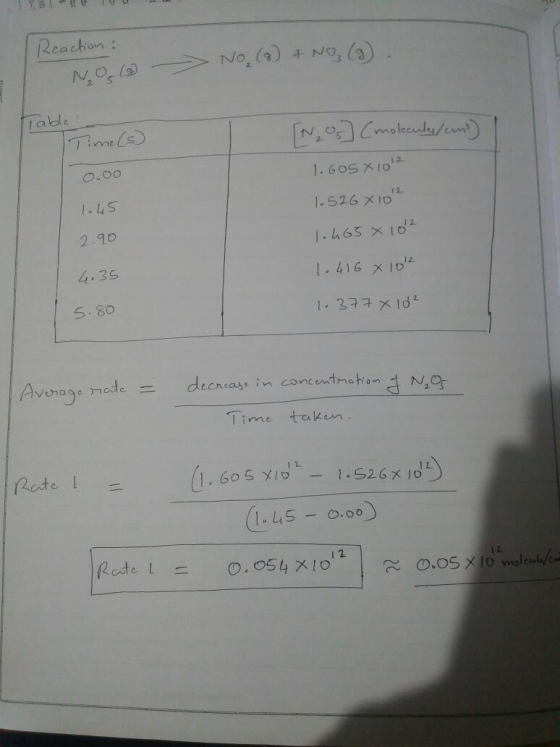
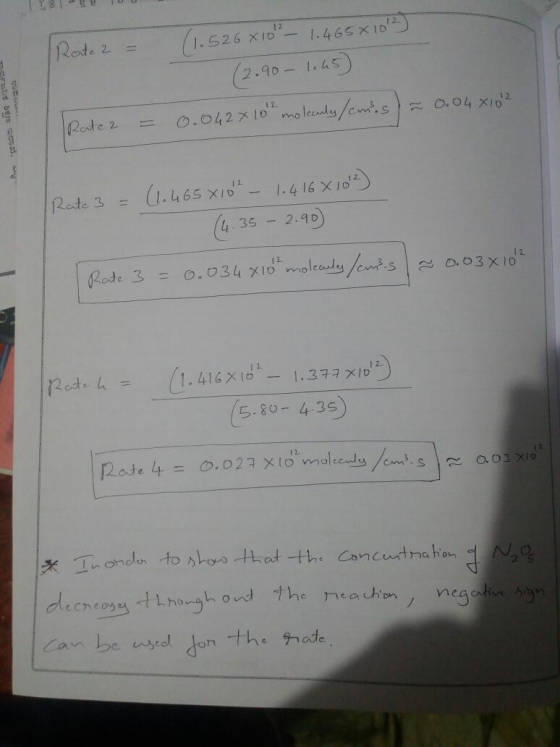
in the above question, it is asked to determine the average rate for the decomposition reaction of N2O5
in the table the time taken for the decomposition is given in the intervals of 1.45sec and the corresponding concentration of N2O5 is also given.
the average rate can be defined as the ratio of the change in the concentration of the chemical substance to the time taken .
that is, average rate = ( change in concentration of chemical substance ) / time taken
in this case , average rate = (decrease in concentration of N2O5) / time taken
Add Answer to:
02 Question (4 points) Dinitrogen pentoxide (N2O) decomposes as follows to nitrogen dioxide and nitrogen trioxide:...
02 Question (4 points) Dinitrogen pentoxide (N2Os) decomposes as follows to nitrogen dioxide and nitrogen trioxide:...
 02 Question (4 points) Dinitrogen pentoxide (N2Os) decomposes as follows to nitrogen dioxide and nitrogen trioxide: N,0(8) NO,(8) + NO3(8) Calculate the average rate of the reaction between consecutive measurement times in the following table. Time (s) [N,Os) (molecules/cm) 0.00 1.805x10¹² 1.65 1.728x10¹² 3.30 1.669x10¹² 1.622x10¹² 6.60 1.585x10¹² 4.95 Part 1 (1 point) Express every answer to two significant figures. Rate 1 = molecules/(cm’s) Part 2 (1 point) Rate 2 = molecules/cms) Part 3 (1 point) Rate 3 = molecules/(cms)...
Dinitrogen pentoxide (N205) decomposes as follows to nitrogen dioxide and nitrogen trioxide: N205(8) —NO2(g) +NO3(g) Calculate...
 Dinitrogen pentoxide (N205) decomposes as follows to nitrogen dioxide and nitrogen trioxide: N205(8) —NO2(g) +NO3(g) Calculate the average rate of the reaction between consecutive measurement times in the following table. Time (s) [N205] (molecules/cm3) 0.00 1.605x10¹² 1.35 1.521x10¹² 2.70 1.455x10¹² 4.05 1.401x10¹² 5.40 1.357x10¹² 3rd attempt Part 1 (1 point) Feedback See Periodic Table Express every answer to two significant figures. Rate 1 = 2.55 x 10 11 molecules/cms) Part 2 (1 point) * Feedback Rate 2 = molecules/(cmºs) Part...
02 Question (4 points) Dinitrogen pentoxide (N2Os) decomposes as follows to nitrogen dioxide and nitrogen trioxide:...
 02 Question (4 points) Dinitrogen pentoxide (N2Os) decomposes as follows to nitrogen dioxide and nitrogen trioxide: N,05(8) ► NO,(8) + NO,(8) Calculate the average rate of the reaction between consecutive measurement times in the following table. Time (s) IN 20s) (molecules/cm3) 0.00 1.405x10¹² 1.344x10¹² 1301x102 1270x102 1.249x10² IN E 1st attempt Part 1 (1 point) W See Pe Express every answer to two significant figures late 1 molecules/(cms) Part 2 (1 point) Rate 2- molecules (cm.) 1st attempt Part 1...
tried it twice and theyre both wrong :/ Dinitrogen pentoxide (N2O5) decomposes as follows to nitrogen...
 tried it twice and theyre both wrong :/
Dinitrogen pentoxide (N2O5) decomposes as follows to nitrogen dioxide and nitrogen trioxide: N205(8) —— NO2(g) + NO3 (8) Calculate the average rate of the reaction between consecutive measurement times in the following table. Time (s) [N205] (molecules/cm²) 0.00 1.705x10¹² 1.95 1.625x10¹² 3.90 1.563x10¹² 5.85 1.513x10¹² 7.80 1.473x10¹² Express every answer to two significant figures. Rate 1 = -1.7 x 10¹⁰ molecules/(cm3.s) Part 2 (1 point) & Feedback Rate 2 = -1.6 x...
tried it twice and theyre both wrong :/
Dinitrogen pentoxide (N2O5) decomposes as follows to nitrogen dioxide and nitrogen trioxide: N205(8) —— NO2(g) + NO3 (8) Calculate the average rate of the reaction between consecutive measurement times in the following table. Time (s) [N205] (molecules/cm²) 0.00 1.705x10¹² 1.95 1.625x10¹² 3.90 1.563x10¹² 5.85 1.513x10¹² 7.80 1.473x10¹² Express every answer to two significant figures. Rate 1 = -1.7 x 10¹⁰ molecules/(cm3.s) Part 2 (1 point) & Feedback Rate 2 = -1.6 x...
Dinitrogen pentoxide (N2O5) decomposes as follows to nitrogen dioxide and nitrogen trioxide: N,o,()NO,(g)-No, (g) Calculate the...
 Dinitrogen pentoxide (N2O5) decomposes as follows to nitrogen dioxide and nitrogen trioxide: N,o,()NO,(g)-No, (g) Calculate the average rate of the reaction between consecutive measurement times in the following table. Time (s) IN2O51 (molecules/cm2) 0.00 1.605x10¹² 1.25 1.529x10¹² 1.471x10¹² 2.50 3.75 1.425x10¹² 5,00 1.389x10¹² 1OF 14 OUreTIONE Tropospheric ozone is rapidly consumed in many reactions, including (o-(a)ON(a)oN- ()0 Use the following data to calculate the instantaneous rate of the preceding reaction at t 0.000s and t-0.0520 s Express your answers to...
Part 2 (1 point) Rate 2 = molecules/(cm3·s) Part 3 Rate 3 = molecules/(cm3·s) Part 4 Rate...
 Part 2 (1 point)
Rate 2 = molecules/(cm3·s)
Part 3
Rate 3 = molecules/(cm3·s)
Part 4
Rate 4 = molecules/(cm3·s)
@ See page 639 02 Question (4 points) Dinitrogen pentoxide (N2O5) decomposes as follows to nitrogen dioxide and nitrogen trioxide: N,93(g) — NO2(g) + NO3(g) Calculate the average rate of the reaction between consecutive measurement times in the following table. Time (s) [N2O5] (molecules/cm3) 0.00 1.505x10¹² 1.55 1.444x10¹² 3.10 1.401x10¹² 4.65 1.370x10¹² 1.349x10¹² 6.20 v 1st attempt Part 1 (1 point)...
Part 2 (1 point)
Rate 2 = molecules/(cm3·s)
Part 3
Rate 3 = molecules/(cm3·s)
Part 4
Rate 4 = molecules/(cm3·s)
@ See page 639 02 Question (4 points) Dinitrogen pentoxide (N2O5) decomposes as follows to nitrogen dioxide and nitrogen trioxide: N,93(g) — NO2(g) + NO3(g) Calculate the average rate of the reaction between consecutive measurement times in the following table. Time (s) [N2O5] (molecules/cm3) 0.00 1.505x10¹² 1.55 1.444x10¹² 3.10 1.401x10¹² 4.65 1.370x10¹² 1.349x10¹² 6.20 v 1st attempt Part 1 (1 point)...
Question 6 1 pts Dinitrogen pentoxide decomposes to nitrogen dioxide and oxygen, all species are gaseous....
 Question 6 1 pts Dinitrogen pentoxide decomposes to nitrogen dioxide and oxygen, all species are gaseous. Given 19.19 g of dinitrogen pentoxide, how many grams of oxygen will be produced when the reaction goes to completion? No new data to save. Last checked at 9:15am Submit Quiz
Question 6 1 pts Dinitrogen pentoxide decomposes to nitrogen dioxide and oxygen, all species are gaseous. Given 19.19 g of dinitrogen pentoxide, how many grams of oxygen will be produced when the reaction...
Question 6 1 pts Dinitrogen pentoxide decomposes to nitrogen dioxide and oxygen, all species are gaseous. Given 19.19 g of dinitrogen pentoxide, how many grams of oxygen will be produced when the reaction goes to completion? No new data to save. Last checked at 9:15am Submit Quiz
Question 6 1 pts Dinitrogen pentoxide decomposes to nitrogen dioxide and oxygen, all species are gaseous. Given 19.19 g of dinitrogen pentoxide, how many grams of oxygen will be produced when the reaction...
4) At elevated temperatures, dinitrogen pentoxide decomposes to nitrogen dioxide and oxygen: 2N2O3(g) - ANO, (2)...
 4) At elevated temperatures, dinitrogen pentoxide decomposes to nitrogen dioxide and oxygen: 2N2O3(g) - ANO, (2) + O2(g) Write the general rate expression using all chemical species: 5) Ar elevated temperatures, dinitrogen pentoxide decomposes to nitrogen dioxide and oxygen: 2N,Os(8) ANO, (g) + O, (g) When the rate of formation of NO, is 5.5 x 10-M/s, the rate of decomposition of No, is M/s. 6) . A[NH 1 = a[Nal = +2H2] = + Write the balanced equation for a...
Just need help with d[N2]/dt please 18.1 Nitrogen pentoxide (N205) gas decomposes according to the reaction...
 Just need help with d[N2]/dt please
18.1 Nitrogen pentoxide (N205) gas decomposes according to the reaction 2N2O5 = 4NO2 + O2 At 328 K, the rate of reaction v under certain conditions is 0.75 X 10⁻⁴ mol L-75-1. Assuming that none of the interme- diates have appreciable concentrations, what are the values of d[N2O5]/dt, d[N2]/dt, and d[02]/dt?
Just need help with d[N2]/dt please
18.1 Nitrogen pentoxide (N205) gas decomposes according to the reaction 2N2O5 = 4NO2 + O2 At 328 K, the rate of reaction v under certain conditions is 0.75 X 10⁻⁴ mol L-75-1. Assuming that none of the interme- diates have appreciable concentrations, what are the values of d[N2O5]/dt, d[N2]/dt, and d[02]/dt?
1A. The decomposition of dinitrogen pentoxide in carbon tetrachloride solution at 30 °C N2O5 2 NO2...
 1A. The decomposition of dinitrogen pentoxide in carbon
tetrachloride solution at 30 °C N2O5 2 NO2 + ½ O2 is first order in
N2O5 with a rate constant of 4.10×10⁻³ min-1. If the initial
concentration of N2O5 is 0.510 M, the concentration of N2O5 will be
M after 402 min h
1B. The gas phase decomposition of phosphine at 120 °C
PH3(g)1/4
P4(g) + 3/2 H2(g)
is first order in PH3
with a rate constant of 1.80×10⁻²
s-1.
If the...
1A. The decomposition of dinitrogen pentoxide in carbon
tetrachloride solution at 30 °C N2O5 2 NO2 + ½ O2 is first order in
N2O5 with a rate constant of 4.10×10⁻³ min-1. If the initial
concentration of N2O5 is 0.510 M, the concentration of N2O5 will be
M after 402 min h
1B. The gas phase decomposition of phosphine at 120 °C
PH3(g)1/4
P4(g) + 3/2 H2(g)
is first order in PH3
with a rate constant of 1.80×10⁻²
s-1.
If the...
 02 Question (4 points) Dinitrogen pentoxide (N2Os) decomposes as follows to nitrogen dioxide and nitrogen trioxide: N,0(8) NO,(8) + NO3(8) Calculate the average rate of the reaction between consecutive measurement times in the following table. Time (s) [N,Os) (molecules/cm) 0.00 1.805x10¹² 1.65 1.728x10¹² 3.30 1.669x10¹² 1.622x10¹² 6.60 1.585x10¹² 4.95 Part 1 (1 point) Express every answer to two significant figures. Rate 1 = molecules/(cm’s) Part 2 (1 point) Rate 2 = molecules/cms) Part 3 (1 point) Rate 3 = molecules/(cms)...
 Dinitrogen pentoxide (N205) decomposes as follows to nitrogen dioxide and nitrogen trioxide: N205(8) —NO2(g) +NO3(g) Calculate the average rate of the reaction between consecutive measurement times in the following table. Time (s) [N205] (molecules/cm3) 0.00 1.605x10¹² 1.35 1.521x10¹² 2.70 1.455x10¹² 4.05 1.401x10¹² 5.40 1.357x10¹² 3rd attempt Part 1 (1 point) Feedback See Periodic Table Express every answer to two significant figures. Rate 1 = 2.55 x 10 11 molecules/cms) Part 2 (1 point) * Feedback Rate 2 = molecules/(cmºs) Part...
 02 Question (4 points) Dinitrogen pentoxide (N2Os) decomposes as follows to nitrogen dioxide and nitrogen trioxide: N,05(8) ► NO,(8) + NO,(8) Calculate the average rate of the reaction between consecutive measurement times in the following table. Time (s) IN 20s) (molecules/cm3) 0.00 1.405x10¹² 1.344x10¹² 1301x102 1270x102 1.249x10² IN E 1st attempt Part 1 (1 point) W See Pe Express every answer to two significant figures late 1 molecules/(cms) Part 2 (1 point) Rate 2- molecules (cm.) 1st attempt Part 1...
 tried it twice and theyre both wrong :/
Dinitrogen pentoxide (N2O5) decomposes as follows to nitrogen dioxide and nitrogen trioxide: N205(8) —— NO2(g) + NO3 (8) Calculate the average rate of the reaction between consecutive measurement times in the following table. Time (s) [N205] (molecules/cm²) 0.00 1.705x10¹² 1.95 1.625x10¹² 3.90 1.563x10¹² 5.85 1.513x10¹² 7.80 1.473x10¹² Express every answer to two significant figures. Rate 1 = -1.7 x 10¹⁰ molecules/(cm3.s) Part 2 (1 point) & Feedback Rate 2 = -1.6 x...
tried it twice and theyre both wrong :/
Dinitrogen pentoxide (N2O5) decomposes as follows to nitrogen dioxide and nitrogen trioxide: N205(8) —— NO2(g) + NO3 (8) Calculate the average rate of the reaction between consecutive measurement times in the following table. Time (s) [N205] (molecules/cm²) 0.00 1.705x10¹² 1.95 1.625x10¹² 3.90 1.563x10¹² 5.85 1.513x10¹² 7.80 1.473x10¹² Express every answer to two significant figures. Rate 1 = -1.7 x 10¹⁰ molecules/(cm3.s) Part 2 (1 point) & Feedback Rate 2 = -1.6 x...
 Dinitrogen pentoxide (N2O5) decomposes as follows to nitrogen dioxide and nitrogen trioxide: N,o,()NO,(g)-No, (g) Calculate the average rate of the reaction between consecutive measurement times in the following table. Time (s) IN2O51 (molecules/cm2) 0.00 1.605x10¹² 1.25 1.529x10¹² 1.471x10¹² 2.50 3.75 1.425x10¹² 5,00 1.389x10¹² 1OF 14 OUreTIONE Tropospheric ozone is rapidly consumed in many reactions, including (o-(a)ON(a)oN- ()0 Use the following data to calculate the instantaneous rate of the preceding reaction at t 0.000s and t-0.0520 s Express your answers to...
 Part 2 (1 point)
Rate 2 = molecules/(cm3·s)
Part 3
Rate 3 = molecules/(cm3·s)
Part 4
Rate 4 = molecules/(cm3·s)
@ See page 639 02 Question (4 points) Dinitrogen pentoxide (N2O5) decomposes as follows to nitrogen dioxide and nitrogen trioxide: N,93(g) — NO2(g) + NO3(g) Calculate the average rate of the reaction between consecutive measurement times in the following table. Time (s) [N2O5] (molecules/cm3) 0.00 1.505x10¹² 1.55 1.444x10¹² 3.10 1.401x10¹² 4.65 1.370x10¹² 1.349x10¹² 6.20 v 1st attempt Part 1 (1 point)...
Part 2 (1 point)
Rate 2 = molecules/(cm3·s)
Part 3
Rate 3 = molecules/(cm3·s)
Part 4
Rate 4 = molecules/(cm3·s)
@ See page 639 02 Question (4 points) Dinitrogen pentoxide (N2O5) decomposes as follows to nitrogen dioxide and nitrogen trioxide: N,93(g) — NO2(g) + NO3(g) Calculate the average rate of the reaction between consecutive measurement times in the following table. Time (s) [N2O5] (molecules/cm3) 0.00 1.505x10¹² 1.55 1.444x10¹² 3.10 1.401x10¹² 4.65 1.370x10¹² 1.349x10¹² 6.20 v 1st attempt Part 1 (1 point)...
 Question 6 1 pts Dinitrogen pentoxide decomposes to nitrogen dioxide and oxygen, all species are gaseous. Given 19.19 g of dinitrogen pentoxide, how many grams of oxygen will be produced when the reaction goes to completion? No new data to save. Last checked at 9:15am Submit Quiz
Question 6 1 pts Dinitrogen pentoxide decomposes to nitrogen dioxide and oxygen, all species are gaseous. Given 19.19 g of dinitrogen pentoxide, how many grams of oxygen will be produced when the reaction...
Question 6 1 pts Dinitrogen pentoxide decomposes to nitrogen dioxide and oxygen, all species are gaseous. Given 19.19 g of dinitrogen pentoxide, how many grams of oxygen will be produced when the reaction goes to completion? No new data to save. Last checked at 9:15am Submit Quiz
Question 6 1 pts Dinitrogen pentoxide decomposes to nitrogen dioxide and oxygen, all species are gaseous. Given 19.19 g of dinitrogen pentoxide, how many grams of oxygen will be produced when the reaction...
 4) At elevated temperatures, dinitrogen pentoxide decomposes to nitrogen dioxide and oxygen: 2N2O3(g) - ANO, (2) + O2(g) Write the general rate expression using all chemical species: 5) Ar elevated temperatures, dinitrogen pentoxide decomposes to nitrogen dioxide and oxygen: 2N,Os(8) ANO, (g) + O, (g) When the rate of formation of NO, is 5.5 x 10-M/s, the rate of decomposition of No, is M/s. 6) . A[NH 1 = a[Nal = +2H2] = + Write the balanced equation for a...
 Just need help with d[N2]/dt please
18.1 Nitrogen pentoxide (N205) gas decomposes according to the reaction 2N2O5 = 4NO2 + O2 At 328 K, the rate of reaction v under certain conditions is 0.75 X 10⁻⁴ mol L-75-1. Assuming that none of the interme- diates have appreciable concentrations, what are the values of d[N2O5]/dt, d[N2]/dt, and d[02]/dt?
Just need help with d[N2]/dt please
18.1 Nitrogen pentoxide (N205) gas decomposes according to the reaction 2N2O5 = 4NO2 + O2 At 328 K, the rate of reaction v under certain conditions is 0.75 X 10⁻⁴ mol L-75-1. Assuming that none of the interme- diates have appreciable concentrations, what are the values of d[N2O5]/dt, d[N2]/dt, and d[02]/dt?
Most questions answered within 3 hours.
-
Where is the error in this code sequence?
String s1 = "Hello";
String s2 = "ello";...
asked 11 months ago -
Financial data for Joel de Paris, Inc., for last year
follow:
Joel de Paris, Inc.
Balance...
asked 11 months ago -
Consider this reaction:
Al2(SO4)3 (aq)+ BaCl3
(aq) Al2Cl6 (aq)- +
3BaSO4(s) . What is the...
asked 11 months ago -
Suppose that Savneet is considering increasing her
recent random sample from 20 car rentals to 40...
asked 11 months ago -
Trucks arrive at an unloading terminal at an average rate of 120
per hour.
Trucks arrive...
asked 11 months ago -
Why are methanol and ethanol completely soluble in water while
octanol is not very little soluble....
asked 11 months ago -
A facilities manager at a university reads in a research report
that the mean amount of...
asked 11 months ago -
When the CuSO4 is rehydrated by adding water to the anhydrous
compound, is this an endothermic...
asked 11 months ago -
A ray of sunlight is passing from diamond into crown glass; the
angle of incidence is...
asked 11 months ago -
A block of mass 0.249 kg is placed on top of a light, vertical
spring of...
asked 11 months ago -
how do the kidneys compensate in the presences of acidosis
a) trigger hyperventilate
b) reserve acid...
asked 11 months ago -
Question 501 pts
The rental rate of capital to the firm increases. Which of the
following...
asked 11 months ago