
Homework Answers

Add Answer to:
5. Given the stereochemistry of the product, propose a chairlike transition that explains the result. CO...
explain in full Propose a mechanısm to account for the observed stereochemistry of the product of...
 explain in full
Propose a mechanısm to account for the observed stereochemistry of the product of the reaction of cyclohexene with odıne in the presence of aqueous sılver acetate followed by quenching with dılute base
explain in full
Propose a mechanısm to account for the observed stereochemistry of the product of the reaction of cyclohexene with odıne in the presence of aqueous sılver acetate followed by quenching with dılute base
4. Show the product of the following Cope Rearrangment. Make sure to show a transition state that addresses stereochemis...
 4.
Show the product of the following Cope Rearrangment. Make sure to show a transition state that addresses stereochemistry (6 points) Show the product of the following Diels-Alder reaction, assuming Endo Selectivity. Make sure to show an approach or transition state that illustrates how you got your answer Endo Selectivity 6. Show the product of the following Diels-Alder reaction, assuming Exo Selectivity. Make sure to show an approach or transition state that illustrates how you got your answer NO2 Exo...
4.
Show the product of the following Cope Rearrangment. Make sure to show a transition state that addresses stereochemistry (6 points) Show the product of the following Diels-Alder reaction, assuming Endo Selectivity. Make sure to show an approach or transition state that illustrates how you got your answer Endo Selectivity 6. Show the product of the following Diels-Alder reaction, assuming Exo Selectivity. Make sure to show an approach or transition state that illustrates how you got your answer NO2 Exo...
This is Question 4 from chapter 9 of Modern organic Synthesis an introduction. the chapter is tit...
 This is Question 4 from chapter 9 of Modern organic Synthesis an
introduction. the chapter is titled synthesis of carbocyclic
systems.
4. Reactivity. Propose a mechanism for each of the following transformations that explains the observed regioselectivity and stereochemistry. Me 75 °C Me Me CO Me Me O 76% b. Me CF3CO2H Me a. CH3CN 4 A mol. sieves NH2 оме MegSi OMe b. CF3CO2H c. NaCN CN 79% *d CO2Et 2Et CO2Et conditions xylene, heat, 5 h EtAici, 0...
This is Question 4 from chapter 9 of Modern organic Synthesis an
introduction. the chapter is titled synthesis of carbocyclic
systems.
4. Reactivity. Propose a mechanism for each of the following transformations that explains the observed regioselectivity and stereochemistry. Me 75 °C Me Me CO Me Me O 76% b. Me CF3CO2H Me a. CH3CN 4 A mol. sieves NH2 оме MegSi OMe b. CF3CO2H c. NaCN CN 79% *d CO2Et 2Et CO2Et conditions xylene, heat, 5 h EtAici, 0...
1. Draw a mechanism and predict the product for each of the following reactions. Indicate stereochemistry...
 1. Draw a mechanism and predict the product for each of the following reactions. Indicate stereochemistry in the products where applicable. [10 points) Co Me a) 150 d) 0 tan CO Et Co Me OSIR3 heat
1) Propose a sequence of reactions that efficiently converts the given starting material(s) to th...
 1) Propose a sequence of reactions that efficiently converts the given starting material(s) to the target molecule. Draw the structure of the product formed after each synthetic step. Do not write mechanisms. c) NH2 HN racemic
1) Propose a sequence of reactions that efficiently converts the given starting material(s) to the target molecule. Draw the structure of the product formed after each synthetic step. Do not write mechanisms. c) NH2 HN racemic
1) Propose a sequence of reactions that efficiently converts the given starting material(s) to the target molecule. Draw the structure of the product formed after each synthetic step. Do not write mechanisms. c) NH2 HN racemic
Propose the starting material for each product from a molecule with the given formula in the...
 Propose the starting material for each product from a molecule with the given formula in the reactants box. You do not have to show mechanisms, but use any reagents you require for each problem. Each problem is ONE OF TWO retrosynthetic steps to the starting materials and all steps should be described CH, Br C Hia 4. Propose a mechanism for the reaction below, showing the movement of every pair of electrons. Draw in an energy diagram, labeling, with structures,...
ADraw the reactant required to produce each major product. Be sure to indicate the correct stereochemistry where...
 ADraw the reactant required to produce each major product. Be sure to indicate the correct stereochemistry where appropriate. Нс CI Cl2, CH2CI, hv NH3 NH2 OCH3 KCO3 (a base) then CHaBr 1. Na (metal) 2. butyl bromide Осн Н.с. 1. Br2, hv, CHCl 2. methanolysis 1. mesyl chloride, pyridine NH2 HO 2. NH3 Он 1.TICI, py 2. H2O (hydrolysis) 1.TsCl, K2CO3 2. Nal (acetone) Page 5 of 8
16. Propose structure(s) for major organic product(s) of the following reactions. Show all relevant stereochemistry. (3pts....
 16. Propose structure(s) for major organic product(s) of the following reactions. Show all relevant stereochemistry. (3pts. each, 24 pts. total) OCH3 NaOCH, CH OH HaCO 1. (CH3 CuLi 2. H20
5. Given the following transformation, please explain why the stereochemistry is retained in the product (see...
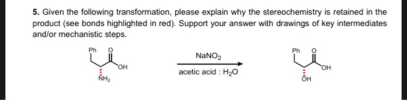 5. Given the following transformation, please explain why the stereochemistry is retained in the product (see bonds highlighted in red). Support your answer with drawings of key intermediates and/or mechanistic steps. NaNO2 ОН ОН acetic acid: H2O
1. Draw the product(s) of the following reactions. Include stereochemistry when relevant. If stereoisomers are formed...
 1. Draw the product(s) of the following reactions. Include stereochemistry when relevant. If stereoisomers are formed then draw out and label the relationship between your structures. Ph-N3 40°C HN-NH2 SACOMe 150 °C d. CO2CH3 210 °C нсОСН3 In hv ZI 160 °C OBn 85 °C OBn OBno= o 1 equiv. CI K2CO3 heat PhCH N= H 1. LDA (1 equiv.) P 2. Ph Ph 3. aqueous work-up heat EtOH NaOEt 2. Draw the mechanism for the following transformations. I Н...
 explain in full
Propose a mechanısm to account for the observed stereochemistry of the product of the reaction of cyclohexene with odıne in the presence of aqueous sılver acetate followed by quenching with dılute base
explain in full
Propose a mechanısm to account for the observed stereochemistry of the product of the reaction of cyclohexene with odıne in the presence of aqueous sılver acetate followed by quenching with dılute base
 4.
Show the product of the following Cope Rearrangment. Make sure to show a transition state that addresses stereochemistry (6 points) Show the product of the following Diels-Alder reaction, assuming Endo Selectivity. Make sure to show an approach or transition state that illustrates how you got your answer Endo Selectivity 6. Show the product of the following Diels-Alder reaction, assuming Exo Selectivity. Make sure to show an approach or transition state that illustrates how you got your answer NO2 Exo...
4.
Show the product of the following Cope Rearrangment. Make sure to show a transition state that addresses stereochemistry (6 points) Show the product of the following Diels-Alder reaction, assuming Endo Selectivity. Make sure to show an approach or transition state that illustrates how you got your answer Endo Selectivity 6. Show the product of the following Diels-Alder reaction, assuming Exo Selectivity. Make sure to show an approach or transition state that illustrates how you got your answer NO2 Exo...
 This is Question 4 from chapter 9 of Modern organic Synthesis an
introduction. the chapter is titled synthesis of carbocyclic
systems.
4. Reactivity. Propose a mechanism for each of the following transformations that explains the observed regioselectivity and stereochemistry. Me 75 °C Me Me CO Me Me O 76% b. Me CF3CO2H Me a. CH3CN 4 A mol. sieves NH2 оме MegSi OMe b. CF3CO2H c. NaCN CN 79% *d CO2Et 2Et CO2Et conditions xylene, heat, 5 h EtAici, 0...
This is Question 4 from chapter 9 of Modern organic Synthesis an
introduction. the chapter is titled synthesis of carbocyclic
systems.
4. Reactivity. Propose a mechanism for each of the following transformations that explains the observed regioselectivity and stereochemistry. Me 75 °C Me Me CO Me Me O 76% b. Me CF3CO2H Me a. CH3CN 4 A mol. sieves NH2 оме MegSi OMe b. CF3CO2H c. NaCN CN 79% *d CO2Et 2Et CO2Et conditions xylene, heat, 5 h EtAici, 0...
 1. Draw a mechanism and predict the product for each of the following reactions. Indicate stereochemistry in the products where applicable. [10 points) Co Me a) 150 d) 0 tan CO Et Co Me OSIR3 heat
 1) Propose a sequence of reactions that efficiently converts the given starting material(s) to the target molecule. Draw the structure of the product formed after each synthetic step. Do not write mechanisms. c) NH2 HN racemic
1) Propose a sequence of reactions that efficiently converts the given starting material(s) to the target molecule. Draw the structure of the product formed after each synthetic step. Do not write mechanisms. c) NH2 HN racemic
1) Propose a sequence of reactions that efficiently converts the given starting material(s) to the target molecule. Draw the structure of the product formed after each synthetic step. Do not write mechanisms. c) NH2 HN racemic
 Propose the starting material for each product from a molecule with the given formula in the reactants box. You do not have to show mechanisms, but use any reagents you require for each problem. Each problem is ONE OF TWO retrosynthetic steps to the starting materials and all steps should be described CH, Br C Hia 4. Propose a mechanism for the reaction below, showing the movement of every pair of electrons. Draw in an energy diagram, labeling, with structures,...
 ADraw the reactant required to produce each major product. Be sure to indicate the correct stereochemistry where appropriate. Нс CI Cl2, CH2CI, hv NH3 NH2 OCH3 KCO3 (a base) then CHaBr 1. Na (metal) 2. butyl bromide Осн Н.с. 1. Br2, hv, CHCl 2. methanolysis 1. mesyl chloride, pyridine NH2 HO 2. NH3 Он 1.TICI, py 2. H2O (hydrolysis) 1.TsCl, K2CO3 2. Nal (acetone) Page 5 of 8
 16. Propose structure(s) for major organic product(s) of the following reactions. Show all relevant stereochemistry. (3pts. each, 24 pts. total) OCH3 NaOCH, CH OH HaCO 1. (CH3 CuLi 2. H20
 5. Given the following transformation, please explain why the stereochemistry is retained in the product (see bonds highlighted in red). Support your answer with drawings of key intermediates and/or mechanistic steps. NaNO2 ОН ОН acetic acid: H2O
 1. Draw the product(s) of the following reactions. Include stereochemistry when relevant. If stereoisomers are formed then draw out and label the relationship between your structures. Ph-N3 40°C HN-NH2 SACOMe 150 °C d. CO2CH3 210 °C нсОСН3 In hv ZI 160 °C OBn 85 °C OBn OBno= o 1 equiv. CI K2CO3 heat PhCH N= H 1. LDA (1 equiv.) P 2. Ph Ph 3. aqueous work-up heat EtOH NaOEt 2. Draw the mechanism for the following transformations. I Н...
Most questions answered within 3 hours.
-
Where is the error in this code sequence?
String s1 = "Hello";
String s2 = "ello";...
asked 11 months ago -
Financial data for Joel de Paris, Inc., for last year
follow:
Joel de Paris, Inc.
Balance...
asked 11 months ago -
Consider this reaction:
Al2(SO4)3 (aq)+ BaCl3
(aq) Al2Cl6 (aq)- +
3BaSO4(s) . What is the...
asked 11 months ago -
Suppose that Savneet is considering increasing her
recent random sample from 20 car rentals to 40...
asked 11 months ago -
Trucks arrive at an unloading terminal at an average rate of 120
per hour.
Trucks arrive...
asked 11 months ago -
Why are methanol and ethanol completely soluble in water while
octanol is not very little soluble....
asked 11 months ago -
A facilities manager at a university reads in a research report
that the mean amount of...
asked 11 months ago -
When the CuSO4 is rehydrated by adding water to the anhydrous
compound, is this an endothermic...
asked 11 months ago -
A ray of sunlight is passing from diamond into crown glass; the
angle of incidence is...
asked 11 months ago -
A block of mass 0.249 kg is placed on top of a light, vertical
spring of...
asked 11 months ago -
how do the kidneys compensate in the presences of acidosis
a) trigger hyperventilate
b) reserve acid...
asked 11 months ago -
Question 501 pts
The rental rate of capital to the firm increases. Which of the
following...
asked 11 months ago