
Homework Answers
=======================================================================================
Add Answer to:
Question 7 (1 point) Given: MnO4"(aq) + H+ (aq) + CI+(aq) --> Mn2+ (aq) + Cl2(g)...
Question 5 (1 point) For the cell diagram Pt(s) | Br2(1) | Br"(aq) || C1-(aq)| Cl2(g)...
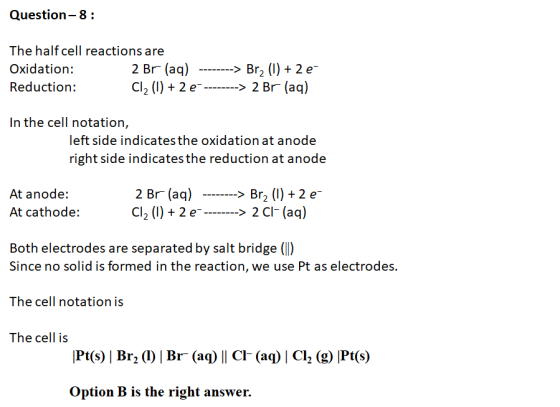
 Question 5 (1 point) For the cell diagram Pt(s) | Br2(1) | Br"(aq) || C1-(aq)| Cl2(g) | Pt(s) which reaction occurs at the cathode? O 2C1-(aq) --> Cl2(g) + 2e- O 2Br (aq) --> Br2(1) + 2e O Br2(l) +2e --> 2Br (aq) O Cl2(g) + 2Br (aq) --> 2C1-(aq) + Br2(1) O C12(g) + 22 --> 2C1“(aq)
Question 10 (1 point) Given: MnO4 (aq) + H*(aq) + CI (aq) --> Mn2*(aq) + Cl2(g)...
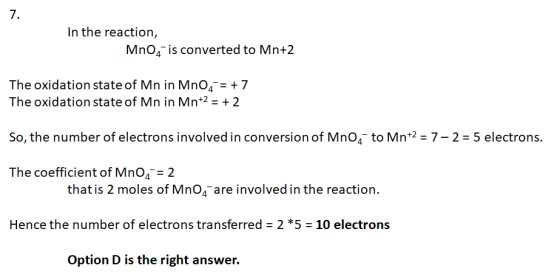
 Question 10 (1 point) Given: MnO4 (aq) + H*(aq) + CI (aq) --> Mn2*(aq) + Cl2(g) + H2O(1) If 10 electrons are transferred in the balanced equation, what is the coefficient of CI-? ООООО
Question 5 (1 point) Given: MnO4 (aq) + H+(aq) + Cl (aq) --> Mn2+(aq) + Cl2(g)...
 Question 5 (1 point) Given: MnO4 (aq) + H+(aq) + Cl (aq) --> Mn2+(aq) + Cl2(g) + H2O(1) If the coefficient of MnO4 in the balanced equation is 2, what are the coefficients of H+, Cl- and Cl2, respectively? 8,5,5 0 16, 10,5 010, 10,5 o 4, 8, 4 08, 10,5
Saved Question 8 (1 point) Saved For the cell diagram Pt(s) | Br2(1) | Br-(aq) ||...
 Saved Question 8 (1 point) Saved For the cell diagram Pt(s) | Br2(1) | Br-(aq) || Cl-(aq) | Cl2(g) | Pt(s) which reaction occurs at the anode? O Cl2(g) + 2Br (aq) --> 2C1-(aq) + Br2(1) O Br2(l) +2e --> 2Br" (aq) O 2Br"(aq) --> Br2(I) + 2e O Cl2(g) +2e --> 2014(aq) O 2014(aq) --> Cl2(g) + 2e
Question 4 (1 point) Write the cell diagram for the reaction 2AgCl(s) + H2(g) --> 2Ag(s)...
 Question 4 (1 point) Write the cell diagram for the reaction 2AgCl(s) + H2(g) --> 2Ag(s) + 2H+(aq) + 2C1-(aq) OPt(s) | H2(g)| H+(aq) || CI+(aq)| AgCl(s) | Ag(s) Pt(s) | H2(g)| H+(aq) || CI+(aq) | Ag(s) | Pt(s) O Ag(s) | AgCl(s) || H+(aq), Ci-(aq) | H2(g) | Pt(s) O Ag(s) | AgCl(s) | CI+(aq) || H+(aq)| H2(g) | Pt(s) Pt(s) Cl(aq), H(aq)| H2(g) || AgCl(s) Ag(s)
Use the half-reaction method to balance each redox reaction occurring in acidic aqueous solution. Cl−(aq)+MnO4−(aq)→Cl2(g)+Mn2+(aq) Express...
Use the half-reaction method to balance each redox reaction occurring in acidic aqueous solution. Cl−(aq)+MnO4−(aq)→Cl2(g)+Mn2+(aq) Express your answer as a chemical equation. Identify all of the phases in your answer.
After balancing the following redox reaction, what is the coefficient of H+? MnO4-(aq) + SO2(g) +...
After balancing the following redox reaction, what is the coefficient of H+? MnO4-(aq) + SO2(g) + H2O(l) → Mn2+(aq) + SO42-(aq) + H+ (aq)
Given that Eºcell is 0.62 V for the following cell TI(s) | T|3+ (aq) || CI(aq)...
 Given that Eºcell is 0.62 V for the following cell TI(s) | T|3+ (aq) || CI(aq) | Cl2(g) | Pt(s) and that the standard reduction potential for the half-reaction Cl2(g) + 2e - →2C1-(aq) is 1.36 V, calculate the standard reduction potential for the half-reaction T13+(aq) + 3e → Tl(s). 0.74 V -1.98 V -0.74 V +1.98 V +0.12 V
Consider the following half-reactions: Half-reaction F2(g) + 2e - 2H+ (aq) + 2 Mn2+ (aq) +...
 Consider the following half-reactions: Half-reaction F2(g) + 2e - 2H+ (aq) + 2 Mn2+ (aq) + 2e E° (V) 2F (aq) 2.870V H2(g) 0.000V Mn(s) -1.180V The strongest oxidizing agent is: enter formula / / The weakest oxidizing agent is: / The weakest reducing agent is: The strongest reducing agent is: Will Mn2+ (aq) reduce F2(g) to F"(aq)? Which species can be reduced by H2(g)? If none, leave box blank. Consider the following half-reactions: Half-reaction E° (V) Br2(1) + 2e...
Which of the following is the strongest oxidizing agent? 6 Cl2(g) + 2€ - 2 C1-(29)...
 Which of the following is the strongest oxidizing agent? 6 Cl2(g) + 2€ - 2 C1-(29) Cut(aq) + € - Cu(5) 5042-(29) + 4H+ (aq)+26 - H2SO3(aq) + H2O(1) MnO4+(29) + 4 H+ (aq) +3 e - MnO2(s) + 2 H2O(1) EP1.36 V EP0.52V E° -0.20 V E1.68 V 9 -- MnO2(s) 5042-(aq) 12 Cu*(aq) MnO4 (aq) 15 ci (aq) 18
 Question 5 (1 point) For the cell diagram Pt(s) | Br2(1) | Br"(aq) || C1-(aq)| Cl2(g) | Pt(s) which reaction occurs at the cathode? O 2C1-(aq) --> Cl2(g) + 2e- O 2Br (aq) --> Br2(1) + 2e O Br2(l) +2e --> 2Br (aq) O Cl2(g) + 2Br (aq) --> 2C1-(aq) + Br2(1) O C12(g) + 22 --> 2C1“(aq)
 Question 10 (1 point) Given: MnO4 (aq) + H*(aq) + CI (aq) --> Mn2*(aq) + Cl2(g) + H2O(1) If 10 electrons are transferred in the balanced equation, what is the coefficient of CI-? ООООО
 Question 5 (1 point) Given: MnO4 (aq) + H+(aq) + Cl (aq) --> Mn2+(aq) + Cl2(g) + H2O(1) If the coefficient of MnO4 in the balanced equation is 2, what are the coefficients of H+, Cl- and Cl2, respectively? 8,5,5 0 16, 10,5 010, 10,5 o 4, 8, 4 08, 10,5
 Saved Question 8 (1 point) Saved For the cell diagram Pt(s) | Br2(1) | Br-(aq) || Cl-(aq) | Cl2(g) | Pt(s) which reaction occurs at the anode? O Cl2(g) + 2Br (aq) --> 2C1-(aq) + Br2(1) O Br2(l) +2e --> 2Br" (aq) O 2Br"(aq) --> Br2(I) + 2e O Cl2(g) +2e --> 2014(aq) O 2014(aq) --> Cl2(g) + 2e
 Question 4 (1 point) Write the cell diagram for the reaction 2AgCl(s) + H2(g) --> 2Ag(s) + 2H+(aq) + 2C1-(aq) OPt(s) | H2(g)| H+(aq) || CI+(aq)| AgCl(s) | Ag(s) Pt(s) | H2(g)| H+(aq) || CI+(aq) | Ag(s) | Pt(s) O Ag(s) | AgCl(s) || H+(aq), Ci-(aq) | H2(g) | Pt(s) O Ag(s) | AgCl(s) | CI+(aq) || H+(aq)| H2(g) | Pt(s) Pt(s) Cl(aq), H(aq)| H2(g) || AgCl(s) Ag(s)
 Given that Eºcell is 0.62 V for the following cell TI(s) | T|3+ (aq) || CI(aq) | Cl2(g) | Pt(s) and that the standard reduction potential for the half-reaction Cl2(g) + 2e - →2C1-(aq) is 1.36 V, calculate the standard reduction potential for the half-reaction T13+(aq) + 3e → Tl(s). 0.74 V -1.98 V -0.74 V +1.98 V +0.12 V
 Consider the following half-reactions: Half-reaction F2(g) + 2e - 2H+ (aq) + 2 Mn2+ (aq) + 2e E° (V) 2F (aq) 2.870V H2(g) 0.000V Mn(s) -1.180V The strongest oxidizing agent is: enter formula / / The weakest oxidizing agent is: / The weakest reducing agent is: The strongest reducing agent is: Will Mn2+ (aq) reduce F2(g) to F"(aq)? Which species can be reduced by H2(g)? If none, leave box blank. Consider the following half-reactions: Half-reaction E° (V) Br2(1) + 2e...
 Which of the following is the strongest oxidizing agent? 6 Cl2(g) + 2€ - 2 C1-(29) Cut(aq) + € - Cu(5) 5042-(29) + 4H+ (aq)+26 - H2SO3(aq) + H2O(1) MnO4+(29) + 4 H+ (aq) +3 e - MnO2(s) + 2 H2O(1) EP1.36 V EP0.52V E° -0.20 V E1.68 V 9 -- MnO2(s) 5042-(aq) 12 Cu*(aq) MnO4 (aq) 15 ci (aq) 18
Most questions answered within 3 hours.
-
Where is the error in this code sequence?
String s1 = "Hello";
String s2 = "ello";...
asked 11 months ago -
Financial data for Joel de Paris, Inc., for last year
follow:
Joel de Paris, Inc.
Balance...
asked 11 months ago -
Consider this reaction:
Al2(SO4)3 (aq)+ BaCl3
(aq) Al2Cl6 (aq)- +
3BaSO4(s) . What is the...
asked 11 months ago -
Suppose that Savneet is considering increasing her
recent random sample from 20 car rentals to 40...
asked 11 months ago -
Trucks arrive at an unloading terminal at an average rate of 120
per hour.
Trucks arrive...
asked 11 months ago -
Why are methanol and ethanol completely soluble in water while
octanol is not very little soluble....
asked 11 months ago -
A facilities manager at a university reads in a research report
that the mean amount of...
asked 11 months ago -
When the CuSO4 is rehydrated by adding water to the anhydrous
compound, is this an endothermic...
asked 11 months ago -
A ray of sunlight is passing from diamond into crown glass; the
angle of incidence is...
asked 11 months ago -
A block of mass 0.249 kg is placed on top of a light, vertical
spring of...
asked 11 months ago -
how do the kidneys compensate in the presences of acidosis
a) trigger hyperventilate
b) reserve acid...
asked 11 months ago -
Question 501 pts
The rental rate of capital to the firm increases. Which of the
following...
asked 11 months ago