
Homework Answers
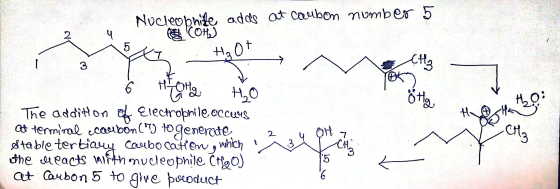
THE MECJHANISM FOR REACTION AND ADDITION OF NUCLEOPHILE i.e. H2O WHICH LATER LOSES AN H+ TO FORM OH IS GIVEN BELOW
NUCLEOPHILE ADDS AT CARBON 5
Add Answer to:
Carbon number___ is most likely to receive (react with) the nucleophile in this reaction. 24 Map...
Given this reaction: Br SH - Which is the most likely nucleophile used in the reaction?...
 Given this reaction: Br SH - Which is the most likely nucleophile used in the reaction? NaSH O H₂S Br
Based on nucleophile, substrate, and reaction conditions, state the most likely reaction mechanism (s_n 1 or...
 Based on nucleophile, substrate, and reaction conditions, state the most likely reaction mechanism (s_n 1 or s_n 2) in each example. Draw the products, including stereochemistry as needed. Predict the product of the following reactions:
16,17,18,19 14. a) Is the following more likely a nucleophile or a base? b) Is the...
 16,17,18,19
14. a) Is the following more likely a nucleophile or a base? b) Is the following more likely a nucleophile or a base? 15. Which of the following is the strongest nucleophile? MeOH MeO A. B. C. D. 16. a) By what mechanism is the following reaction likely to occur? (+1 point for the product) b) By what mechanism is the following reaction likely to occur? 17. What is the most likely product for the following reaction? OTs H2O...
16,17,18,19
14. a) Is the following more likely a nucleophile or a base? b) Is the following more likely a nucleophile or a base? 15. Which of the following is the strongest nucleophile? MeOH MeO A. B. C. D. 16. a) By what mechanism is the following reaction likely to occur? (+1 point for the product) b) By what mechanism is the following reaction likely to occur? 17. What is the most likely product for the following reaction? OTs H2O...
Question 24 4 pts Which of the following nuclei is most likely to decay by alpha...
 Question 24 4 pts Which of the following nuclei is most likely to decay by alpha decay? manganese-51 carbon-14 carbon-12 helium-3 uranium-235
1. At what carbon atoms will these aromatics most likely undergo an EAS reaction? Circle them....
 1. At what carbon atoms will these aromatics most likely undergo an EAS reaction? Circle them. Can you support your predictions with resonance structures? ÇOH more com- & - 2 2. Provide the curved arrows that interconvert these resonance structures of naphthol. 3. Tryptophan 7-Halogenase is an enzyme that chlorinates tryptophan at an activated position on the aromatic ring. First, the electrophilic chlorine source, HOCI is produced, shown in box 1. Then, a normal EAS mechanism is proposed to take...
2. Determine the mole ratio for the following reaction: oxygen gas and carbon react to form...
 2. Determine the mole ratio for the following reaction: oxygen gas and carbon react to form carbon monoxide, CO. 3. Determine the number of moles of sodium hydroxide, NaOH, produced when 2 mol of sodium and 3 mol of water react to form sodium hydroxide and hydrogen gas, H2. 4. Calculate the mass of carbon monoxide, CO, that was needed to produce 78 g of methanol, CH2OH, by the following reaction: 2H2 + CO → CH3OH. 5. Demonstrate that the...
1. What is the most likely product of the following reaction? 2. What is the most likely product...
 1. What is the most likely product of the following
reaction?
2. What is the most likely product of the following
reaction?
3. What is the most likely product of the following
reaction?
please please help me
1. NaCN 2. Ho CN HBr Br Br IV TV a racemic mixture of I and II ir NaOH Br Br Br Br Br Br
1. NaCN 2. Ho CN
HBr Br Br IV TV a racemic mixture of I and II
ir...
1. What is the most likely product of the following
reaction?
2. What is the most likely product of the following
reaction?
3. What is the most likely product of the following
reaction?
please please help me
1. NaCN 2. Ho CN HBr Br Br IV TV a racemic mixture of I and II ir NaOH Br Br Br Br Br Br
1. NaCN 2. Ho CN
HBr Br Br IV TV a racemic mixture of I and II
ir...
4. (24 points) a) Circle one of the alkyl bromide (A or B) that most likely...
 4. (24 points) a) Circle one of the alkyl bromide (A or B) that most likely corresponds to the reaction coordinate diagram for the substitution reaction shown below. (4 points) b) Provide the product of the reaction in the box provided. (5 points) c) Determine if the reactions conditions favors SN1 or SN2 reaction and provide the reaction rate equation. (5 points) d) Label the diagram with the Free energy of activation (AGⓇ) and the overall free energy change (AG'rx)....
Match each description with the most appropriate atom of the choices given: chlorine, sodium, or carbon....
 Match each description with the most appropriate atom of the choices given: chlorine, sodium, or carbon. Most likely to formClosest to the right side of the Periodic Table Has 4 valence electrons Highest electronegativity Most likely to form an anion covalent bonds Lowest electronegativity Most likely to lose anMost likely to share Has 1 valence electron Has 7 valence electrons electron electrons Most likely to gain an Closest to the left side Most likely to form a of the Periodic...
Model 3: Reactions of Bromine Radical with Various Alkanes For each reaction below, the most likely products are sh...
 Model 3: Reactions of Bromine Radical with Various Alkanes For each reaction below, the most likely products are shown. H H H H Rxn I : Br -H H H H H H H H Br H Rxn IV C- H H CHy сн, H,C нC Rxn V BrH н.с CH -сн Critical Thinking Questions 5. Label the carbon radicals in Model 3 as methyl. primary, secondary, tertiary, allyl or benzyl. a) Which carbon radical in Model 3 is closest...
 Given this reaction: Br SH - Which is the most likely nucleophile used in the reaction? NaSH O H₂S Br
 Based on nucleophile, substrate, and reaction conditions, state the most likely reaction mechanism (s_n 1 or s_n 2) in each example. Draw the products, including stereochemistry as needed. Predict the product of the following reactions:
 16,17,18,19
14. a) Is the following more likely a nucleophile or a base? b) Is the following more likely a nucleophile or a base? 15. Which of the following is the strongest nucleophile? MeOH MeO A. B. C. D. 16. a) By what mechanism is the following reaction likely to occur? (+1 point for the product) b) By what mechanism is the following reaction likely to occur? 17. What is the most likely product for the following reaction? OTs H2O...
16,17,18,19
14. a) Is the following more likely a nucleophile or a base? b) Is the following more likely a nucleophile or a base? 15. Which of the following is the strongest nucleophile? MeOH MeO A. B. C. D. 16. a) By what mechanism is the following reaction likely to occur? (+1 point for the product) b) By what mechanism is the following reaction likely to occur? 17. What is the most likely product for the following reaction? OTs H2O...
 Question 24 4 pts Which of the following nuclei is most likely to decay by alpha decay? manganese-51 carbon-14 carbon-12 helium-3 uranium-235
 1. At what carbon atoms will these aromatics most likely undergo an EAS reaction? Circle them. Can you support your predictions with resonance structures? ÇOH more com- & - 2 2. Provide the curved arrows that interconvert these resonance structures of naphthol. 3. Tryptophan 7-Halogenase is an enzyme that chlorinates tryptophan at an activated position on the aromatic ring. First, the electrophilic chlorine source, HOCI is produced, shown in box 1. Then, a normal EAS mechanism is proposed to take...
 2. Determine the mole ratio for the following reaction: oxygen gas and carbon react to form carbon monoxide, CO. 3. Determine the number of moles of sodium hydroxide, NaOH, produced when 2 mol of sodium and 3 mol of water react to form sodium hydroxide and hydrogen gas, H2. 4. Calculate the mass of carbon monoxide, CO, that was needed to produce 78 g of methanol, CH2OH, by the following reaction: 2H2 + CO → CH3OH. 5. Demonstrate that the...
 1. What is the most likely product of the following
reaction?
2. What is the most likely product of the following
reaction?
3. What is the most likely product of the following
reaction?
please please help me
1. NaCN 2. Ho CN HBr Br Br IV TV a racemic mixture of I and II ir NaOH Br Br Br Br Br Br
1. NaCN 2. Ho CN
HBr Br Br IV TV a racemic mixture of I and II
ir...
1. What is the most likely product of the following
reaction?
2. What is the most likely product of the following
reaction?
3. What is the most likely product of the following
reaction?
please please help me
1. NaCN 2. Ho CN HBr Br Br IV TV a racemic mixture of I and II ir NaOH Br Br Br Br Br Br
1. NaCN 2. Ho CN
HBr Br Br IV TV a racemic mixture of I and II
ir...
 4. (24 points) a) Circle one of the alkyl bromide (A or B) that most likely corresponds to the reaction coordinate diagram for the substitution reaction shown below. (4 points) b) Provide the product of the reaction in the box provided. (5 points) c) Determine if the reactions conditions favors SN1 or SN2 reaction and provide the reaction rate equation. (5 points) d) Label the diagram with the Free energy of activation (AGⓇ) and the overall free energy change (AG'rx)....
 Match each description with the most appropriate atom of the choices given: chlorine, sodium, or carbon. Most likely to formClosest to the right side of the Periodic Table Has 4 valence electrons Highest electronegativity Most likely to form an anion covalent bonds Lowest electronegativity Most likely to lose anMost likely to share Has 1 valence electron Has 7 valence electrons electron electrons Most likely to gain an Closest to the left side Most likely to form a of the Periodic...
 Model 3: Reactions of Bromine Radical with Various Alkanes For each reaction below, the most likely products are shown. H H H H Rxn I : Br -H H H H H H H H Br H Rxn IV C- H H CHy сн, H,C нC Rxn V BrH н.с CH -сн Critical Thinking Questions 5. Label the carbon radicals in Model 3 as methyl. primary, secondary, tertiary, allyl or benzyl. a) Which carbon radical in Model 3 is closest...
Most questions answered within 3 hours.
-
Where is the error in this code sequence?
String s1 = "Hello";
String s2 = "ello";...
asked 10 months ago -
Financial data for Joel de Paris, Inc., for last year
follow:
Joel de Paris, Inc.
Balance...
asked 10 months ago -
Consider this reaction:
Al2(SO4)3 (aq)+ BaCl3
(aq) Al2Cl6 (aq)- +
3BaSO4(s) . What is the...
asked 10 months ago -
Suppose that Savneet is considering increasing her
recent random sample from 20 car rentals to 40...
asked 10 months ago -
Trucks arrive at an unloading terminal at an average rate of 120
per hour.
Trucks arrive...
asked 10 months ago -
Why are methanol and ethanol completely soluble in water while
octanol is not very little soluble....
asked 10 months ago -
A facilities manager at a university reads in a research report
that the mean amount of...
asked 10 months ago -
When the CuSO4 is rehydrated by adding water to the anhydrous
compound, is this an endothermic...
asked 10 months ago -
A ray of sunlight is passing from diamond into crown glass; the
angle of incidence is...
asked 10 months ago -
A block of mass 0.249 kg is placed on top of a light, vertical
spring of...
asked 10 months ago -
how do the kidneys compensate in the presences of acidosis
a) trigger hyperventilate
b) reserve acid...
asked 10 months ago -
Question 501 pts
The rental rate of capital to the firm increases. Which of the
following...
asked 10 months ago