


Homework Answers
![(0) tin solution :- Given A + 2B CTD Rate = K Cunits ) [A] na (BjMb (6) from given data , we can wente 512 X10-4 M/S = K 60.0](http://img.homeworklib.com/questions/069df100-df66-11eb-8244-65d0ea376b02.png?x-oss-process=image/resize,w_560)
Add Answer to:
Questions 6, 7, 8, and 9 pertain to different parts of the same problem. They are...
q 4 Be sure to answer all parts. The reaction of peroxydisulfate ion (S20s with iodide...
 q 4
Be sure to answer all parts. The reaction of peroxydisulfate ion (S20s with iodide ion (I) is S20s(aq) + 31(aq) - » 2sO4(aq) + I3 (aq) From the following data collected at a certain temperature, determine the rate law and calculate the rate constant. Experiment[S20sj(M IM Initial Rate [M/s] 0.0300 0.0300 0.0600 0.0440 0.0220 0.0220 8.40 × 10⁻⁴ 4.20 × 10⁻⁴ 8.40 x 10⁴ (a) Which of the following equations represents the rate law for this reaction? A....
q 4
Be sure to answer all parts. The reaction of peroxydisulfate ion (S20s with iodide ion (I) is S20s(aq) + 31(aq) - » 2sO4(aq) + I3 (aq) From the following data collected at a certain temperature, determine the rate law and calculate the rate constant. Experiment[S20sj(M IM Initial Rate [M/s] 0.0300 0.0300 0.0600 0.0440 0.0220 0.0220 8.40 × 10⁻⁴ 4.20 × 10⁻⁴ 8.40 x 10⁴ (a) Which of the following equations represents the rate law for this reaction? A....
6. (25 points) Water at standard atmospheric conditions flows through a 100 m long plastic pipe...
 6. (25 points) Water at standard atmospheric conditions flows through a 100 m long plastic pipe with a circular cross section of diameter D = 0.2 m at an average velocity of 10 cm/s. The flow exits into the atmosphere. The pipe material is smooth and has essentially no roughness. What is the pressure at the pipe entrance if it is horizontal? What is the pressure at the pipe entrance if the elevation increases by 50 cm? A Moody diagram...
(I just need part B) Consider the reaction A+2B⇌C whose rate at 25 ∘C was measured using three different sets of initial...
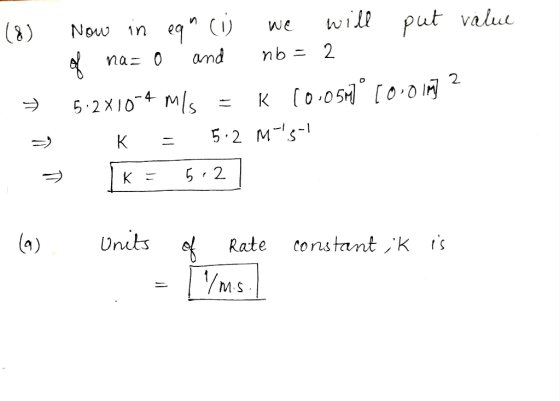
(I just need part B) Consider the reaction A+2B⇌C whose rate at 25 ∘C was measured using three different sets of initial concentrations as listed in the following table: Trial [A] (M) [B] (M) Rate (M/s) 1 0.50 0.030 9.0×10⁻³ 2 0.50 0.060 1.8×10⁻² 3 1.00 0.030 3.6×10⁻² Part A Part complete What is the rate law for this reaction? Express the rate law symbolically in terms of k, [A], and [B]. rate = k[A]2[B] Part B Calculate the initial...
#11 6. B =- Val-3-6) 7. B = 726-6) 8. B- V20+k) 9. B =-; 10....
 #11
6. B =- Val-3-6) 7. B = 726-6) 8. B- V20+k) 9. B =-; 10. B = - 007 (part 2 of 2) 10.0 points For given values of Ê and B, there exists a critical speed such that the electrons may move along the + direction undeflected. if the speed of the electron is less than the criti- cal speed, along which direction will the elec- trons be deflected? 1. c = 120+B) 2. = Answer in units...
#11
6. B =- Val-3-6) 7. B = 726-6) 8. B- V20+k) 9. B =-; 10. B = - 007 (part 2 of 2) 10.0 points For given values of Ê and B, there exists a critical speed such that the electrons may move along the + direction undeflected. if the speed of the electron is less than the criti- cal speed, along which direction will the elec- trons be deflected? 1. c = 120+B) 2. = Answer in units...
please answer all parts 10 9 8 7 6 5 4 3 2 1 9. I...
 please answer all parts
10 9 8 7 6 5 4 3 2 1 9. I know which countries tend to cluster in similar sociocultural and economic groupi 10 9 8 7 6 5 4 3 2 1 2. I frequently attend seminars and lectures about other cultures or international topics. 10 9 8 7 6 5 4 3 2 1 3. I believe female expatriates can be equally as effective as male expatriates. 10. I feel capable of assessing...
please answer all parts
10 9 8 7 6 5 4 3 2 1 9. I know which countries tend to cluster in similar sociocultural and economic groupi 10 9 8 7 6 5 4 3 2 1 2. I frequently attend seminars and lectures about other cultures or international topics. 10 9 8 7 6 5 4 3 2 1 3. I believe female expatriates can be equally as effective as male expatriates. 10. I feel capable of assessing...
Please answer as many questions as you can Thanks 1. For the reaction, N2(g) 3H2(g)2NH3(g). if...
 Please answer as many questions as you can
Thanks
1. For the reaction, N2(g) 3H2(g)2NH3(g). if the rate of formation of ammonia is 0.04 mol/L min, find the rate of disappearance of H2 and N2 during that same time period. 2. For the following reaction, 5Br BrO3 6H3Br2 3H20, the rate of consumption of bromide ion at some time was found to be 0.20 mo/L s. What is the rate of formation of water over the same time period? 3....
Please answer as many questions as you can
Thanks
1. For the reaction, N2(g) 3H2(g)2NH3(g). if the rate of formation of ammonia is 0.04 mol/L min, find the rate of disappearance of H2 and N2 during that same time period. 2. For the following reaction, 5Br BrO3 6H3Br2 3H20, the rate of consumption of bromide ion at some time was found to be 0.20 mo/L s. What is the rate of formation of water over the same time period? 3....
From the data table determine the rate law for reactions 1-4 and calculate the value of...
 From the data table determine the rate law for reactions 1-4
and calculate the value of k for each. Thanks
I-IV
BACKGROUND
INFORMATION
Given: 3% H2O2 Concentration= 0.88M & 1.5% H2O2
Concentration= 0.44 M
•Calculation of H2O2 after mixing for parts I,II, IV= 0.704 M
•Calculation of I^- after mixing for parts I,II, IV= 0.10
M
•Calculation of Initial (mol/L-s)
Filled in Table
Now the solutions for Rate Order and Rate Constant are
needed
Reactants 8 ml 30% HO, 2...
From the data table determine the rate law for reactions 1-4
and calculate the value of k for each. Thanks
I-IV
BACKGROUND
INFORMATION
Given: 3% H2O2 Concentration= 0.88M & 1.5% H2O2
Concentration= 0.44 M
•Calculation of H2O2 after mixing for parts I,II, IV= 0.704 M
•Calculation of I^- after mixing for parts I,II, IV= 0.10
M
•Calculation of Initial (mol/L-s)
Filled in Table
Now the solutions for Rate Order and Rate Constant are
needed
Reactants 8 ml 30% HO, 2...
4) A reaction is performed to study the reaction of nitrogen dioxide with carbon monoxide: NO2...
4) A reaction is performed to study the reaction of nitrogen dioxide with carbon monoxide: NO2 + CO ---> NO + CO2 The following reaction rate data was obtained in four separate experiments. Experiment [NO2]0, M [CO]0, M Initial Rate, Ms-1 1 1.54 0.435 1.33 2 3.08 0.435 5.31 3 1.54 0.870 1.33 4 3.08 0.870 5.31 What is the rate law for the reaction and what is the numerical value of k? Complete the rate law in the box...
7) The reaction of peroxydisulfate ion (S2O82−) with iodide ion (I−) is S2O82−(aq) + 3I−(aq) →...
7) The reaction of peroxydisulfate ion (S2O82−) with iodide ion (I−) is S2O82−(aq) + 3I−(aq) → 2SO42−(aq) + I3−(aq) From the following data collected at a certain temperature, determine the rate law and calculate the rate constant. Experiment [S2O82−](M) [I−](M) Initial Rate [M/s] 1 0.0200 0.0960 7.60 × 10⁻⁴ 2 0.0200 0.0480 3.80 × 10⁻⁴ 3 0.0400 0.0480 7.60 × 10⁻⁴ (a) Which of the following equations represents the rate law for this reaction? A. rate = k[S2O82−][I−] . ...
Ulemist CHM 4L. Report on Exp. 6 Page 225 Last Name: Post Lab Problem 2 (10...
 Ulemist CHM 4L. Report on Exp. 6 Page 225 Last Name: Post Lab Problem 2 (10 points). Initial concentrations and rates for the balanced reaction: raten (Al M 18). M a +bB products exp.#1: 16 2.0 | 20 exp #2 are collected in three experiments in the Table on the right What are: (a) the orders in A and B hl the overall order of the reaction, and (c) the rate constant? Enter your detailed solution below and answers in...
 q 4
Be sure to answer all parts. The reaction of peroxydisulfate ion (S20s with iodide ion (I) is S20s(aq) + 31(aq) - » 2sO4(aq) + I3 (aq) From the following data collected at a certain temperature, determine the rate law and calculate the rate constant. Experiment[S20sj(M IM Initial Rate [M/s] 0.0300 0.0300 0.0600 0.0440 0.0220 0.0220 8.40 × 10⁻⁴ 4.20 × 10⁻⁴ 8.40 x 10⁴ (a) Which of the following equations represents the rate law for this reaction? A....
q 4
Be sure to answer all parts. The reaction of peroxydisulfate ion (S20s with iodide ion (I) is S20s(aq) + 31(aq) - » 2sO4(aq) + I3 (aq) From the following data collected at a certain temperature, determine the rate law and calculate the rate constant. Experiment[S20sj(M IM Initial Rate [M/s] 0.0300 0.0300 0.0600 0.0440 0.0220 0.0220 8.40 × 10⁻⁴ 4.20 × 10⁻⁴ 8.40 x 10⁴ (a) Which of the following equations represents the rate law for this reaction? A....
 6. (25 points) Water at standard atmospheric conditions flows through a 100 m long plastic pipe with a circular cross section of diameter D = 0.2 m at an average velocity of 10 cm/s. The flow exits into the atmosphere. The pipe material is smooth and has essentially no roughness. What is the pressure at the pipe entrance if it is horizontal? What is the pressure at the pipe entrance if the elevation increases by 50 cm? A Moody diagram...
 #11
6. B =- Val-3-6) 7. B = 726-6) 8. B- V20+k) 9. B =-; 10. B = - 007 (part 2 of 2) 10.0 points For given values of Ê and B, there exists a critical speed such that the electrons may move along the + direction undeflected. if the speed of the electron is less than the criti- cal speed, along which direction will the elec- trons be deflected? 1. c = 120+B) 2. = Answer in units...
#11
6. B =- Val-3-6) 7. B = 726-6) 8. B- V20+k) 9. B =-; 10. B = - 007 (part 2 of 2) 10.0 points For given values of Ê and B, there exists a critical speed such that the electrons may move along the + direction undeflected. if the speed of the electron is less than the criti- cal speed, along which direction will the elec- trons be deflected? 1. c = 120+B) 2. = Answer in units...
 please answer all parts
10 9 8 7 6 5 4 3 2 1 9. I know which countries tend to cluster in similar sociocultural and economic groupi 10 9 8 7 6 5 4 3 2 1 2. I frequently attend seminars and lectures about other cultures or international topics. 10 9 8 7 6 5 4 3 2 1 3. I believe female expatriates can be equally as effective as male expatriates. 10. I feel capable of assessing...
please answer all parts
10 9 8 7 6 5 4 3 2 1 9. I know which countries tend to cluster in similar sociocultural and economic groupi 10 9 8 7 6 5 4 3 2 1 2. I frequently attend seminars and lectures about other cultures or international topics. 10 9 8 7 6 5 4 3 2 1 3. I believe female expatriates can be equally as effective as male expatriates. 10. I feel capable of assessing...
 Please answer as many questions as you can
Thanks
1. For the reaction, N2(g) 3H2(g)2NH3(g). if the rate of formation of ammonia is 0.04 mol/L min, find the rate of disappearance of H2 and N2 during that same time period. 2. For the following reaction, 5Br BrO3 6H3Br2 3H20, the rate of consumption of bromide ion at some time was found to be 0.20 mo/L s. What is the rate of formation of water over the same time period? 3....
Please answer as many questions as you can
Thanks
1. For the reaction, N2(g) 3H2(g)2NH3(g). if the rate of formation of ammonia is 0.04 mol/L min, find the rate of disappearance of H2 and N2 during that same time period. 2. For the following reaction, 5Br BrO3 6H3Br2 3H20, the rate of consumption of bromide ion at some time was found to be 0.20 mo/L s. What is the rate of formation of water over the same time period? 3....
 From the data table determine the rate law for reactions 1-4
and calculate the value of k for each. Thanks
I-IV
BACKGROUND
INFORMATION
Given: 3% H2O2 Concentration= 0.88M & 1.5% H2O2
Concentration= 0.44 M
•Calculation of H2O2 after mixing for parts I,II, IV= 0.704 M
•Calculation of I^- after mixing for parts I,II, IV= 0.10
M
•Calculation of Initial (mol/L-s)
Filled in Table
Now the solutions for Rate Order and Rate Constant are
needed
Reactants 8 ml 30% HO, 2...
From the data table determine the rate law for reactions 1-4
and calculate the value of k for each. Thanks
I-IV
BACKGROUND
INFORMATION
Given: 3% H2O2 Concentration= 0.88M & 1.5% H2O2
Concentration= 0.44 M
•Calculation of H2O2 after mixing for parts I,II, IV= 0.704 M
•Calculation of I^- after mixing for parts I,II, IV= 0.10
M
•Calculation of Initial (mol/L-s)
Filled in Table
Now the solutions for Rate Order and Rate Constant are
needed
Reactants 8 ml 30% HO, 2...
 Ulemist CHM 4L. Report on Exp. 6 Page 225 Last Name: Post Lab Problem 2 (10 points). Initial concentrations and rates for the balanced reaction: raten (Al M 18). M a +bB products exp.#1: 16 2.0 | 20 exp #2 are collected in three experiments in the Table on the right What are: (a) the orders in A and B hl the overall order of the reaction, and (c) the rate constant? Enter your detailed solution below and answers in...
Most questions answered within 3 hours.
-
Where is the error in this code sequence?
String s1 = "Hello";
String s2 = "ello";...
asked 11 months ago -
Financial data for Joel de Paris, Inc., for last year
follow:
Joel de Paris, Inc.
Balance...
asked 11 months ago -
Consider this reaction:
Al2(SO4)3 (aq)+ BaCl3
(aq) Al2Cl6 (aq)- +
3BaSO4(s) . What is the...
asked 11 months ago -
Suppose that Savneet is considering increasing her
recent random sample from 20 car rentals to 40...
asked 11 months ago -
Trucks arrive at an unloading terminal at an average rate of 120
per hour.
Trucks arrive...
asked 11 months ago -
Why are methanol and ethanol completely soluble in water while
octanol is not very little soluble....
asked 11 months ago -
A facilities manager at a university reads in a research report
that the mean amount of...
asked 11 months ago -
When the CuSO4 is rehydrated by adding water to the anhydrous
compound, is this an endothermic...
asked 11 months ago -
A ray of sunlight is passing from diamond into crown glass; the
angle of incidence is...
asked 11 months ago -
A block of mass 0.249 kg is placed on top of a light, vertical
spring of...
asked 11 months ago -
how do the kidneys compensate in the presences of acidosis
a) trigger hyperventilate
b) reserve acid...
asked 11 months ago -
Question 501 pts
The rental rate of capital to the firm increases. Which of the
following...
asked 11 months ago