
Homework Answers
Add Answer to:
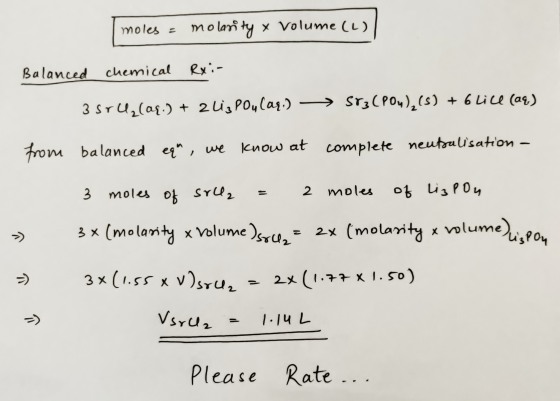
3SrCl2(aq) + 2Li3PO4(aq) → Sr3(PO4)2(s) + 6LiCl(aq) What volume of a 1.55 M SrCl2 solution will...
Write complete ionic and net ionic equations for each reaction. 3 SrCl2(aq) + 2Li3PO4(aq) → Sr3(PO4)2(s)...
Write complete ionic and net ionic equations for each reaction. 3 SrCl2(aq) + 2Li3PO4(aq) → Sr3(PO4)2(s) + 6 LiCl(aq) Complete ionic equation: 3 Sr2+ (aq) + 6 Cl- (aq) + 6 Li+ (aq) + 2 PO43- (aq) → Sr3(PO4)2(s) + 6 Li+ (aq) + 6 Cl- (aq) Net ionic equation: 3 Sr2+ (aq) + 2 PO43- (aq) → Sr3(PO4)2(s) HC2H3O2(aq) + KOH(aq) → H2O(l) + KC2H3O2 (aq) Complete ionic equation: HC2H3O2(aq) + K+(aq) + OH- (aq) → H2O(l)...
c. (10 pts.) Using the equation: 3 S-Cl2 (aq) + 2 Li3PO4 (aq) → Sr3(PO4)2 (8)...
 c. (10 pts.) Using the equation: 3 S-Cl2 (aq) + 2 Li3PO4 (aq) → Sr3(PO4)2 (8) + 6 LICI (aq) If you are given 5.80 g of SrCl2 and 2.45 g of Li3PO4, which of the two compounds is the limiting reactant, and what is the theoretical yield (in grams)? src S 8762)*1 is 4.524
Consider the balanced equation for the following reaction: 3Ca(ClO3)2(aq) + 2Li3PO4(aq) → Ca3(PO4)2(s) + 6LiClO3(aq) How...
Consider the balanced equation for the following reaction: 3Ca(ClO3)2(aq) + 2Li3PO4(aq) → Ca3(PO4)2(s) + 6LiClO3(aq) How much excess reactant remains in the reaction if 44.1 grams of Ca(ClO3)2 reacts with 55.3 grams of Li3PO4?
Consider the following balanced equation: 3Ca(ClO3)2(aq) + 2Li3PO4(aq) → Ca3(PO4)2(s) + 6LiClO3(aq) If 41.0 moles of...
Consider the following balanced equation: 3Ca(ClO3)2(aq) + 2Li3PO4(aq) → Ca3(PO4)2(s) + 6LiClO3(aq) If 41.0 moles of Li3PO4(aq) reacts with an excess of Ca(ClO3)2(aq) to produce 61.9 moles of LiClO3(aq), what is the percent yield of the reaction?
Consider the following balanced equation: 3Ca(ClO3)2(aq) + 2Li3PO4(aq) → Ca3(PO4)2(s) + 6LiClO3(aq) If 18.8 moles of...
Consider the following balanced equation: 3Ca(ClO3)2(aq) + 2Li3PO4(aq) → Ca3(PO4)2(s) + 6LiClO3(aq) If 18.8 moles of Ca(ClO3)2(aq) and 20.9 moles of Li3PO4(aq) are allowed to react, what is the theoretical yield of LiClO3(aq)? a-81.5 moles b-90.1 moles c-89.0 moles 76.1 moles 37.6 moles
Consider the following balanced equation: 3Ca(ClO3)2(aq) + 2Li3PO4(aq) → Ca3(PO4)2(s) + 6LiClO3(aq) If 15.8 moles of Ca(...
Consider the following balanced equation: 3Ca(ClO3)2(aq) + 2Li3PO4(aq) → Ca3(PO4)2(s) + 6LiClO3(aq) If 15.8 moles of Ca(ClO3)2(aq) reacts with an excess of Li3PO4(aq), and the percent yield is 63.3%, how many moles of LiClO3(aq) will actually be produced
Consider the reaction: 2K3PO4(aq)+3NiCl2(aq)→ Ni3(PO4)2(s)+6KCl(aq) What volume of 0.205 M K3PO4 solution is necessary to completely...
Consider the reaction: 2K3PO4(aq)+3NiCl2(aq)→ Ni3(PO4)2(s)+6KCl(aq) What volume of 0.205 M K3PO4 solution is necessary to completely react with 154 mL of 0.0116 M NiCl2?
Consider the reaction: 2K3PO4(aq)+3NiCl2(aq)→ Ni3(PO4)2(s)+6KCl(aq) What volume of 0.205 M K3PO4 solution is necessary to completely...
Consider the reaction: 2K3PO4(aq)+3NiCl2(aq)→ Ni3(PO4)2(s)+6KCl(aq) What volume of 0.205 M K3PO4 solution is necessary to completely react with 122 mL of 0.0120 M NiCl2?
Consider the reaction: 2K3PO4(aq)+3NiCl2(aq)→ Ni3(PO4)2(s)+6KCl(aq) What volume of 0.205 M K3PO4 solution is necessary to completely...
Consider the reaction: 2K3PO4(aq)+3NiCl2(aq)→ Ni3(PO4)2(s)+6KCl(aq) What volume of 0.205 M K3PO4 solution is necessary to completely react with 146 mL of 0.0122 M NiCl2?
Consider the following precipitation reaction: 2Na3PO4(aq)+3CuCl2(aq)→ Cu3(PO4)2(s)+6NaCl(aq) What volume of 0.175 M Na3PO4 solution is necessary...
Consider the following precipitation reaction: 2Na3PO4(aq)+3CuCl2(aq)→ Cu3(PO4)2(s)+6NaCl(aq) What volume of 0.175 M Na3PO4 solution is necessary to completely react with 88.5 mL of 0.105 M CuCl2?
 c. (10 pts.) Using the equation: 3 S-Cl2 (aq) + 2 Li3PO4 (aq) → Sr3(PO4)2 (8) + 6 LICI (aq) If you are given 5.80 g of SrCl2 and 2.45 g of Li3PO4, which of the two compounds is the limiting reactant, and what is the theoretical yield (in grams)? src S 8762)*1 is 4.524
Most questions answered within 3 hours.
-
Where is the error in this code sequence?
String s1 = "Hello";
String s2 = "ello";...
asked 11 months ago -
Financial data for Joel de Paris, Inc., for last year
follow:
Joel de Paris, Inc.
Balance...
asked 11 months ago -
Consider this reaction:
Al2(SO4)3 (aq)+ BaCl3
(aq) Al2Cl6 (aq)- +
3BaSO4(s) . What is the...
asked 11 months ago -
Suppose that Savneet is considering increasing her
recent random sample from 20 car rentals to 40...
asked 11 months ago -
Trucks arrive at an unloading terminal at an average rate of 120
per hour.
Trucks arrive...
asked 11 months ago -
Why are methanol and ethanol completely soluble in water while
octanol is not very little soluble....
asked 11 months ago -
A facilities manager at a university reads in a research report
that the mean amount of...
asked 11 months ago -
When the CuSO4 is rehydrated by adding water to the anhydrous
compound, is this an endothermic...
asked 11 months ago -
A ray of sunlight is passing from diamond into crown glass; the
angle of incidence is...
asked 11 months ago -
A block of mass 0.249 kg is placed on top of a light, vertical
spring of...
asked 11 months ago -
how do the kidneys compensate in the presences of acidosis
a) trigger hyperventilate
b) reserve acid...
asked 11 months ago -
Question 501 pts
The rental rate of capital to the firm increases. Which of the
following...
asked 11 months ago