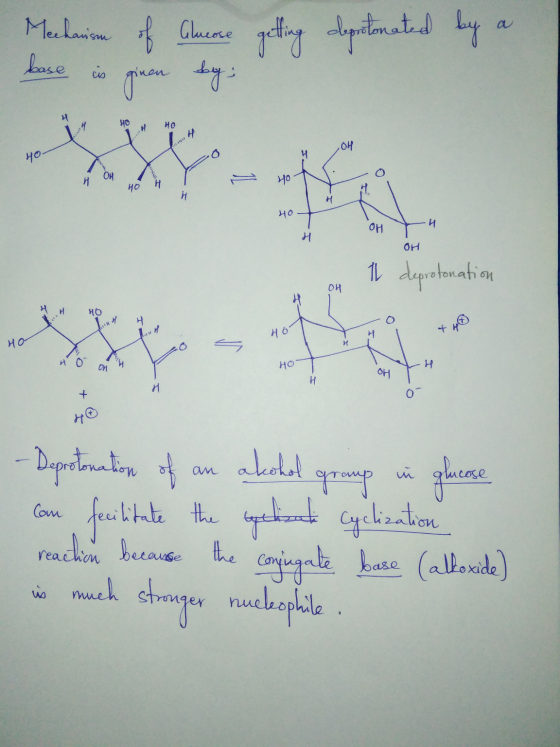
Draw the mechism of glucose getting deprotonated by a base so it can partake in the...
Draw the mechism of glucose getting deprotonated by a base so it can partake in the first transferase reaction of glycolysis.
Homework Answers
Add Answer to:
Draw the mechism of glucose getting deprotonated by a base so it
can partake in the...
Draw out the transferase mechanism for first step of glycolysis (Glucose to G6p). Start with deprotonation...
Draw out the transferase mechanism for first step of glycolysis (Glucose to G6p). Start with deprotonation and include the trigonal bipyramidal intermediate.
2. Synthesis of 1-hexanol. a) Suggest one base that can deprotonate 1-butyne. b) When the deprotonated...
2. Synthesis of 1-hexanol. a) Suggest one base that can deprotonate 1-butyne. b) When the deprotonated 1-butyne reacts with epoxyethane, CH3CH2CCCH2CH2O- forms. Draw this step's curly arrow mechanism. c) Suggest an acid that will covert CH3CH2CCCH2CH2O- to CH3CH2CCCH2CH2OH. d) What reagents are needed to convert CH3CH2CCCH2CH2OH to 1-hexanol?
Please help Practice Worksheet 8: Alkyne 3. Alkynes are deprotonated (remove H) by strong base leg.. NaNH then can u...
 Please help
Practice Worksheet 8: Alkyne 3. Alkynes are deprotonated (remove H) by strong base leg.. NaNH then can undergo SN2 substitution with electrophiles such as alky in the missing boxes for each alkylation. The first reaction is shown as move H) by strong base lee Na Hal to give acetylide ions. These ution with electrophiles such as alkyl halides and alkyl sulfonates. Fill en alkylation. The first reaction is shown as an example of an alkylation a. NaNH, NH3...
Please help
Practice Worksheet 8: Alkyne 3. Alkynes are deprotonated (remove H) by strong base leg.. NaNH then can undergo SN2 substitution with electrophiles such as alky in the missing boxes for each alkylation. The first reaction is shown as move H) by strong base lee Na Hal to give acetylide ions. These ution with electrophiles such as alkyl halides and alkyl sulfonates. Fill en alkylation. The first reaction is shown as an example of an alkylation a. NaNH, NH3...
Draw a simplified, balanced reaction for the glycolysis of glucose (conversion to pyruvate) and another simplified...
Draw a simplified, balanced reaction for the glycolysis of glucose (conversion to pyruvate) and another simplified reaction for the glycolysis of any pentose (show initial conversion to glyceraldehyde, leading to pyruvate). Best answer gets a rating! Thanks!
The phosphonate is deprotonated with a relatively weak base, potassium carbonate. If we were trying to...
The phosphonate is deprotonated with a relatively weak base, potassium carbonate. If we were trying to design another experiment and screen bases, what other bases could we try in this reaction (excluding sodium methoxide)? Lap report for oganic chemsitry. horner-wadsworth-emmons reaction.
4. (6 points) a. Draw the product(s) of an aldol cleavage carried out on glucose-6-phosphate. (This...
 4. (6 points) a. Draw the product(s) of an aldol cleavage carried out on glucose-6-phosphate. (This reaction is not part of glycolysis, but please give the products of what this reaction would be if it took place.) b. Explain why the aldol cleavage in glycolysis takes place on fructose-1,6-bisphophate instead of glucose-6-phosphate.
Hexokinase catalyzes the first step of glycolysis, in which glucose is phosphorylated to form glucose-6-phosphate. Which...
 Hexokinase catalyzes the first step of glycolysis, in which glucose is phosphorylated to form glucose-6-phosphate. Which of these statements are accurate? The conformational shift that occurs when glucose, but nox water, enters the active site prevents water from hydrolyzing ATP Most kinases require the presence of a monovalent metal ion cofactor to prevent ATP hydrolysis. Hexokinase transfers the terminal phosphate of ATP to carbon 3 of glucose. Hexokinase consists of two domains, or lobes, that come together when glucose and...
1. Draw the reaction that links glycolysis to the citric acid cycle 2. Draw the reaction...
1. Draw the reaction that links glycolysis to the citric acid cycle 2. Draw the reaction by which glycerol (from fats) can be metabolized into pyruvate or synthesized into glucose.
The first reaction in glycolysis is the phosphorylation of glucose:
The first reaction in glycolysis is the phosphorylation of glucose:Pi+glucose⟶glucose−6−phosphate+H2OThis is a thermodynamically unfavorable process, with ΔG∘′=+13.8kJ/mol.Part AIn a liver cell at 37 ∘C the concentrations of both phosphate and glucose are normally maintained at about 5 mM each. =>theequilibrium concentration of glucose-6-phosphate = 1.2*10^-7 MPart BThis very low concentration of the desired product would be unfavorable for glycolysis. In fact, the reaction is coupled to ATP hydrolysis to give the overall reactionATP+glucose⟶glucose−6−phosphate+ADP+H+ΔG∘′ for the coupled reaction is -18.4 kJ/mol
Drawing Glycolytic intermediates. Glucose labeled with 14_C at C-1 was incubated with the glycolytic enzymes and...
 Drawing Glycolytic intermediates. Glucose labeled with 14_C at C-1 was incubated with the glycolytic enzymes and necessary cofactors. Draw structures to show the transformation of glucose to two molecules of glyceraldehyde 3-phosphate via the first half of glycolysis, clearly indicating the position of the 14_C label at each step. You do not need to show reaction mechanisms for each reaction.
 Please help
Practice Worksheet 8: Alkyne 3. Alkynes are deprotonated (remove H) by strong base leg.. NaNH then can undergo SN2 substitution with electrophiles such as alky in the missing boxes for each alkylation. The first reaction is shown as move H) by strong base lee Na Hal to give acetylide ions. These ution with electrophiles such as alkyl halides and alkyl sulfonates. Fill en alkylation. The first reaction is shown as an example of an alkylation a. NaNH, NH3...
Please help
Practice Worksheet 8: Alkyne 3. Alkynes are deprotonated (remove H) by strong base leg.. NaNH then can undergo SN2 substitution with electrophiles such as alky in the missing boxes for each alkylation. The first reaction is shown as move H) by strong base lee Na Hal to give acetylide ions. These ution with electrophiles such as alkyl halides and alkyl sulfonates. Fill en alkylation. The first reaction is shown as an example of an alkylation a. NaNH, NH3...
 4. (6 points) a. Draw the product(s) of an aldol cleavage carried out on glucose-6-phosphate. (This reaction is not part of glycolysis, but please give the products of what this reaction would be if it took place.) b. Explain why the aldol cleavage in glycolysis takes place on fructose-1,6-bisphophate instead of glucose-6-phosphate.
 Hexokinase catalyzes the first step of glycolysis, in which glucose is phosphorylated to form glucose-6-phosphate. Which of these statements are accurate? The conformational shift that occurs when glucose, but nox water, enters the active site prevents water from hydrolyzing ATP Most kinases require the presence of a monovalent metal ion cofactor to prevent ATP hydrolysis. Hexokinase transfers the terminal phosphate of ATP to carbon 3 of glucose. Hexokinase consists of two domains, or lobes, that come together when glucose and...
 Drawing Glycolytic intermediates. Glucose labeled with 14_C at C-1 was incubated with the glycolytic enzymes and necessary cofactors. Draw structures to show the transformation of glucose to two molecules of glyceraldehyde 3-phosphate via the first half of glycolysis, clearly indicating the position of the 14_C label at each step. You do not need to show reaction mechanisms for each reaction.
Most questions answered within 3 hours.
-
Where is the error in this code sequence?
String s1 = "Hello";
String s2 = "ello";...
asked 11 months ago -
Financial data for Joel de Paris, Inc., for last year
follow:
Joel de Paris, Inc.
Balance...
asked 11 months ago -
Consider this reaction:
Al2(SO4)3 (aq)+ BaCl3
(aq) Al2Cl6 (aq)- +
3BaSO4(s) . What is the...
asked 11 months ago -
Suppose that Savneet is considering increasing her
recent random sample from 20 car rentals to 40...
asked 11 months ago -
Trucks arrive at an unloading terminal at an average rate of 120
per hour.
Trucks arrive...
asked 11 months ago -
Why are methanol and ethanol completely soluble in water while
octanol is not very little soluble....
asked 11 months ago -
A facilities manager at a university reads in a research report
that the mean amount of...
asked 11 months ago -
When the CuSO4 is rehydrated by adding water to the anhydrous
compound, is this an endothermic...
asked 11 months ago -
A ray of sunlight is passing from diamond into crown glass; the
angle of incidence is...
asked 11 months ago -
A block of mass 0.249 kg is placed on top of a light, vertical
spring of...
asked 11 months ago -
how do the kidneys compensate in the presences of acidosis
a) trigger hyperventilate
b) reserve acid...
asked 11 months ago -
Question 501 pts
The rental rate of capital to the firm increases. Which of the
following...
asked 11 months ago