
Homework Answers
Add Answer to:
Let us assume that Fe(OH)3 (s) is completely insoluble, which signifies that the precipitation reaction with...
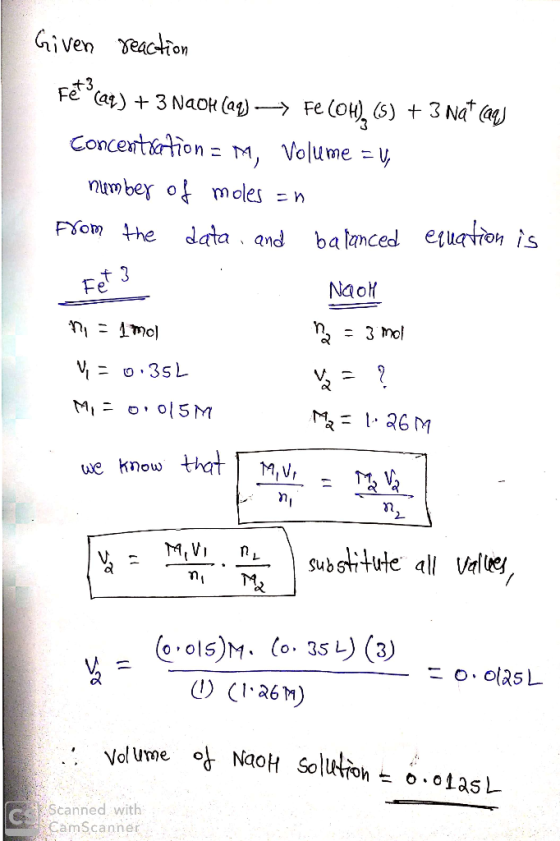
Let us assume that Fe(OH)3(s) is completely insoluble, which signifies that the precipitation reaction with NaOH(aq)...
Let us assume that Fe(OH)3(s) is completely insoluble, which signifies that the precipitation reaction with NaOH(aq) (presented in the transition) would go to completion. Fe3+(aq)+3NaOH(aq) ? Fe(OH)3(s)+3Na+(aq) If you had a 0.450 L solution containing 0.0200 M of Fe3+(aq), and you wished to add enough 1.33 M NaOH(aq) to precipitate all of the metal, what is the minimum amount of the NaOH(aq)solution you would need to add? Assume that the NaOH(aq) solution is the only source of OH?(aq) for the precipitation....
Let us assume that Cd(OH)2(s) is completely insoluble, which signifies that the precipitation reaction with NaOH(aq)...
Let us assume that Cd(OH)2(s) is completely insoluble, which signifies that the precipitation reaction with NaOH(aq) (presented in the transition) would go to completion. Cd2+(aq)+2NaOH(aq) → Cd(OH)2(s)+2Na+(aq) If you had a 0.450 L solution containing 0.0190 M of Cd2+(aq), and you wished to add enough 1.31 M NaOH(aq) to precipitate all of the metal, what is the minimum amount of the NaOH(aq) solution you would need to add? Assume that the NaOH(aq) solution is the only source of OH−(aq) for the...
Taking into account the dissolution-precipitation equilibrium of Fe(OH)2: Fe(OH)2 (s) ---> Fe2+ (aq) + 2OH- (aq)...
Taking into account the dissolution-precipitation equilibrium of Fe(OH)2: Fe(OH)2 (s) ---> Fe2+ (aq) + 2OH- (aq) (a) How much Fe2+ (expressed in mg/dm3) may be present in a water containing 0.001 M of NaOH without occurring precipitation of Fe(OH)2 ? (b) Determine the maximum amount of Fe2+ in solution (expressed in mg/dm3) by lowering the pH value of water by two units (possible by the addition of a strong acid). Kps (Fe(OH)2)= 2.0 x 10^-15 M^3
Consider the reaction. Fe (SO )3(aq) + 6 NaOH(aq) — 2 Fe(OH),(s) + 3 Na, SO,...
 Consider the reaction. Fe (SO )3(aq) + 6 NaOH(aq) — 2 Fe(OH),(s) + 3 Na, SO, (aq) What is the total ionic equation for the reaction? - O2 Fe3+ (aq) + 6 OH(aq) 2 Fe(OH),(s) O2 Fe(aq) + 3 so (aq) + 6 Na+ (aq) + 6 OH(aq) - 6 Na' (aq) + 3 50- (aq) O2 Fe3+ (aq) + 3 so (aq) + 6 Na+ (aq) + 6 OH(aq) — 2 Fe(OH),(s) + 6 Na+ (aq) + 3 SO-(aq)...
Q45 Number ONLY. 1 Point Balance the following chemical reaction: Co203 (s) + C(s) + Co...
 Q45 Number ONLY. 1 Point Balance the following chemical reaction: Co203 (s) + C(s) + Co (s) + CO2 (g) Enter the COEFFICIENTS of the reactants and products in order, TOGETHER AS ONE NUMBER in the subquestions below. THE NUMBER 1 MUST BE ENTERED Example: For 2H, + 0,2H,O you would enter 212 Q46 Multiple Choice 1 Point If aqueous solutions of lead(II) nitrate (Pb(NO3)2) and sodium sulfate (Na2SO.) are mixed together, which insoluble precipitate is formed? NaNO: Na.NO PbSO4...
Refer to the precipitation reaction below. CoCl2(aq)+2NaOH(ag) Co(OH)2(s)+2NaCI(aq) How much 0.5 M NaOH solution in liters...
 Refer to the precipitation reaction below. CoCl2(aq)+2NaOH(ag) Co(OH)2(s)+2NaCI(aq) How much 0.5 M NaOH solution in liters will completely precipitate the Co+ in 1.6 L of 0.12 M CoCl solution? Round to two significant figures, and do not include units in your answer Provide your answer below
15. The mixing of which pair of reactants will result in a precipitation reaction? CsI(aq)...
15. The mixing of which pair of reactants will result in a precipitation reaction? CsI(aq) + NaOH(aq) HCl(aq) + Ca(OH)2(aq) K2SO4(aq) + Hg2(NO3)2(aq) NaNO3(aq) + NH4Cl(aq) 16. Which of the following is a precipitation reaction? Zn(s) + 2 AgNO3(aq) 2 Ag(s) + Zn(NO3)2(aq) NaCl(aq) + LiI(aq) NaI(aq) + LiCl(aq) 2 KI(aq) + Hg2(NO3)2(aq) Hg2I2(s) + 2 KNO3(aq) HI(aq) + NaOH(aq) NaI(aq) + H2O(l) None of these are precipitation reactions. 17. Which...
The chemical equation below, FeCl3(aq) + 3NaOH(aq) → Fe(OH)3(s) + 3 NaCl(aq) is
The chemical equation below, FeCl3(aq) + 3NaOH(aq) → Fe(OH)3(s) + 3 NaCl(aq) is an example of what type of reaction? Group of answer choices precipitation acid-base combustion oxidation-reduction What mass of oxygen is consumed by the complete combustion of 7.0 grams of ethylene, C2H4? Molar mass of C2H4 = 28.05 g/mol C2H4(g) + 3 O2(g) → 2 CO2(g) + 2 H2O(g) Which of the following can donate a proton, H+ , to water? Group of answer choices HCl...
Question: Procedure Separation and Identification of Pb2 (aq), Fe (aq), Al(a), and Cu Note: Tests should...
 Question:
Procedure Separation and Identification of Pb2 (aq), Fe (aq), Al(a), and Cu Note: Tests should be performed concurrently on the known and the unknown solutions. Volumes are approximate. All work excepting the centrifugation should be done in the fume hood 1. To about 2. mL of your sample in a test tube, add 5 drops (-0.2 mL) of 6 M HCl(a). Mix well and centrifuge. Decant the clear liquid into a clean test tube and save it for Step...
Question:
Procedure Separation and Identification of Pb2 (aq), Fe (aq), Al(a), and Cu Note: Tests should be performed concurrently on the known and the unknown solutions. Volumes are approximate. All work excepting the centrifugation should be done in the fume hood 1. To about 2. mL of your sample in a test tube, add 5 drops (-0.2 mL) of 6 M HCl(a). Mix well and centrifuge. Decant the clear liquid into a clean test tube and save it for Step...
3. Insoluble metal hydroxides can be used as a "buffer" to resist changes in pH. For example, con...
 3. Insoluble metal hydroxides can be used as a "buffer" to resist changes in pH. For example, consider the solution that would sul if 0.200 moles of MgCl2 are combined wih0.200 moles of NaOH in a total volume of 1.00 liter a) Determine the concentrations of all ionic species in this solution b) Calculate the pH of this solution c) You could add 0.040 moles of NaOH to the solution in part (a), causing additional Mg(OH)2 to precipitate. Calculate the...
 Consider the reaction. Fe (SO )3(aq) + 6 NaOH(aq) — 2 Fe(OH),(s) + 3 Na, SO, (aq) What is the total ionic equation for the reaction? - O2 Fe3+ (aq) + 6 OH(aq) 2 Fe(OH),(s) O2 Fe(aq) + 3 so (aq) + 6 Na+ (aq) + 6 OH(aq) - 6 Na' (aq) + 3 50- (aq) O2 Fe3+ (aq) + 3 so (aq) + 6 Na+ (aq) + 6 OH(aq) — 2 Fe(OH),(s) + 6 Na+ (aq) + 3 SO-(aq)...
 Q45 Number ONLY. 1 Point Balance the following chemical reaction: Co203 (s) + C(s) + Co (s) + CO2 (g) Enter the COEFFICIENTS of the reactants and products in order, TOGETHER AS ONE NUMBER in the subquestions below. THE NUMBER 1 MUST BE ENTERED Example: For 2H, + 0,2H,O you would enter 212 Q46 Multiple Choice 1 Point If aqueous solutions of lead(II) nitrate (Pb(NO3)2) and sodium sulfate (Na2SO.) are mixed together, which insoluble precipitate is formed? NaNO: Na.NO PbSO4...
 Refer to the precipitation reaction below. CoCl2(aq)+2NaOH(ag) Co(OH)2(s)+2NaCI(aq) How much 0.5 M NaOH solution in liters will completely precipitate the Co+ in 1.6 L of 0.12 M CoCl solution? Round to two significant figures, and do not include units in your answer Provide your answer below
 Question:
Procedure Separation and Identification of Pb2 (aq), Fe (aq), Al(a), and Cu Note: Tests should be performed concurrently on the known and the unknown solutions. Volumes are approximate. All work excepting the centrifugation should be done in the fume hood 1. To about 2. mL of your sample in a test tube, add 5 drops (-0.2 mL) of 6 M HCl(a). Mix well and centrifuge. Decant the clear liquid into a clean test tube and save it for Step...
Question:
Procedure Separation and Identification of Pb2 (aq), Fe (aq), Al(a), and Cu Note: Tests should be performed concurrently on the known and the unknown solutions. Volumes are approximate. All work excepting the centrifugation should be done in the fume hood 1. To about 2. mL of your sample in a test tube, add 5 drops (-0.2 mL) of 6 M HCl(a). Mix well and centrifuge. Decant the clear liquid into a clean test tube and save it for Step...
 3. Insoluble metal hydroxides can be used as a "buffer" to resist changes in pH. For example, consider the solution that would sul if 0.200 moles of MgCl2 are combined wih0.200 moles of NaOH in a total volume of 1.00 liter a) Determine the concentrations of all ionic species in this solution b) Calculate the pH of this solution c) You could add 0.040 moles of NaOH to the solution in part (a), causing additional Mg(OH)2 to precipitate. Calculate the...
Most questions answered within 3 hours.
-
Where is the error in this code sequence?
String s1 = "Hello";
String s2 = "ello";...
asked 11 months ago -
Financial data for Joel de Paris, Inc., for last year
follow:
Joel de Paris, Inc.
Balance...
asked 11 months ago -
Consider this reaction:
Al2(SO4)3 (aq)+ BaCl3
(aq) Al2Cl6 (aq)- +
3BaSO4(s) . What is the...
asked 11 months ago -
Suppose that Savneet is considering increasing her
recent random sample from 20 car rentals to 40...
asked 11 months ago -
Trucks arrive at an unloading terminal at an average rate of 120
per hour.
Trucks arrive...
asked 11 months ago -
Why are methanol and ethanol completely soluble in water while
octanol is not very little soluble....
asked 11 months ago -
A facilities manager at a university reads in a research report
that the mean amount of...
asked 11 months ago -
When the CuSO4 is rehydrated by adding water to the anhydrous
compound, is this an endothermic...
asked 11 months ago -
A ray of sunlight is passing from diamond into crown glass; the
angle of incidence is...
asked 11 months ago -
A block of mass 0.249 kg is placed on top of a light, vertical
spring of...
asked 11 months ago -
how do the kidneys compensate in the presences of acidosis
a) trigger hyperventilate
b) reserve acid...
asked 11 months ago -
Question 501 pts
The rental rate of capital to the firm increases. Which of the
following...
asked 11 months ago