

Homework Answers
Add Answer to:
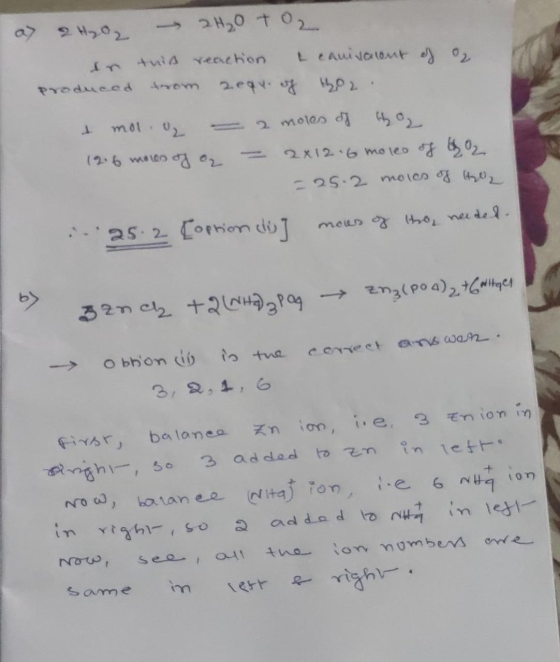
In the reaction: 2H2O2 --> 2 H20 + O2 How many moles of hydrogen peroxide would...
When hydrogen peroxide (H2O2) is used in rocket fuels, it produces water and oxygen (O2). 2H2O2(1)-2H20...
 When hydrogen peroxide (H2O2) is used in rocket fuels, it produces water and oxygen (O2). 2H2O2(1)-2H20 (1) + O2(9) How many moles of H, O, are needed to produce 4.50 mol of H, 0? Express your answer with the appropriate units. OLA OP? n(H2O2) = Value Units Submit Request Answer Part B How many grams of H, O, are required to produce 40.9 g of O,? Express your answer with the appropriate units. T! + O2 ? m(H2O2) = Value...
QUESTION 2 Consider the reaction, C5H12 + O2 -> CO2 + H20; How many moles of...
 QUESTION 2 Consider the reaction, C5H12 + O2 -> CO2 + H20; How many moles of O2 will form 1.29 moles of H20?
Hydrogen peroxide is unstable and decomposes readily: 2H2O2(aq) → 2H2O(l) + O2(g) This reaction is accelerated...
Hydrogen peroxide is unstable and decomposes readily: 2H2O2(aq) → 2H2O(l) + O2(g) This reaction is accelerated by light, heat, or a catalyst. The concentrations of aqueous hydrogen peroxide solutions are normally expressed as percent by mass. In the decomposition of hydrogen peroxide, how many liters of oxygen gas can be produced at STP from 29.0 g of a 7.50% hydrogen peroxide solution?
Consider the reaction, CH4 + O2 -> CO2 + H20. How many moles of O2 will...
 Consider the reaction, CH4 + O2 -> CO2 + H20. How many moles of O2 will react with 6.78 moles of CH4?
How many grams of hydrogen peroxide (H2O2) are needed to produce 25.0 g of oxygen?
How many grams of hydrogen peroxide (H2O2) are needed to produce 25.0 g of oxygen? 2H2O2 + 2H2O + O2 25.0g 53.1g 5.88 g 106g 26.6g
(Part A) Hydrogen peroxide is unstable and decomposes readily: 2H2O2(aq) → 2H2O(l) + O2(g) This reaction...
(Part A) Hydrogen peroxide is unstable and decomposes readily: 2H2O2(aq) → 2H2O(l) + O2(g) This reaction is accelerated by light, heat, or a catalyst. The concentrations of aqueous hydrogen peroxide solutions are normally expressed as percent by mass. In the decomposition of hydrogen peroxide, how many liters of oxygen gas can be produced at STP from 26.8 g of a 7.50% hydrogen peroxide solution? (Part B) What volume of bromine (Br2) vapor measured at 100.°C and 700. mmHg pressure would...
When hydrogen peroxide (H2O2) is used in rocket fuels, it produces water, oxygen, and heat. 2H2O2(l)⟶2H2O(l)+O2(g)ΔH=−196kJ...
When hydrogen peroxide (H2O2) is used in rocket fuels, it produces water, oxygen, and heat. 2H2O2(l)⟶2H2O(l)+O2(g)ΔH=−196kJ Part B: How many kilojoules are released when 3.05 moles of H2O2 reacts? Express your answer with the appropriate units. Part C: How many kilojoules are released when 277 g of O2 is produced? Express your answer with the appropriate units.
Hydrogen peroxide decomposes spontaneously to yield water and oxygen gas according to the reaction equation 2H2O2(aq)⟶2H2O(l)+O2(g)2H2O2(aq)⟶2H2O(l)+O2(g)...
Hydrogen peroxide decomposes spontaneously to yield water and oxygen gas according to the reaction equation 2H2O2(aq)⟶2H2O(l)+O2(g)2H2O2(aq)⟶2H2O(l)+O2(g) The activation energy for this reaction is 75 kJ⋅mol−1.75 kJ⋅mol−1. In the presence of a metal catalyst, the activation energy is lowered to 49 kJ⋅mol−1.49 kJ⋅mol−1. At what temperature would the non‑catalyzed reaction need to be run to have a rate equal to that of the metal‑catalyzed reaction at 25 ∘C? T= K
Hydrogen peroxide decomposes into water and oxygen according to the following reaction: 2H2O2(1)→ 2H2O(g) + O2(g)...
 Hydrogen peroxide decomposes into water and oxygen according to the following reaction: 2H2O2(1)→ 2H2O(g) + O2(g) 0.11 g of H2O2 is decomposed in a flask with a volume of 2.50 L. What is the pressure of O2 at 298 K? a. 0.032 atm b. 0.048 atm C. 0.016 atm d. 0.16 atm e. None of the above Predict the signs of AH° and ASº for the following reaction: O2(g) + O2(1) a. + AH°; + AS° b. + AH°; -...
7.H₂O H2 + O2 a. How many moles of oxygen are produced when 1.26 moles of...
 7.H₂O H2 + O2 a. How many moles of oxygen are produced when 1.26 moles of H,O is reacted? (1pts) 1.26 mol H201 molo2 0.63 mol 02 12 mol H20 10.0 b. How many moles of H,0 are needed to produce 55.7 moles of hydrogen? (1pts)
 When hydrogen peroxide (H2O2) is used in rocket fuels, it produces water and oxygen (O2). 2H2O2(1)-2H20 (1) + O2(9) How many moles of H, O, are needed to produce 4.50 mol of H, 0? Express your answer with the appropriate units. OLA OP? n(H2O2) = Value Units Submit Request Answer Part B How many grams of H, O, are required to produce 40.9 g of O,? Express your answer with the appropriate units. T! + O2 ? m(H2O2) = Value...
 QUESTION 2 Consider the reaction, C5H12 + O2 -> CO2 + H20; How many moles of O2 will form 1.29 moles of H20?
 Consider the reaction, CH4 + O2 -> CO2 + H20. How many moles of O2 will react with 6.78 moles of CH4?
 Hydrogen peroxide decomposes into water and oxygen according to the following reaction: 2H2O2(1)→ 2H2O(g) + O2(g) 0.11 g of H2O2 is decomposed in a flask with a volume of 2.50 L. What is the pressure of O2 at 298 K? a. 0.032 atm b. 0.048 atm C. 0.016 atm d. 0.16 atm e. None of the above Predict the signs of AH° and ASº for the following reaction: O2(g) + O2(1) a. + AH°; + AS° b. + AH°; -...
 7.H₂O H2 + O2 a. How many moles of oxygen are produced when 1.26 moles of H,O is reacted? (1pts) 1.26 mol H201 molo2 0.63 mol 02 12 mol H20 10.0 b. How many moles of H,0 are needed to produce 55.7 moles of hydrogen? (1pts)
Most questions answered within 3 hours.
-
Where is the error in this code sequence?
String s1 = "Hello";
String s2 = "ello";...
asked 11 months ago -
Financial data for Joel de Paris, Inc., for last year
follow:
Joel de Paris, Inc.
Balance...
asked 11 months ago -
Consider this reaction:
Al2(SO4)3 (aq)+ BaCl3
(aq) Al2Cl6 (aq)- +
3BaSO4(s) . What is the...
asked 11 months ago -
Suppose that Savneet is considering increasing her
recent random sample from 20 car rentals to 40...
asked 11 months ago -
Trucks arrive at an unloading terminal at an average rate of 120
per hour.
Trucks arrive...
asked 11 months ago -
Why are methanol and ethanol completely soluble in water while
octanol is not very little soluble....
asked 11 months ago -
A facilities manager at a university reads in a research report
that the mean amount of...
asked 11 months ago -
When the CuSO4 is rehydrated by adding water to the anhydrous
compound, is this an endothermic...
asked 11 months ago -
A ray of sunlight is passing from diamond into crown glass; the
angle of incidence is...
asked 11 months ago -
A block of mass 0.249 kg is placed on top of a light, vertical
spring of...
asked 11 months ago -
how do the kidneys compensate in the presences of acidosis
a) trigger hyperventilate
b) reserve acid...
asked 11 months ago -
Question 501 pts
The rental rate of capital to the firm increases. Which of the
following...
asked 11 months ago