
Homework Answers
5.
a.
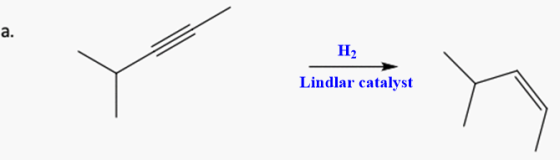
Cis-alkene is obtained from the reduction of alkyne using Lindlar catalyst.
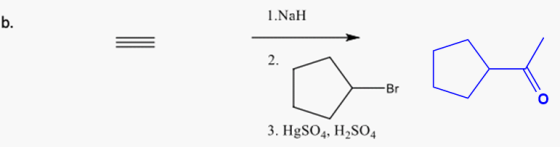
First, NaH deprotonates acetylene to form sodium acetylide. SN2 attack of acetylide to 1-bromopentane leads to the formation of cyclopentyl acetylene. Hydrolysis of the cyclopentyl acetylene in presence of acid and mercury(II) catalysts yield the cyclopentyl methyl ketone as the product.

The product alkene can be obtained from the elimination reaction of tosylate. The tosylate can be obtained from the reaction of alcohol with tosyl chloride. Hence, the starting material is an alcohol.
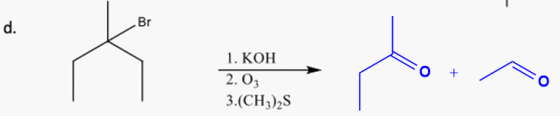
The reactant undergo elimination reaction in presence of KOH. Then ozonolysis followed by dimethyl sulfide work up gives the ketone and the aldehyde.
Add Answer to:
5. For the following set of reactions fill in the blank, whether it is the starting...
5. For the following set of reactions fill in the blank, whether it is the starting...
 5. For the following set of reactions fill in the blank, whether it is the starting material s) or product(s). Draw structures neatly and write any necessary reagents correctly. Some may include more than one step. Draw intermediates if want partial credit. (3 pts ea.) Y - 1. NaH 3. HgSO4, H2SO4 1. TCI 2. t-buOK d. 1. KOH 2. 03 3.(CH3)2S 1. (sia) BH 2. HẠO), NaOH 3. KOH 4. PCC 1. 1 eq HBr 2. mCPBA
An incomplete selection of reagents is listed below. A set of reactions and products starting with...
 An incomplete selection of reagents is listed below. A set of reactions and products starting with acetophenone 5 is depicted. Write the reagents needed for each reaction over/next to/under the arrows. Draw the intermediate in the box. Circle all of the chiral compounds in this scheme. BH, n-Bu NF f-BUOK ETO Na+ HBr HCI HI Ha(OA), HO LI/ENH, imidazole NaBHA Nah NaNH, NaOH/H2O2 Ni,B PCI Pd/Cacos/quinoline Pt pyridine SOCI2 TBSCI ZnCl2 CICI
1. Predict the product (s) (or no reaction) and reagent(s). (31 pts; no partial point) 1....
 1. Predict the product (s) (or no reaction) and reagent(s). (31 pts; no partial point) 1. TsCI, pyridine OH 2. SNa b. OH NaH C. HBr 2 eq, 0 °C d. ОН H2SO4 heat CH3 HBr Он heat f. но 1. PBr3, EtzO 2. NaCN OH NaH OTs h. Он HBr 0°C CH3 H2SO4 heat Он
Predict the products of the following reactions 1 equivalent HBr NaNH2 Br (excess) 1. Sia BH,...
 Predict the products of the following reactions
1 equivalent HBr NaNH2 Br (excess) 1. Sia BH, THE 2. H2O2, NaOH HgSO4 H2SO4 H20
Predict the products of the following reactions
1 equivalent HBr NaNH2 Br (excess) 1. Sia BH, THE 2. H2O2, NaOH HgSO4 H2SO4 H20
1. Predict the product(s) (or no reaction) and reagent(s). (31 pts; no partial point) 1. Predict...
 1. Predict the product(s) (or no reaction) and reagent(s). (31
pts; no partial point)
1. Predict the product(s) (or no reaction) and reagent(s). (31 pts; no partial point) LOH I 1. TsCI, pyridine 2. SNa SNa OH Nah or HBr 2 eq, 0 °C OH сон H2SO4 сHз heat Хон HBr heat
1. Predict the product(s) (or no reaction) and reagent(s). (31
pts; no partial point)
1. Predict the product(s) (or no reaction) and reagent(s). (31 pts; no partial point) LOH I 1. TsCI, pyridine 2. SNa SNa OH Nah or HBr 2 eq, 0 °C OH сон H2SO4 сHз heat Хон HBr heat
Place the best reagent in the bin for each of the following reactions involving cyclohexylmethanol. Ph3PB12...
 Place the best reagent in the bin for each of the following reactions involving cyclohexylmethanol. Ph3PB12 1, NaH oH Cr0 H30 .2 اوCH SOCI2 PCC ord SOCI PhPBr2 CH3 H230, PCC HBr) NaH CO. Ho HCI NaCl mCPBA NaBr
Practice Problem 11.15a Identify reagents that can be used for the following synthesis: Draw the structure...
 Practice Problem 11.15a
Identify reagents that can be used for the following
synthesis:
Draw the structure of compound A.
Practice Problem 11.15a Identify reagents that can be used for the following synthesis: он Compound A он correct. Identify reagent(s) that can be used to convert the starting alcohol into compound A. (1) TsCI, py; (2) NaOMe H2, Pt H2504 (1) TSCl, py; (2) t-BuOk SHOW ANSWER X Incorrect. Draw the structure of compound A 2 Edit Correct Identify reagent(s) that...
Practice Problem 11.15a
Identify reagents that can be used for the following
synthesis:
Draw the structure of compound A.
Practice Problem 11.15a Identify reagents that can be used for the following synthesis: он Compound A он correct. Identify reagent(s) that can be used to convert the starting alcohol into compound A. (1) TsCI, py; (2) NaOMe H2, Pt H2504 (1) TSCl, py; (2) t-BuOk SHOW ANSWER X Incorrect. Draw the structure of compound A 2 Edit Correct Identify reagent(s) that...
Instructions: Draw in the product for each of the following reactions and fill in the name...
 Instructions: Draw in the product for each of the following reactions and fill in the name under nomenclature. For Synthesis Questions please provide both the intermediate product and the reagents used. Nomenclature HBr HBr Reactions . xs NaNH2 2. NH3 H2SO4, H20 HgSO4 Br Br CI, C 1. xs NaNH H2SO4, H20 HgSO4
Select the best reagents for each of the following transformations. You should only use each set...
 Select the best reagents for each of the following transformations. You should only use each set of reagents once. You can record your answers on this worksheet, or type/write on another sheet of paper. You only need to submit the question number and the letter corresponding to the set of reagents from the table below. A H2(g), Pd/C 1 eq. HBr 2 eq. HBr H2SO4, HgSO4, H, 1) 9-BBN 2) H202, NaOH(aq) H Naº, NH3(1), -78 °C 1 eq. Br,...
Select the best reagents for each of the following transformations. You should only use each set...
 Select the best reagents for each of the following transformations. You should only use each set of reagents once. You can record your answers on this worksheet, or type/write on another sheet of paper. You only need to submit the question number and the letter corresponding to the set of reagents from the table below. H2(g), Pd/C 1 eq. HBr 2 eq. HBr H2SO4, HgSO4, H2O 1) 9-BBN 2) H2O2, NaOH(aq) H Naº, NH3(1), -78 °C 1 eq. Br2, CH2Cl2...
 5. For the following set of reactions fill in the blank, whether it is the starting material s) or product(s). Draw structures neatly and write any necessary reagents correctly. Some may include more than one step. Draw intermediates if want partial credit. (3 pts ea.) Y - 1. NaH 3. HgSO4, H2SO4 1. TCI 2. t-buOK d. 1. KOH 2. 03 3.(CH3)2S 1. (sia) BH 2. HẠO), NaOH 3. KOH 4. PCC 1. 1 eq HBr 2. mCPBA
 An incomplete selection of reagents is listed below. A set of reactions and products starting with acetophenone 5 is depicted. Write the reagents needed for each reaction over/next to/under the arrows. Draw the intermediate in the box. Circle all of the chiral compounds in this scheme. BH, n-Bu NF f-BUOK ETO Na+ HBr HCI HI Ha(OA), HO LI/ENH, imidazole NaBHA Nah NaNH, NaOH/H2O2 Ni,B PCI Pd/Cacos/quinoline Pt pyridine SOCI2 TBSCI ZnCl2 CICI
 1. Predict the product (s) (or no reaction) and reagent(s). (31 pts; no partial point) 1. TsCI, pyridine OH 2. SNa b. OH NaH C. HBr 2 eq, 0 °C d. ОН H2SO4 heat CH3 HBr Он heat f. но 1. PBr3, EtzO 2. NaCN OH NaH OTs h. Он HBr 0°C CH3 H2SO4 heat Он
 Predict the products of the following reactions
1 equivalent HBr NaNH2 Br (excess) 1. Sia BH, THE 2. H2O2, NaOH HgSO4 H2SO4 H20
Predict the products of the following reactions
1 equivalent HBr NaNH2 Br (excess) 1. Sia BH, THE 2. H2O2, NaOH HgSO4 H2SO4 H20
 1. Predict the product(s) (or no reaction) and reagent(s). (31
pts; no partial point)
1. Predict the product(s) (or no reaction) and reagent(s). (31 pts; no partial point) LOH I 1. TsCI, pyridine 2. SNa SNa OH Nah or HBr 2 eq, 0 °C OH сон H2SO4 сHз heat Хон HBr heat
1. Predict the product(s) (or no reaction) and reagent(s). (31
pts; no partial point)
1. Predict the product(s) (or no reaction) and reagent(s). (31 pts; no partial point) LOH I 1. TsCI, pyridine 2. SNa SNa OH Nah or HBr 2 eq, 0 °C OH сон H2SO4 сHз heat Хон HBr heat
 Place the best reagent in the bin for each of the following reactions involving cyclohexylmethanol. Ph3PB12 1, NaH oH Cr0 H30 .2 اوCH SOCI2 PCC ord SOCI PhPBr2 CH3 H230, PCC HBr) NaH CO. Ho HCI NaCl mCPBA NaBr
 Practice Problem 11.15a
Identify reagents that can be used for the following
synthesis:
Draw the structure of compound A.
Practice Problem 11.15a Identify reagents that can be used for the following synthesis: он Compound A он correct. Identify reagent(s) that can be used to convert the starting alcohol into compound A. (1) TsCI, py; (2) NaOMe H2, Pt H2504 (1) TSCl, py; (2) t-BuOk SHOW ANSWER X Incorrect. Draw the structure of compound A 2 Edit Correct Identify reagent(s) that...
Practice Problem 11.15a
Identify reagents that can be used for the following
synthesis:
Draw the structure of compound A.
Practice Problem 11.15a Identify reagents that can be used for the following synthesis: он Compound A он correct. Identify reagent(s) that can be used to convert the starting alcohol into compound A. (1) TsCI, py; (2) NaOMe H2, Pt H2504 (1) TSCl, py; (2) t-BuOk SHOW ANSWER X Incorrect. Draw the structure of compound A 2 Edit Correct Identify reagent(s) that...
 Instructions: Draw in the product for each of the following reactions and fill in the name under nomenclature. For Synthesis Questions please provide both the intermediate product and the reagents used. Nomenclature HBr HBr Reactions . xs NaNH2 2. NH3 H2SO4, H20 HgSO4 Br Br CI, C 1. xs NaNH H2SO4, H20 HgSO4
 Select the best reagents for each of the following transformations. You should only use each set of reagents once. You can record your answers on this worksheet, or type/write on another sheet of paper. You only need to submit the question number and the letter corresponding to the set of reagents from the table below. A H2(g), Pd/C 1 eq. HBr 2 eq. HBr H2SO4, HgSO4, H, 1) 9-BBN 2) H202, NaOH(aq) H Naº, NH3(1), -78 °C 1 eq. Br,...
 Select the best reagents for each of the following transformations. You should only use each set of reagents once. You can record your answers on this worksheet, or type/write on another sheet of paper. You only need to submit the question number and the letter corresponding to the set of reagents from the table below. H2(g), Pd/C 1 eq. HBr 2 eq. HBr H2SO4, HgSO4, H2O 1) 9-BBN 2) H2O2, NaOH(aq) H Naº, NH3(1), -78 °C 1 eq. Br2, CH2Cl2...
Most questions answered within 3 hours.
-
Where is the error in this code sequence?
String s1 = "Hello";
String s2 = "ello";...
asked 11 months ago -
Financial data for Joel de Paris, Inc., for last year
follow:
Joel de Paris, Inc.
Balance...
asked 11 months ago -
Consider this reaction:
Al2(SO4)3 (aq)+ BaCl3
(aq) Al2Cl6 (aq)- +
3BaSO4(s) . What is the...
asked 11 months ago -
Suppose that Savneet is considering increasing her
recent random sample from 20 car rentals to 40...
asked 11 months ago -
Trucks arrive at an unloading terminal at an average rate of 120
per hour.
Trucks arrive...
asked 11 months ago -
Why are methanol and ethanol completely soluble in water while
octanol is not very little soluble....
asked 11 months ago -
A facilities manager at a university reads in a research report
that the mean amount of...
asked 11 months ago -
When the CuSO4 is rehydrated by adding water to the anhydrous
compound, is this an endothermic...
asked 11 months ago -
A ray of sunlight is passing from diamond into crown glass; the
angle of incidence is...
asked 11 months ago -
A block of mass 0.249 kg is placed on top of a light, vertical
spring of...
asked 11 months ago -
how do the kidneys compensate in the presences of acidosis
a) trigger hyperventilate
b) reserve acid...
asked 11 months ago -
Question 501 pts
The rental rate of capital to the firm increases. Which of the
following...
asked 11 months ago