
Homework Answers
Add Answer to:
4. Indicate which of the following reactions results in a positive AS. a. Ba(NO3)2(aq) + Na...
3. The following figures represent distributions of two types of gas molecules between by an open...
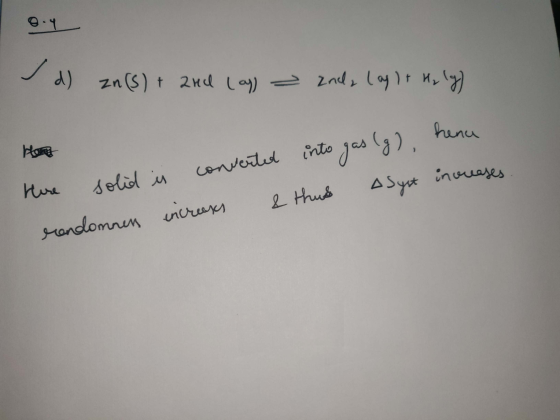
 3. The following figures represent distributions of two types of gas molecules between by an open tube. In which figure is the entropy of the system maximized? e. These are equal entropy systems 4. Indicate which of the following reactions results in a positive ASsys. a. Ba(NO3)2(aq) + Na S0,(aq) = BaSO,($) +2 NaNO3(aq) b. 4 Fe(s) +3 0 () S 2 Fe 0,($) c. 2 H (g) + O2(g) 5 2 H,O(g) d. Zn(s) + 2 HCl(aq) = ZnCl(aq)...
-2. Indicate which one of the following reactions results in a positive ASsys. a. AgNO3(aq) +...
 -2. Indicate which one of the following reactions results in a positive ASsys. a. AgNO3(aq) + NaCl(aq) 5 AgCl(s) + NaNO, (aq) b. HCl(g) + H2O(1) SHCl(aq) c. H,(g) +1,(8) $2HI(g) d. C,H,O,(8) S2CO(g) + H, (g) e. H,O(g) SHO(1)
Indicate which one of the following reactions results in a positive DSsys. AgNO3(aq) + NaCl(aq) —...
 Indicate which one of the following reactions results in a positive DSsys. AgNO3(aq) + NaCl(aq) — 7 AgCl(s) + NaNO3(aq) C2H2O2(g) + 2 CO(g) + H2(g) H2O(g) + H20(1) H2(g) +12(g) D - HI(g) HCI(g) + H2O(1) + HCl(aq)
Indicate which one of the following reactions results in a positive ?Ssys. a. AgNO3(aq) + NaCl(aq)...
Indicate which one of the following reactions results in a positive ?Ssys. a. AgNO3(aq) + NaCl(aq) <-->AgCl(s) + NaNO3(aq) b. HCl(g) + H2O(l) <--> HCl(aq) c. H2(g) + I2(g) <--> 2 HI(g) d. C2H2O2(g) <--> 2 CO(g) + H2(g) e. H2O(g) <--> H2O(aq) The answer is D. Can someone please explain why? and how the answer was determined?
Redox Equations Which of the following reactions are redox reactions? Identify the substance oxidized, the substance...
 Redox Equations Which of the following reactions are redox reactions? Identify the substance oxidized, the substance reduced, the oxidizing agent, the reducing agent. 1.2 Mg(s) + O2(g) → 2 MgO (s) 2. H SO. (aq) + Al(OH) (aq) → Al(SO.) (aq) + H,O (1) 3. 2 Na (s) + H2O (1) ► 2 NaOH(aq) + H2(g) 4. Cao (s) + CO2(g) → Caco, (s) 5. AgNO, (aq) + NaCl (aq) ► AgCl(s) + NaNO, (aq) Identify the substance oxidized, the...
Balance the following reactions and label the type of reaction. POST-LAB PROBLEMS Balance the following reactions an...
 Balance the following reactions and label the type of
reaction.
POST-LAB PROBLEMS Balance the following reactions and label the type of reaction. 1. Reaction Type Balance Chemical Reaction CaCO, CaO Co, a. Fe CuSO,(n Cu b. FeSO, 4 (a) Al O2 AlO, C. Na SO BaC NaCl d. BaSO, + 4() CH CO, H,O е. + 2 (g) HCI NaOH (aq) но, f. NaCl KNO, РЫ, * _Pb(NO) KI (ag) 2 (a) 3 (ag) 2 (ag) K,SO H,O H_SO КОН...
Balance the following reactions and label the type of
reaction.
POST-LAB PROBLEMS Balance the following reactions and label the type of reaction. 1. Reaction Type Balance Chemical Reaction CaCO, CaO Co, a. Fe CuSO,(n Cu b. FeSO, 4 (a) Al O2 AlO, C. Na SO BaC NaCl d. BaSO, + 4() CH CO, H,O е. + 2 (g) HCI NaOH (aq) но, f. NaCl KNO, РЫ, * _Pb(NO) KI (ag) 2 (a) 3 (ag) 2 (ag) K,SO H,O H_SO КОН...
All of the following reactions can be described as displacement reactions except: a.) Zn(s) + FeCl2(aq)...
All of the following reactions can be described as displacement reactions except: a.) Zn(s) + FeCl2(aq) → ZnCl2(aq) + Fe(s). b.) C6H6(l) + Cl2(g) → C6H5Cl(l) + HCl(g). c.) 2Na(s) + 2H2O(l) → 2NaOH(aq) + H2(g). d.) Cu(s) + 2AgNO3(aq) → Cu(NO3)2(aq) + 2Ag(s). e.) CuSO4(aq) + Fe(s) → Cu(s) + FeSO4(aq).
18) Which of the following is an acid-base reaction? A) Fe(s) + 2 AgNO3(aq) - 2...
 18) Which of the following is an acid-base reaction? A) Fe(s) + 2 AgNO3(aq) - 2 Ag(s) + Fe(NO3)2(aq) B) MgSO4(aq) + Ba(NO3)2(aq) -- Mg(NO3)2(aq) + Baso C) C(s) + O2(g) - CO2(g) (D) 2 HCIO 4(aq) + Ca(OH)2(aq) → 2 H2O(l) + Ca(C1O4)2 E) None of the above are acid base reactions. 1 Determine the oxidation state of P in PO 33-. A-3 B) 0 C) +6
please write legible. answer all questions. 1. Identify each of the following reactions as a precipitation...
 please write legible. answer all questions.
1. Identify each of the following reactions as a precipitation reaction, an acid-base reaction or as a redox reaction Pb(NO), (aq) + 2 HCl(aq) - PbCl(s) + 2 HNO(aq) b. 2 H2 + Oxel - 2 H2O CHNO, (aq) + KOH(aq) - KNO, (aq) + H2O (1) d. Zn + 2HCl - ZnCl + H e. Ba"(aq) + 2 Br(aq) + 2 Na' (aq) +SO. (aq) BaSO. (s) + 2 Na'(aq) + 2 Br"...
please write legible. answer all questions.
1. Identify each of the following reactions as a precipitation reaction, an acid-base reaction or as a redox reaction Pb(NO), (aq) + 2 HCl(aq) - PbCl(s) + 2 HNO(aq) b. 2 H2 + Oxel - 2 H2O CHNO, (aq) + KOH(aq) - KNO, (aq) + H2O (1) d. Zn + 2HCl - ZnCl + H e. Ba"(aq) + 2 Br(aq) + 2 Na' (aq) +SO. (aq) BaSO. (s) + 2 Na'(aq) + 2 Br"...
Complete the following precipitation reactions, predict the precipitate and balance them. Na2SO4 (aq) + Ba(NO3)2 (aq)...
Complete the following precipitation reactions, predict the precipitate and balance them. Na2SO4 (aq) + Ba(NO3)2 (aq) Fe(NO3) 3 (aq) + K2S(aq) Pb(NO3) 2 (aq) + Li2SO4 (aq) K2S (aq) + ZnCl2 (aq)
 3. The following figures represent distributions of two types of gas molecules between by an open tube. In which figure is the entropy of the system maximized? e. These are equal entropy systems 4. Indicate which of the following reactions results in a positive ASsys. a. Ba(NO3)2(aq) + Na S0,(aq) = BaSO,($) +2 NaNO3(aq) b. 4 Fe(s) +3 0 () S 2 Fe 0,($) c. 2 H (g) + O2(g) 5 2 H,O(g) d. Zn(s) + 2 HCl(aq) = ZnCl(aq)...
 -2. Indicate which one of the following reactions results in a positive ASsys. a. AgNO3(aq) + NaCl(aq) 5 AgCl(s) + NaNO, (aq) b. HCl(g) + H2O(1) SHCl(aq) c. H,(g) +1,(8) $2HI(g) d. C,H,O,(8) S2CO(g) + H, (g) e. H,O(g) SHO(1)
 Indicate which one of the following reactions results in a positive DSsys. AgNO3(aq) + NaCl(aq) — 7 AgCl(s) + NaNO3(aq) C2H2O2(g) + 2 CO(g) + H2(g) H2O(g) + H20(1) H2(g) +12(g) D - HI(g) HCI(g) + H2O(1) + HCl(aq)
 Redox Equations Which of the following reactions are redox reactions? Identify the substance oxidized, the substance reduced, the oxidizing agent, the reducing agent. 1.2 Mg(s) + O2(g) → 2 MgO (s) 2. H SO. (aq) + Al(OH) (aq) → Al(SO.) (aq) + H,O (1) 3. 2 Na (s) + H2O (1) ► 2 NaOH(aq) + H2(g) 4. Cao (s) + CO2(g) → Caco, (s) 5. AgNO, (aq) + NaCl (aq) ► AgCl(s) + NaNO, (aq) Identify the substance oxidized, the...
 Balance the following reactions and label the type of
reaction.
POST-LAB PROBLEMS Balance the following reactions and label the type of reaction. 1. Reaction Type Balance Chemical Reaction CaCO, CaO Co, a. Fe CuSO,(n Cu b. FeSO, 4 (a) Al O2 AlO, C. Na SO BaC NaCl d. BaSO, + 4() CH CO, H,O е. + 2 (g) HCI NaOH (aq) но, f. NaCl KNO, РЫ, * _Pb(NO) KI (ag) 2 (a) 3 (ag) 2 (ag) K,SO H,O H_SO КОН...
Balance the following reactions and label the type of
reaction.
POST-LAB PROBLEMS Balance the following reactions and label the type of reaction. 1. Reaction Type Balance Chemical Reaction CaCO, CaO Co, a. Fe CuSO,(n Cu b. FeSO, 4 (a) Al O2 AlO, C. Na SO BaC NaCl d. BaSO, + 4() CH CO, H,O е. + 2 (g) HCI NaOH (aq) но, f. NaCl KNO, РЫ, * _Pb(NO) KI (ag) 2 (a) 3 (ag) 2 (ag) K,SO H,O H_SO КОН...
 18) Which of the following is an acid-base reaction? A) Fe(s) + 2 AgNO3(aq) - 2 Ag(s) + Fe(NO3)2(aq) B) MgSO4(aq) + Ba(NO3)2(aq) -- Mg(NO3)2(aq) + Baso C) C(s) + O2(g) - CO2(g) (D) 2 HCIO 4(aq) + Ca(OH)2(aq) → 2 H2O(l) + Ca(C1O4)2 E) None of the above are acid base reactions. 1 Determine the oxidation state of P in PO 33-. A-3 B) 0 C) +6
 please write legible. answer all questions.
1. Identify each of the following reactions as a precipitation reaction, an acid-base reaction or as a redox reaction Pb(NO), (aq) + 2 HCl(aq) - PbCl(s) + 2 HNO(aq) b. 2 H2 + Oxel - 2 H2O CHNO, (aq) + KOH(aq) - KNO, (aq) + H2O (1) d. Zn + 2HCl - ZnCl + H e. Ba"(aq) + 2 Br(aq) + 2 Na' (aq) +SO. (aq) BaSO. (s) + 2 Na'(aq) + 2 Br"...
please write legible. answer all questions.
1. Identify each of the following reactions as a precipitation reaction, an acid-base reaction or as a redox reaction Pb(NO), (aq) + 2 HCl(aq) - PbCl(s) + 2 HNO(aq) b. 2 H2 + Oxel - 2 H2O CHNO, (aq) + KOH(aq) - KNO, (aq) + H2O (1) d. Zn + 2HCl - ZnCl + H e. Ba"(aq) + 2 Br(aq) + 2 Na' (aq) +SO. (aq) BaSO. (s) + 2 Na'(aq) + 2 Br"...
Most questions answered within 3 hours.
-
Where is the error in this code sequence?
String s1 = "Hello";
String s2 = "ello";...
asked 11 months ago -
Financial data for Joel de Paris, Inc., for last year
follow:
Joel de Paris, Inc.
Balance...
asked 11 months ago -
Consider this reaction:
Al2(SO4)3 (aq)+ BaCl3
(aq) Al2Cl6 (aq)- +
3BaSO4(s) . What is the...
asked 11 months ago -
Suppose that Savneet is considering increasing her
recent random sample from 20 car rentals to 40...
asked 11 months ago -
Trucks arrive at an unloading terminal at an average rate of 120
per hour.
Trucks arrive...
asked 11 months ago -
Why are methanol and ethanol completely soluble in water while
octanol is not very little soluble....
asked 11 months ago -
A facilities manager at a university reads in a research report
that the mean amount of...
asked 11 months ago -
When the CuSO4 is rehydrated by adding water to the anhydrous
compound, is this an endothermic...
asked 11 months ago -
A ray of sunlight is passing from diamond into crown glass; the
angle of incidence is...
asked 11 months ago -
A block of mass 0.249 kg is placed on top of a light, vertical
spring of...
asked 11 months ago -
how do the kidneys compensate in the presences of acidosis
a) trigger hyperventilate
b) reserve acid...
asked 11 months ago -
Question 501 pts
The rental rate of capital to the firm increases. Which of the
following...
asked 11 months ago