The three bulbs in (Figure 1) are identical. Part A Rank the bulbs from brightest to...
The three bulbs in (Figure 1) are identical.
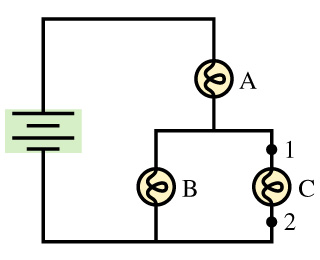
Part A Rank the bulbs from brightest to dimmest. Rank the bulbs from brightest to dimmest. To rank items as equivalent, overlap them.
Part B
Suppose a wire is connected between points 1 and 2. What happens to bulb A?
Part C
What happens to bulb B?
Part D
What happens to bulb C?
Homework Answers
The concepts used to solve this problem are effective resistance of the combination of resistor, potential across the bulbs, Ohm’s law, and the power dissipated by the bulbs.
Initially, simplify the circuit by using a parallel and series combination of resistors. Later, rank the bulb based on brightness by using the relation between the power and the current.
Finally, use the relation between the
The expression for a parallel combination of resistors is,

Here,  is the equivalent resistance of bulbs in a parallel combination,
  is the resistance of one bulb, and
  is the resistance of the other bulb.
The expression for power in the circuit is,

Here, P is the power, I is the current, and R is the resistance.
The expression for current in the circuit is,

Here, I is the current in the circuit, V is the potential, and R is the resistance
(A)
Consider the resistance of each bulb as R.
The expression to find the effective resistance for the parallel connection is,

Here,  is the effective combination of bulbs B and C connected in parallel,
 and
and  are the resistance of the bulb B and C.
Substitute R for and R for .

The combination of the resistors B and C and the resistor A are connected in series.
So, the equivalent resistance of the resistors connected in series is given by,

Here,  is the resistance of the bulb A.
Substitute  for and R for in equation as follows:

The current passing through the circuit is given by,

Here,  is the current through the circuit, V is the potential across the battery, and
  is the resistance of the circuit.
Substitute  for in equation as follows:

The bulbs A and the combination of bulbs B and C are connected in series. So, the current passing through the circuit the bulb A and the combination of bulbs B and C are same as the current passing through the circuit.
The current across the bulb A is given by,

The power across the bulb A is given by,

Substitute  for
for  in equation
  as follows:

The voltage across the combination of bulbs B and C is given by,

Substitute  for I and for in equation as follows:

The bulbs B and C are connected in parallel. So, the voltage across the bulbs B and C is equal to the voltage across the combination of bulbs.
The expression for current in the bulb B is,

Substitute  for
for  and R for
  in equation as follows:

The power across the bulb B is given by,

Substitute  for
for  and R for in equation as follows:

The expression for current in the bulb C is,

Substitute for and R for  in equation as follows:

The power across the bulb C is given by,

Substitute for  and R for
  in equation as follows:

The power across the bulb B and C is equal and is less than the power across the bulb A.
(B)
When the wire is connected across points 1 and 2 then the Bulbs B and C gets shorted.
Therefore, the current across the bulb A is given by,

(C)
When the wire is connected across the points 1 and 2 there is no current passing through the bulb B.
The expression for the power across the bulb B is given by,

From the above expression, the power across the bulb is directly proportional to the square of current across the bulb.
So, the power across the bulb B is zero.
(D)
When the wire is connected across the points 1 and 2 there is no current passing through the bulb C.
The expression for the power across the bulb C is given by,

From the above expression, the power across the bulb is directly proportional to the square of current across the bulb.
So, the power across the bulb C is zero.
Ans: Part AThe rank of power in the bulb based on brightness is .
.
The brightness of bulb A is increases.
Part CThe bulb B gets shorted.
Part DThe bulb C gets shorted.
Add Answer to:
The three bulbs in (Figure 1) are identical.
Part A Rank the bulbs from brightest to...
Most questions answered within 3 hours.
-
Where is the error in this code sequence?
String s1 = "Hello";
String s2 = "ello";...
asked 11 months ago -
Financial data for Joel de Paris, Inc., for last year
follow:
Joel de Paris, Inc.
Balance...
asked 11 months ago -
Consider this reaction:
Al2(SO4)3 (aq)+ BaCl3
(aq) Al2Cl6 (aq)- +
3BaSO4(s) . What is the...
asked 11 months ago -
Suppose that Savneet is considering increasing her
recent random sample from 20 car rentals to 40...
asked 11 months ago -
Trucks arrive at an unloading terminal at an average rate of 120
per hour.
Trucks arrive...
asked 11 months ago -
Why are methanol and ethanol completely soluble in water while
octanol is not very little soluble....
asked 11 months ago -
A facilities manager at a university reads in a research report
that the mean amount of...
asked 11 months ago -
When the CuSO4 is rehydrated by adding water to the anhydrous
compound, is this an endothermic...
asked 11 months ago -
A ray of sunlight is passing from diamond into crown glass; the
angle of incidence is...
asked 11 months ago -
A block of mass 0.249 kg is placed on top of a light, vertical
spring of...
asked 11 months ago -
how do the kidneys compensate in the presences of acidosis
a) trigger hyperventilate
b) reserve acid...
asked 11 months ago -
Question 501 pts
The rental rate of capital to the firm increases. Which of the
following...
asked 11 months ago