
Homework Answers
The concepts used to solve this problem are magnetic field due to a current carrying long straight wire, magnetic flux, Lenz’s law, and maxwell's right-hand thumb rule.
First, find the change in the magnetic field using the formula of the magnetic field due to a current carrying long straight wire then find the change in magnetic flux using its formula. Later, apply the Lenz's law and Maxwell’s right-hand thumb rule to find the direction of the induced current.
Magnetic field due to current carrying long straight wire:
The magnetic field due to current carrying long straight wire can be defined by the relation:
Here, is the magnetic field, is the magnetic permeability, is current and is the shortest distance of the point where the magnetic field needs to be found to the wire.
Magnetic flux:
Magnetic flux is the total number of magnetic field lines passing through some area per unit time.
The relation of magnetic flux can be written as:
Here, is the magnetic flux, is the magnetic field, and is the area element.
Lenz’s law:
According to this law, if there is the change in magnetic flux through a closed circuit, there will be an induced electromotive force in the circuit. The induced electromotive force generates a current such a way that the magnetic field of the induced current opposes the change in the original magnetic flux.
It can be described as:
Here, is the magnetic flux, is the time, and is the electromotive force.
Maxwell’s right-hand thumb rule:
Maxwell’s right-hand thumb explains the direction of the current and magnetic field. If a current carrying straight wire is held by the right hand such a way that the direction of thumb represents the direction of current then the fingers which warp fingers in a circular way represent the direction of the magnetic field that is generated by the current.
The same rule is applicable if the magnetic field and current are interchanged by each other. In the circuit like circular ring or coil if the warp fingers represent the direction of current then thumb will represent the direction of the magnetic field generated by the current.
A long wire is carrying steady current and a metal circular loop is moving towards the wire with a uniform velocity . The situation is shown in the figure.
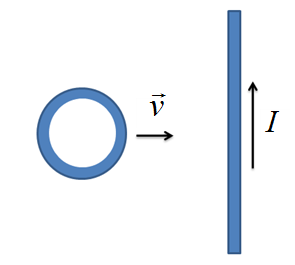

If the moment of time the ring is at distance from the wire, The magnetic field intensity can be written as,
Here, the term is constant; therefore the magnetic field only depends on the distance of the circular loop from the wire.
This dependency can be seen as:
Therefore if distance will decrease the magnetic field intensity will increase and in the current situation, the loop is moving towards the wire. Hence, the intensity of the magnetic field at the loop will increase with time.
Now using the concept of magnetic flux:
Here, the area of the circular loop is constant, so flux through the circular ring will only depend upon the magnetic field.
The relation can also be written as:
Here, is the constant area of the circular loop.
So it can be said that if the magnetic field will increase, the magnetic flux will also increase. Therefore, if the circular loop will move towards the wire, the flux through the wire will increase with time.
The concept of Lenz’s law,
According to formula if there is the change in the magnetic flux through the closed loop with the time, there will an induced electromotive force in the loop. According to Lenz’s law, the electromotive force will induce a current in the loop in such a way that the direction of the magnetic field due to induced current will oppose the original magnetic flux.
Therefore, to find the direction of the current, first, find the direction of the magnetic field due to current carrying long wire.
According to Maxwell’s right-hand thumb rule, if the direction of the right-hand thumb is towards the current in the long wire, then the direction of curled fingers will be in the outside direction through the loop. Hence the direction of magnetic flux due to current carrying log wire the magnetic flux will be outward to the loop.
The current is needed to be induced in such a way that its magnetic field should be opposing the initial flux. Therefore the direction of the magnetic field generated by the induced current will be inside the loop.
Now again applying Maxwell’s right-hand thumb rule, if the direction of thumb is inside the loop for defining the direction of the magnetic field, then the direction of curled fingers will tell about the direction of the induced current. The direction of the fingers will be clockwise. Therefore, the direction of induced current in the circular loop will be clockwise.
Ans:The induced current in the circular loop will be directed clockwise.
Add Answer to:
A metal loop moves at constant velocity toward a long wire carrying a steady current I,...
The current I in a long, straight wire is constant and is directed toward the right as in (Figure 1).
 The current I in a long, straight wire is constant and is directed toward the right as in (Figure 1). Conducting loops A, B, C, and D are moving, in the directions shown, near the wire. Part A For each loop, is the direction of the induced current clockwise or counterclockwise, or is the induced current zero? Drag the appropriate items to their respective bins. Part B For each loop, what is the direction of the net force that the wire exerts on the...
A long straight wire carrying a current I1 is near a wire loop as shown.
A long straight wire carrying a current I1 is near a wire loop as shown. For each part, determine whether the magnetic flux Φ through the loop due to Ii is into the page, out of the page or zero, and whether the current 12 induced in the loop is clockwise, counterclockwise or zero. a) I1 is constant to the left and the loop is moving toward the wireΦ: into page/out of page/zero I2: clockwise/counterclockwise/zero b) I1 is increasing to the right Φ: into...
A loop is moved toward a current-carrying wire as shown below. As the wire is moving,...
 A loop is moved toward a current-carrying wire as shown below. As the wire is moving, A B There is not enough information to correctly answer this question a clockwise current is induced in the loop a counterclockwise current is induced in the loop No current is induced in the loop D
For each of the actions depicted below, a magnet and/or metal loop moves with velocity v?...
 For each of the actions depicted below, a magnet and/or metal
loop moves with velocity v? (v? is constant and has the same
magnitude in all parts). Determine whether a current is induced in
the metal loop. If so, indicate the direction of the current in the
loop, either clockwise or counterclockwise when seen from the right
of the loop. The axis of the magnet is lined up with the center of
the loop.
Part A
For the action depicted...
For each of the actions depicted below, a magnet and/or metal
loop moves with velocity v? (v? is constant and has the same
magnitude in all parts). Determine whether a current is induced in
the metal loop. If so, indicate the direction of the current in the
loop, either clockwise or counterclockwise when seen from the right
of the loop. The axis of the magnet is lined up with the center of
the loop.
Part A
For the action depicted...
A loop of wire in the shape of a rectangle of width w and length L and a long
 A loop of wire in the shape of a rectangle of width w and length L and a long, straight wire carrying a current I lie on a tabletop as shown in the figure below.(a) Determine the magnetic flux through the loop due to the current I. (Use any variable stated above along with the following as necessary: μ₀ . )ΦB=(b) Suppose the current is changing with time according to I=a+b t, where a and b are constants. Determine the...
A rectangular loop of dimensions / and w moves with a constant velocity v away from an infinitely long straight wire carrying a current I in the plane of the loop, as shown in Figure 10.9.6
 Problem 2 (Current through Loop) A rectangular loop of dimensions / and w moves with a constant velocity v away from an infinitely long straight wire carrying a current I in the plane of the loop, as shown in Figure 10.9.6. Let the total resistance of the loop be R. What is the current in the loop at the instant the near side is a distance r from the wire? Figure 10.9.6 A rectangular loop moving away from a current-carrying wire
A loop of wire in the shape of a rectangle of width w and length L and a long, straight wire carrying a current I lie on a tabletop as shown in the figure below.
 A loop of wire in the shape of a rectangle of width w and length L and a long, straight wire carrying a current I lie on a tabletop as shown in the figure below. (a) Determine the magnetic flux through the loop due to the current I. (b) Suppose the current is changing with time according to I = a + bt, where a and b are constants. Determine the magnitude of the emf that is induced in the loop if...
A loop of wire in the shape of a rectangle of width w and length L and a long, straight wire carrying a current I lie on a tabletop as shown in the figure below
 A loop of wire in the shape of a rectangle of width w and length L and a long, straight wire carrying a current I lie on a tabletop as shown in the figure below (a) Determine the magnetic flux through the loop due to the current I. (Use any variable stated above along with the following as necessary: μ0 and π.) (b) Suppose the current is changing with time according to I = a + bt, where a and b are...
A long straight wire carrying a current of 2.03 A moves with a constant speed v...
 A long straight wire carrying a current of 2.03 A moves with a constant speed v to the right. A 120 turn circular coil of diameter 1.50 cm, and resistance of 3.25 u 2, lies stationary in the same plane as the straight wire. At some initial time the wire is to the left of the coil at a distance d = 13.0 cm from its center. 5.00 s later, the wire has moved to the right of the coil...
(5 Points) The figure below shows a rectangular loop of wire moving away from a long...
 (5 Points) The figure below shows a rectangular loop of wire moving away from a long straight wire carrying a constant current upward. What is the direction of the current induced in the loop? I This no current induced clockwise counterclockwise d need more information
 A loop is moved toward a current-carrying wire as shown below. As the wire is moving, A B There is not enough information to correctly answer this question a clockwise current is induced in the loop a counterclockwise current is induced in the loop No current is induced in the loop D
 For each of the actions depicted below, a magnet and/or metal
loop moves with velocity v? (v? is constant and has the same
magnitude in all parts). Determine whether a current is induced in
the metal loop. If so, indicate the direction of the current in the
loop, either clockwise or counterclockwise when seen from the right
of the loop. The axis of the magnet is lined up with the center of
the loop.
Part A
For the action depicted...
For each of the actions depicted below, a magnet and/or metal
loop moves with velocity v? (v? is constant and has the same
magnitude in all parts). Determine whether a current is induced in
the metal loop. If so, indicate the direction of the current in the
loop, either clockwise or counterclockwise when seen from the right
of the loop. The axis of the magnet is lined up with the center of
the loop.
Part A
For the action depicted...
 A long straight wire carrying a current of 2.03 A moves with a constant speed v to the right. A 120 turn circular coil of diameter 1.50 cm, and resistance of 3.25 u 2, lies stationary in the same plane as the straight wire. At some initial time the wire is to the left of the coil at a distance d = 13.0 cm from its center. 5.00 s later, the wire has moved to the right of the coil...
 (5 Points) The figure below shows a rectangular loop of wire moving away from a long straight wire carrying a constant current upward. What is the direction of the current induced in the loop? I This no current induced clockwise counterclockwise d need more information
Most questions answered within 3 hours.
-
Where is the error in this code sequence?
String s1 = "Hello";
String s2 = "ello";...
asked 11 months ago -
Financial data for Joel de Paris, Inc., for last year
follow:
Joel de Paris, Inc.
Balance...
asked 11 months ago -
Consider this reaction:
Al2(SO4)3 (aq)+ BaCl3
(aq) Al2Cl6 (aq)- +
3BaSO4(s) . What is the...
asked 11 months ago -
Suppose that Savneet is considering increasing her
recent random sample from 20 car rentals to 40...
asked 11 months ago -
Trucks arrive at an unloading terminal at an average rate of 120
per hour.
Trucks arrive...
asked 11 months ago -
Why are methanol and ethanol completely soluble in water while
octanol is not very little soluble....
asked 11 months ago -
A facilities manager at a university reads in a research report
that the mean amount of...
asked 11 months ago -
When the CuSO4 is rehydrated by adding water to the anhydrous
compound, is this an endothermic...
asked 11 months ago -
A ray of sunlight is passing from diamond into crown glass; the
angle of incidence is...
asked 11 months ago -
A block of mass 0.249 kg is placed on top of a light, vertical
spring of...
asked 11 months ago -
how do the kidneys compensate in the presences of acidosis
a) trigger hyperventilate
b) reserve acid...
asked 11 months ago -
Question 501 pts
The rental rate of capital to the firm increases. Which of the
following...
asked 11 months ago