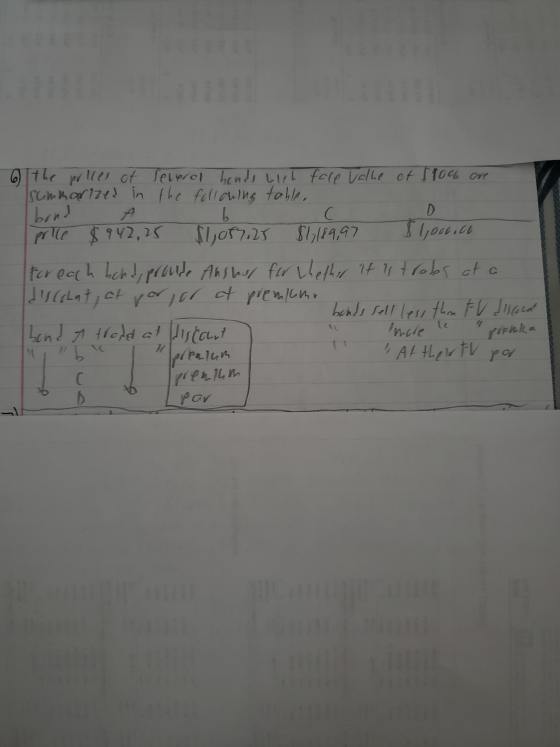
The prices of several bonds with face values of $1,000 are summarized in the following table: Bond A B C D Price $942.25 $1,057.25 $1,189.97 $1,000.00 For each bond, provide an answer for whether it trades at a discount, at par, or at a premium
The prices of several bonds with face values of are summarized in the following table:
Bond | A | B | C | D |
Price | $ | $ | $ | $ |
For each bond, provide an answer for whether it trades at a discount, at par, or at a premium.
Homework Answers
Add Answer to:
The prices of several bonds with face values of $1,000 are summarized in the following table: Bond A B C D Price $942.25 $1,057.25 $1,189.97 $1,000.00 For each bond, provide an answer for whether it trades at a discount, at par, or at a premium
The prices of several bonds with face values of $1,000 are summarized in the following table:...
 The prices of several bonds with face values of $1,000 are summarized in the following table: For each bond, state whether it trades at a discount, at par. or at a premium. Bond A is selling at (Select from the drop-down menu.)
steps by steps please, by using the fourmal Study the following table and answer questions: c. Bond ABond B Par Value (R...
 steps by steps please, by using the fourmal
Study the following table and answer questions: c. Bond ABond B Par Value (RM) 1,000 1,000 Coupon Rate(%) Maturity (years) 10 15 I 20 What would be the bond price if both bonds have a required rate of return of i) 8%? (6 marks) ii) Describe what it means if bond sells at a discount, a premium, and its face amount (par value). (5 marks)
Study the following table and answer questions:...
steps by steps please, by using the fourmal
Study the following table and answer questions: c. Bond ABond B Par Value (RM) 1,000 1,000 Coupon Rate(%) Maturity (years) 10 15 I 20 What would be the bond price if both bonds have a required rate of return of i) 8%? (6 marks) ii) Describe what it means if bond sells at a discount, a premium, and its face amount (par value). (5 marks)
Study the following table and answer questions:...
Bond prices. Price the bonds from the following table with monthly coupon payments. Par Value Coupon...
Bond prices. Price the bonds from the following table with monthly coupon payments. Par Value Coupon Rate Years to Maturity Yield to Maturity Price $1,000.00 9% 25 7% ? $1,000.00 10% 10 11% ? $5,000.00 5% 10 8% ? $5,000.00 7% 5 9% ? Hint: make sure to round all intermediate calculations to at least seven decimal places. a. Find the price for the bond in the following table: (Round to the nearest cent.) Par Value Coupon Rate Years to...
Bond prices. Price the bonds from the following table with semiannual coupon payments: a. Find the...
 Bond prices. Price the bonds from the following table with semiannual coupon payments: a. Find the price for the bond in the following table: (Round to the nearest cent.) Coupon Rate Par Value $1,000.00 Years to Maturity 15 Yield to Maturity 10% Price $ 5% Bond prices. Price the bonds from the following table with semiannual coupon payments: a. Find the price for the bond in the following table: (Round to the nearest cent.) Years to Yield to Coupon Nuri...
Prices of zero-coupon, default-free securities with face values of $1,000 are summarized in the following table:...
 Prices of zero-coupon, default-free securities with face values of $1,000 are summarized in the following table: Maturity (years) Price (per $1,000 face value) $971.52 $939.15 $904.51 Suppose you observe that a three-year, default-free security with an annual coupon rate of 10% and a face value of $1,000 has a price today of $1,182.85. Is there an arbitrage opportunity? If so, show specifically how you would take advantage of this opportunity. If not, why not?
Bond prices. Price the bonds from the following table with semiannual coupon payments: a. Find the price for the bo...
 Bond prices. Price the bonds from the following table with semiannual coupon payments: a. Find the price for the bond in the following table: (Round to the nearest cent) Coupon Rate Year to Maturity Yield to Maturity Price Par Value $5,000.00 $ 7,49447 b. Find the price for the bond in the following table: (Round to the ne 0 Data Table Years to Maturity Yield Matur Par Value $1,000.00 Coupon Rate 10% (Click on the following icon in order to...
Bond prices. Price the bonds from the following table with annual Coupon payments: Find the price...
 Bond prices. Price the bonds from the following table with annual Coupon payments: Find the price for the bond in the following table (Round to the nearest cent) Yield to Maturity Years to Maturity 15 Par Value $5,000.00 Price Coupon Rate 10% Data Table (Click on the following icon in order to copy its contents into a spreadsheet.) Years to Maturity Yield to Maturity Price Coupon Rate 10% Par Value $5,000.00 $1,000.00 $1,000.00 $1,000.00 12% 7% 15 20 Print Done
Bond prices: Price the bonds from the following table with semiannual coupon (Coupon is the regular...
Bond prices: Price the bonds from the following table with semiannual coupon (Coupon is the regular interest payment of a bond) payments. a. Find the price for the bond in the following table: (Round to the nearest cent.) Par Value: $1,000.00 Coupon Rate: 10% Years to Maturity: 25 Yield to Maturity: 11% What is the answer for the: Price: $??
6) Which of the following statements is FALSE? A) If the bond trades at a discount,...
6) Which of the following statements is FALSE? A) If the bond trades at a discount, and investor who buys the bond will earn a return both from receiving the coupons and from receiving a face value that exceeds the price paid for the bond. B) Most coupon bond issuers choose a coupon rate so that the bonds will initially trade at, or very near to, par. C) Coupon bonds always trade for a discount. D) At any point in...
Bond prices. Price the bonds from the following table with semiannual coupon payments: E. a. Find...
 Bond prices. Price the bonds from the following table with semiannual coupon payments: E. a. Find the price for the bond in the following table: (Round to the nearest cent.) Years to Yield to Coupon Par Value $1,000.00 129 Data Table (Click on the following icon in order to copy its contents into a spreadsheet.) Years to Matu Price 25 ? Par Value $1,000.00 $5,000.00 $5,000.00 $1,000.00 Coupon Rate 12% 6% 9% Yield to Maturity 5% 9% 10% 11% ?...
 The prices of several bonds with face values of $1,000 are summarized in the following table: For each bond, state whether it trades at a discount, at par. or at a premium. Bond A is selling at (Select from the drop-down menu.)
 steps by steps please, by using the fourmal
Study the following table and answer questions: c. Bond ABond B Par Value (RM) 1,000 1,000 Coupon Rate(%) Maturity (years) 10 15 I 20 What would be the bond price if both bonds have a required rate of return of i) 8%? (6 marks) ii) Describe what it means if bond sells at a discount, a premium, and its face amount (par value). (5 marks)
Study the following table and answer questions:...
steps by steps please, by using the fourmal
Study the following table and answer questions: c. Bond ABond B Par Value (RM) 1,000 1,000 Coupon Rate(%) Maturity (years) 10 15 I 20 What would be the bond price if both bonds have a required rate of return of i) 8%? (6 marks) ii) Describe what it means if bond sells at a discount, a premium, and its face amount (par value). (5 marks)
Study the following table and answer questions:...
 Bond prices. Price the bonds from the following table with semiannual coupon payments: a. Find the price for the bond in the following table: (Round to the nearest cent.) Coupon Rate Par Value $1,000.00 Years to Maturity 15 Yield to Maturity 10% Price $ 5% Bond prices. Price the bonds from the following table with semiannual coupon payments: a. Find the price for the bond in the following table: (Round to the nearest cent.) Years to Yield to Coupon Nuri...
 Prices of zero-coupon, default-free securities with face values of $1,000 are summarized in the following table: Maturity (years) Price (per $1,000 face value) $971.52 $939.15 $904.51 Suppose you observe that a three-year, default-free security with an annual coupon rate of 10% and a face value of $1,000 has a price today of $1,182.85. Is there an arbitrage opportunity? If so, show specifically how you would take advantage of this opportunity. If not, why not?
 Bond prices. Price the bonds from the following table with semiannual coupon payments: a. Find the price for the bond in the following table: (Round to the nearest cent) Coupon Rate Year to Maturity Yield to Maturity Price Par Value $5,000.00 $ 7,49447 b. Find the price for the bond in the following table: (Round to the ne 0 Data Table Years to Maturity Yield Matur Par Value $1,000.00 Coupon Rate 10% (Click on the following icon in order to...
 Bond prices. Price the bonds from the following table with annual Coupon payments: Find the price for the bond in the following table (Round to the nearest cent) Yield to Maturity Years to Maturity 15 Par Value $5,000.00 Price Coupon Rate 10% Data Table (Click on the following icon in order to copy its contents into a spreadsheet.) Years to Maturity Yield to Maturity Price Coupon Rate 10% Par Value $5,000.00 $1,000.00 $1,000.00 $1,000.00 12% 7% 15 20 Print Done
 Bond prices. Price the bonds from the following table with semiannual coupon payments: E. a. Find the price for the bond in the following table: (Round to the nearest cent.) Years to Yield to Coupon Par Value $1,000.00 129 Data Table (Click on the following icon in order to copy its contents into a spreadsheet.) Years to Matu Price 25 ? Par Value $1,000.00 $5,000.00 $5,000.00 $1,000.00 Coupon Rate 12% 6% 9% Yield to Maturity 5% 9% 10% 11% ?...
Most questions answered within 3 hours.
-
Where is the error in this code sequence?
String s1 = "Hello";
String s2 = "ello";...
asked 11 months ago -
Financial data for Joel de Paris, Inc., for last year
follow:
Joel de Paris, Inc.
Balance...
asked 11 months ago -
Consider this reaction:
Al2(SO4)3 (aq)+ BaCl3
(aq) Al2Cl6 (aq)- +
3BaSO4(s) . What is the...
asked 11 months ago -
Suppose that Savneet is considering increasing her
recent random sample from 20 car rentals to 40...
asked 11 months ago -
Trucks arrive at an unloading terminal at an average rate of 120
per hour.
Trucks arrive...
asked 11 months ago -
Why are methanol and ethanol completely soluble in water while
octanol is not very little soluble....
asked 11 months ago -
A facilities manager at a university reads in a research report
that the mean amount of...
asked 11 months ago -
When the CuSO4 is rehydrated by adding water to the anhydrous
compound, is this an endothermic...
asked 11 months ago -
A ray of sunlight is passing from diamond into crown glass; the
angle of incidence is...
asked 11 months ago -
A block of mass 0.249 kg is placed on top of a light, vertical
spring of...
asked 11 months ago -
how do the kidneys compensate in the presences of acidosis
a) trigger hyperventilate
b) reserve acid...
asked 11 months ago -
Question 501 pts
The rental rate of capital to the firm increases. Which of the
following...
asked 11 months ago