The existence of money leads to a. greater specialization in production, but not to a higher...
The existence of money leads to
|
|
a. |
greater specialization in production, but not to a higher standard of living. |
|
|
b. |
a higher standard of living, but not to greater specialization. |
|
|
c. |
greater specialization and to a higher standard of living. |
|
|
d. |
neither greater specialization nor to a higher standard of living. |
Homework Answers
Answer
Option C
greater specialization and to a higher standard of living
Money is used for the transaction, to save and to value, this features of money leads to greater specialization and to a higher standard of living as the money can be used for trade and the requirements can be measured in money. It reduces the barter system which is a barrier to trade and opens up the door for specialization as anyone can trade and get goods at lower rates from the specialized produces and each one can specialize as per the available resources.
Add Answer to:
The existence of money leads to
a.
greater specialization in production, but not to a higher...
1. Which of the following properly describes the interest-rate effect? a. A higher price level leads to higher money demand, higher money demand leads to higher interest rates, and a higher interest rate increases the quantity of goods and serv
1. Which of the following properly describes the interest-rate effect? a. A higher price level leads to higher money demand, higher money demand leads to higher interest rates, and a higher interest rate increases the quantity of goods and services demanded.b. A higher price level leads to higher money demand, higher money demand leads to lower interest rates, and a lower interest rate reduces the quantity of goods and services demanded.c. A lower price level leads to lower money demand, lower...
To look for evidence concerning whether higher money growth leads to higher inflation, one should, according...
To look for evidence concerning whether higher money growth leads to higher inflation, one should, according to the quantity equation, examine periods of time when 1. changes in velocity and real GDP were small compared to changes in inflation and money growth. 2. changes in the price level and real GDP were small compared to changes in velocity and money growth. 3. changes in the price level and velocity were small compared to changes in velocity and real GDP. 4....
hich of the following statements is true? As the degree of specialization and interdependence has increased...
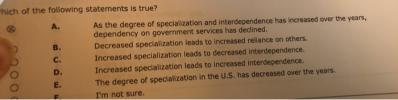 hich of the following statements is true? As the degree of specialization and interdependence has increased over the years, dependency on government services has declined. Decreased specialization leads to increased reliance on others. Increased specialization leads to decreased interdependence. Increased specialization leads to increased interdependence. The degree of specialization in the U.S. has decreased over the years. I'm not sure A. B. c. D. E.
Bank runs a. will affect neither the money supply nor the money multiplier. b. increase the...
Bank runs a. will affect neither the money supply nor the money multiplier. b. increase the money supply c. can be neither prevented nor mitigated by the Federal Reserve. d. are a problem because banks only hold a fraction of deposits as reserves.
13. According to the two production possibility curves shown, Country A should specialize in the production...
 13. According to the two production possibility curves shown, Country A should specialize in the production of which of the following? Corn (tons) 6 5 4 3 2 1 Country A Country B 0 2 15 Wheat (tons) a. Wheat b. Both corn and wheat c. Corn d. Neither corn nor wheat. a. 14. Which of the following is NOT a benefit of specialization and exchange? Taxes will be reduced. b. A country can produce beyond its production possibility curve....
17. In the following graph showing indifference curves for country A (a) and for country B...
 17. In the following graph showing indifference curves for country A (a) and for country B (b) in a situation where both countries have the same production possibilities frontier, in autarky, Px/Py in country A is Px/Py in country B, and, if trade begins, country A will export good good Y sood X a. less than; X b. less than; Y c. greater than; X d. greater than; Y 18. Given the following diagram showing a fixed-quantity production-possibilities frontier, a...
13. Suppose the United States unexpectedly decided to pay off its debt by printing new money....
13. Suppose the United States unexpectedly decided to pay off its debt by printing new money. Which of the following would happen? A. Prices would rise. B. People who had lent money at a fixed interest rate would feel poorer. C. People who held money would feel poorer. D. All of the above are correct. E. A and B, only 14. The Fisher effect A. says the government can generate revenue by printing money. B. says there is a one...
Identify the correct statement. a. Neither the initial development process nor the sustained growth of an...
 Identify the correct statement. a. Neither the initial development process nor the sustained growth of an economy is dependent on a large natural resource base. b. An increase in labor input necessarily increases output per capita. c. Economic growth is usually measured by the annual percent change in the nominal output of goods and services per capita. d. Improvements in and greater stocks of land, labor, capital, and entrepreneurial activity shift the production possibilities curve inward. Oe. According to the...
Economists refer to the relationship that a higher price leads to a lower quantity demanded as...
Economists refer to the relationship that a higher price leads to a lower quantity demanded as the a- income gap b- market equilibrium c- law of demand d- price model
Import tariff in the case of domestic monopoly a) leads to a higher welfare than the equivalent quota b) leads to the lower domestic prices than in the case of free trade c) leads to a lower welfare t...
Import tariff in the case of domestic monopoly a) leads to a higher welfare than the equivalent quota b) leads to the lower domestic prices than in the case of free trade c) leads to a lower welfare than the equivalent quota d) leads to the same level of welfare than the equivalent quota
 hich of the following statements is true? As the degree of specialization and interdependence has increased over the years, dependency on government services has declined. Decreased specialization leads to increased reliance on others. Increased specialization leads to decreased interdependence. Increased specialization leads to increased interdependence. The degree of specialization in the U.S. has decreased over the years. I'm not sure A. B. c. D. E.
 13. According to the two production possibility curves shown, Country A should specialize in the production of which of the following? Corn (tons) 6 5 4 3 2 1 Country A Country B 0 2 15 Wheat (tons) a. Wheat b. Both corn and wheat c. Corn d. Neither corn nor wheat. a. 14. Which of the following is NOT a benefit of specialization and exchange? Taxes will be reduced. b. A country can produce beyond its production possibility curve....
 17. In the following graph showing indifference curves for country A (a) and for country B (b) in a situation where both countries have the same production possibilities frontier, in autarky, Px/Py in country A is Px/Py in country B, and, if trade begins, country A will export good good Y sood X a. less than; X b. less than; Y c. greater than; X d. greater than; Y 18. Given the following diagram showing a fixed-quantity production-possibilities frontier, a...
 Identify the correct statement. a. Neither the initial development process nor the sustained growth of an economy is dependent on a large natural resource base. b. An increase in labor input necessarily increases output per capita. c. Economic growth is usually measured by the annual percent change in the nominal output of goods and services per capita. d. Improvements in and greater stocks of land, labor, capital, and entrepreneurial activity shift the production possibilities curve inward. Oe. According to the...
Most questions answered within 3 hours.
-
Where is the error in this code sequence?
String s1 = "Hello";
String s2 = "ello";...
asked 11 months ago -
Financial data for Joel de Paris, Inc., for last year
follow:
Joel de Paris, Inc.
Balance...
asked 11 months ago -
Consider this reaction:
Al2(SO4)3 (aq)+ BaCl3
(aq) Al2Cl6 (aq)- +
3BaSO4(s) . What is the...
asked 11 months ago -
Suppose that Savneet is considering increasing her
recent random sample from 20 car rentals to 40...
asked 11 months ago -
Trucks arrive at an unloading terminal at an average rate of 120
per hour.
Trucks arrive...
asked 11 months ago -
Why are methanol and ethanol completely soluble in water while
octanol is not very little soluble....
asked 11 months ago -
A facilities manager at a university reads in a research report
that the mean amount of...
asked 11 months ago -
When the CuSO4 is rehydrated by adding water to the anhydrous
compound, is this an endothermic...
asked 11 months ago -
A ray of sunlight is passing from diamond into crown glass; the
angle of incidence is...
asked 11 months ago -
A block of mass 0.249 kg is placed on top of a light, vertical
spring of...
asked 11 months ago -
how do the kidneys compensate in the presences of acidosis
a) trigger hyperventilate
b) reserve acid...
asked 11 months ago -
Question 501 pts
The rental rate of capital to the firm increases. Which of the
following...
asked 11 months ago