As per the Given Questions By Finite Element Analysis the Result
has been Studied.
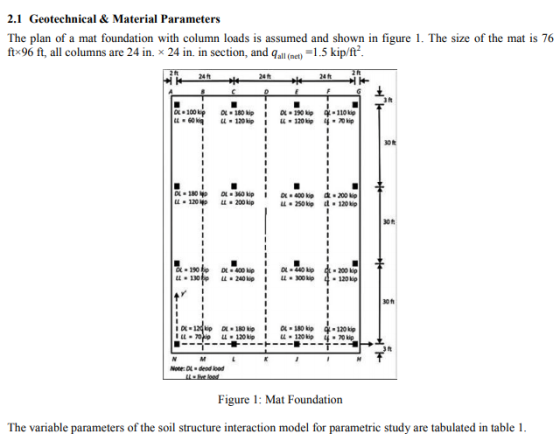
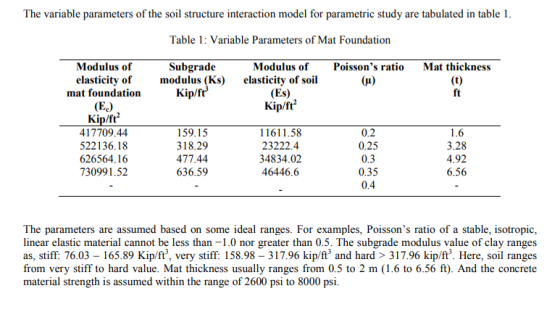
2.1 Geotechnical & Material Parameters The plan of a mat foundation with column loads is assumed and shown in figure 1. The size of the mat is 76 flx96 ft, all columns are 24 in. * 24 in. in section, and all (net) =1.5 kip/ft?. 24 24 2 D G 1 DE 100 p LOG DL180 kip U-120 kip I I D 190 kg 120 i - 110 Lip 4 kip 1 1 1 30 F2 180P u 120 DL360 Hip 1 u. 200 kip ! DE 400 kip d. 200 kip 250 kip 120 kip 1 30: - DL-40 kip u. 300 kg 200 kip • 120 kip DE 400 kipi 13010 240 kip 1 1 ! 1 1 Dt 120 tip DL180 kip! IL 700 120 kip 301 OL 180 kip 4 - 120 kip L. 120 kip 70 kg N M Note:Oldead lood Figure 1: Mat Foundation The variable parameters of the soil structure interaction model for parametric study are tabulated in table 1.
The variable parameters of the soil structure interaction model for parametric study are tabulated in table 1. Table 1: Variable Parameters of Mat Foundation Modulus of Subgrade Modulus of Poisson's ratio Mat thickness elasticity of modulus (Ks) elasticity of soil mat foundation Kip/ft (Es) ft (E) Kip/ft? Kip/ft? 417709.44 159.15 11611.58 0.2 1.6 522136.18 318.29 23222.4 0.25 3.28 626564.16 477.44 34834.02 0.3 4.92 730991.52 636.59 46446.6 0.35 6.56 0.4 The parameters are assumed based on some ideal ranges. For examples, Poisson's ratio of a stable, isotropic, linear elastic material cannot be less than -1.0 nor greater than 0.5. The subgrade modulus value of clay ranges as, stiff: 76.03 – 165.89 Kip/ft, very stiff: 158.98 – 317.96 kip/ft and hard > 317.96 kip/ft? Here, soil ranges from very stiff to hard value. Mat thickness usually ranges from 0.5 to 2 m (1.6 to 6.56 ft). And the concrete material strength is assumed within the range of 2600 psi to 8000 psi.
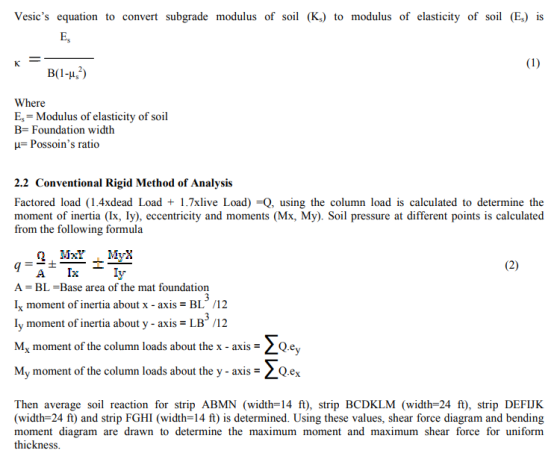
Vesic's equation to convert subgrade modulus of soil (K) to modulus of elasticity of soil (Es) is ES K (1) B(1-u,?) Where Es = Modulus of elasticity of soil B= Foundation width u= Possoin's ratio 2.2 Conventional Rigid Method of Analysis Factored load (1.4xdead Load + 1.7xlive Load) =Q, using the column load is calculated to determine the moment of inertia (Ix, ly), eccentricity and moments (Mx, My). Soil pressure at different points is calculated from the following formula (2) 9 - Ix A = BL =Base area of the mat foundation 1x moment of inertia about x -axis = BL /12 ly moment of inertia about y - axis = LB” /12 My moment of the column loads about the x - axis - Epey My moment of the column loads about the y - axis = {Q.ex Then average soil reaction for strip ABMN (width=14 ft), strip BCDKLM (width=24 ft), strip DEFIJK (width=24 ft) and strip FGHI (width=14 ft) is determined. Using these values, shear force diagram and bending moment diagram are drawn to determine the maximum moment and maximum shear force for uniform thickness.
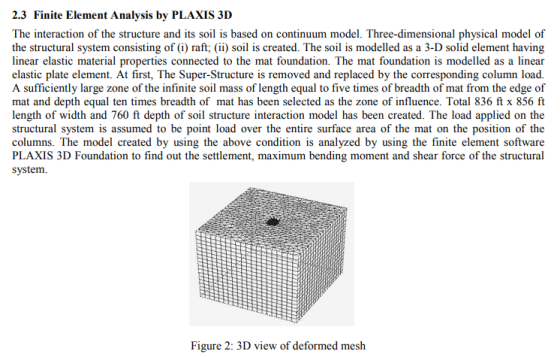
2.3 Finite Element Analysis by PLAXIS 3D The interaction of the structure and its soil is based on continuum model. Three-dimensional physical model of the structural system consisting of (i) raft; (ii) soil is created. The soil is modelled as a 3-D solid element having linear elastic material properties connected to the mat foundation. The mat foundation is modelled as a linear elastic plate element. At first, The Super-Structure is removed and replaced by the corresponding column load. A sufficiently large zone of the infinite soil mass of length equal to five times of breadth of mat from the edge of mat and depth equal ten times breadth of mat has been selected as the zone of influence. Total 836 ft x 856 ft length of width and 760 ft depth of soil structure interaction model has been created. The load applied on the structural system is assumed to be point load over the entire surface area of the mat on the position of the columns. The model created by using the above condition is analyzed by using the finite element software PLAXIS 3D Foundation to find out the settlement, maximum bending moment and shear force of the structural system. Figure 2: 3D view of deformed mesh
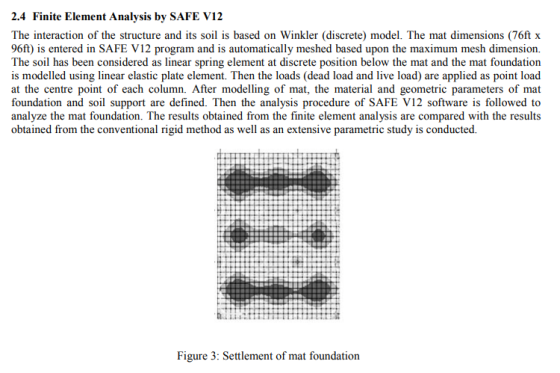
2.4 Finite Element Analysis by SAFE V12 The interaction of the structure and its soil is based on Winkler (discrete) model. The mat dimensions (76ft x 96ft) is entered in SAFE V12 program and is automatically meshed based upon the maximum mesh dimension. The soil has been considered as linear spring element at discrete position below the mat and the mat foundation is modelled using linear elastic plate element. Then the loads (dead load and live load) are applied as point load at the centre point of each column. After modelling of mat, the material and geometric parameters of mat foundation and soil support are defined. Then the analysis procedure of SAFE V12 software is followed to analyze the mat foundation. The results obtained from the finite element analysis are compared with the results obtained from the conventional rigid method as well as an extensive parametric study is conducted. 111 Figure 3: Settlement of mat foundation
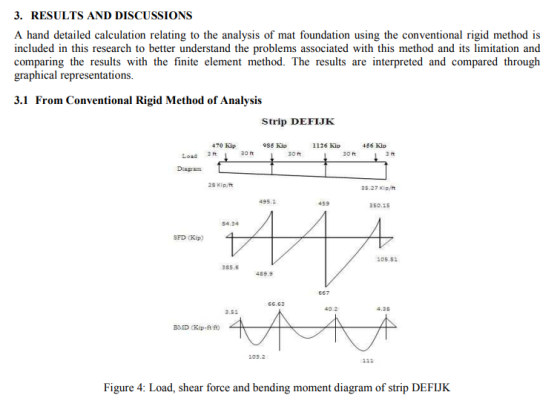
3. RESULTS AND DISCUSSIONS A hand detailed calculation relating to the analysis of mat foundation using the conventional rigid method is included in this research to better understand the problems associated with this method and its limitation and comparing the results with the finite element method. The results are interpreted and compared through graphical representations. 3.1 From Conventional Rigid Method of Analysis Strip DEFIJK 456 kip 470 Kip 31 301 OS6 Kip 30 1126 Kip 301 Load Diagram 25 Kit 35.27 Kip/t 495.a 350.15 54.34 SFD (Kip) AMA 105.53 469.9 667 55.53 3.58 40.2 4.35 BMD (Kip.it TÄ Figure 4: Load, shear force and bending moment diagram of strip DEFIJK
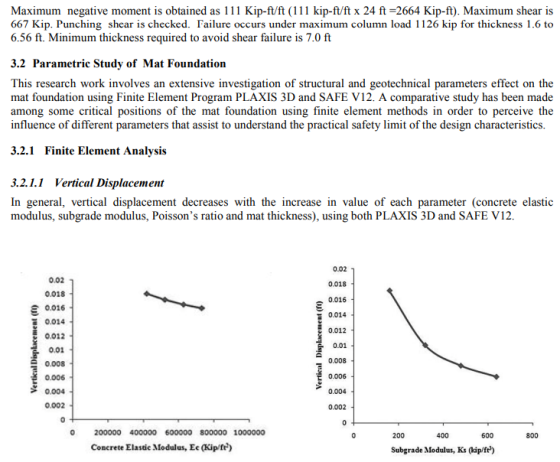
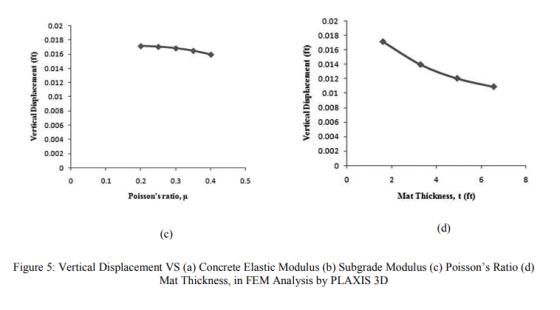
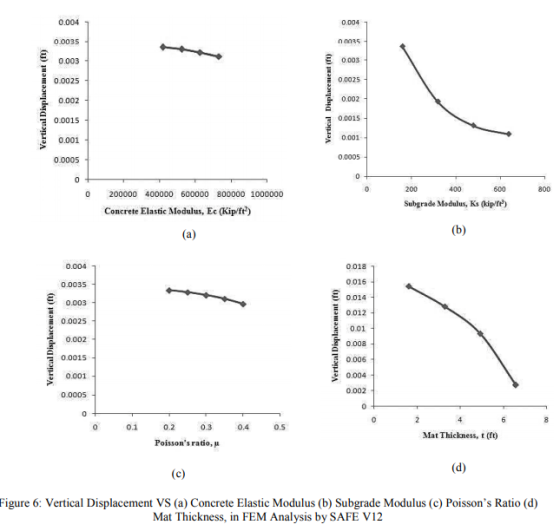
Maximum negative moment is obtained as 111 Kip-ft/ft (111 kip-ft/ft x 24 ft =2664 Kip-ft). Maximum shear is 667 Kip. Punching shear is checked. Failure occurs under maximum column load 1126 kip for thickness 1.6 to 6.56 ft. Minimum thickness required to avoid shear failure is 7.0 ft 3.2 Parametric Study of Mat Foundation This research work involves an extensive investigation of structural and geotechnical parameters effect on the mat foundation using Finite Element Program PLAXIS 3D and SAFE V12. A comparative study has been made among some critical positions of the mat foundation using finite element methods in order to perceive the influence of different parameters that assist to understand the practical safety limit of the design characteristics. 3.2.1 Finite Element Analysis 3.2.1.1 Vertical Displacement In general, vertical displacement decreases with the increase in value of each parameter (concrete elastic modulus, subgrade modulus, Poisson's ratio and mat thickness), using both PLAXIS 3D and SAFE V12. 0.02 0.02 0.018 0.018 0.016 0.016 0.014 0.014 0.012 0.012 Vertical Displacement (1) Vertical Displacement (1) 0.01 0.01 0.008 0.008 0.006 0.004 0.006 0.004 0.002 0.002 0 0 0 200 400 800 200000 400000 600000 800000 1000000 Concrete Elastic Modulus, Ec (Kip/ft?) 600 Subgrade Modulus, ks (kip/ft?)
0.02 0.02 0.018 0.016 0.018 0.016 0.014 0.012 0.014 Vertical Displacement (ft) 0.012 0.01 Vertical Displacement (ft) 0.01 0.008 0.008 0.006 0.004 0.006 0.004 0.002 0 0.002 0 0 0.1 0.2 0.3 0.4 0.5 0 2 4 6 8 Poisson's ratio, Mat Thickness, t (ft) (c) (d) Figure 5: Vertical Displacement VS (a) Concrete Elastic Modulus (b) Subgrade Modulus (c) Poisson's Ratio (d) Mat Thickness, in FEM Analysis by PLAXIS 3D
0.004 0.004 0.0035 00035 0.003 0.003 0.0025 0.0025 Vertical Displacement (ft) 0.002 Vertical Displacement (ft) 0.002 0.0015 0.0015 0.001 0.001 0.0005 0.0005 0 0 0 200 400 600 800 0 Subgrade Modulus, Ks (kiple) 200000 400000 500000 800000 1000000 Concrete Elastic Modulus, Ec (Kip/ft) (a) (b) 0.004 0.018 0.016 0.0035 0.014 0.003 0.0025 0.012 0.01 Vertical Displacement (ft) Vertical Displacement (ft) 0.002 - 0.008 0.0015 0.006 0.001 0.004 0.002 0.0005 o 0 0 2 8 0 0.1 0.3 0.4 0.5 0.2 Poisson's ratio, Mat Thickness, t (ft) (d) (c) Figure 6: Vertical Displacement VS (a) Concrete Elastic Modulus (b) Subgrade Modulus (c) Poisson's Ratio (d) Mat Thickness, in FEM Analysis by SAFE V12

 HW#10 Given the following column loading and footing information, determine the size of a mat foundation shown below: I 15 Column Information: Column A: Live load = 40 kips, Dead load = 50 kips Column B: Live load = 80 kips, Dead load = 100 kips. Distance between two columns: 15 ft. W soil = 120 psf 24" I CA C. Footing information: Distance from column A to edge of footing: 1 ft. Allowable soil bearing capacity = 3000 psf...
 find v belt drive
design power
select belt type
determine shive size (belt speed 4000 ft/min)
find shive size from power rating figure
find rated power
find estimated centre distance
find belt length (by selecting standard belt length)
calculate actual centre distance
find contact angle for small shieve
determine correct factors
calculate correct power per belt
no. of belt needed
V-Belt Designing Sample Problem . Given: A 4 cylinder diesel engine runs at 80 hp, 1800 rpm, to drive a...
find v belt drive
design power
select belt type
determine shive size (belt speed 4000 ft/min)
find shive size from power rating figure
find rated power
find estimated centre distance
find belt length (by selecting standard belt length)
calculate actual centre distance
find contact angle for small shieve
determine correct factors
calculate correct power per belt
no. of belt needed
V-Belt Designing Sample Problem . Given: A 4 cylinder diesel engine runs at 80 hp, 1800 rpm, to drive a...
 HW#10 Given the following column loading and footing information, determine the size of a mat foundation shown below: I 15 Column Information: Column A: Live load = 40 kips, Dead load = 50 kips Column B: Live load = 80 kips, Dead load = 100 kips. Distance between two columns: 15 ft. W soil = 120 psf 24" I CA C. Footing information: Distance from column A to edge of footing: 1 ft. Allowable soil bearing capacity = 3000 psf...
 find v belt drive
design power
select belt type
determine shive size (belt speed 4000 ft/min)
find shive size from power rating figure
find rated power
find estimated centre distance
find belt length (by selecting standard belt length)
calculate actual centre distance
find contact angle for small shieve
determine correct factors
calculate correct power per belt
no. of belt needed
V-Belt Designing Sample Problem . Given: A 4 cylinder diesel engine runs at 80 hp, 1800 rpm, to drive a...
find v belt drive
design power
select belt type
determine shive size (belt speed 4000 ft/min)
find shive size from power rating figure
find rated power
find estimated centre distance
find belt length (by selecting standard belt length)
calculate actual centre distance
find contact angle for small shieve
determine correct factors
calculate correct power per belt
no. of belt needed
V-Belt Designing Sample Problem . Given: A 4 cylinder diesel engine runs at 80 hp, 1800 rpm, to drive a...