Suppose price-taking firms have cost functions given by C(q) = 90 + 5q + 0.025q^2 What...
Suppose price-taking firms have cost functions given by C(q) = 90 + 5q + 0.025q^2
-
What are the equations of marginal costs and average costs?
-
How much would the firm produce at prices of $9, $10, $11, and $12?
-
How much profit would the firm earn at prices of $9, $10, $11, and $12?
-
Graph the MC, AC. Indicate the profits at a price of $9 per unit.
-
What price would be charged in the perfect competitive equilibrium?
Homework Answers
(a) C(q) = 90 + 5q + 0.025q^2
MC = dC(q) / dq
MC = 5 + 0.05q
AC = C(q) / q
AC = (90 + 5q + 0.025q^2) / q
AC = (90 /q) + 5 + 0.025q
---------------------------------------------------------------------------------
(b) A perfeclty competitive firm produces at P = MC
P = 5 + 0.05q
Put P = 9 and solve for q
9 = 5 + 0.05q
0.05q = 9-5
0.05q = 4
q = (4 / 0.05)
q = 80
The firm will produce q=80 at a price of $9
--------------------------------------------------------------------------
P = 5 + 0.05q
Put P = 10 and solve for q
10 = 5 + 0.05q
0.05q = 10-5
0.05q = 5
q = (5/ 0.05)
q = 100
The firm will produce q=100 at a price of $10
--------------------------------------------------------------------------
P = 5 + 0.05q
Put P = 11 and solve for q
11 = 5 + 0.05q
0.05q = 11-5
0.05q = 6
q = (6 / 0.05)
q = 120
The firm will produce q=120 at a price of $11
--------------------------------------------------------------------------
P = 5 + 0.05q
Put P = 12 and solve for q
12 = 5 + 0.05q
0.05q = 12-5
0.05q = 7
q = (7 / 0.05)
q = 140
The firm will produce q=140 at a price of $12
--------------------------------------------------------------------------
(c) Profit = TR - TC
Profit = Pq - C(q)
At a price of $9, q is 80
Profit = ($9 * 80) - [90 + (5 * 80) + 0.025 (80)^2]
Profit = $720 - $650
Profit = $70
A firm will earn a profit of $70 at a price of $8
--------------------------------------------------------------------------------
Profit = Pq - C(q)
At a price of $10, q is 100
Profit = ($10 * 100) - [90 + (5 * 100) + 0.025 (100)^2]
Profit = $1000- $840
Profit = $160
A firm will earn a profit of $160 at a price of $10
--------------------------------------------------------------------------------
Profit = Pq - C(q)
At a price of $11, q is 120
Profit = ($11 * 120) - [90 + (5 * 120) + 0.025 (120)^2]
Profit = $1320- $1050
Profit = $270
A firm will earn a profit of $270 at a price of $11
--------------------------------------------------------------------------------
Profit = Pq - C(q)
At a price of $12, q is 140
Profit = ($12 * 140) - [90 + (5 * 140) + 0.025 (140)^2]
Profit = $1680- $1280
Profit = $400
A firm will earn a profit of $400 at a price of $12
--------------------------------------------------------------------------------
(d)
| Q | AC | MC |
| 0 | 5 | |
| 10 | 14.25 | 5.50 |
| 20 | 10.00 | 6.00 |
| 30 | 8.75 | 6.50 |
| 40 | 8.25 | 7.00 |
| 50 | 8.05 | 7.50 |
| 60 | 8.00 | 8.00 |
| 70 | 8.04 | 8.50 |
| 80 | 8.13 | 9.00 |
| 90 | 8.25 | 9.50 |
| 100 | 8.40 | 10.00 |
| 110 | 8.57 | 10.50 |
| 120 | 8.75 | 11.00 |
| 130 | 8.94 | 11.50 |
| 140 | 9.14 | 12.00 |
| 150 | 9.35 | 12.50 |
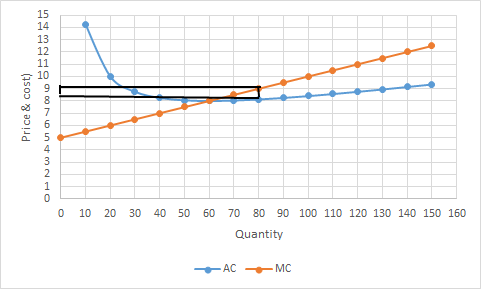
At a price of $9, 80 units of output will be produced at an average cost of $8.13.
Hence, the black color outline rectangle is the profit at a price of $8.13.
---------------------------------------------------------------------------------
(e) A perfectly competitive firm produces at the following point in the long run.
i.e., P = MC = min.AC
MC intersects AC at its minimum point.
MC intersects AC at 60 units of output and corresponding AC and MC is $8.
P = MC = min. AC = $8
Hence, perfectly competitive firm will charge a price of $8 in the long run.
Add Answer to:
Suppose price-taking firms have cost functions given by C(q) =
90 + 5q + 0.025q^2
What...
Consider firms facing the demand curve P=90-5Q 17 where Q- Q1 +Q2 The firms' cost functions...
 Consider firms facing the demand curve P=90-5Q 17 where Q- Q1 +Q2 The firms' cost functions are Cl (Q1) = 15 + 5Q1 12 and (2)-+1002 Suppose that both firms have entered the industry. What is the joint profit-maximizing level of output? How much will each firm produce? Combined, the firms will produce units of output, of which Firm 1 will produceunits and Firm 2 will produce units. (Enter a numeric response using a real number rounded to two decimal...
Suppose an electricity generating firm exists with the following cost functions, C(Q) = 2Q^2 + 3Q...
Suppose an electricity generating firm exists with the following cost functions, C(Q) = 2Q^2 + 3Q + 72, FC = 72, MC(Q) = 4Q + 3, AC(Q) = 2Q + 3 + (72/Q), AVC(Q) = 2Q + 3 Graph the AC(Q), the AVC(Q), the MC(Q) on the same graph below. Hint, this is easiest to do by creating a schedule with quantity from 1 – 10 and calculating the corresponding costs for each quantity. I.e., when Q = 1, the AVC =?...
Two firms compete by choosing price. Their demand functions are; Q1=80−P1+P2 and Q2=80+P1+P2. where P1 and...
Two firms compete by choosing price. Their demand functions are; Q1=80−P1+P2 and Q2=80+P1+P2. where P1 and P2 are the prices charged by each firm, respectively, and Q1 and Q2 are the resulting demands. Note that the demand for each good depends only on the difference in prices; if the two firms colluded and set the same price, they could make that price as high as they wanted, and earn infinite profits. Marginal costs are zero. Suppose the two firms set...
Suppose there are two firms in a market producing differentiated products. Both firms have MC=0. The...
Suppose there are two firms in a market producing differentiated products. Both firms have MC=0. The demand for firm 1 and 2’s products are given by: q1(p1,p2) = 5 - 2p1 + p2 q2(p1,p2) = 5 - 2p2 + p1 a. First, suppose that the two firms compete in prices (i.e. Bertrand). Compute and graph each firm’s best response functions. What is the sign of the slope of the firms’ best-response functions? Are prices strategic substitutes or complements? b. Solve...
answer 14.1, extra detail for c depends on its ability to prevent buyers. pertectly competitive firms....
 answer 14.1, extra detail for c
depends on its ability to prevent buyers. pertectly competitive firms. Durable goods s may be constrained by markets for used may opt for different levels of quality than olies (firms with diminishing avate naturs broad range of output levels). The mechanisms adopted can affect the regulated firm. . Governments often choose t average costs goods type A monopoly may be able to increase its profits further discrimination- that is, charging differ of buyers. The...
answer 14.1, extra detail for c
depends on its ability to prevent buyers. pertectly competitive firms. Durable goods s may be constrained by markets for used may opt for different levels of quality than olies (firms with diminishing avate naturs broad range of output levels). The mechanisms adopted can affect the regulated firm. . Governments often choose t average costs goods type A monopoly may be able to increase its profits further discrimination- that is, charging differ of buyers. The...
For a perfectly competitive market made up of firms represented in the graph below, what is...
 For a perfectly competitive market made up of firms represented in the graph below, what is the long run equilibrium price of the good? Cost ($) MC ATC AVC $16 $14 $12 $10 Quantity $14 $10 $12 $16 For a perfectly competitive market made up of firms represented in the graph below, if the price is $14, Cost ($) MC ATC $16 AVC - $14 $12 $10 Quantity The firm is operating at its minimum long run average total cost....
6. There are two firms in a market with marginal cost functions given by MC:(9) =...
 6. There are two firms in a market with marginal cost functions given by MC:(9) = 59 MC2(q) = q. Market demand is given by D(p) = 20 - 2p. (a) Obtain the competitive equilibrium output and price. Calculate consumer surplus and each firm's producer surplus. (b) Derive the monopoly price when only firm 1 operates. Calculate consumer surplus and each firm's producer surplus. (c) Derive the monopoly price when only firm 2 operates. (d) Now assume that a monopolist...
The market demand curve is given by Q = 200-2p. There is one dominant firm, which...
The market demand curve is given by Q = 200-2p. There is one dominant firm, which sets the market price and has a constant marginal cost of 5, and a competitive fringe of 10 price-taking firms, each of which has a marginal cost function MC (Q) = 10 +Q. Derive the equation of the dominant firm’s residual demand curve. What price will the dominant firm set to maximize its profits? At this price, how much does the competitive fringe produce?
The market demand curve is given by Q = 200-2p. There is one dominant firm, which sets the market...
The market demand curve is given by Q = 200-2p. There is one dominant firm, which sets the market price and has a constant marginal cost of 5, and a competitive fringe of 10 price-taking firms, each of which has a marginal cost function MC (Q) = 10 +Q. Derive the equation of the dominant firm’s residual demand curve. What price will the dominant firm set to maximize its profits? At this price, how much does the competitive fringe produce?
1. Suppose there are two firms with constant marginal cost MC = 3 and the market...
1. Suppose there are two firms with constant marginal cost MC = 3 and the market demand is P = 63 − 5Q. (a) Calculate the market price and profits for each firm in each of the following settings: • Cartel • Cournot duopoly • Bertrand duopoly (firms can set any price) (b) Using part a), construct a 3×3 payoff matrix where the firms are choosing prices. The actions available to each of two players are to charge the price...
 Consider firms facing the demand curve P=90-5Q 17 where Q- Q1 +Q2 The firms' cost functions are Cl (Q1) = 15 + 5Q1 12 and (2)-+1002 Suppose that both firms have entered the industry. What is the joint profit-maximizing level of output? How much will each firm produce? Combined, the firms will produce units of output, of which Firm 1 will produceunits and Firm 2 will produce units. (Enter a numeric response using a real number rounded to two decimal...
 answer 14.1, extra detail for c
depends on its ability to prevent buyers. pertectly competitive firms. Durable goods s may be constrained by markets for used may opt for different levels of quality than olies (firms with diminishing avate naturs broad range of output levels). The mechanisms adopted can affect the regulated firm. . Governments often choose t average costs goods type A monopoly may be able to increase its profits further discrimination- that is, charging differ of buyers. The...
answer 14.1, extra detail for c
depends on its ability to prevent buyers. pertectly competitive firms. Durable goods s may be constrained by markets for used may opt for different levels of quality than olies (firms with diminishing avate naturs broad range of output levels). The mechanisms adopted can affect the regulated firm. . Governments often choose t average costs goods type A monopoly may be able to increase its profits further discrimination- that is, charging differ of buyers. The...
 For a perfectly competitive market made up of firms represented in the graph below, what is the long run equilibrium price of the good? Cost ($) MC ATC AVC $16 $14 $12 $10 Quantity $14 $10 $12 $16 For a perfectly competitive market made up of firms represented in the graph below, if the price is $14, Cost ($) MC ATC $16 AVC - $14 $12 $10 Quantity The firm is operating at its minimum long run average total cost....
 6. There are two firms in a market with marginal cost functions given by MC:(9) = 59 MC2(q) = q. Market demand is given by D(p) = 20 - 2p. (a) Obtain the competitive equilibrium output and price. Calculate consumer surplus and each firm's producer surplus. (b) Derive the monopoly price when only firm 1 operates. Calculate consumer surplus and each firm's producer surplus. (c) Derive the monopoly price when only firm 2 operates. (d) Now assume that a monopolist...
Most questions answered within 3 hours.
-
Where is the error in this code sequence?
String s1 = "Hello";
String s2 = "ello";...
asked 11 months ago -
Financial data for Joel de Paris, Inc., for last year
follow:
Joel de Paris, Inc.
Balance...
asked 11 months ago -
Consider this reaction:
Al2(SO4)3 (aq)+ BaCl3
(aq) Al2Cl6 (aq)- +
3BaSO4(s) . What is the...
asked 11 months ago -
Suppose that Savneet is considering increasing her
recent random sample from 20 car rentals to 40...
asked 11 months ago -
Trucks arrive at an unloading terminal at an average rate of 120
per hour.
Trucks arrive...
asked 11 months ago -
Why are methanol and ethanol completely soluble in water while
octanol is not very little soluble....
asked 11 months ago -
A facilities manager at a university reads in a research report
that the mean amount of...
asked 11 months ago -
When the CuSO4 is rehydrated by adding water to the anhydrous
compound, is this an endothermic...
asked 11 months ago -
A ray of sunlight is passing from diamond into crown glass; the
angle of incidence is...
asked 11 months ago -
A block of mass 0.249 kg is placed on top of a light, vertical
spring of...
asked 11 months ago -
how do the kidneys compensate in the presences of acidosis
a) trigger hyperventilate
b) reserve acid...
asked 11 months ago -
Question 501 pts
The rental rate of capital to the firm increases. Which of the
following...
asked 11 months ago