Can you please explain Q7.2? I have the answers here,
but I'm having trouble understanding what is happening to the
circuit when the switch is at b.
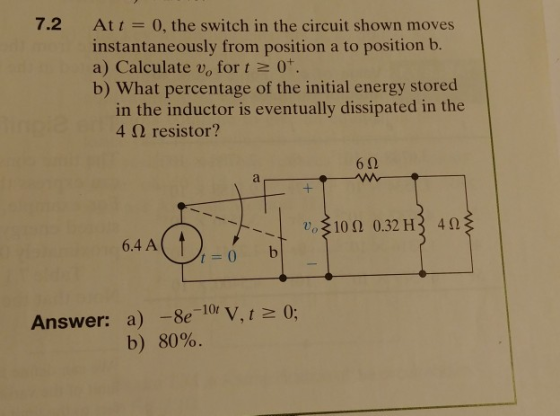
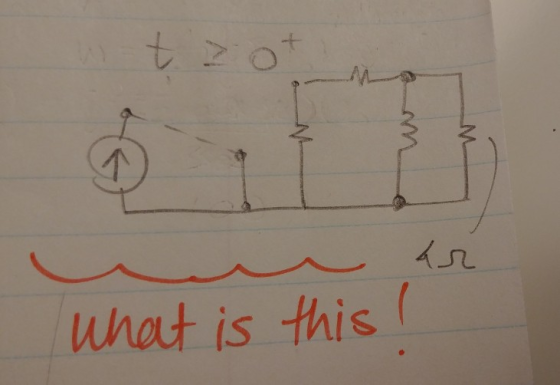
How is it possible to draw a circuit this way when there is no return path? (please see my hand drawing).
Homework Answers


Add Answer to:
Can you please explain Q7.2? I have the answers here,
but I'm having trouble understanding what...
I have two questions I'm having trouble understanding. I greatly appreciate any help you all can...
 I have two questions I'm having trouble understanding. I greatly
appreciate any help you all can give me! I'm not great at physics
so the more details the better.
THANKS!!!
In the RC circuit of Figure WG32.6, the emf of the AC source is given by 'E = Emax sin ω| t. The emf amplitude is Emax = 10 V, and the angular frequency is ω,-100 s-1 when the angular frequency is changed to a new value ω2, the time...
I have two questions I'm having trouble understanding. I greatly
appreciate any help you all can give me! I'm not great at physics
so the more details the better.
THANKS!!!
In the RC circuit of Figure WG32.6, the emf of the AC source is given by 'E = Emax sin ω| t. The emf amplitude is Emax = 10 V, and the angular frequency is ω,-100 s-1 when the angular frequency is changed to a new value ω2, the time...
I need a full solution for those questions please, although I'm half way through question one...
 I need a full solution for those questions please,
although I'm half way through question one and it is quite simple
but I would like to double check if Ive got that right. like and
comment are rewarded for good answers
Consider the following circuit containing a switch S, an ideal battery with e.m.f. ε-20.0 V, resistors R,-: 8.00 Ω, R2-20.0 Ω and R3-30.0 Ω, and capacitors R2-20Ω RI-8Ω R3 -3082 After the switch is closed: (a) Calculate the initial...
I need a full solution for those questions please,
although I'm half way through question one and it is quite simple
but I would like to double check if Ive got that right. like and
comment are rewarded for good answers
Consider the following circuit containing a switch S, an ideal battery with e.m.f. ε-20.0 V, resistors R,-: 8.00 Ω, R2-20.0 Ω and R3-30.0 Ω, and capacitors R2-20Ω RI-8Ω R3 -3082 After the switch is closed: (a) Calculate the initial...
I'm almost done with this problem, part a answer is circled but part b I can't...
 I'm almost done with this problem, part a answer is circled but
part b I can't remember how to integrate something like this.
please help, calculus involved physics, thank you!
his circuit, att othe switch is slammed into position A, causing the current through the 5 seconds the switch is sammed into inductor to increase from pro to some val position B, causing the current through the inductor to decrease from this value. eventualni to zero. Answer these questions: Find...
I'm almost done with this problem, part a answer is circled but
part b I can't remember how to integrate something like this.
please help, calculus involved physics, thank you!
his circuit, att othe switch is slammed into position A, causing the current through the 5 seconds the switch is sammed into inductor to increase from pro to some val position B, causing the current through the inductor to decrease from this value. eventualni to zero. Answer these questions: Find...
I have the answers here from the textbook but am having trouble figuring out how to...
 I have the answers here from
the textbook but am having trouble figuring out how to set up
equations. Any help is appreciated thanks!
P 6.4-6 + Determine the node voltages for the circuit shown in Figure P 6.4-6. Answer: va = -0.75 V, Vb = 0 V, and Vc = -0.9375 V 10 k 40 k 20 k MMM- b 25 k W 12 v 340k 3 15k Figure P 6.4-6
I have the answers here from
the textbook but am having trouble figuring out how to set up
equations. Any help is appreciated thanks!
P 6.4-6 + Determine the node voltages for the circuit shown in Figure P 6.4-6. Answer: va = -0.75 V, Vb = 0 V, and Vc = -0.9375 V 10 k 40 k 20 k MMM- b 25 k W 12 v 340k 3 15k Figure P 6.4-6
Please show all steps for the proofs. I'm having trouble wrapping my heads around these. 15.65CALC...
 Please show all steps for the proofs. I'm having trouble
wrapping my heads around these.
15.65CALC Waves of Arbitrary Shape. (a) Explain why any wave described by a function of the form y(x, )f(x - ) hat when moves in the tx-direction with speed u. (b) Show that y(x,1) =f(x-v) satisfies the wave equation, no matter what he figure? the functional form of f. To do this, write y(x, rf(), where harp (fre- power P(x, r) as given by Eq....
Please show all steps for the proofs. I'm having trouble
wrapping my heads around these.
15.65CALC Waves of Arbitrary Shape. (a) Explain why any wave described by a function of the form y(x, )f(x - ) hat when moves in the tx-direction with speed u. (b) Show that y(x,1) =f(x-v) satisfies the wave equation, no matter what he figure? the functional form of f. To do this, write y(x, rf(), where harp (fre- power P(x, r) as given by Eq....
I'm having trouble with this. Please show work so I can see where I'm messing up....
I'm having trouble with this. Please show work so I can see where I'm messing up. Thanks 1. For each sample, state the sample size, mean, and standard deviation. Sample A: 0.75, 1.38, 2.13, 2.45, 4.7 Sample B: 2.18, 3.5, 4.7, 5.63, 7.35 2. State Hypotheses in statistical format: a. H0: b. H1: 3. State Significance Level: Use significance level α = .05 4. State critical t (explain how it was found) 5. State decision rule 6. Calculate the test...
I'm having some trouble with these. Can I have some help please. (1 point) Suppose the...
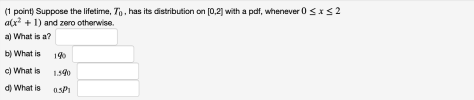 I'm having some trouble with these. Can I have some help
please.
(1 point) Suppose the lifetime, To, has its distribution on [0,2] with a pdf, whenever 0 < x < 2 a(x4 + 1) and zero otherwise. a) What is a? b) What is c) What is d) What is 190 1.590 0.5P1
I'm having some trouble with these. Can I have some help
please.
(1 point) Suppose the lifetime, To, has its distribution on [0,2] with a pdf, whenever 0 < x < 2 a(x4 + 1) and zero otherwise. a) What is a? b) What is c) What is d) What is 190 1.590 0.5P1
I need some help with this Circuit question. Please show the full steps. Thank you. 8.17...
 I need some help with this Circuit question. Please show the
full steps.
Thank you.
8.17 In the circuit of Fig. 8.71, the switch instantaneously 0. Find v(t) for all moves from position A to B at t t2 0. 0.25 H 5 A 0.04Fv (t) 10Ω 4Ω Figure 8.71 For Prob. 8.17.
I need some help with this Circuit question. Please show the
full steps.
Thank you.
8.17 In the circuit of Fig. 8.71, the switch instantaneously 0. Find v(t) for all moves from position A to B at t t2 0. 0.25 H 5 A 0.04Fv (t) 10Ω 4Ω Figure 8.71 For Prob. 8.17.
Please explain your steps as you go along, I'm having trouble understanding. Problem 4. (20 points)...
 Please explain your steps as
you go along, I'm having trouble understanding.
Problem 4. (20 points) For any real number c, define [c] - read as ceiling - as an integer d such that 3z with 0 <2<1 and crd - 2. Assume, as a premise, that [c] exists for every real c. a) (10 points) Prove that for any c, [c] is unique. b) (10 points) Prove that Va, b: (a + b) is equal to [a] + [6]...
Please explain your steps as
you go along, I'm having trouble understanding.
Problem 4. (20 points) For any real number c, define [c] - read as ceiling - as an integer d such that 3z with 0 <2<1 and crd - 2. Assume, as a premise, that [c] exists for every real c. a) (10 points) Prove that for any c, [c] is unique. b) (10 points) Prove that Va, b: (a + b) is equal to [a] + [6]...
Please show all work and explain steps So that I can see where I am going...
 Please show all work and explain steps So that I can see where I
am going wrong.
After having been in position 1 for a long time, the switch in the circuit as shown below was moved to position 2 at t-os, were Vo-14 V, R1-2 Ω, R2 = 148 Ω, R3-40 Ω, and L-1 H OL (a) Determine () and VL(O) iL(:0.000 (A); VL(o):0.000 (V) You are correct ies ur receipt no. is 146-1674 (b) Determine iL(O) and Vi(O):...
Please show all work and explain steps So that I can see where I
am going wrong.
After having been in position 1 for a long time, the switch in the circuit as shown below was moved to position 2 at t-os, were Vo-14 V, R1-2 Ω, R2 = 148 Ω, R3-40 Ω, and L-1 H OL (a) Determine () and VL(O) iL(:0.000 (A); VL(o):0.000 (V) You are correct ies ur receipt no. is 146-1674 (b) Determine iL(O) and Vi(O):...
 I have two questions I'm having trouble understanding. I greatly
appreciate any help you all can give me! I'm not great at physics
so the more details the better.
THANKS!!!
In the RC circuit of Figure WG32.6, the emf of the AC source is given by 'E = Emax sin ω| t. The emf amplitude is Emax = 10 V, and the angular frequency is ω,-100 s-1 when the angular frequency is changed to a new value ω2, the time...
I have two questions I'm having trouble understanding. I greatly
appreciate any help you all can give me! I'm not great at physics
so the more details the better.
THANKS!!!
In the RC circuit of Figure WG32.6, the emf of the AC source is given by 'E = Emax sin ω| t. The emf amplitude is Emax = 10 V, and the angular frequency is ω,-100 s-1 when the angular frequency is changed to a new value ω2, the time...
 I need a full solution for those questions please,
although I'm half way through question one and it is quite simple
but I would like to double check if Ive got that right. like and
comment are rewarded for good answers
Consider the following circuit containing a switch S, an ideal battery with e.m.f. ε-20.0 V, resistors R,-: 8.00 Ω, R2-20.0 Ω and R3-30.0 Ω, and capacitors R2-20Ω RI-8Ω R3 -3082 After the switch is closed: (a) Calculate the initial...
I need a full solution for those questions please,
although I'm half way through question one and it is quite simple
but I would like to double check if Ive got that right. like and
comment are rewarded for good answers
Consider the following circuit containing a switch S, an ideal battery with e.m.f. ε-20.0 V, resistors R,-: 8.00 Ω, R2-20.0 Ω and R3-30.0 Ω, and capacitors R2-20Ω RI-8Ω R3 -3082 After the switch is closed: (a) Calculate the initial...
 I'm almost done with this problem, part a answer is circled but
part b I can't remember how to integrate something like this.
please help, calculus involved physics, thank you!
his circuit, att othe switch is slammed into position A, causing the current through the 5 seconds the switch is sammed into inductor to increase from pro to some val position B, causing the current through the inductor to decrease from this value. eventualni to zero. Answer these questions: Find...
I'm almost done with this problem, part a answer is circled but
part b I can't remember how to integrate something like this.
please help, calculus involved physics, thank you!
his circuit, att othe switch is slammed into position A, causing the current through the 5 seconds the switch is sammed into inductor to increase from pro to some val position B, causing the current through the inductor to decrease from this value. eventualni to zero. Answer these questions: Find...
 I have the answers here from
the textbook but am having trouble figuring out how to set up
equations. Any help is appreciated thanks!
P 6.4-6 + Determine the node voltages for the circuit shown in Figure P 6.4-6. Answer: va = -0.75 V, Vb = 0 V, and Vc = -0.9375 V 10 k 40 k 20 k MMM- b 25 k W 12 v 340k 3 15k Figure P 6.4-6
I have the answers here from
the textbook but am having trouble figuring out how to set up
equations. Any help is appreciated thanks!
P 6.4-6 + Determine the node voltages for the circuit shown in Figure P 6.4-6. Answer: va = -0.75 V, Vb = 0 V, and Vc = -0.9375 V 10 k 40 k 20 k MMM- b 25 k W 12 v 340k 3 15k Figure P 6.4-6
 Please show all steps for the proofs. I'm having trouble
wrapping my heads around these.
15.65CALC Waves of Arbitrary Shape. (a) Explain why any wave described by a function of the form y(x, )f(x - ) hat when moves in the tx-direction with speed u. (b) Show that y(x,1) =f(x-v) satisfies the wave equation, no matter what he figure? the functional form of f. To do this, write y(x, rf(), where harp (fre- power P(x, r) as given by Eq....
Please show all steps for the proofs. I'm having trouble
wrapping my heads around these.
15.65CALC Waves of Arbitrary Shape. (a) Explain why any wave described by a function of the form y(x, )f(x - ) hat when moves in the tx-direction with speed u. (b) Show that y(x,1) =f(x-v) satisfies the wave equation, no matter what he figure? the functional form of f. To do this, write y(x, rf(), where harp (fre- power P(x, r) as given by Eq....
 I'm having some trouble with these. Can I have some help
please.
(1 point) Suppose the lifetime, To, has its distribution on [0,2] with a pdf, whenever 0 < x < 2 a(x4 + 1) and zero otherwise. a) What is a? b) What is c) What is d) What is 190 1.590 0.5P1
I'm having some trouble with these. Can I have some help
please.
(1 point) Suppose the lifetime, To, has its distribution on [0,2] with a pdf, whenever 0 < x < 2 a(x4 + 1) and zero otherwise. a) What is a? b) What is c) What is d) What is 190 1.590 0.5P1
 I need some help with this Circuit question. Please show the
full steps.
Thank you.
8.17 In the circuit of Fig. 8.71, the switch instantaneously 0. Find v(t) for all moves from position A to B at t t2 0. 0.25 H 5 A 0.04Fv (t) 10Ω 4Ω Figure 8.71 For Prob. 8.17.
I need some help with this Circuit question. Please show the
full steps.
Thank you.
8.17 In the circuit of Fig. 8.71, the switch instantaneously 0. Find v(t) for all moves from position A to B at t t2 0. 0.25 H 5 A 0.04Fv (t) 10Ω 4Ω Figure 8.71 For Prob. 8.17.
 Please explain your steps as
you go along, I'm having trouble understanding.
Problem 4. (20 points) For any real number c, define [c] - read as ceiling - as an integer d such that 3z with 0 <2<1 and crd - 2. Assume, as a premise, that [c] exists for every real c. a) (10 points) Prove that for any c, [c] is unique. b) (10 points) Prove that Va, b: (a + b) is equal to [a] + [6]...
Please explain your steps as
you go along, I'm having trouble understanding.
Problem 4. (20 points) For any real number c, define [c] - read as ceiling - as an integer d such that 3z with 0 <2<1 and crd - 2. Assume, as a premise, that [c] exists for every real c. a) (10 points) Prove that for any c, [c] is unique. b) (10 points) Prove that Va, b: (a + b) is equal to [a] + [6]...
 Please show all work and explain steps So that I can see where I
am going wrong.
After having been in position 1 for a long time, the switch in the circuit as shown below was moved to position 2 at t-os, were Vo-14 V, R1-2 Ω, R2 = 148 Ω, R3-40 Ω, and L-1 H OL (a) Determine () and VL(O) iL(:0.000 (A); VL(o):0.000 (V) You are correct ies ur receipt no. is 146-1674 (b) Determine iL(O) and Vi(O):...
Please show all work and explain steps So that I can see where I
am going wrong.
After having been in position 1 for a long time, the switch in the circuit as shown below was moved to position 2 at t-os, were Vo-14 V, R1-2 Ω, R2 = 148 Ω, R3-40 Ω, and L-1 H OL (a) Determine () and VL(O) iL(:0.000 (A); VL(o):0.000 (V) You are correct ies ur receipt no. is 146-1674 (b) Determine iL(O) and Vi(O):...
Most questions answered within 3 hours.
-
Where is the error in this code sequence?
String s1 = "Hello";
String s2 = "ello";...
asked 10 months ago -
Financial data for Joel de Paris, Inc., for last year
follow:
Joel de Paris, Inc.
Balance...
asked 10 months ago -
Consider this reaction:
Al2(SO4)3 (aq)+ BaCl3
(aq) Al2Cl6 (aq)- +
3BaSO4(s) . What is the...
asked 10 months ago -
Suppose that Savneet is considering increasing her
recent random sample from 20 car rentals to 40...
asked 10 months ago -
Trucks arrive at an unloading terminal at an average rate of 120
per hour.
Trucks arrive...
asked 10 months ago -
Why are methanol and ethanol completely soluble in water while
octanol is not very little soluble....
asked 10 months ago -
A facilities manager at a university reads in a research report
that the mean amount of...
asked 10 months ago -
When the CuSO4 is rehydrated by adding water to the anhydrous
compound, is this an endothermic...
asked 10 months ago -
A ray of sunlight is passing from diamond into crown glass; the
angle of incidence is...
asked 10 months ago -
A block of mass 0.249 kg is placed on top of a light, vertical
spring of...
asked 10 months ago -
how do the kidneys compensate in the presences of acidosis
a) trigger hyperventilate
b) reserve acid...
asked 10 months ago -
Question 501 pts
The rental rate of capital to the firm increases. Which of the
following...
asked 10 months ago