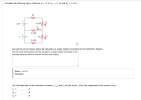
Please use the Reduce and Return method to solve and show steps. thank you

Homework Answers
Reducing the resistance first 1.8 K and 2.7 K are in series so the total resistance is 4.5 K ohms and 1.5 K and 1.2 K resistance are also in series to each other so the combination gives 2.7 K ohms
now the combination of (1.8K+2.7K) and 8.2 K ohms resistors are
in parallel so the combination gives  that gives the value 2.9055 K oms and this resistance is in series
with 1.5 K ohms and 1.2 K ohms that gives the value 5.6055 K ohms
now this resistance is in parallel with 5.6 K ohms resistance so
the parallel combination gives
that gives the value 2.9055 K oms and this resistance is in series
with 1.5 K ohms and 1.2 K ohms that gives the value 5.6055 K ohms
now this resistance is in parallel with 5.6 K ohms resistance so
the parallel combination gives  that gives the total resistance of the circuit with respect to
source is 2.801 K ohms
that gives the total resistance of the circuit with respect to
source is 2.801 K ohms

Now for current go from bottom to top. For 18 V voltage source
here there are two parallel resistances 5.6K and 5.6055K ohms now
calculate current through 5.6055 ohms resistance that gives
 3.211 mA and this current is divided in 8.2 K ohms and 4.5 K ohms
resistance as they are in parallel by current division rule the
current in 4.5 K ohms combination is
3.211 mA and this current is divided in 8.2 K ohms and 4.5 K ohms
resistance as they are in parallel by current division rule the
current in 4.5 K ohms combination is  that is 2.073 mA the same current will flow
through 1.8 K ohms resistance as 4.5 K is the series combination of
1.8 K and 2.7 K ohms now from the given circuit to find I1 use KCL
for the node between 5.6 K ohms resistor and 1.8 K ohms resistor
for that we need current through 5.6 ohms resistor that is
that is 2.073 mA the same current will flow
through 1.8 K ohms resistance as 4.5 K is the series combination of
1.8 K and 2.7 K ohms now from the given circuit to find I1 use KCL
for the node between 5.6 K ohms resistor and 1.8 K ohms resistor
for that we need current through 5.6 ohms resistor that is
 3.214 mA i.e current through 5.6 K ohms resistor is 3.214
mA so we know the current through 1.8 K and 5.6 K
resistors to find I1 we have to use KCL at the node between them
i.e sum of currents entering the node is equal to sum of the
currents leaving the node here both current through 5.6 K and 1.8 K
are entering the node and current I1 is leaving the node so
I1= current through 5.6K ohms + current through 1.8 K
ohms=3.214+2.073 =5.287 mA . I1=5.287mA
3.214 mA i.e current through 5.6 K ohms resistor is 3.214
mA so we know the current through 1.8 K and 5.6 K
resistors to find I1 we have to use KCL at the node between them
i.e sum of currents entering the node is equal to sum of the
currents leaving the node here both current through 5.6 K and 1.8 K
are entering the node and current I1 is leaving the node so
I1= current through 5.6K ohms + current through 1.8 K
ohms=3.214+2.073 =5.287 mA . I1=5.287mA
voltage Vb means voltage at point B with respect to ground . b is located between 1.8K ohms and 2.7 K ohms so Vb can be found by knowing the voltage drops across resistance 2.7 K and 1.5 K ohms as the ground is present next to 1.5 K ohms the sum of voltage drops across 1.5 K ohms and 2.7K ohms gives the voltage at b with respect to ground as we know current through 2.7 K ohms is same as the current flowing in 1.8 K ohms as they are in series i.e.2.073 mA and the current through 1.5 K ohms resistor is 3.211 mA this is the same current flowing in 5.6055 K ohms combination

Both the current are going up wards so by KVL
Vb=(2.7 (-2.073))+(1.5(-3.211))=-10.415V
for Vab as we know the value of Vb now calculate the value of Va
in similar way and calculate Vab = Va-Vb. Va is the voltage across
1.2 K ohms i.e.1.2 K ohms is the only resistance between node a and
the neutral or ground. current through resistance 1.2 K ohms is
same as the current through 1.5 K i.e 3.211 mA so the voltage
Va=(1.23.211)=3.8532
V . Now as we know Va and Vb
Vab=Va-Vb=3.853-(-10.415)=3.853+10.415 =14.27
V
Vab=14.27 V
We were unable to transcribe this image
5.6055 X 5.6 5.6055 + 5.6
We were unable to transcribe this image
We were unable to transcribe this image
3.211 x 8.2 8.2 + 4.5
We were unable to transcribe this image
We were unable to transcribe this image
We were unable to transcribe this image
We were unable to transcribe this image
We were unable to transcribe this image
Add Answer to:
Please use the Reduce and Return method to solve and show steps.
thank you
Calculate R1,...
please show work and steps thank you Use an appropriate method to solve the given system...
 please show work and steps thank you
Use an appropriate method to solve the given system e *-=( ")x+ te'
please show work and steps thank you
Use an appropriate method to solve the given system e *-=( ")x+ te'
please include work. II. Series-Parallel Circuits Use the Reduce and Return circuit analysis approach to solve...
 please include work.
II. Series-Parallel Circuits Use the Reduce and Return circuit analysis approach to solve for all voltages and currents in the circuit shown in Figure 1. Complete Table 1 in its entirety including analytical and Multisim results. All Multisim diagrams should be captured and included in the Lab Reprot. R1 R3 w 4.7ko 1ko R2 2.2k RA 10k0 E = 15 V Figure 1: Series Parallel Circuit TO Table 1: Series-Parallel Analysis (Reduce and Return Approach) Calculated Multisim...
please include work.
II. Series-Parallel Circuits Use the Reduce and Return circuit analysis approach to solve for all voltages and currents in the circuit shown in Figure 1. Complete Table 1 in its entirety including analytical and Multisim results. All Multisim diagrams should be captured and included in the Lab Reprot. R1 R3 w 4.7ko 1ko R2 2.2k RA 10k0 E = 15 V Figure 1: Series Parallel Circuit TO Table 1: Series-Parallel Analysis (Reduce and Return Approach) Calculated Multisim...
use elimination or substitution method show all steps please thank you (2xy + y2 = 10...
 use elimination or substitution method
show all steps please thank you
(2xy + y2 = 10 3y2 - xy = 2
use elimination or substitution method
show all steps please thank you
(2xy + y2 = 10 3y2 - xy = 2
PHYSICS!! PLEASE HELP! PLEASE SHOW ALL WORK TO EACH PART OF THE QUESTION! THANK YOU! 4)...
 PHYSICS!! PLEASE HELP! PLEASE
SHOW ALL WORK TO EACH PART OF THE QUESTION! THANK YOU!
4) In the circuit below, and R 5 2. Calculate the following: 12 V, r 1 92 a) What is the rate of conversion of energy within the battery? b) What is the rate of dissipation of energy within the battery? c) What is the power output of the battery to the remainder of the circuit? d) What is the power of dissipation of the...
PHYSICS!! PLEASE HELP! PLEASE
SHOW ALL WORK TO EACH PART OF THE QUESTION! THANK YOU!
4) In the circuit below, and R 5 2. Calculate the following: 12 V, r 1 92 a) What is the rate of conversion of energy within the battery? b) What is the rate of dissipation of energy within the battery? c) What is the power output of the battery to the remainder of the circuit? d) What is the power of dissipation of the...
DO NOT use cursive. Answer all the questions, please. Please write down the process in detail....
 DO NOT use cursive.
Answer all the questions, please.
Please write down the process in detail.
Thank you.
10. (6 marks) Find the voltage vy by reducing the circuit to its simplest form, using source transformations for R1 = 212, R2 = 312, R3 = 922, R = 312, R5 = 492, Re = 612, = 2A, Vo = 20V, Vi = 5V and Vo = 20V; draw diagrams for every source transformations you make and show your work step-by-step....
DO NOT use cursive.
Answer all the questions, please.
Please write down the process in detail.
Thank you.
10. (6 marks) Find the voltage vy by reducing the circuit to its simplest form, using source transformations for R1 = 212, R2 = 312, R3 = 922, R = 312, R5 = 492, Re = 612, = 2A, Vo = 20V, Vi = 5V and Vo = 20V; draw diagrams for every source transformations you make and show your work step-by-step....
Please explain /show steps thank you ! Problem 9.34 Part A Find the steady-state expression for...
 Please explain /show steps thank you !
Problem 9.34 Part A Find the steady-state expression for v, in the circuit of (Figure 1) if ig = 50 cos 10000t mA. Suppose that vo(t) = Vo cos(wt+), where -180º < < 180º. Determine the values V, W, 0. Express your answers using three significant figures separated by commas. V AED 1 vec o 2 ? Vo, w, $ = 3.72, 10000,26.5 V, rad/s, º Submit Previous Answers Request Answer Figure <...
Please explain /show steps thank you !
Problem 9.34 Part A Find the steady-state expression for v, in the circuit of (Figure 1) if ig = 50 cos 10000t mA. Suppose that vo(t) = Vo cos(wt+), where -180º < < 180º. Determine the values V, W, 0. Express your answers using three significant figures separated by commas. V AED 1 vec o 2 ? Vo, w, $ = 3.72, 10000,26.5 V, rad/s, º Submit Previous Answers Request Answer Figure <...
please help solve and show the steps you did to help me better understand it, thank...
 please help solve and show the steps you did to help me better
understand it, thank you?
Solve 53x-2 = 625.
please help solve and show the steps you did to help me better
understand it, thank you?
Solve 53x-2 = 625.
please help solve this and show me the steps you did to help me get a...
 please help solve this and show me the steps you did to help me get
a better understanding, thank you?
Solve 2 log, r = log, 196.
please help solve this and show me the steps you did to help me get
a better understanding, thank you?
Solve 2 log, r = log, 196.
Just need to solve Part b. Please show all the work. Thank You. Consider the following...
 Just need to solve Part b. Please show all the work. Thank You.
Consider the following figure. (Assume V = 15 V, R = 2.1Q, and R, = 1.6 1.) 24 V 4.0 NB I w 3.012 RB 1: 5.0 12 (a) Can the circuit shown above be reduced to a single resistor connected to the batteries? Explain. No the circuit shown above can't be reduced to a single resistor connected to the batteries because different currents flow thru each...
Just need to solve Part b. Please show all the work. Thank You.
Consider the following figure. (Assume V = 15 V, R = 2.1Q, and R, = 1.6 1.) 24 V 4.0 NB I w 3.012 RB 1: 5.0 12 (a) Can the circuit shown above be reduced to a single resistor connected to the batteries? Explain. No the circuit shown above can't be reduced to a single resistor connected to the batteries because different currents flow thru each...
Please use Precaulc to solve and show steps. Thank you 1. Let f(x) = *** a)...
 Please use Precaulc to solve and show steps. Thank you
1. Let f(x) = *** a) Find f-'(x), if it exits b) show that f(--(x)) = x c) Sketch NEAT graphs of both functions below, labeling their intercepts, asymptotes etc. y = f(x) y = f'(x) d) Write the intervals of the functions below Domain of f(x) Domain off-(x) Range of f(x) Range of f-'(x)
Please use Precaulc to solve and show steps. Thank you
1. Let f(x) = *** a) Find f-'(x), if it exits b) show that f(--(x)) = x c) Sketch NEAT graphs of both functions below, labeling their intercepts, asymptotes etc. y = f(x) y = f'(x) d) Write the intervals of the functions below Domain of f(x) Domain off-(x) Range of f(x) Range of f-'(x)
 please show work and steps thank you
Use an appropriate method to solve the given system e *-=( ")x+ te'
please show work and steps thank you
Use an appropriate method to solve the given system e *-=( ")x+ te'
 please include work.
II. Series-Parallel Circuits Use the Reduce and Return circuit analysis approach to solve for all voltages and currents in the circuit shown in Figure 1. Complete Table 1 in its entirety including analytical and Multisim results. All Multisim diagrams should be captured and included in the Lab Reprot. R1 R3 w 4.7ko 1ko R2 2.2k RA 10k0 E = 15 V Figure 1: Series Parallel Circuit TO Table 1: Series-Parallel Analysis (Reduce and Return Approach) Calculated Multisim...
please include work.
II. Series-Parallel Circuits Use the Reduce and Return circuit analysis approach to solve for all voltages and currents in the circuit shown in Figure 1. Complete Table 1 in its entirety including analytical and Multisim results. All Multisim diagrams should be captured and included in the Lab Reprot. R1 R3 w 4.7ko 1ko R2 2.2k RA 10k0 E = 15 V Figure 1: Series Parallel Circuit TO Table 1: Series-Parallel Analysis (Reduce and Return Approach) Calculated Multisim...
 use elimination or substitution method
show all steps please thank you
(2xy + y2 = 10 3y2 - xy = 2
use elimination or substitution method
show all steps please thank you
(2xy + y2 = 10 3y2 - xy = 2
 PHYSICS!! PLEASE HELP! PLEASE
SHOW ALL WORK TO EACH PART OF THE QUESTION! THANK YOU!
4) In the circuit below, and R 5 2. Calculate the following: 12 V, r 1 92 a) What is the rate of conversion of energy within the battery? b) What is the rate of dissipation of energy within the battery? c) What is the power output of the battery to the remainder of the circuit? d) What is the power of dissipation of the...
PHYSICS!! PLEASE HELP! PLEASE
SHOW ALL WORK TO EACH PART OF THE QUESTION! THANK YOU!
4) In the circuit below, and R 5 2. Calculate the following: 12 V, r 1 92 a) What is the rate of conversion of energy within the battery? b) What is the rate of dissipation of energy within the battery? c) What is the power output of the battery to the remainder of the circuit? d) What is the power of dissipation of the...
 DO NOT use cursive.
Answer all the questions, please.
Please write down the process in detail.
Thank you.
10. (6 marks) Find the voltage vy by reducing the circuit to its simplest form, using source transformations for R1 = 212, R2 = 312, R3 = 922, R = 312, R5 = 492, Re = 612, = 2A, Vo = 20V, Vi = 5V and Vo = 20V; draw diagrams for every source transformations you make and show your work step-by-step....
DO NOT use cursive.
Answer all the questions, please.
Please write down the process in detail.
Thank you.
10. (6 marks) Find the voltage vy by reducing the circuit to its simplest form, using source transformations for R1 = 212, R2 = 312, R3 = 922, R = 312, R5 = 492, Re = 612, = 2A, Vo = 20V, Vi = 5V and Vo = 20V; draw diagrams for every source transformations you make and show your work step-by-step....
 Please explain /show steps thank you !
Problem 9.34 Part A Find the steady-state expression for v, in the circuit of (Figure 1) if ig = 50 cos 10000t mA. Suppose that vo(t) = Vo cos(wt+), where -180º < < 180º. Determine the values V, W, 0. Express your answers using three significant figures separated by commas. V AED 1 vec o 2 ? Vo, w, $ = 3.72, 10000,26.5 V, rad/s, º Submit Previous Answers Request Answer Figure <...
Please explain /show steps thank you !
Problem 9.34 Part A Find the steady-state expression for v, in the circuit of (Figure 1) if ig = 50 cos 10000t mA. Suppose that vo(t) = Vo cos(wt+), where -180º < < 180º. Determine the values V, W, 0. Express your answers using three significant figures separated by commas. V AED 1 vec o 2 ? Vo, w, $ = 3.72, 10000,26.5 V, rad/s, º Submit Previous Answers Request Answer Figure <...
 please help solve and show the steps you did to help me better
understand it, thank you?
Solve 53x-2 = 625.
please help solve and show the steps you did to help me better
understand it, thank you?
Solve 53x-2 = 625.
 please help solve this and show me the steps you did to help me get
a better understanding, thank you?
Solve 2 log, r = log, 196.
please help solve this and show me the steps you did to help me get
a better understanding, thank you?
Solve 2 log, r = log, 196.
 Just need to solve Part b. Please show all the work. Thank You.
Consider the following figure. (Assume V = 15 V, R = 2.1Q, and R, = 1.6 1.) 24 V 4.0 NB I w 3.012 RB 1: 5.0 12 (a) Can the circuit shown above be reduced to a single resistor connected to the batteries? Explain. No the circuit shown above can't be reduced to a single resistor connected to the batteries because different currents flow thru each...
Just need to solve Part b. Please show all the work. Thank You.
Consider the following figure. (Assume V = 15 V, R = 2.1Q, and R, = 1.6 1.) 24 V 4.0 NB I w 3.012 RB 1: 5.0 12 (a) Can the circuit shown above be reduced to a single resistor connected to the batteries? Explain. No the circuit shown above can't be reduced to a single resistor connected to the batteries because different currents flow thru each...
 Please use Precaulc to solve and show steps. Thank you
1. Let f(x) = *** a) Find f-'(x), if it exits b) show that f(--(x)) = x c) Sketch NEAT graphs of both functions below, labeling their intercepts, asymptotes etc. y = f(x) y = f'(x) d) Write the intervals of the functions below Domain of f(x) Domain off-(x) Range of f(x) Range of f-'(x)
Please use Precaulc to solve and show steps. Thank you
1. Let f(x) = *** a) Find f-'(x), if it exits b) show that f(--(x)) = x c) Sketch NEAT graphs of both functions below, labeling their intercepts, asymptotes etc. y = f(x) y = f'(x) d) Write the intervals of the functions below Domain of f(x) Domain off-(x) Range of f(x) Range of f-'(x)
Most questions answered within 3 hours.
-
Where is the error in this code sequence?
String s1 = "Hello";
String s2 = "ello";...
asked 11 months ago -
Financial data for Joel de Paris, Inc., for last year
follow:
Joel de Paris, Inc.
Balance...
asked 11 months ago -
Consider this reaction:
Al2(SO4)3 (aq)+ BaCl3
(aq) Al2Cl6 (aq)- +
3BaSO4(s) . What is the...
asked 11 months ago -
Suppose that Savneet is considering increasing her
recent random sample from 20 car rentals to 40...
asked 11 months ago -
Trucks arrive at an unloading terminal at an average rate of 120
per hour.
Trucks arrive...
asked 11 months ago -
Why are methanol and ethanol completely soluble in water while
octanol is not very little soluble....
asked 11 months ago -
A facilities manager at a university reads in a research report
that the mean amount of...
asked 11 months ago -
When the CuSO4 is rehydrated by adding water to the anhydrous
compound, is this an endothermic...
asked 11 months ago -
A ray of sunlight is passing from diamond into crown glass; the
angle of incidence is...
asked 11 months ago -
A block of mass 0.249 kg is placed on top of a light, vertical
spring of...
asked 11 months ago -
how do the kidneys compensate in the presences of acidosis
a) trigger hyperventilate
b) reserve acid...
asked 11 months ago -
Question 501 pts
The rental rate of capital to the firm increases. Which of the
following...
asked 11 months ago