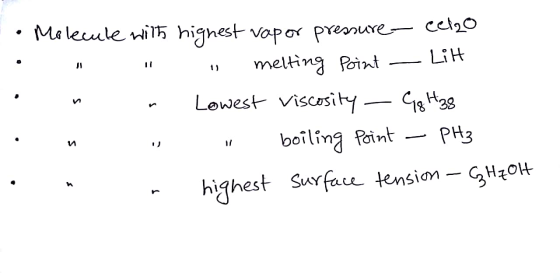
Choose the molecule in each line with the specified property: Highest vapor pressure: CCl2O
Choose the molecule in each line with the specified property:
Highest vapor pressure: CCl2O CH2O CBr2O
Highest melting point: LiH CH4 NH3
Lowest viscosity: C6H14 C12H26 C18H38
Lowest boiling point: AsH3 PH3 NH3
Highest surface tension: CH3OH C2H5OH C3H7OH
Homework Answers
Add Answer to:
Choose the molecule in each line with the specified
property:
Highest vapor
pressure:
CCl2O
1. Arrange the following in increasing order of vapor pressure, starting from lowest to highest. C6H14...
1. Arrange the following in increasing order of vapor pressure, starting from lowest to highest. C6H14 -C2H6 -C10H22 -CH4 -C15H32 2. Name the all the intermolecular forces in each of the following substances: a. BaCl2 b. H2O c. CH4 d. HI e. NH3 3. Arrange the following substances in increasing order of melting point, starting from the lowest to highest. C2H5OH N2 CH3Cl C3H8 4. Which type of intermolecular force is the most important attraction in each of the following:...
en temperatu lder 4. Place the following substances in order of decreasing vapor pressure at a...
 en temperatu lder 4. Place the following substances in order of decreasing vapor pressure at a given CF. PF BrF, BrF, > PFS > CF Brf > CF, > PES PF, > BrF, > CF CF, > BrF, > PFS CF, > PF > BrFs C d 5. Define critical point. 2 The temperature and pressure above which a supercritical fluid exists. bThe temperature and pressure where liquid, solid, and gas are equally stable and are in equilibrium c. The...
*Explanations should be brief. Draw a box around each final answer, if applicable.* 1. Consider intermolecular...
 *Explanations should be brief. Draw a box around each final answer, if applicable.* 1. Consider intermolecular forces and kinetic energies with respect to a solid and a liquid. Explain why molecules in a liquid are free to move past each other, while molecules in a solid are held in fixed positions. 2. Use your knowledge of intermolecular forces to provide an explanation for why the boiling point of 2-hexanol is higher than the boiling point of 2,3-dimethyl-2-butanol. Be sure to...
39) What property of liquids explains the formation of leaves? A) surface tension B) adhesion C)...
 39) What property of liquids explains the formation of leaves? A) surface tension B) adhesion C) viscosity D) vapor pressure E) None of the choices are correct. mation of spherical water droplets on green 3 9) - um at constant pressure and temperature has the volume 40) 40) A balloon containing helium at constant pres doubled by adding a more helium. Which ' adding a more helium. Which statement(s) isare) TRUE? A) The number of moles of helium doubled. B)...
 en temperatu lder 4. Place the following substances in order of decreasing vapor pressure at a given CF. PF BrF, BrF, > PFS > CF Brf > CF, > PES PF, > BrF, > CF CF, > BrF, > PFS CF, > PF > BrFs C d 5. Define critical point. 2 The temperature and pressure above which a supercritical fluid exists. bThe temperature and pressure where liquid, solid, and gas are equally stable and are in equilibrium c. The...
 *Explanations should be brief. Draw a box around each final answer, if applicable.* 1. Consider intermolecular forces and kinetic energies with respect to a solid and a liquid. Explain why molecules in a liquid are free to move past each other, while molecules in a solid are held in fixed positions. 2. Use your knowledge of intermolecular forces to provide an explanation for why the boiling point of 2-hexanol is higher than the boiling point of 2,3-dimethyl-2-butanol. Be sure to...
 39) What property of liquids explains the formation of leaves? A) surface tension B) adhesion C) viscosity D) vapor pressure E) None of the choices are correct. mation of spherical water droplets on green 3 9) - um at constant pressure and temperature has the volume 40) 40) A balloon containing helium at constant pres doubled by adding a more helium. Which ' adding a more helium. Which statement(s) isare) TRUE? A) The number of moles of helium doubled. B)...
Most questions answered within 3 hours.
-
Where is the error in this code sequence?
String s1 = "Hello";
String s2 = "ello";...
asked 10 months ago -
Financial data for Joel de Paris, Inc., for last year
follow:
Joel de Paris, Inc.
Balance...
asked 10 months ago -
Consider this reaction:
Al2(SO4)3 (aq)+ BaCl3
(aq) Al2Cl6 (aq)- +
3BaSO4(s) . What is the...
asked 10 months ago -
Suppose that Savneet is considering increasing her
recent random sample from 20 car rentals to 40...
asked 10 months ago -
Trucks arrive at an unloading terminal at an average rate of 120
per hour.
Trucks arrive...
asked 10 months ago -
Why are methanol and ethanol completely soluble in water while
octanol is not very little soluble....
asked 10 months ago -
A facilities manager at a university reads in a research report
that the mean amount of...
asked 10 months ago -
When the CuSO4 is rehydrated by adding water to the anhydrous
compound, is this an endothermic...
asked 10 months ago -
A ray of sunlight is passing from diamond into crown glass; the
angle of incidence is...
asked 10 months ago -
A block of mass 0.249 kg is placed on top of a light, vertical
spring of...
asked 10 months ago -
how do the kidneys compensate in the presences of acidosis
a) trigger hyperventilate
b) reserve acid...
asked 10 months ago -
Question 501 pts
The rental rate of capital to the firm increases. Which of the
following...
asked 10 months ago