
Homework Answers
Add Answer to:
What current (A) is flowing in a resistor if 4.0E16 electrons pass a point in the...
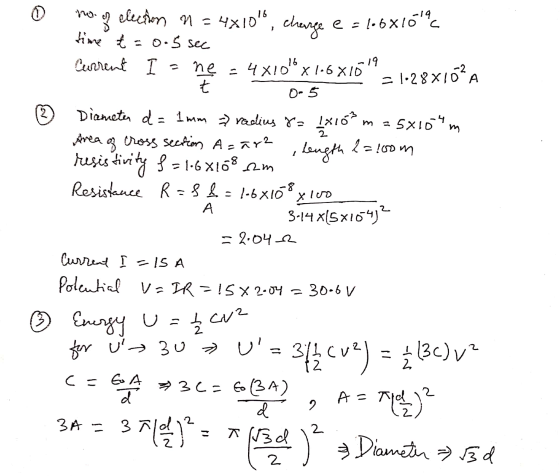
A 1.0-mm diameter extension cord is made of metal having a resistivity of 1.68 × 10⁻⁸...
A 1.0-mm diameter extension cord is made of metal having a resistivity of 1.68 × 10⁻⁸ Ω • m. When it carries a current of 15 A, what is the potential difference between two points in the cord that are 100 m apart?
1. A resistor carries a current I. The power dissipated in the resistor is P. What...
1. A resistor carries a current I. The power dissipated in the resistor is P. What is the power dissipated if the same resistor carries current 3I? A. P B. 3P C. 9P D. P/9 2. Which of the following statements is false? A. An electric field is needed to produce an electric current. B. A potential difference between two points is needed to produce an electric current. C. For a steady current to flow in a wire, the wire...
A current of I=8.0 A is flowing in a typical extension cord of length L=3.00 m....
A current of I=8.0 A is flowing in a typical extension cord of length L=3.00 m. The cord is made of copper wire with diameter d=1.5 mm. The charge of the electron is e=1.6×10⁻¹⁹ C. The mass of the electron is m=9.1×10⁻³¹ kg. The resisitivity of copper is ρ=1.7×10⁻⁸ Ω⋅m. The concentration of free electrons in copper is n=8.5×1028 m−3. Find the total number of collisions (Nc) that all free electrons in this extension cord undergo in one second.
A current i flows into (and, on the other side, out of) a paralle-plate capacitor. The...
A current i flows into (and, on the other side, out of) a paralle-plate capacitor. The plates are circular, spaced 0.0010 m apart, and have an area of 0.785m2. The voltage across the capacitor changes at 1.0 kV/s, causing a magnetic field to be induced in the capacitor, parallel to the plates. (a) Find the rate at which the electric field and the electric flux are changing between the plates. (b) Find the magnitude of the magnetic field between the...
V-0.0 1. An electron is accelerated from rest to a final speed of 1.50 x 10⁶....
 V-0.0 1. An electron is accelerated from rest to a final speed of 1.50 x 10⁶. It begins at a location where the electric potential is zero. a) What is the final kinetic energy of the electron? (4) v = 1.50 x 10m's - b) What is the value of the electric potential (V) at the electron's final position? (Be sure to get the sign right.) (6) 2. a) What is the capacitance of a capacitor which stores 1.0 C...
A current of I=8.0A is flowing in a typical extension cord of length L=3.00m. The cord...
A current of I=8.0A is flowing in a typical extension cord of length L=3.00m. The cord is made of copper wire with diameter d=1.5mm. The charge of the electron is e=1.6×10⁻¹⁹C. The mass of the electron is m=9.1×10⁻³¹kg. The resisitivity of copper is ρ=1.7×10⁻⁸Ω⋅m. The concentration of free electrons in copper is n=8.5×1028m−3. A. Find the drift velocity vd of the electrons in the wire. B. The population of the Earth is roughly eight billion people. If all free electrons...
) A cylindrical resistor of radius 5.5 mm and length 1.8 cm is made of material...
) A cylindrical resistor of radius 5.5 mm and length 1.8 cm is made of material that has a resistivity of 3.50×10⁻⁵Ω m. What is the current density when the energy dissipation rate in the resistor is 1.0 W? What is the potential difference?
Experiment 7 - The Resistor Capacitor Circuit Learning Objectives: Understand the short and long time behavior...
 Experiment 7 - The Resistor Capacitor Circuit Learning Objectives: Understand the short and long time behavior of circuits containing capacitors. Understand the and the mathematical relationshin between the current through the circuit as a function time, resistance, capacitance, and potential difference 1. Understanding the models for the behavior of a capacitor in a circuit A capacitor is a device that stores energy in a circuit as potential energy in an electric field. In the simple circuit drawn on the night,...
A cylindrical resistor of radius 5.4 mm and length 2.3 cm is made of material that...
A cylindrical resistor of radius 5.4 mm and length 2.3 cm is made of material that has a resistivity of 3.50×10⁻⁵ Ω m. What is the current density when the energy dissipation rate in the resistor is 1.0 W? What is the potential difference?
Chapter 26, Problem 064 A cylindrical resistor of radius 2.7 mm and length 3.0 cm is...
 Chapter 26, Problem 064 A cylindrical resistor of radius 2.7 mm and length 3.0 cm is made of material that has a resistivity of 2.8 x 10⁻⁵ 2.m. What are (a) the magnitude of the current density and (b) the potential difference when the energy dissipation rate in the resistor is 1.0 W? (a) Number Units (b) Number Units SHOW HINT
 V-0.0 1. An electron is accelerated from rest to a final speed of 1.50 x 10⁶. It begins at a location where the electric potential is zero. a) What is the final kinetic energy of the electron? (4) v = 1.50 x 10m's - b) What is the value of the electric potential (V) at the electron's final position? (Be sure to get the sign right.) (6) 2. a) What is the capacitance of a capacitor which stores 1.0 C...
 Experiment 7 - The Resistor Capacitor Circuit Learning Objectives: Understand the short and long time behavior of circuits containing capacitors. Understand the and the mathematical relationshin between the current through the circuit as a function time, resistance, capacitance, and potential difference 1. Understanding the models for the behavior of a capacitor in a circuit A capacitor is a device that stores energy in a circuit as potential energy in an electric field. In the simple circuit drawn on the night,...
 Chapter 26, Problem 064 A cylindrical resistor of radius 2.7 mm and length 3.0 cm is made of material that has a resistivity of 2.8 x 10⁻⁵ 2.m. What are (a) the magnitude of the current density and (b) the potential difference when the energy dissipation rate in the resistor is 1.0 W? (a) Number Units (b) Number Units SHOW HINT
Most questions answered within 3 hours.
-
Where is the error in this code sequence?
String s1 = "Hello";
String s2 = "ello";...
asked 10 months ago -
Financial data for Joel de Paris, Inc., for last year
follow:
Joel de Paris, Inc.
Balance...
asked 10 months ago -
Consider this reaction:
Al2(SO4)3 (aq)+ BaCl3
(aq) Al2Cl6 (aq)- +
3BaSO4(s) . What is the...
asked 10 months ago -
Suppose that Savneet is considering increasing her
recent random sample from 20 car rentals to 40...
asked 10 months ago -
Trucks arrive at an unloading terminal at an average rate of 120
per hour.
Trucks arrive...
asked 10 months ago -
Why are methanol and ethanol completely soluble in water while
octanol is not very little soluble....
asked 10 months ago -
A facilities manager at a university reads in a research report
that the mean amount of...
asked 10 months ago -
When the CuSO4 is rehydrated by adding water to the anhydrous
compound, is this an endothermic...
asked 10 months ago -
A ray of sunlight is passing from diamond into crown glass; the
angle of incidence is...
asked 10 months ago -
A block of mass 0.249 kg is placed on top of a light, vertical
spring of...
asked 10 months ago -
how do the kidneys compensate in the presences of acidosis
a) trigger hyperventilate
b) reserve acid...
asked 10 months ago -
Question 501 pts
The rental rate of capital to the firm increases. Which of the
following...
asked 10 months ago