
Homework Answers
Add Answer to:
A mass weighing 4 pounds stretches a spring 6 inches. At time t = 0, the...
Detailed explanation and solution would kindly be appreciated, Thanks :) A mass weighing 4 pounds stretches...
 Detailed explanation and
solution would kindly be appreciated, Thanks :)
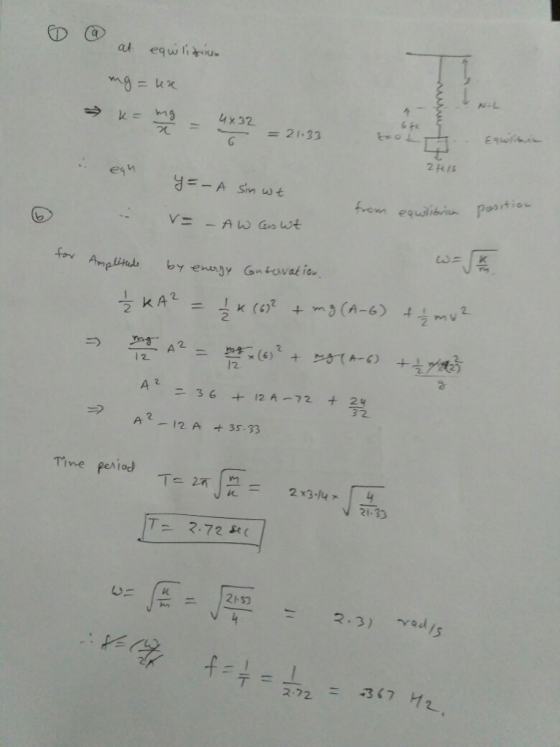
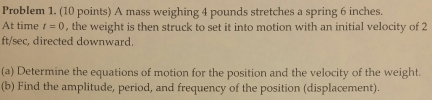
A mass weighing 4 pounds stretches a spring 6 inches. At time t = 0, the weight is then struck to set it into motion with an initial velocity of 2 ft/sec, directed downward. Determine the equations of motion for the position and the velocity of the weight. Find the amplitude, period, and frequency of the position (displacement).
Detailed explanation and
solution would kindly be appreciated, Thanks :)
A mass weighing 4 pounds stretches a spring 6 inches. At time t = 0, the weight is then struck to set it into motion with an initial velocity of 2 ft/sec, directed downward. Determine the equations of motion for the position and the velocity of the weight. Find the amplitude, period, and frequency of the position (displacement).
(7 points) 13. A mass weighing 10 pounds stretches a spring 3 inches. The mass is...
 (7 points) 13. A mass weighing 10 pounds stretches a spring 3 inches. The mass is removed and replaced with a mass weighing 51.2 pounds, which is initially released from a point 4 inches above the equilibrium position with an downward velocity of ft/s. Find the equation of motion, ä(t). (g = 32 ft/s2) (7 points) 14. A mass weighing 4 pounds stretches a spring 2 feet. The system is submerged in a medium which offers a damping force that...
5. (20 points) A mass weighing 8 pounds stretches a spring 1.6 feet. The entire system...
 5. (20 points) A mass weighing 8 pounds stretches a spring 1.6 feet. The entire system is placed in a medium that offers a damping force numerically equivalent to twice the instantaneous velocity. The mass is initially released from a point 1/2 foot above the equilibrium point with a downward velocity of 5 ft/sec. (a) (6 points) Write the differential equation for the mass/spring system and identify the initial conditions. 7 5. (b) (12 points) Solve the IVP in part...
plz print your result -1 points МУ Not A mass weighing 3V 10 N stretches a spring 2 m. The mass is attached to a dashpot device that offers a damping force numerically equal to β (B > 0) times the...
 plz print your result
-1 points МУ Not A mass weighing 3V 10 N stretches a spring 2 m. The mass is attached to a dashpot device that offers a damping force numerically equal to β (B > 0) times the instantaneous velocity Determine the values of the damping constant B so that the subsequent motion is overdamped, critically damped, and underdamped. (If an answer is an interval, use interval notation. Use g 9.8 m/s2 for the acceleration due to...
plz print your result
-1 points МУ Not A mass weighing 3V 10 N stretches a spring 2 m. The mass is attached to a dashpot device that offers a damping force numerically equal to β (B > 0) times the instantaneous velocity Determine the values of the damping constant B so that the subsequent motion is overdamped, critically damped, and underdamped. (If an answer is an interval, use interval notation. Use g 9.8 m/s2 for the acceleration due to...
5. (20 points) A mass weighing 8 pounds stretches a spring 1.6 fort. The entire system...
 5. (20 points) A mass weighing 8 pounds stretches a spring 1.6 fort. The entire system is placed in a medium that offers a damping force numerically equivalent to twice the instantaneous velocity. The mass is initially released from a point 1/2 foot above the equilibrium point with a downward velocity of 5 sec (a) (6 points) Write the differential equation for the mass spring system and identify the initial conditions 7 5. (b) (12 points) Solve the IVP in...
(7 points) 14. A mass weighing 4 pounds stretches a spring 2 feet. The system is...
 (7 points) 14. A mass weighing 4 pounds stretches a spring 2 feet. The system is submerged in a medium which offers a damping force that is numerically equal to the instantaneous velocity. The mass is initially released from a point 1 foot above the equilibrium position with a downward velocity of 8 ft/s. Find the equation of motion, ä(t). What type of damped motion is this system?
A mass of 2 kg stretches a spring 0.1 m. At time t= 0 the mass...
A mass of 2 kg stretches a spring 0.1 m. At time t= 0 the mass is released from its equilibrium position with a downward velocity of 1 m/s. Air resistance adds a damping force equal to one fifth of the velocity of the mass. Set up an initial value problem for the position x(t) of the mass at time t. Determine whether the system is overdamped, underdamped or critically damped. You can assume the acceleration of gravity g equals...
1. A mass weighing 8 pounds is attached to a 4 foot long spring and stretches it to 8 feet long. ...
 1. A mass weighing 8 pounds is attached to a 4 foot long spring and stretches it to 8 feet long. The medium offers a damping force equal to 0.5 times the instantaneous velocity. Find the equation of motion if the mass is released from rest at a position 18 inches above the equilibrium.
1. A mass weighing 8 pounds is attached to a 4 foot long spring and stretches it to 8 feet long. The medium offers a damping...
1. A mass weighing 8 pounds is attached to a 4 foot long spring and stretches it to 8 feet long. The medium offers a damping force equal to 0.5 times the instantaneous velocity. Find the equation of motion if the mass is released from rest at a position 18 inches above the equilibrium.
1. A mass weighing 8 pounds is attached to a 4 foot long spring and stretches it to 8 feet long. The medium offers a damping...
(1 point) A mass weighing 8 lb stretches a spring 3 in. Suppose the mass is...
 (1 point) A mass weighing 8 lb stretches a spring 3 in. Suppose the mass is displaced an additional 11 in in the positive (downward) direction and then released with an initial upward velocity of 2 ft/s. The mass is in a medium, that exerts a viscuouse resistance of 1 lb when the mass has a velocity of 4 ft/s. Assume g 32 ft/s is the gravitational acceleration (a) Find the mass m (in lb.s/ft) (b) Find the damping coefficient...
Consider a mass-spring-dashpot system in which the mass is m = 4 lb-sec^2/ft, the damping constant...
Consider a mass-spring-dashpot system in which the mass is m = 4 lb-sec^2/ft, the damping constant is c =24 lb-sec/ft, and the spring constant is k=52lb/ft. The motion is free damped motion and the mass is set in motion with initial position x0=5ft and the initial velocity v0= -7ft/sec. Find the position function x(t) and determine whether the motion is overdamped, critically damped, or underdamped.
 Detailed explanation and
solution would kindly be appreciated, Thanks :)
A mass weighing 4 pounds stretches a spring 6 inches. At time t = 0, the weight is then struck to set it into motion with an initial velocity of 2 ft/sec, directed downward. Determine the equations of motion for the position and the velocity of the weight. Find the amplitude, period, and frequency of the position (displacement).
Detailed explanation and
solution would kindly be appreciated, Thanks :)
A mass weighing 4 pounds stretches a spring 6 inches. At time t = 0, the weight is then struck to set it into motion with an initial velocity of 2 ft/sec, directed downward. Determine the equations of motion for the position and the velocity of the weight. Find the amplitude, period, and frequency of the position (displacement).
 (7 points) 13. A mass weighing 10 pounds stretches a spring 3 inches. The mass is removed and replaced with a mass weighing 51.2 pounds, which is initially released from a point 4 inches above the equilibrium position with an downward velocity of ft/s. Find the equation of motion, ä(t). (g = 32 ft/s2) (7 points) 14. A mass weighing 4 pounds stretches a spring 2 feet. The system is submerged in a medium which offers a damping force that...
 5. (20 points) A mass weighing 8 pounds stretches a spring 1.6 feet. The entire system is placed in a medium that offers a damping force numerically equivalent to twice the instantaneous velocity. The mass is initially released from a point 1/2 foot above the equilibrium point with a downward velocity of 5 ft/sec. (a) (6 points) Write the differential equation for the mass/spring system and identify the initial conditions. 7 5. (b) (12 points) Solve the IVP in part...
 plz print your result
-1 points МУ Not A mass weighing 3V 10 N stretches a spring 2 m. The mass is attached to a dashpot device that offers a damping force numerically equal to β (B > 0) times the instantaneous velocity Determine the values of the damping constant B so that the subsequent motion is overdamped, critically damped, and underdamped. (If an answer is an interval, use interval notation. Use g 9.8 m/s2 for the acceleration due to...
plz print your result
-1 points МУ Not A mass weighing 3V 10 N stretches a spring 2 m. The mass is attached to a dashpot device that offers a damping force numerically equal to β (B > 0) times the instantaneous velocity Determine the values of the damping constant B so that the subsequent motion is overdamped, critically damped, and underdamped. (If an answer is an interval, use interval notation. Use g 9.8 m/s2 for the acceleration due to...
 5. (20 points) A mass weighing 8 pounds stretches a spring 1.6 fort. The entire system is placed in a medium that offers a damping force numerically equivalent to twice the instantaneous velocity. The mass is initially released from a point 1/2 foot above the equilibrium point with a downward velocity of 5 sec (a) (6 points) Write the differential equation for the mass spring system and identify the initial conditions 7 5. (b) (12 points) Solve the IVP in...
 (7 points) 14. A mass weighing 4 pounds stretches a spring 2 feet. The system is submerged in a medium which offers a damping force that is numerically equal to the instantaneous velocity. The mass is initially released from a point 1 foot above the equilibrium position with a downward velocity of 8 ft/s. Find the equation of motion, ä(t). What type of damped motion is this system?
 1. A mass weighing 8 pounds is attached to a 4 foot long spring and stretches it to 8 feet long. The medium offers a damping force equal to 0.5 times the instantaneous velocity. Find the equation of motion if the mass is released from rest at a position 18 inches above the equilibrium.
1. A mass weighing 8 pounds is attached to a 4 foot long spring and stretches it to 8 feet long. The medium offers a damping...
1. A mass weighing 8 pounds is attached to a 4 foot long spring and stretches it to 8 feet long. The medium offers a damping force equal to 0.5 times the instantaneous velocity. Find the equation of motion if the mass is released from rest at a position 18 inches above the equilibrium.
1. A mass weighing 8 pounds is attached to a 4 foot long spring and stretches it to 8 feet long. The medium offers a damping...
 (1 point) A mass weighing 8 lb stretches a spring 3 in. Suppose the mass is displaced an additional 11 in in the positive (downward) direction and then released with an initial upward velocity of 2 ft/s. The mass is in a medium, that exerts a viscuouse resistance of 1 lb when the mass has a velocity of 4 ft/s. Assume g 32 ft/s is the gravitational acceleration (a) Find the mass m (in lb.s/ft) (b) Find the damping coefficient...
Most questions answered within 3 hours.
-
Where is the error in this code sequence?
String s1 = "Hello";
String s2 = "ello";...
asked 10 months ago -
Financial data for Joel de Paris, Inc., for last year
follow:
Joel de Paris, Inc.
Balance...
asked 10 months ago -
Consider this reaction:
Al2(SO4)3 (aq)+ BaCl3
(aq) Al2Cl6 (aq)- +
3BaSO4(s) . What is the...
asked 10 months ago -
Suppose that Savneet is considering increasing her
recent random sample from 20 car rentals to 40...
asked 10 months ago -
Trucks arrive at an unloading terminal at an average rate of 120
per hour.
Trucks arrive...
asked 10 months ago -
Why are methanol and ethanol completely soluble in water while
octanol is not very little soluble....
asked 10 months ago -
A facilities manager at a university reads in a research report
that the mean amount of...
asked 10 months ago -
When the CuSO4 is rehydrated by adding water to the anhydrous
compound, is this an endothermic...
asked 10 months ago -
A ray of sunlight is passing from diamond into crown glass; the
angle of incidence is...
asked 10 months ago -
A block of mass 0.249 kg is placed on top of a light, vertical
spring of...
asked 10 months ago -
how do the kidneys compensate in the presences of acidosis
a) trigger hyperventilate
b) reserve acid...
asked 10 months ago -
Question 501 pts
The rental rate of capital to the firm increases. Which of the
following...
asked 10 months ago