
Homework Answers


Add Answer to:
Need help with 1,2,3 thank you.
1. Order of growth (20 points) Order the following functions...
Let f(n) and g(n) be asymptotically positive functions. Prove or disprove each of the following conjectures....
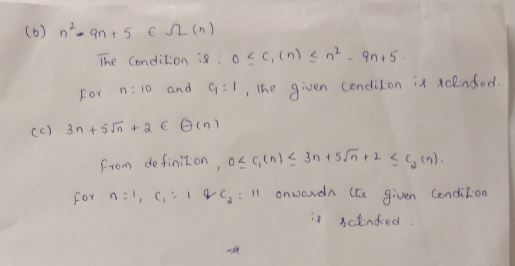
Let f(n) and g(n) be asymptotically positive functions. Prove or disprove each of the following conjectures. f(n) = O(g(n)) implies g(n) = Ω(f(n)) . f(n) = O(g(n)) implies g(n) = O(f(n)). f(n) + g(n) = Θ(min(f(n),g(n))).
Order the following functions by growth rate: N, squrerootN, N1.5, N2, NlogN, N log logN, Nlog2N,...
 Order the following functions by growth rate: N, squrerootN, N1.5, N2, NlogN, N log logN, Nlog2N, Nlog(N2), 2/N,2N, 2N/2, 37, N2 logN, N3. Indicate which functions grow at the same rate.
Order the following functions by asymptotic growth rate. 2n log n + 2n, 210, 2 log...
Order the following functions by asymptotic growth rate. 2n log n + 2n, 210, 2 log n, 3n + 100 log n, 4n, 2n, n2 + 10n, n3, n log n2
Let f1 and f2 be asymptotically positive non-decreasing functions. Prove or disprove each of the following...
Let f1 and f2 be asymptotically positive non-decreasing functions. Prove or disprove each of the following conjectures. To disprove give a counter example. If f1(n) = O(g(n)) and f2(n) = O(g(n)) then f1(n)= Θ (f2(n) ).
1. a) Let f(n) = 6n2 - 100n + 44 and g(n) = 0.5n3 . Prove...
 1. a) Let f(n) = 6n2 - 100n + 44 and g(n) =
0.5n3 . Prove that f(n) = O(g(n)) using the definition
of Big-O notation. (You need to find constants c and n0).
b) Let f(n) = 3n2 + n and g(n) = 2n2 . Use
the definition of big-O notation to prove that
f(n) = O(g(n)) (you need to find constants c and n0) and
g(n) = O(f(n)) (you need to find constants c and n0).
Conclude that...
1. a) Let f(n) = 6n2 - 100n + 44 and g(n) =
0.5n3 . Prove that f(n) = O(g(n)) using the definition
of Big-O notation. (You need to find constants c and n0).
b) Let f(n) = 3n2 + n and g(n) = 2n2 . Use
the definition of big-O notation to prove that
f(n) = O(g(n)) (you need to find constants c and n0) and
g(n) = O(f(n)) (you need to find constants c and n0).
Conclude that...
Compare the following pairs of functions f, g. In each case, say whether f- o(g) f-w(g), or f = Θ...
 Compare the following pairs of functions f, g. In each case, say whether f- o(g) f-w(g), or f = Θ(g), and prove your claim. 157. f(n) -100n+logn, gn) (logn)2. 158,介f(n) = logn, g(n) = log log(n2). 159. . f(n)-n2/log n, g(n) = n(log n)2. 160·介介f(n)-(log n)106.9(n)-n10-6 . 161. (n)logn, g(n) (log nlog n 162. f(n) n2, gn) 3.
Compare the following pairs of functions f, g. In each case, say whether f- o(g) f-w(g), or f = Θ(g), and prove...
Compare the following pairs of functions f, g. In each case, say whether f- o(g) f-w(g), or f = Θ(g), and prove your claim. 157. f(n) -100n+logn, gn) (logn)2. 158,介f(n) = logn, g(n) = log log(n2). 159. . f(n)-n2/log n, g(n) = n(log n)2. 160·介介f(n)-(log n)106.9(n)-n10-6 . 161. (n)logn, g(n) (log nlog n 162. f(n) n2, gn) 3.
Compare the following pairs of functions f, g. In each case, say whether f- o(g) f-w(g), or f = Θ(g), and prove...
3-3 Ordering by asymptotic growth rates a. Rank the following functions by order of growth; that...
 3-3 Ordering by asymptotic growth rates a. Rank the following functions by order of growth; that is, find an arrangement 81,82, 830 of the functions satisfying gi = Ω(82), g2 Ω(83), , g29 = Ω(g30). Partition your list into equivalence classes such that functions f(n) and g(n) are in the same class if and only if f(n) = Θ(g(n)) Chaptr3 Growth of Functions 1n In Inn lg* g nn-2" n'ln Ig nIn n 2" nlgn 22+1 b. Give an example...
Prove or disprove the following statements, using the relationship among typical growth-rate functions seen in class....
Prove or disprove the following statements, using the relationship among typical growth-rate functions seen in class. a)n^15log n + n^9 is O(n^9 log n) b) 15^7n^5 + 5n^4 + 8000000n^2 + n is Θ(n^3) c) n^n is Ω (n!) d) 0.01n^9 + 800000n^7 is O(n^9) e) n^14 + 0.0000001n^5 is Ω(n^13) f) n! is O(3n)
Answer the following questions related to ?(·), Ω(·) and Θ(·). – (i). [8 marks] Prove the...
Answer the following questions related to ?(·), Ω(·) and Θ(·). – (i). [8 marks] Prove the correctness of the product property of ? (·). Specifically, prove: if ?1(?) = ?(?1(?)) and ?2(?) = ?(?2(?)), then ?1(?) · ?2(?) = ?(?1(?) · ?2(?)). (Hint. Using the definition. If ?? (?) = ?(?? (?)), then there exists constants ?? and?? suchthat??(?)≤?? ·??(?)for?≥??. – (ii). [5 marks] What is the asymptotic (Big-Oh) complexity of the function ?(?) = (?2 + √?) · (?...
2. Asymptotic Notation (8 points) Show the following using the definitions of O, Ω, and Θ....
2. Asymptotic Notation (8 points) Show the following using the definitions of O, Ω, and Θ. (1) (2 points) 2n 3 + n 2 + 4 ∈ Θ(n 3 ) (2) (2 points) 3n 4 − 9n 2 + 4n ∈ Θ(n 4 ) (Hint: careful with the negative number) (3) (4 points) Suppose f(n) ∈ O(g1(n)) and f(n) ∈ O(g2(n)). Which of the following are true? Justify your answers using the definition of O. Give a counter example if...
 Order the following functions by growth rate: N, squrerootN, N1.5, N2, NlogN, N log logN, Nlog2N, Nlog(N2), 2/N,2N, 2N/2, 37, N2 logN, N3. Indicate which functions grow at the same rate.
 1. a) Let f(n) = 6n2 - 100n + 44 and g(n) =
0.5n3 . Prove that f(n) = O(g(n)) using the definition
of Big-O notation. (You need to find constants c and n0).
b) Let f(n) = 3n2 + n and g(n) = 2n2 . Use
the definition of big-O notation to prove that
f(n) = O(g(n)) (you need to find constants c and n0) and
g(n) = O(f(n)) (you need to find constants c and n0).
Conclude that...
1. a) Let f(n) = 6n2 - 100n + 44 and g(n) =
0.5n3 . Prove that f(n) = O(g(n)) using the definition
of Big-O notation. (You need to find constants c and n0).
b) Let f(n) = 3n2 + n and g(n) = 2n2 . Use
the definition of big-O notation to prove that
f(n) = O(g(n)) (you need to find constants c and n0) and
g(n) = O(f(n)) (you need to find constants c and n0).
Conclude that...
 Compare the following pairs of functions f, g. In each case, say whether f- o(g) f-w(g), or f = Θ(g), and prove your claim. 157. f(n) -100n+logn, gn) (logn)2. 158,介f(n) = logn, g(n) = log log(n2). 159. . f(n)-n2/log n, g(n) = n(log n)2. 160·介介f(n)-(log n)106.9(n)-n10-6 . 161. (n)logn, g(n) (log nlog n 162. f(n) n2, gn) 3.
Compare the following pairs of functions f, g. In each case, say whether f- o(g) f-w(g), or f = Θ(g), and prove...
Compare the following pairs of functions f, g. In each case, say whether f- o(g) f-w(g), or f = Θ(g), and prove your claim. 157. f(n) -100n+logn, gn) (logn)2. 158,介f(n) = logn, g(n) = log log(n2). 159. . f(n)-n2/log n, g(n) = n(log n)2. 160·介介f(n)-(log n)106.9(n)-n10-6 . 161. (n)logn, g(n) (log nlog n 162. f(n) n2, gn) 3.
Compare the following pairs of functions f, g. In each case, say whether f- o(g) f-w(g), or f = Θ(g), and prove...
 3-3 Ordering by asymptotic growth rates a. Rank the following functions by order of growth; that is, find an arrangement 81,82, 830 of the functions satisfying gi = Ω(82), g2 Ω(83), , g29 = Ω(g30). Partition your list into equivalence classes such that functions f(n) and g(n) are in the same class if and only if f(n) = Θ(g(n)) Chaptr3 Growth of Functions 1n In Inn lg* g nn-2" n'ln Ig nIn n 2" nlgn 22+1 b. Give an example...
Most questions answered within 3 hours.
-
Where is the error in this code sequence?
String s1 = "Hello";
String s2 = "ello";...
asked 11 months ago -
Financial data for Joel de Paris, Inc., for last year
follow:
Joel de Paris, Inc.
Balance...
asked 11 months ago -
Consider this reaction:
Al2(SO4)3 (aq)+ BaCl3
(aq) Al2Cl6 (aq)- +
3BaSO4(s) . What is the...
asked 11 months ago -
Suppose that Savneet is considering increasing her
recent random sample from 20 car rentals to 40...
asked 11 months ago -
Trucks arrive at an unloading terminal at an average rate of 120
per hour.
Trucks arrive...
asked 11 months ago -
Why are methanol and ethanol completely soluble in water while
octanol is not very little soluble....
asked 11 months ago -
A facilities manager at a university reads in a research report
that the mean amount of...
asked 11 months ago -
When the CuSO4 is rehydrated by adding water to the anhydrous
compound, is this an endothermic...
asked 11 months ago -
A ray of sunlight is passing from diamond into crown glass; the
angle of incidence is...
asked 11 months ago -
A block of mass 0.249 kg is placed on top of a light, vertical
spring of...
asked 11 months ago -
how do the kidneys compensate in the presences of acidosis
a) trigger hyperventilate
b) reserve acid...
asked 11 months ago -
Question 501 pts
The rental rate of capital to the firm increases. Which of the
following...
asked 11 months ago