

Homework Answers
Add Answer to:
Please refer to the Aldol Condensation experiment in your lab manual (page 89) • Calculate the...
what is the theoretical yield of anisalacetophenone and dibenzalacetone formed? thank you. The Aldol Condensation Precautions:...
 what is the theoretical yield of anisalacetophenone and
dibenzalacetone formed? thank you.
The Aldol Condensation Precautions: Acetone, ethanol and acetophenone are flammable; work in a fume hood. Sodium hydroxide is a strong base and can cause severe skin burns and eye damage. Safety goggles are required. Gloves are recommended. Purpose To carry out two Aldol condensation reactions in which no heat is needed to obtain the condensation product. The two reactions differ in the number of enolizable protons at the...
what is the theoretical yield of anisalacetophenone and
dibenzalacetone formed? thank you.
The Aldol Condensation Precautions: Acetone, ethanol and acetophenone are flammable; work in a fume hood. Sodium hydroxide is a strong base and can cause severe skin burns and eye damage. Safety goggles are required. Gloves are recommended. Purpose To carry out two Aldol condensation reactions in which no heat is needed to obtain the condensation product. The two reactions differ in the number of enolizable protons at the...
Chemistry 326 Laboratory Manual obowy zawabnya CH, HycoF OCH Pre-Lab Assignment: Complete BEFORE Lab! (5 pts)...
 Chemistry 326 Laboratory Manual obowy zawabnya CH, HycoF OCH Pre-Lab Assignment: Complete BEFORE Lab! (5 pts) 1. Draw the ketones and aldehydes necessary to synthesize ALL compounds A-F via double Aldol condensation. 2. Determine the moles of acetone and the moles of benzaldehyde used in the sample procedure below. NOTE: you will need to find the density of acetone and benzaldehyde to do this exercise. 3. Using the same number of moles you calculated above, determine the VOLUME of each...
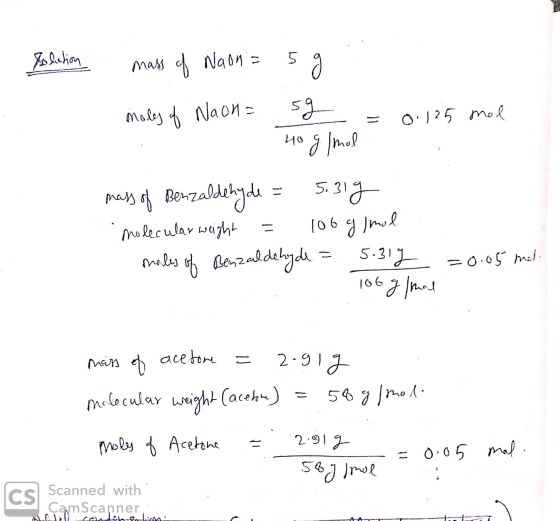
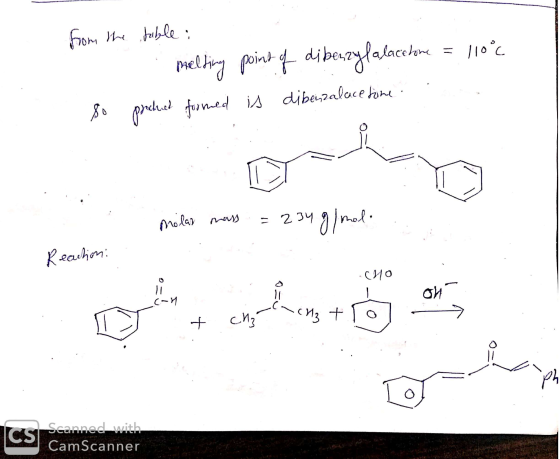
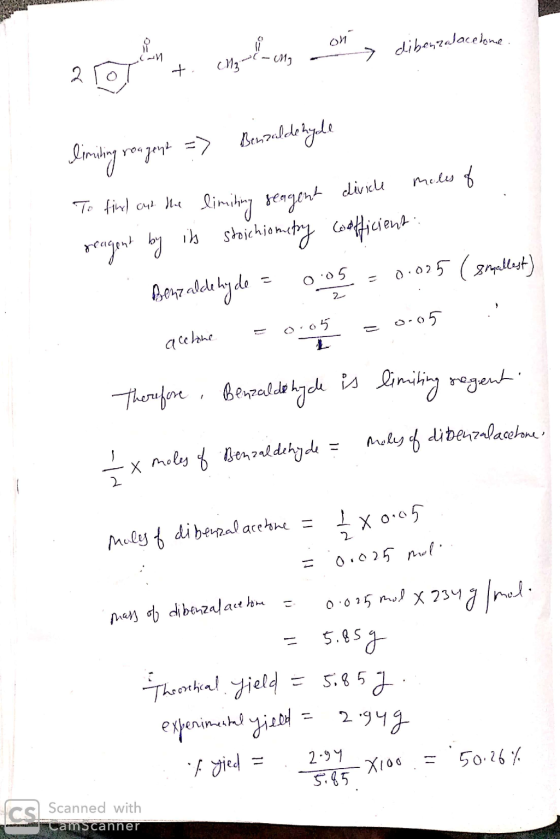
what is the theoretical yield and what is the percent yield? In a 125-mL Erlenmeyer flask...
 what is the theoretical yield and what is the percent
yield?
In a 125-mL Erlenmeyer flask containing a magnetic stirring bar, mix 0.05 md benzaldehyde with the theoretical quantity of acetone, and add one-half the ture to a solution of 5 g of sodium hydroxide dissolved in 50 mL of water and 40 mL of ethanol at room temperature (<25°C). After 15 minutes of stirring ada remainder of the aldehyde-ketone mixture and rinse the container with a little ethanol to...
what is the theoretical yield and what is the percent
yield?
In a 125-mL Erlenmeyer flask containing a magnetic stirring bar, mix 0.05 md benzaldehyde with the theoretical quantity of acetone, and add one-half the ture to a solution of 5 g of sodium hydroxide dissolved in 50 mL of water and 40 mL of ethanol at room temperature (<25°C). After 15 minutes of stirring ada remainder of the aldehyde-ketone mixture and rinse the container with a little ethanol to...
What is the limiting reagent in this experiment? Acetophenone or aqueous bleach? 1. Add about 1.0...
 What is the limiting reagent in this experiment? Acetophenone or
aqueous bleach?
1. Add about 1.0 g (measured accurately) of acetophenone to 40 mL of the bleach solution (5% NaCl in water - this reactant should be included in your table of reagents!) in a 100 mL round bottom flask equipped with a magnetic stirrer. Clamp the flask in the fume hood above a stir plate. 2. After the initial reaction has subsided, boil the reaction mixture gently for 5...
What is the limiting reagent in this experiment? Acetophenone or
aqueous bleach?
1. Add about 1.0 g (measured accurately) of acetophenone to 40 mL of the bleach solution (5% NaCl in water - this reactant should be included in your table of reagents!) in a 100 mL round bottom flask equipped with a magnetic stirrer. Clamp the flask in the fume hood above a stir plate. 2. After the initial reaction has subsided, boil the reaction mixture gently for 5...
Calculate the quantity (mmol) of reagents to be used in the assigned experiment. Which reagent is...
 Calculate the quantity (mmol) of reagents to be used in the
assigned experiment. Which reagent is the limiting reagent? Show by
calculations.
8. n the reaction of vanillin with silver oxide, what gets oxidized and what gets reduced? Part B: Miniscale Hydrolysis of Methyl Salicylate To a 25-mL round-bottom flask containing a spin bar, add 7.5 mL of 5 M NaOH and 1.0mL. of methyl salicylate. Swirl to mix. A white solid will form, which will eventually disap- pear as...
Calculate the quantity (mmol) of reagents to be used in the
assigned experiment. Which reagent is the limiting reagent? Show by
calculations.
8. n the reaction of vanillin with silver oxide, what gets oxidized and what gets reduced? Part B: Miniscale Hydrolysis of Methyl Salicylate To a 25-mL round-bottom flask containing a spin bar, add 7.5 mL of 5 M NaOH and 1.0mL. of methyl salicylate. Swirl to mix. A white solid will form, which will eventually disap- pear as...
How does the acetone destroy the unreacted hypochlorite? 1. Add about 1.0 g (measured accurately) of...
 How does the acetone destroy
the unreacted hypochlorite?
1. Add about 1.0 g (measured accurately) of acetophenone to 40 mL of the bleach solution (5% NaCl in water - this reactant should be included in your table of reagents!) in a 100 mL round bottom flask equipped with a magnetic stirrer. Clamp the flask in the fume hood above a stir plate. 2. After the initial reaction has subsided, boil the reaction mixture gently for 5 - 10 minutes using...
How does the acetone destroy
the unreacted hypochlorite?
1. Add about 1.0 g (measured accurately) of acetophenone to 40 mL of the bleach solution (5% NaCl in water - this reactant should be included in your table of reagents!) in a 100 mL round bottom flask equipped with a magnetic stirrer. Clamp the flask in the fume hood above a stir plate. 2. After the initial reaction has subsided, boil the reaction mixture gently for 5 - 10 minutes using...
What is the mechanism (with curved arrows) for this reaction? 1. Add about 1.0 g (measured accurately) of acetophenone t...
 What is the mechanism (with
curved arrows) for this reaction?
1. Add about 1.0 g (measured accurately) of acetophenone to 40 mL of the bleach solution (5% NaCl in water - this reactant should be included in your table of reagents!) in a 100 mL round bottom flask equipped with a magnetic stirrer. Clamp the flask in the fume hood above a stir plate. 2. After the initial reaction has subsided, boil the reaction mixture gently for 5 - 10...
What is the mechanism (with
curved arrows) for this reaction?
1. Add about 1.0 g (measured accurately) of acetophenone to 40 mL of the bleach solution (5% NaCl in water - this reactant should be included in your table of reagents!) in a 100 mL round bottom flask equipped with a magnetic stirrer. Clamp the flask in the fume hood above a stir plate. 2. After the initial reaction has subsided, boil the reaction mixture gently for 5 - 10...
Please answer the following questions/fill in the data tables based on the following experiment. EXPERIMENTAL PROCEDURE:...
Please answer the following questions/fill in the data tables based on the following experiment. EXPERIMENTAL PROCEDURE: Place sodium hydroxide (2.500 g) in a 100 mL Erlenmeyer flask and add water (25.0 mL) and ethanol (20.0 mL). Add a magnetic stirrer bar and stir until all the NaOH has dissolved. To a second reaction vessel, add benzaldehyde (2.650 g, 0.025 mol) and acetone (0.725 g, 0.0125 mol). Add approximately half of the aldehyde-ketone solution to the sodium hydroxide solution, and stir...
Experiment: A mixture of equal proportions of benzoic acid, ethyl 4-aminobenzoate, and 1,4-dimethoxybenzene are to be...
Experiment: A mixture of equal proportions of benzoic acid, ethyl 4-aminobenzoate, and 1,4-dimethoxybenzene are to be separated by extraction using the solvent diethyl ether. Day 1: Part A. Isolation of the basic component: In a small beaker, dissolve 3 g of the mixture (benzoic acid, ethyl 4-aminobenzoate, and 1,4-dimethoxybenzene) in 30 mL of diethyl ether and transfer the mixture to a 125- mL separatory funnel (see Fig. 1) using a little diethyl ether to complete the transfer. Add 10 mL...
Part A of experiment: Working in the fume hood, combine 4.0 mL of 10% NaOH solution and 4 mL EtOH in a 50 mL round bot...
 Part A of experiment:
Working in the fume hood, combine 4.0 mL of 10% NaOH solution
and 4 mL EtOH in a 50 mL round bottom flask.
Dissolve 1.0 mL (8.6 mmol) of acetophenone into your
solution.
Add 1.0 mL (9.8 mmol) of benzaldehyde and a magnetic stir bar to
your flask. Clamp the flask
above a stir plate.
Monitor the reaction for 45 minutes by TLC. Acetophenone needs
to be diluted prior to TLC, and
cannot be spotted neat....
Part A of experiment:
Working in the fume hood, combine 4.0 mL of 10% NaOH solution
and 4 mL EtOH in a 50 mL round bottom flask.
Dissolve 1.0 mL (8.6 mmol) of acetophenone into your
solution.
Add 1.0 mL (9.8 mmol) of benzaldehyde and a magnetic stir bar to
your flask. Clamp the flask
above a stir plate.
Monitor the reaction for 45 minutes by TLC. Acetophenone needs
to be diluted prior to TLC, and
cannot be spotted neat....
 what is the theoretical yield of anisalacetophenone and
dibenzalacetone formed? thank you.
The Aldol Condensation Precautions: Acetone, ethanol and acetophenone are flammable; work in a fume hood. Sodium hydroxide is a strong base and can cause severe skin burns and eye damage. Safety goggles are required. Gloves are recommended. Purpose To carry out two Aldol condensation reactions in which no heat is needed to obtain the condensation product. The two reactions differ in the number of enolizable protons at the...
what is the theoretical yield of anisalacetophenone and
dibenzalacetone formed? thank you.
The Aldol Condensation Precautions: Acetone, ethanol and acetophenone are flammable; work in a fume hood. Sodium hydroxide is a strong base and can cause severe skin burns and eye damage. Safety goggles are required. Gloves are recommended. Purpose To carry out two Aldol condensation reactions in which no heat is needed to obtain the condensation product. The two reactions differ in the number of enolizable protons at the...
 Chemistry 326 Laboratory Manual obowy zawabnya CH, HycoF OCH Pre-Lab Assignment: Complete BEFORE Lab! (5 pts) 1. Draw the ketones and aldehydes necessary to synthesize ALL compounds A-F via double Aldol condensation. 2. Determine the moles of acetone and the moles of benzaldehyde used in the sample procedure below. NOTE: you will need to find the density of acetone and benzaldehyde to do this exercise. 3. Using the same number of moles you calculated above, determine the VOLUME of each...
 what is the theoretical yield and what is the percent
yield?
In a 125-mL Erlenmeyer flask containing a magnetic stirring bar, mix 0.05 md benzaldehyde with the theoretical quantity of acetone, and add one-half the ture to a solution of 5 g of sodium hydroxide dissolved in 50 mL of water and 40 mL of ethanol at room temperature (<25°C). After 15 minutes of stirring ada remainder of the aldehyde-ketone mixture and rinse the container with a little ethanol to...
what is the theoretical yield and what is the percent
yield?
In a 125-mL Erlenmeyer flask containing a magnetic stirring bar, mix 0.05 md benzaldehyde with the theoretical quantity of acetone, and add one-half the ture to a solution of 5 g of sodium hydroxide dissolved in 50 mL of water and 40 mL of ethanol at room temperature (<25°C). After 15 minutes of stirring ada remainder of the aldehyde-ketone mixture and rinse the container with a little ethanol to...
 What is the limiting reagent in this experiment? Acetophenone or
aqueous bleach?
1. Add about 1.0 g (measured accurately) of acetophenone to 40 mL of the bleach solution (5% NaCl in water - this reactant should be included in your table of reagents!) in a 100 mL round bottom flask equipped with a magnetic stirrer. Clamp the flask in the fume hood above a stir plate. 2. After the initial reaction has subsided, boil the reaction mixture gently for 5...
What is the limiting reagent in this experiment? Acetophenone or
aqueous bleach?
1. Add about 1.0 g (measured accurately) of acetophenone to 40 mL of the bleach solution (5% NaCl in water - this reactant should be included in your table of reagents!) in a 100 mL round bottom flask equipped with a magnetic stirrer. Clamp the flask in the fume hood above a stir plate. 2. After the initial reaction has subsided, boil the reaction mixture gently for 5...
 Calculate the quantity (mmol) of reagents to be used in the
assigned experiment. Which reagent is the limiting reagent? Show by
calculations.
8. n the reaction of vanillin with silver oxide, what gets oxidized and what gets reduced? Part B: Miniscale Hydrolysis of Methyl Salicylate To a 25-mL round-bottom flask containing a spin bar, add 7.5 mL of 5 M NaOH and 1.0mL. of methyl salicylate. Swirl to mix. A white solid will form, which will eventually disap- pear as...
Calculate the quantity (mmol) of reagents to be used in the
assigned experiment. Which reagent is the limiting reagent? Show by
calculations.
8. n the reaction of vanillin with silver oxide, what gets oxidized and what gets reduced? Part B: Miniscale Hydrolysis of Methyl Salicylate To a 25-mL round-bottom flask containing a spin bar, add 7.5 mL of 5 M NaOH and 1.0mL. of methyl salicylate. Swirl to mix. A white solid will form, which will eventually disap- pear as...
 How does the acetone destroy
the unreacted hypochlorite?
1. Add about 1.0 g (measured accurately) of acetophenone to 40 mL of the bleach solution (5% NaCl in water - this reactant should be included in your table of reagents!) in a 100 mL round bottom flask equipped with a magnetic stirrer. Clamp the flask in the fume hood above a stir plate. 2. After the initial reaction has subsided, boil the reaction mixture gently for 5 - 10 minutes using...
How does the acetone destroy
the unreacted hypochlorite?
1. Add about 1.0 g (measured accurately) of acetophenone to 40 mL of the bleach solution (5% NaCl in water - this reactant should be included in your table of reagents!) in a 100 mL round bottom flask equipped with a magnetic stirrer. Clamp the flask in the fume hood above a stir plate. 2. After the initial reaction has subsided, boil the reaction mixture gently for 5 - 10 minutes using...
 What is the mechanism (with
curved arrows) for this reaction?
1. Add about 1.0 g (measured accurately) of acetophenone to 40 mL of the bleach solution (5% NaCl in water - this reactant should be included in your table of reagents!) in a 100 mL round bottom flask equipped with a magnetic stirrer. Clamp the flask in the fume hood above a stir plate. 2. After the initial reaction has subsided, boil the reaction mixture gently for 5 - 10...
What is the mechanism (with
curved arrows) for this reaction?
1. Add about 1.0 g (measured accurately) of acetophenone to 40 mL of the bleach solution (5% NaCl in water - this reactant should be included in your table of reagents!) in a 100 mL round bottom flask equipped with a magnetic stirrer. Clamp the flask in the fume hood above a stir plate. 2. After the initial reaction has subsided, boil the reaction mixture gently for 5 - 10...
 Part A of experiment:
Working in the fume hood, combine 4.0 mL of 10% NaOH solution
and 4 mL EtOH in a 50 mL round bottom flask.
Dissolve 1.0 mL (8.6 mmol) of acetophenone into your
solution.
Add 1.0 mL (9.8 mmol) of benzaldehyde and a magnetic stir bar to
your flask. Clamp the flask
above a stir plate.
Monitor the reaction for 45 minutes by TLC. Acetophenone needs
to be diluted prior to TLC, and
cannot be spotted neat....
Part A of experiment:
Working in the fume hood, combine 4.0 mL of 10% NaOH solution
and 4 mL EtOH in a 50 mL round bottom flask.
Dissolve 1.0 mL (8.6 mmol) of acetophenone into your
solution.
Add 1.0 mL (9.8 mmol) of benzaldehyde and a magnetic stir bar to
your flask. Clamp the flask
above a stir plate.
Monitor the reaction for 45 minutes by TLC. Acetophenone needs
to be diluted prior to TLC, and
cannot be spotted neat....
Most questions answered within 3 hours.
-
Where is the error in this code sequence?
String s1 = "Hello";
String s2 = "ello";...
asked 10 months ago -
Financial data for Joel de Paris, Inc., for last year
follow:
Joel de Paris, Inc.
Balance...
asked 10 months ago -
Consider this reaction:
Al2(SO4)3 (aq)+ BaCl3
(aq) Al2Cl6 (aq)- +
3BaSO4(s) . What is the...
asked 10 months ago -
Suppose that Savneet is considering increasing her
recent random sample from 20 car rentals to 40...
asked 10 months ago -
Trucks arrive at an unloading terminal at an average rate of 120
per hour.
Trucks arrive...
asked 10 months ago -
Why are methanol and ethanol completely soluble in water while
octanol is not very little soluble....
asked 10 months ago -
A facilities manager at a university reads in a research report
that the mean amount of...
asked 10 months ago -
When the CuSO4 is rehydrated by adding water to the anhydrous
compound, is this an endothermic...
asked 10 months ago -
A ray of sunlight is passing from diamond into crown glass; the
angle of incidence is...
asked 10 months ago -
A block of mass 0.249 kg is placed on top of a light, vertical
spring of...
asked 10 months ago -
how do the kidneys compensate in the presences of acidosis
a) trigger hyperventilate
b) reserve acid...
asked 10 months ago -
Question 501 pts
The rental rate of capital to the firm increases. Which of the
following...
asked 10 months ago