
Homework Answers
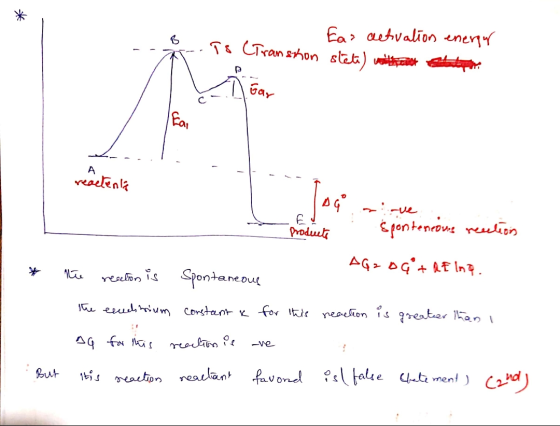
Add Answer to:
Consider the reaction coordinate diagram below and select which statement is FALSE, potential energy reaction coordinate...
6.27 Consider the following four energy diagrams: Potential energy Potential energy Reaction coordinate Reaction coordinate Potential...
 6.27 Consider the following four energy diagrams: Potential energy Potential energy Reaction coordinate Reaction coordinate Potential energy =th -th Potential energy Reaction coordinate Reaction coordinate (a) Which diagrams correspond with a two-step mechanism? (b) which diagrams correspond with a one-step mechanism? (C) Compare energy diagrams A and C. Which has a relatively larger E,? (d) Compare diagrams A and C. Which has a negative AG? (e) Compare diagrams A and D. Which has a positive AG? (1) Compare all four...
6.26 Consider the folloving four energy diagrams: Potential energy Potential energy Reaction coordinate Reaction coordinate Potential...
 6.26 Consider the folloving four energy diagrams: Potential energy Potential energy Reaction coordinate Reaction coordinate Potential energy Potential energy n Reaction coordinate Reaction coordinate (a) Which diagrams correspond with a two-step mechanism? (b) Which diagrams correspond with a one-step mechanism? (c) Compare energy diagrams A and C. Which has a relatively larger E.? (d) Compare diagrams A and C. Which has a negative AG? (e) Compare diagrams A and D. Which has a positive AG? (f) Compare all four energy...
Consider the two reaction progress diagrams below: Activated complex Activated complex Potential energy Potential energy Reaction...
 Consider the two reaction progress diagrams below: Activated complex Activated complex Potential energy Potential energy Reaction coordinate Reaction coordinate a) Which diagram (left or right) represents an exothermic reaction? Which represents an endothermic reaction? Explain. b) Does a positive activation energy (E,> 0 always denote an endothermic reaction? Explain
which reaction product would be kinetically favored? Potential energy A+B E+F C+D Reaction coordinate Select one:...
 which reaction product would be kinetically favored? Potential energy A+B E+F C+D Reaction coordinate Select one: O a. All would be favored ob. None would be favored O c. E and F d. C and D
For the reaction coordinate diagram shown below, which of the following statements are true? Energy Reaction...
 For the reaction coordinate diagram shown below, which of the following statements are true? Energy Reaction Coordinate True AErxn = A-C True Reaction is endothermic False Ea(forward) = Ea(reverse) True A represents the energy of the starting materials False Ea(forward) = B-C True Eg of the forward reaction is less than Ea of the reverse reaction Remember that thermodynamic quantities are calculated by products - reactants. The activation energy can be thought of as the barrier height.
2. Given the reaction coordinate diagram below, answer the following questions: Free energy Progress of the...
 2. Given the reaction coordinate diagram below, answer the following questions: Free energy Progress of the reaction a) How many intermediates are formed in the reaction? b) Which letter(s) represent(s) a transition state? c) What is the fastest step in the reaction? d) Which is more stable: A or G? e) Does A or E form faster from C? f) Which is the most stable intermediate? g) What is the reactant of the rate-determining step? h) is the first step...
4. Draw a free energy reaction coordinate diagram for both a generic endergonic and a generic exergonic...
4. Draw a free energy reaction coordinate diagram for both a generic endergonic and a generic exergonic reaction (label each). Make sure to label the x- and y-axes. Now label where reactants and products should go on the figure. Draw something that illustrates the free energy change for each reaction. Now write something like the following next to your figures: “reactants <—> products”. a. What do the reaction coordinate diagrams have to do with the text you just wrote? b. What...
ENED NERGY VS REACTION COORDINATE DIAGRAM MODEL T ction coordinate graph is used to show how...
 ENED NERGY VS REACTION COORDINATE DIAGRAM MODEL T ction coordinate graph is used to show how the potential energy of the reactants become products. A reaction coordinate is a measure of the progress of the reac- An energy vs. reaction changes as they becom along the reaction pathway. Figure 1 Transition State Energy activation energy Reactants AG energy change at constant pressure Products Reaction Coordinate KEY QUESTIONS 1. Is the change in energy from reactants to products in Model 1...
If the reaction A + B → C has an equilibrium constant of 10-6. Which of...
If the reaction A + B → C has an equilibrium constant of 10-6. Which of the following statements are necessarily true? Make sure to select all of the correct responses At equilibrium there will be more products than reactants At equilibrium there will be more reactants than products the reaction is spontaneous the reaction is not spontaneous The reaction is fast The reaction is slow The chemical potential energy of the products is greater than that of the reactants...
Consider the following energy diagram Reaction coordinate Which point on the graph corresponds to a reactive...
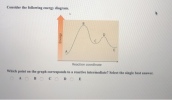 Consider the following energy diagram Reaction coordinate Which point on the graph corresponds to a reactive intermediate? Select the single best answer OBOCODOE
 6.27 Consider the following four energy diagrams: Potential energy Potential energy Reaction coordinate Reaction coordinate Potential energy =th -th Potential energy Reaction coordinate Reaction coordinate (a) Which diagrams correspond with a two-step mechanism? (b) which diagrams correspond with a one-step mechanism? (C) Compare energy diagrams A and C. Which has a relatively larger E,? (d) Compare diagrams A and C. Which has a negative AG? (e) Compare diagrams A and D. Which has a positive AG? (1) Compare all four...
 6.26 Consider the folloving four energy diagrams: Potential energy Potential energy Reaction coordinate Reaction coordinate Potential energy Potential energy n Reaction coordinate Reaction coordinate (a) Which diagrams correspond with a two-step mechanism? (b) Which diagrams correspond with a one-step mechanism? (c) Compare energy diagrams A and C. Which has a relatively larger E.? (d) Compare diagrams A and C. Which has a negative AG? (e) Compare diagrams A and D. Which has a positive AG? (f) Compare all four energy...
 Consider the two reaction progress diagrams below: Activated complex Activated complex Potential energy Potential energy Reaction coordinate Reaction coordinate a) Which diagram (left or right) represents an exothermic reaction? Which represents an endothermic reaction? Explain. b) Does a positive activation energy (E,> 0 always denote an endothermic reaction? Explain
 which reaction product would be kinetically favored? Potential energy A+B E+F C+D Reaction coordinate Select one: O a. All would be favored ob. None would be favored O c. E and F d. C and D
 For the reaction coordinate diagram shown below, which of the following statements are true? Energy Reaction Coordinate True AErxn = A-C True Reaction is endothermic False Ea(forward) = Ea(reverse) True A represents the energy of the starting materials False Ea(forward) = B-C True Eg of the forward reaction is less than Ea of the reverse reaction Remember that thermodynamic quantities are calculated by products - reactants. The activation energy can be thought of as the barrier height.
 2. Given the reaction coordinate diagram below, answer the following questions: Free energy Progress of the reaction a) How many intermediates are formed in the reaction? b) Which letter(s) represent(s) a transition state? c) What is the fastest step in the reaction? d) Which is more stable: A or G? e) Does A or E form faster from C? f) Which is the most stable intermediate? g) What is the reactant of the rate-determining step? h) is the first step...
 ENED NERGY VS REACTION COORDINATE DIAGRAM MODEL T ction coordinate graph is used to show how the potential energy of the reactants become products. A reaction coordinate is a measure of the progress of the reac- An energy vs. reaction changes as they becom along the reaction pathway. Figure 1 Transition State Energy activation energy Reactants AG energy change at constant pressure Products Reaction Coordinate KEY QUESTIONS 1. Is the change in energy from reactants to products in Model 1...
 Consider the following energy diagram Reaction coordinate Which point on the graph corresponds to a reactive intermediate? Select the single best answer OBOCODOE
Most questions answered within 3 hours.
-
Where is the error in this code sequence?
String s1 = "Hello";
String s2 = "ello";...
asked 10 months ago -
Financial data for Joel de Paris, Inc., for last year
follow:
Joel de Paris, Inc.
Balance...
asked 10 months ago -
Consider this reaction:
Al2(SO4)3 (aq)+ BaCl3
(aq) Al2Cl6 (aq)- +
3BaSO4(s) . What is the...
asked 10 months ago -
Suppose that Savneet is considering increasing her
recent random sample from 20 car rentals to 40...
asked 10 months ago -
Trucks arrive at an unloading terminal at an average rate of 120
per hour.
Trucks arrive...
asked 10 months ago -
Why are methanol and ethanol completely soluble in water while
octanol is not very little soluble....
asked 10 months ago -
A facilities manager at a university reads in a research report
that the mean amount of...
asked 10 months ago -
When the CuSO4 is rehydrated by adding water to the anhydrous
compound, is this an endothermic...
asked 10 months ago -
A ray of sunlight is passing from diamond into crown glass; the
angle of incidence is...
asked 10 months ago -
A block of mass 0.249 kg is placed on top of a light, vertical
spring of...
asked 10 months ago -
how do the kidneys compensate in the presences of acidosis
a) trigger hyperventilate
b) reserve acid...
asked 10 months ago -
Question 501 pts
The rental rate of capital to the firm increases. Which of the
following...
asked 10 months ago