Consider the structure of the phosphonium ylide formed by treatment of the following haloalkane with triphenylphosphine followed by butyllithium.
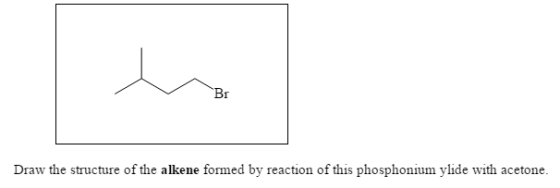
Draw the structure of the alkene formed by reaction of this phosphonium ylide with acetone.
Homework Answers
• The carbonyl compounds readily undergo a nucleophilic addition reaction that involves the breaking of the carbon-oxygen double bond.
• The reactivity of carbonyl compounds is due to the electronegative difference between oxygen and carbon. The oxygen atom attached to carbon is more electronegative.
• Therefore, the oxygen can partially pull the electrons from the carbon atom, making it more electron-deficient.
• Due to this, the nucleophile readily attacks the carbonyl carbon atom and undergoes an addition reaction.
•
The reaction of carbonyl compounds is given below:
Wittig reaction: This method is used in organic synthesis, for the preparation of alkenes from carbonyl compounds. The carbonyl compounds, on reaction with phosphorus ylides, undergoes (2+2) a cycloaddition reaction and forms a four-membered cyclic intermediate (oxophosphetane), followed by the formation of phosphine oxide to give alkenes.
The reaction scheme is given below:


The mechanism for the reaction of acetone with phosphorus ylide is given below:

The alkene formed by the reaction of phosphonium ylide with acetone is given below

Add Answer to:
Consider the structure of the phosphonium ylide formed by treatment of the following haloalkane with triphenylphosphine...
Consider the structure of the phosphonium ylide formed by treatment of the following haloalkane with triphenylphosphine...
 Consider the structure of the phosphonium ylide formed by treatment of the following haloalkane with triphenylphosphine followed by butyllithium Br Draw the structure of the alkene formed by reaction of this phosphonium ylide with acetone. • You do not have to consider stereochemistry In cases where there is more than one answer, just draw one. P 01
A phosphonium ylide Wittig reagent is used in the following conversion. (References i em Draw the...
 A phosphonium ylide Wittig reagent is used in the following conversion. (References i em Draw the structure of the bromoalkane that would be used to form this phosphonium ylide by treatment with triphenylphosphine followed by butyllithium. • You do not have to consider stereochemistry • You do not have to explicitly draw H atoms. • Do not include lone pairs in your answer. They will not be considered in the grading • In cases where there is more than one...
To perform the Wittig reaction, one must first synthesize a phosphonium ylide. Draw a stepwise mechanism for the phospho...
 To perform the Wittig reaction, one must first synthesize a
phosphonium ylide. Draw a stepwise mechanism for the phosphonium
ylide formed from triphenylphosphine (represented as simply PPh3)
and 2‑bromobutane. Then draw the resonance structure of the ylide
product.
To perform the Wittig reaction, one must first synthesize a phosphonium ylide. Draw a stepwise mechanism for the phosphonium ylide formed from triphenylphosphine (represented as simply PPhz) and 2-bromobutane. Then draw the resonance structure of the ylide product. Ph CH3CH2CHBCH3 → n-Buli...
To perform the Wittig reaction, one must first synthesize a
phosphonium ylide. Draw a stepwise mechanism for the phosphonium
ylide formed from triphenylphosphine (represented as simply PPh3)
and 2‑bromobutane. Then draw the resonance structure of the ylide
product.
To perform the Wittig reaction, one must first synthesize a phosphonium ylide. Draw a stepwise mechanism for the phosphonium ylide formed from triphenylphosphine (represented as simply PPhz) and 2-bromobutane. Then draw the resonance structure of the ylide product. Ph CH3CH2CHBCH3 → n-Buli...
To perform the Wittig reaction, one must first synthesize a phosphonium ylide. Draw a stepwise mechanism...
 To perform the Wittig reaction, one must first synthesize a phosphonium ylide. Draw a stepwise mechanism for the phosphonium ylide formed from triphenylphosphine (represented as simply PR3, below) and 2-bromobutane. Then draw the resonance structure of the ylide product.
what carbonyl compound and what phosphonium ylide are required for the synthesis of the following alkene?...
 what carbonyl compound and what phosphonium ylide are required
for the synthesis of the following alkene?
Exam-2 nistryll What carbonyl compound and what phosphonium ylide are required for the synthesis of the folle =CHCH2CH3 I CHCCH P(CH)3 III. 0 CH CH CH=P(CH) chcndu. Cone II. CHỊCHỊCH P(CH) elect one:
what carbonyl compound and what phosphonium ylide are required
for the synthesis of the following alkene?
Exam-2 nistryll What carbonyl compound and what phosphonium ylide are required for the synthesis of the folle =CHCH2CH3 I CHCCH P(CH)3 III. 0 CH CH CH=P(CH) chcndu. Cone II. CHỊCHỊCH P(CH) elect one:
Answer question 2 please with a full response. 1. (8 points) Draw the ylide that is...
 Answer question 2 please with a full response.
1. (8 points) Draw the ylide that is produced upon reacting each of the following compounds with triphenylphosphine (Ph3P) and then butyllithium (BuLi). If the ylide cannot be produced, explain why. a. (CH3)3CCH2Br b. (CH3)3CBr c. (CH3)2CHCH2Br d. CH3C1 2. (4 points) Most Wittig reactions you find in the literature involve a strong base during the reaction. Why is a base not used in this week's experiment? Can we use an ylide...
Answer question 2 please with a full response.
1. (8 points) Draw the ylide that is produced upon reacting each of the following compounds with triphenylphosphine (Ph3P) and then butyllithium (BuLi). If the ylide cannot be produced, explain why. a. (CH3)3CCH2Br b. (CH3)3CBr c. (CH3)2CHCH2Br d. CH3C1 2. (4 points) Most Wittig reactions you find in the literature involve a strong base during the reaction. Why is a base not used in this week's experiment? Can we use an ylide...
YUUKELUU W KTV GULVVVVVALU U U UPUPULU. TUU oxaphosphetane is not isolated but instead spontaneously decomposes...
 YUUKELUU W KTV GULVVVVVALU U U UPUPULU. TUU oxaphosphetane is not isolated but instead spontaneously decomposes to release triphenylphosphin and an alkene. The ylide is formed by reaction of triphenylphosphine, a good nucleophile, with a primary alkyl hal an Sp2 reaction, followed by deprotonation of the carbon with a strong base, such as butyllithium. 1 carbonyl carbon and the carbon originally bonded to the halogen become the two carbons with the d bond in the product alkene The real value...
CHz + PhP-CHCH3 - CH3 НАС НАС Aldehydes and ketones are converted into alkenes by means...
 CHz + PhP-CHCH3 - CH3 НАС НАС Aldehydes and ketones are converted into alkenes by means of a direct nucleophilic addition called the Wittig reaction phosphorane, adds to an aldehyde/ketone to give a four-membered cyclic intermediate called an oxaphosphetane. The decomposes to release triphenylphosphine oxide and an alkene. The ylide is formed by reaction of triphenylphosphine, a good nucleophile, with a primary alkyl halide in an Sy2 react base, such as butyllithium. The carbonyl carbon and the carbon originally bonded...
Wittig reactions with α-chloroethers can be used for the synthesis of aldehydes and ketones. An enol ether is formed by...
 Wittig reactions with α-chloroethers can be used for the
synthesis of aldehydes and ketones.
An enol ether is formed by treating cyclohexanone with
the Wittig reagent derived from this chloroether. Draw the
structures of the products formed when this enol ether is
hydrolyzed with HI.
Ignore alkene stereochemistry.
When drawing products of Wittig reactions, draw only the alkene
formed, do not include triphenylphosphine oxide.
Draw Wittig reagents in ylide form.
Draw one structure per sketcher. Add additional sketchers using
the...
Wittig reactions with α-chloroethers can be used for the
synthesis of aldehydes and ketones.
An enol ether is formed by treating cyclohexanone with
the Wittig reagent derived from this chloroether. Draw the
structures of the products formed when this enol ether is
hydrolyzed with HI.
Ignore alkene stereochemistry.
When drawing products of Wittig reactions, draw only the alkene
formed, do not include triphenylphosphine oxide.
Draw Wittig reagents in ylide form.
Draw one structure per sketcher. Add additional sketchers using
the...
Wittig Reaction Lab: Provide the appropriate Wittig product(s) formed from the following starting materials [assume the...
Wittig Reaction Lab: Provide the appropriate Wittig product(s) formed from the following starting materials [assume the addition of aqueous sodium hydroxide in order to create the reactive ylide intermediate]. Clearly indicate any chiral centers and E/Z isomerism: a) o-methylbenzaldehyde, triphenylphosphine, and (R)-1-bromo-2,3-dimethylbutane b) (S)-1-chloro-3-ethylhexane, triphenylphosphine, and cyclopentanone
 Consider the structure of the phosphonium ylide formed by treatment of the following haloalkane with triphenylphosphine followed by butyllithium Br Draw the structure of the alkene formed by reaction of this phosphonium ylide with acetone. • You do not have to consider stereochemistry In cases where there is more than one answer, just draw one. P 01
 A phosphonium ylide Wittig reagent is used in the following conversion. (References i em Draw the structure of the bromoalkane that would be used to form this phosphonium ylide by treatment with triphenylphosphine followed by butyllithium. • You do not have to consider stereochemistry • You do not have to explicitly draw H atoms. • Do not include lone pairs in your answer. They will not be considered in the grading • In cases where there is more than one...
 To perform the Wittig reaction, one must first synthesize a
phosphonium ylide. Draw a stepwise mechanism for the phosphonium
ylide formed from triphenylphosphine (represented as simply PPh3)
and 2‑bromobutane. Then draw the resonance structure of the ylide
product.
To perform the Wittig reaction, one must first synthesize a phosphonium ylide. Draw a stepwise mechanism for the phosphonium ylide formed from triphenylphosphine (represented as simply PPhz) and 2-bromobutane. Then draw the resonance structure of the ylide product. Ph CH3CH2CHBCH3 → n-Buli...
To perform the Wittig reaction, one must first synthesize a
phosphonium ylide. Draw a stepwise mechanism for the phosphonium
ylide formed from triphenylphosphine (represented as simply PPh3)
and 2‑bromobutane. Then draw the resonance structure of the ylide
product.
To perform the Wittig reaction, one must first synthesize a phosphonium ylide. Draw a stepwise mechanism for the phosphonium ylide formed from triphenylphosphine (represented as simply PPhz) and 2-bromobutane. Then draw the resonance structure of the ylide product. Ph CH3CH2CHBCH3 → n-Buli...
 To perform the Wittig reaction, one must first synthesize a phosphonium ylide. Draw a stepwise mechanism for the phosphonium ylide formed from triphenylphosphine (represented as simply PR3, below) and 2-bromobutane. Then draw the resonance structure of the ylide product.
 what carbonyl compound and what phosphonium ylide are required
for the synthesis of the following alkene?
Exam-2 nistryll What carbonyl compound and what phosphonium ylide are required for the synthesis of the folle =CHCH2CH3 I CHCCH P(CH)3 III. 0 CH CH CH=P(CH) chcndu. Cone II. CHỊCHỊCH P(CH) elect one:
what carbonyl compound and what phosphonium ylide are required
for the synthesis of the following alkene?
Exam-2 nistryll What carbonyl compound and what phosphonium ylide are required for the synthesis of the folle =CHCH2CH3 I CHCCH P(CH)3 III. 0 CH CH CH=P(CH) chcndu. Cone II. CHỊCHỊCH P(CH) elect one:
 Answer question 2 please with a full response.
1. (8 points) Draw the ylide that is produced upon reacting each of the following compounds with triphenylphosphine (Ph3P) and then butyllithium (BuLi). If the ylide cannot be produced, explain why. a. (CH3)3CCH2Br b. (CH3)3CBr c. (CH3)2CHCH2Br d. CH3C1 2. (4 points) Most Wittig reactions you find in the literature involve a strong base during the reaction. Why is a base not used in this week's experiment? Can we use an ylide...
Answer question 2 please with a full response.
1. (8 points) Draw the ylide that is produced upon reacting each of the following compounds with triphenylphosphine (Ph3P) and then butyllithium (BuLi). If the ylide cannot be produced, explain why. a. (CH3)3CCH2Br b. (CH3)3CBr c. (CH3)2CHCH2Br d. CH3C1 2. (4 points) Most Wittig reactions you find in the literature involve a strong base during the reaction. Why is a base not used in this week's experiment? Can we use an ylide...
 YUUKELUU W KTV GULVVVVVALU U U UPUPULU. TUU oxaphosphetane is not isolated but instead spontaneously decomposes to release triphenylphosphin and an alkene. The ylide is formed by reaction of triphenylphosphine, a good nucleophile, with a primary alkyl hal an Sp2 reaction, followed by deprotonation of the carbon with a strong base, such as butyllithium. 1 carbonyl carbon and the carbon originally bonded to the halogen become the two carbons with the d bond in the product alkene The real value...
 CHz + PhP-CHCH3 - CH3 НАС НАС Aldehydes and ketones are converted into alkenes by means of a direct nucleophilic addition called the Wittig reaction phosphorane, adds to an aldehyde/ketone to give a four-membered cyclic intermediate called an oxaphosphetane. The decomposes to release triphenylphosphine oxide and an alkene. The ylide is formed by reaction of triphenylphosphine, a good nucleophile, with a primary alkyl halide in an Sy2 react base, such as butyllithium. The carbonyl carbon and the carbon originally bonded...
 Wittig reactions with α-chloroethers can be used for the
synthesis of aldehydes and ketones.
An enol ether is formed by treating cyclohexanone with
the Wittig reagent derived from this chloroether. Draw the
structures of the products formed when this enol ether is
hydrolyzed with HI.
Ignore alkene stereochemistry.
When drawing products of Wittig reactions, draw only the alkene
formed, do not include triphenylphosphine oxide.
Draw Wittig reagents in ylide form.
Draw one structure per sketcher. Add additional sketchers using
the...
Wittig reactions with α-chloroethers can be used for the
synthesis of aldehydes and ketones.
An enol ether is formed by treating cyclohexanone with
the Wittig reagent derived from this chloroether. Draw the
structures of the products formed when this enol ether is
hydrolyzed with HI.
Ignore alkene stereochemistry.
When drawing products of Wittig reactions, draw only the alkene
formed, do not include triphenylphosphine oxide.
Draw Wittig reagents in ylide form.
Draw one structure per sketcher. Add additional sketchers using
the...
Most questions answered within 3 hours.
-
Where is the error in this code sequence?
String s1 = "Hello";
String s2 = "ello";...
asked 10 months ago -
Financial data for Joel de Paris, Inc., for last year
follow:
Joel de Paris, Inc.
Balance...
asked 10 months ago -
Consider this reaction:
Al2(SO4)3 (aq)+ BaCl3
(aq) Al2Cl6 (aq)- +
3BaSO4(s) . What is the...
asked 10 months ago -
Suppose that Savneet is considering increasing her
recent random sample from 20 car rentals to 40...
asked 10 months ago -
Trucks arrive at an unloading terminal at an average rate of 120
per hour.
Trucks arrive...
asked 10 months ago -
Why are methanol and ethanol completely soluble in water while
octanol is not very little soluble....
asked 10 months ago -
A facilities manager at a university reads in a research report
that the mean amount of...
asked 10 months ago -
When the CuSO4 is rehydrated by adding water to the anhydrous
compound, is this an endothermic...
asked 10 months ago -
A ray of sunlight is passing from diamond into crown glass; the
angle of incidence is...
asked 10 months ago -
A block of mass 0.249 kg is placed on top of a light, vertical
spring of...
asked 10 months ago -
how do the kidneys compensate in the presences of acidosis
a) trigger hyperventilate
b) reserve acid...
asked 10 months ago -
Question 501 pts
The rental rate of capital to the firm increases. Which of the
following...
asked 10 months ago