Exercise 3. (22 pts.) (Rabbits vs. Sheep) a)For each of the following ”rabbits vs. sheep” problems...
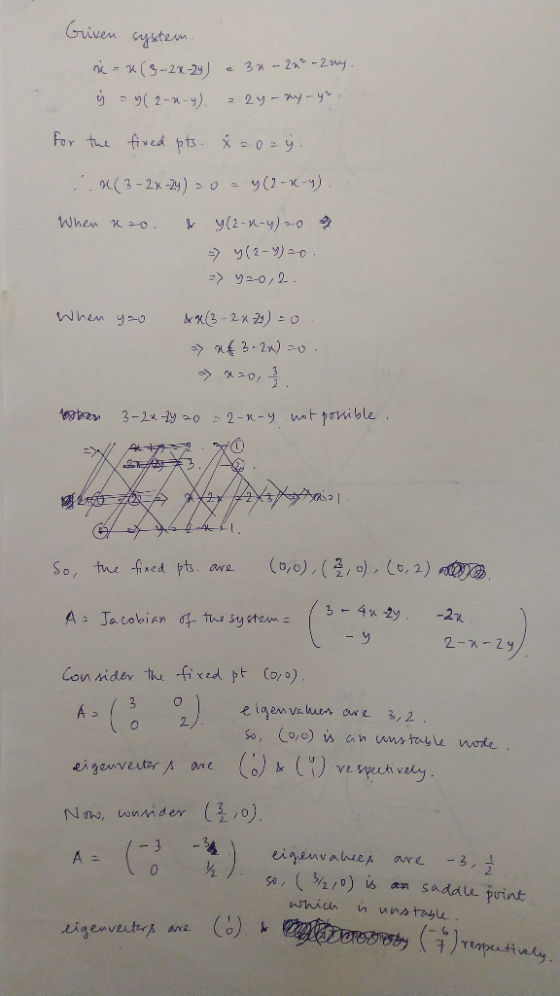
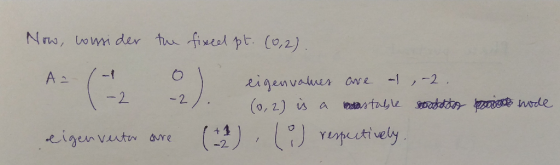
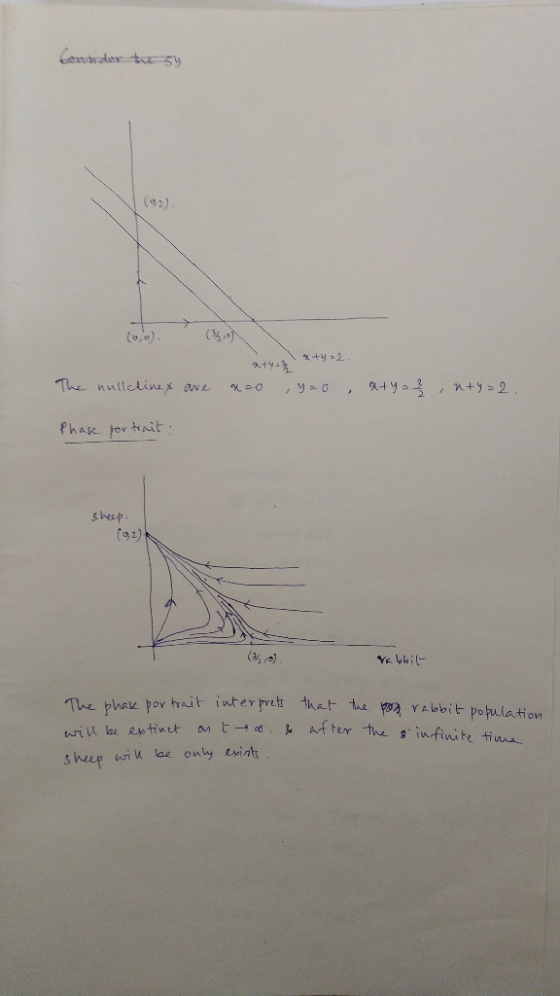
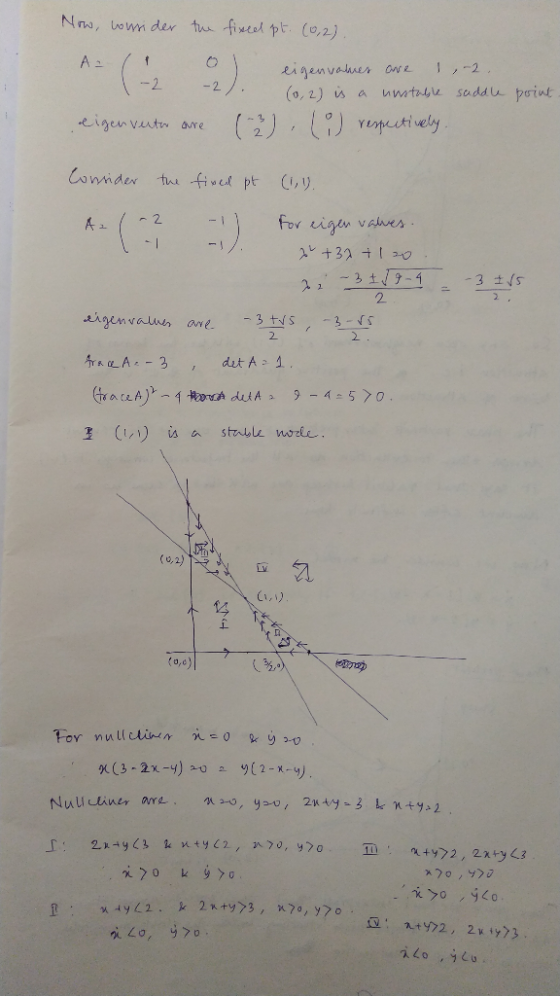
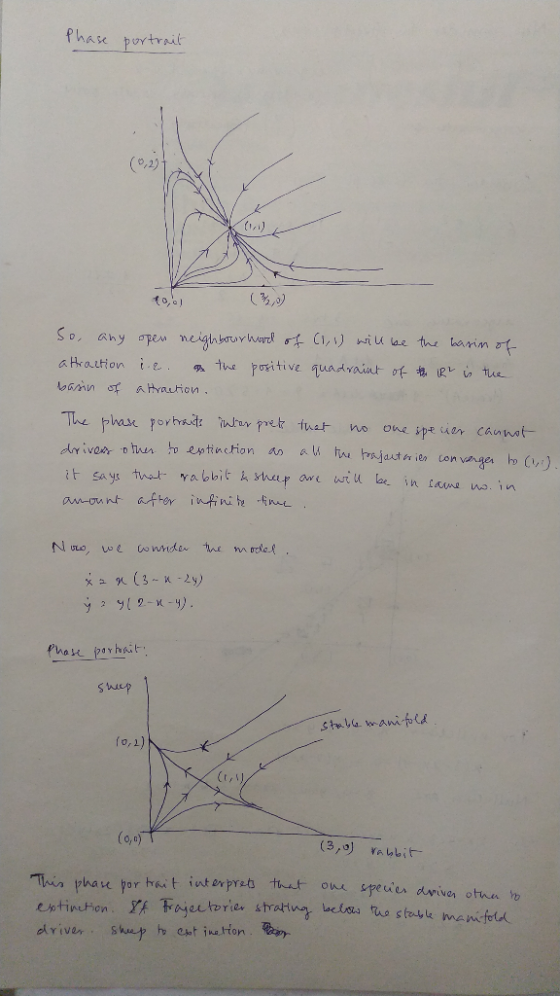
Exercise 3. (22 pts.) (Rabbits vs. Sheep) a)For each of the following ”rabbits vs. sheep” problems with x, y ≥ 0. Find the fixed points, classify them (type and stability), and find the eigenvalues and eigenvectors. Then sketch (by hand) a plausible phase portrait indicating nullclines, all relevant trajectories, and indicate all the different basins of attraction. Finally interpret the behavior of the population of the rabbits and sheep for the different systems (compare the three systems)
• x˙ = x(3 − 2x − 2y), ˙y = y(2 − x − y)
Homework Answers

Add Answer to:
Exercise 3. (22 pts.) (Rabbits vs. Sheep) a)For each of the
following ”rabbits vs. sheep” problems...
Problem 3. Consider the following continuous differential equation dx dt = αx − 2xy dy dt...
Problem 3. Consider the following continuous differential equation dx dt = αx − 2xy dy dt = 3xy − y 3a (5 pts): Find the steady states of the system. 3b (15 pts): Linearize the model about each of the fixed points and determine the type of stability. 3b (15 pts): Draw the phase portrait for this system, including nullclines, flow trajectories, and all fixed points. Problem 2 (25 pts): Two-dimensional linear ODEs For the following linear systems, identify the...
1. (This is problem 5 from the second assignment sheet, reprinted here.) Consider the nonlinear system a. Sketch the ulllines and indicate in your sketch the direction of the vector field in each...
 1. (This is problem 5 from the second assignment sheet, reprinted here.) Consider the nonlinear system a. Sketch the ulllines and indicate in your sketch the direction of the vector field in each of the regions b. Linearize the system around the equilibrium point, and use your result to classify the type of the c. Use the information from parts a and b to sketch the phase portrait of the system. 2. Sketch the phase portraits for the following systems...
1. For each of the following nonlinear systems, (a) Find all of the equilibrium points and describe the behavior of the...
 1. For each of the following nonlinear systems, (a) Find all of the equilibrium points and describe the behavior of the associated linearized system. 185 Exercises (b) Describe the phase portrait for the nonlinear system (c) Does the linearized system accurately describe the local bchavior near the equilibrium points? (iii) x' = x+ y, y, 2y
1. For each of the following nonlinear systems, (a) Find all of the equilibrium points and describe the behavior of the associated linearized system....
1. For each of the following nonlinear systems, (a) Find all of the equilibrium points and describe the behavior of the associated linearized system. 185 Exercises (b) Describe the phase portrait for the nonlinear system (c) Does the linearized system accurately describe the local bchavior near the equilibrium points? (iii) x' = x+ y, y, 2y
1. For each of the following nonlinear systems, (a) Find all of the equilibrium points and describe the behavior of the associated linearized system....
3. There are three ponds, each occupied by a large number of frogs. Every day, a certain fraction...
 3. There are three ponds, each occupied by a large number of frogs. Every day, a certain fraction of the frogs from each pond migrate to one of the two neighbouring ponds according to the diagram at the right. Thus the number of frogs in each pond changes from day to day according to the following dynamical system: 0 Xn+1 Zr The eigenvalues of this matrix are λ-1,A-0.6 and λ-05. 0.1 (a) Find eigenvectors for each of these eigenvalues. (b)...
(7 10 Two connected tanks, each with a capacity of 60 liters, contain brine (salt water) Initially the firs tank contains 40 liters and the second tank contains 30 liers. Brine with a salt conccntrat...
 (7 10 Two connected tanks, each with a capacity of 60 liters, contain brine (salt water) Initially the firs tank contains 40 liters and the second tank contains 30 liers. Brine with a salt conccntration of 1 grams per litcr flows into the first tank at S litcrs per hour. Well-stirred brine flows from the first tank into the second at 7 liters per hour from the second nto the fist at3 lters per honr, from the first into a...
 1. (This is problem 5 from the second assignment sheet, reprinted here.) Consider the nonlinear system a. Sketch the ulllines and indicate in your sketch the direction of the vector field in each of the regions b. Linearize the system around the equilibrium point, and use your result to classify the type of the c. Use the information from parts a and b to sketch the phase portrait of the system. 2. Sketch the phase portraits for the following systems...
 1. For each of the following nonlinear systems, (a) Find all of the equilibrium points and describe the behavior of the associated linearized system. 185 Exercises (b) Describe the phase portrait for the nonlinear system (c) Does the linearized system accurately describe the local bchavior near the equilibrium points? (iii) x' = x+ y, y, 2y
1. For each of the following nonlinear systems, (a) Find all of the equilibrium points and describe the behavior of the associated linearized system....
1. For each of the following nonlinear systems, (a) Find all of the equilibrium points and describe the behavior of the associated linearized system. 185 Exercises (b) Describe the phase portrait for the nonlinear system (c) Does the linearized system accurately describe the local bchavior near the equilibrium points? (iii) x' = x+ y, y, 2y
1. For each of the following nonlinear systems, (a) Find all of the equilibrium points and describe the behavior of the associated linearized system....
 3. There are three ponds, each occupied by a large number of frogs. Every day, a certain fraction of the frogs from each pond migrate to one of the two neighbouring ponds according to the diagram at the right. Thus the number of frogs in each pond changes from day to day according to the following dynamical system: 0 Xn+1 Zr The eigenvalues of this matrix are λ-1,A-0.6 and λ-05. 0.1 (a) Find eigenvectors for each of these eigenvalues. (b)...
 (7 10 Two connected tanks, each with a capacity of 60 liters, contain brine (salt water) Initially the firs tank contains 40 liters and the second tank contains 30 liers. Brine with a salt conccntration of 1 grams per litcr flows into the first tank at S litcrs per hour. Well-stirred brine flows from the first tank into the second at 7 liters per hour from the second nto the fist at3 lters per honr, from the first into a...
Most questions answered within 3 hours.
-
Where is the error in this code sequence?
String s1 = "Hello";
String s2 = "ello";...
asked 10 months ago -
Financial data for Joel de Paris, Inc., for last year
follow:
Joel de Paris, Inc.
Balance...
asked 10 months ago -
Consider this reaction:
Al2(SO4)3 (aq)+ BaCl3
(aq) Al2Cl6 (aq)- +
3BaSO4(s) . What is the...
asked 10 months ago -
Suppose that Savneet is considering increasing her
recent random sample from 20 car rentals to 40...
asked 10 months ago -
Trucks arrive at an unloading terminal at an average rate of 120
per hour.
Trucks arrive...
asked 10 months ago -
Why are methanol and ethanol completely soluble in water while
octanol is not very little soluble....
asked 10 months ago -
A facilities manager at a university reads in a research report
that the mean amount of...
asked 10 months ago -
When the CuSO4 is rehydrated by adding water to the anhydrous
compound, is this an endothermic...
asked 10 months ago -
A ray of sunlight is passing from diamond into crown glass; the
angle of incidence is...
asked 10 months ago -
A block of mass 0.249 kg is placed on top of a light, vertical
spring of...
asked 10 months ago -
how do the kidneys compensate in the presences of acidosis
a) trigger hyperventilate
b) reserve acid...
asked 10 months ago -
Question 501 pts
The rental rate of capital to the firm increases. Which of the
following...
asked 10 months ago