A small asteroid, moving in the positive x direction at 10,000 m/s, collides with a asteroid...
A small  asteroid, moving in the positive x direction at 10,000 m/s,
collides with a
asteroid, moving in the positive x direction at 10,000 m/s,
collides with a  asteroid moving in the positive y direction at 20,000 m/s. The two
stick together and form a single object.
asteroid moving in the positive y direction at 20,000 m/s. The two
stick together and form a single object.
What is the velocity, and angle of the pair after the collision?
Homework Answers
using momentum conservation:
In the x axis:
 (I)
(I)
In the y axis:
 (II)
(II)
(II)/(I)
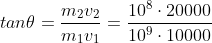

Plugging the angle in any of the equations:

solving for v

Add Answer to:
A small
asteroid, moving in the positive x direction at 10,000 m/s,
collides with a
asteroid...
A 19.5kg object moving in the +x direction at 5.5 m/s collides head on with a...
A 19.5kg object moving in the +x direction at 5.5 m/s collides head on with a 15.9kg object moving in the -x direction at 3.5m/s. Part A Find the final velocity of each mass if the objects stick together. Part B Find the final velocity of each mass if the collision is elastic. Part C Find the final velocity of each mass if the 19.5 kg object is at rest after the collision. Part D Is the result in part...
A 5 kg cart moving at a velocity 2 m/s in the +x-direction collides completely inelastically...
A 5 kg cart moving at a velocity 2 m/s in the +x-direction collides completely inelastically (i.e. they stick) with a second cart of mass 1.5 kg which is initially moving at a velocity of 10 m/s in the +y-direction. What is the total initial kinetic energy? J. What is the total x-component of momentum just before the collision? Kg m/s. What is the total y-component of momentum just before the collision? Kg m/s. What is the total x-component of momentum just after...
On an icy road, a 1600-kg car moving north at 23 m/s collides with a 2400-kg...
On an icy road, a 1600-kg car moving north at 23 m/s collides with a 2400-kg car moving east at 16 m/s. The two cars stick and move together. Let east be the x direction, and north be the y direction. What is the y-component of the velocity of the wreckage after the collision?
A 2-kg block moving in the positive x direction with a speed of 5.0 m/s collides...
A 2-kg block moving in the positive x direction with a speed of 5.0 m/s collides with a 3-kg block moving in the same direction with a speed of 2.0 m/s. After the collision the 3-kg block moves at 4.2 m/s. Find the velocity of the 2-kg block after the collision. Is the collision elastic or inelastic? Justify your answer.
A 1000kg automobile moving with a speed of 24 m/s collides with a 500kg car initially...
A 1000kg automobile moving with a speed of 24 m/s collides with a 500kg car initially at rest. If the two stick together, what is the velocity (in m/s) of the two cars after the collision relative to an automobile moving in the same direction at 15 m/s?
really need help. please. A 4.5 kg object moving in the +x direction at 5.5 m/s...
 really need help. please.
A 4.5 kg object moving in the +x direction at 5.5 m/s collides head-on with a 2.5 kg object moving in the -x direction at 4.0 m/s. Find the final velocity of each mass for each of the following situations. (Take the positive direction to be +x.) (a) The bodies stick together 4.92 X m/s (4.5 kg mass) m/s (2.5 kg mass) (b) The collision is elastic. 4.92 5.92 m/s (4.5 kg mass) m/s (2.5 kg...
really need help. please.
A 4.5 kg object moving in the +x direction at 5.5 m/s collides head-on with a 2.5 kg object moving in the -x direction at 4.0 m/s. Find the final velocity of each mass for each of the following situations. (Take the positive direction to be +x.) (a) The bodies stick together 4.92 X m/s (4.5 kg mass) m/s (2.5 kg mass) (b) The collision is elastic. 4.92 5.92 m/s (4.5 kg mass) m/s (2.5 kg...
A 1570 kg car moving south at 10.6 m/s collides with a 2640 kg car moving...
A 1570 kg car moving south at 10.6 m/s collides with a 2640 kg car moving north. The cars stick together and move as a unit after the collision at a velocity of 5.60 m/s to the north. Find the velocity of the 2640 kg car before the collision. Assume that North is positive.
a 1490 kg car moving east at 17.0 m/s collides with a 1820kg car moving south...
a 1490 kg car moving east at 17.0 m/s collides with a 1820kg car moving south at 15.0 m/s, and the two cars comnect together. What is the magnitude of the velocity of the cars right after the collision? what is the direction after collision? How much kinetic energy was converted to another form during the collision?
A 3.24 kg object initially moving in the positive x-direction with a velocity of +5.15 m/s...
A 3.24 kg object initially moving in the positive x-direction with a velocity of +5.15 m/s collides with and sticks to a 1.66 kg object initially moving in the negative y-direction with a velocity of -2.54 m/s. Find the final components of velocity of the composite object. (Indicate the direction with the sign of your answer.) Vfx = ? Vfy = ?
A mass of 5 kg is moving at 8.2 m/s in the positive x direction and...
A mass of 5 kg is moving at 8.2 m/s in the positive x direction and collides in a perfectly elastic collision with a second mass which is not at rest. After the collision, the second mass is moving at 12.3 m/s in the +x direction. If the 5 kg mass stops after the collision, what is the amount of the second mass in kg?
 really need help. please.
A 4.5 kg object moving in the +x direction at 5.5 m/s collides head-on with a 2.5 kg object moving in the -x direction at 4.0 m/s. Find the final velocity of each mass for each of the following situations. (Take the positive direction to be +x.) (a) The bodies stick together 4.92 X m/s (4.5 kg mass) m/s (2.5 kg mass) (b) The collision is elastic. 4.92 5.92 m/s (4.5 kg mass) m/s (2.5 kg...
really need help. please.
A 4.5 kg object moving in the +x direction at 5.5 m/s collides head-on with a 2.5 kg object moving in the -x direction at 4.0 m/s. Find the final velocity of each mass for each of the following situations. (Take the positive direction to be +x.) (a) The bodies stick together 4.92 X m/s (4.5 kg mass) m/s (2.5 kg mass) (b) The collision is elastic. 4.92 5.92 m/s (4.5 kg mass) m/s (2.5 kg...
Most questions answered within 3 hours.
-
Where is the error in this code sequence?
String s1 = "Hello";
String s2 = "ello";...
asked 10 months ago -
Financial data for Joel de Paris, Inc., for last year
follow:
Joel de Paris, Inc.
Balance...
asked 10 months ago -
Consider this reaction:
Al2(SO4)3 (aq)+ BaCl3
(aq) Al2Cl6 (aq)- +
3BaSO4(s) . What is the...
asked 10 months ago -
Suppose that Savneet is considering increasing her
recent random sample from 20 car rentals to 40...
asked 10 months ago -
Trucks arrive at an unloading terminal at an average rate of 120
per hour.
Trucks arrive...
asked 10 months ago -
Why are methanol and ethanol completely soluble in water while
octanol is not very little soluble....
asked 10 months ago -
A facilities manager at a university reads in a research report
that the mean amount of...
asked 10 months ago -
When the CuSO4 is rehydrated by adding water to the anhydrous
compound, is this an endothermic...
asked 10 months ago -
A ray of sunlight is passing from diamond into crown glass; the
angle of incidence is...
asked 10 months ago -
A block of mass 0.249 kg is placed on top of a light, vertical
spring of...
asked 10 months ago -
how do the kidneys compensate in the presences of acidosis
a) trigger hyperventilate
b) reserve acid...
asked 10 months ago -
Question 501 pts
The rental rate of capital to the firm increases. Which of the
following...
asked 10 months ago