
Homework Answers
Add Answer to:
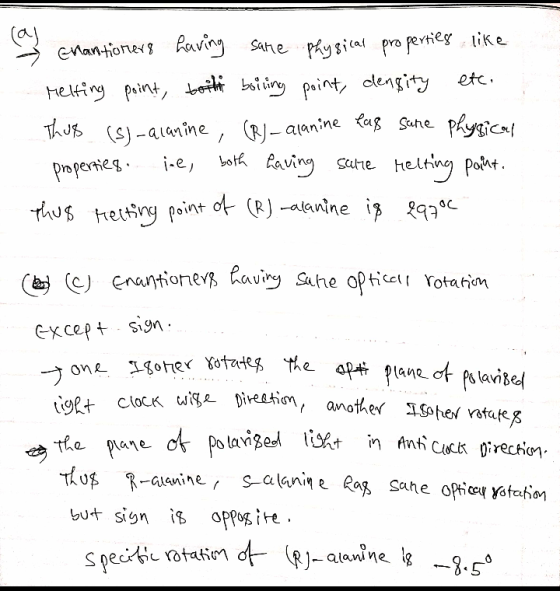
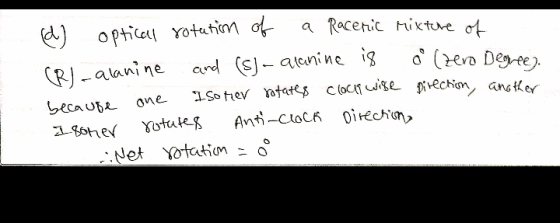
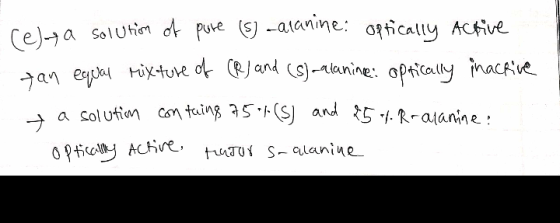
Problem 5.31 O The amino acid (S)-alanine has the physical characteristics listed under the structure. a....
Challenge Problem 5.52 Tartare od OZCCH(OH)CH(OH)COM) was an important compound in the history of stereochemistry, Two...
 Challenge Problem 5.52 Tartare od OZCCH(OH)CH(OH)COM) was an important compound in the history of stereochemistry, Two naturally occurring forms of tartaric acid are optically inactive. One optically nactive form has a melting point of 210-212°C, the other has a melting point of 140°C. The inactive tartanic acid with a melting point of 210-212c can be separated into two optically AR +12 active forms of tartanic acid with the same melting point (168-170°c). One optically active tartani adala -12 h and...
Someone please help me with this problem Enantiomers have very similar physical properties, while for diastereomers...
 Someone please help me with this problem
Enantiomers have very similar physical properties,
while for diastereomers they can be very different. This fact is
important in the separation or resolution of enantiomers. In the
lecture, we looked at how chiral chromatography is used to separate
enantiomers: first, by reacting them with an optically pure chiral
reagent (i.e., pure R or S) to form a pair of diastereomers, then
separating them using chiral chromatography, and finally detaching
the chiral reagent to...
Someone please help me with this problem
Enantiomers have very similar physical properties,
while for diastereomers they can be very different. This fact is
important in the separation or resolution of enantiomers. In the
lecture, we looked at how chiral chromatography is used to separate
enantiomers: first, by reacting them with an optically pure chiral
reagent (i.e., pure R or S) to form a pair of diastereomers, then
separating them using chiral chromatography, and finally detaching
the chiral reagent to...
Please help with pre-lab questions. Pre-Lab Questions: 1. A sample of 2-butanol has a specific rotation...
 Please help with pre-lab questions.
Pre-Lab Questions: 1. A sample of 2-butanol has a specific rotation of +3.25. Determine the optical purity (%ee) and percent composition of this sample (see Mohrig section 17.4). The specific rotation of pure (+)-2-butanol is +13.0°. 2. The equation for the formation of the diastereomeric salts is shown in the background information (performed in Part A of the procedure). Write this chemical equation in your notebook, then ALSO write a balanced equation for the formation...
Please help with pre-lab questions.
Pre-Lab Questions: 1. A sample of 2-butanol has a specific rotation of +3.25. Determine the optical purity (%ee) and percent composition of this sample (see Mohrig section 17.4). The specific rotation of pure (+)-2-butanol is +13.0°. 2. The equation for the formation of the diastereomeric salts is shown in the background information (performed in Part A of the procedure). Write this chemical equation in your notebook, then ALSO write a balanced equation for the formation...
11 Department of Biological Sciences BIOCHEMISTRY Test 2.2018 H. Nucleic Acid, Sequencing of DNA: Amino Acids...
 11 Department of Biological Sciences BIOCHEMISTRY Test 2.2018 H. Nucleic Acid, Sequencing of DNA: Amino Acids Hydrolysis of salt Laboratory buffers, Polyprotie acids QUESTIONS 1. The DNA strand complementary to the strand 3-GTAGCGTAT-Y' would have the sequence a SLTACOCATAT-3 b.3.CATOXICATA-S c. 3-ATGCGTATA-S" ATATGCGTAS 2. When cytosine is treated with bisulfite, the amino group is replaced with a carbonyl group. Identify the resulting base a. adenine b. guanine c uracil d. thyminee. typoxanthine 3. How many amino acids would be in...
Postlab Questions Answer the following questions on a separate sheet or in your lab notebook. Make...
 Postlab Questions Answer the following questions on a separate sheet or in your lab notebook. Make sure that the copy page is readable! D) Calculate the percentage yield for both reactions. Show all calculations. 2) What is the color of the reaction at the beginning of reaction? What causes the color? 3) Why do you dissolve maleic acid in diethyl ether and fumaric acid in water? 4) Give the complete reaction mechanisms for the formation of meso and racemic 2,3-...
10. Write a one-page summary of the attached paper? INTRODUCTION Many problems can develop in activated...
10. Write a one-page summary of the attached paper? INTRODUCTION Many problems can develop in activated sludge operation that adversely affect effluent quality with origins in the engineering, hydraulic and microbiological components of the process. The real "heart" of the activated sludge system is the development and maintenance of a mixed microbial culture (activated sludge) that treats wastewater and which can be managed. One definition of a wastewater treatment plant operator is a "bug farmer", one who controls the aeration...
 Challenge Problem 5.52 Tartare od OZCCH(OH)CH(OH)COM) was an important compound in the history of stereochemistry, Two naturally occurring forms of tartaric acid are optically inactive. One optically nactive form has a melting point of 210-212°C, the other has a melting point of 140°C. The inactive tartanic acid with a melting point of 210-212c can be separated into two optically AR +12 active forms of tartanic acid with the same melting point (168-170°c). One optically active tartani adala -12 h and...
 Someone please help me with this problem
Enantiomers have very similar physical properties,
while for diastereomers they can be very different. This fact is
important in the separation or resolution of enantiomers. In the
lecture, we looked at how chiral chromatography is used to separate
enantiomers: first, by reacting them with an optically pure chiral
reagent (i.e., pure R or S) to form a pair of diastereomers, then
separating them using chiral chromatography, and finally detaching
the chiral reagent to...
Someone please help me with this problem
Enantiomers have very similar physical properties,
while for diastereomers they can be very different. This fact is
important in the separation or resolution of enantiomers. In the
lecture, we looked at how chiral chromatography is used to separate
enantiomers: first, by reacting them with an optically pure chiral
reagent (i.e., pure R or S) to form a pair of diastereomers, then
separating them using chiral chromatography, and finally detaching
the chiral reagent to...
 Please help with pre-lab questions.
Pre-Lab Questions: 1. A sample of 2-butanol has a specific rotation of +3.25. Determine the optical purity (%ee) and percent composition of this sample (see Mohrig section 17.4). The specific rotation of pure (+)-2-butanol is +13.0°. 2. The equation for the formation of the diastereomeric salts is shown in the background information (performed in Part A of the procedure). Write this chemical equation in your notebook, then ALSO write a balanced equation for the formation...
Please help with pre-lab questions.
Pre-Lab Questions: 1. A sample of 2-butanol has a specific rotation of +3.25. Determine the optical purity (%ee) and percent composition of this sample (see Mohrig section 17.4). The specific rotation of pure (+)-2-butanol is +13.0°. 2. The equation for the formation of the diastereomeric salts is shown in the background information (performed in Part A of the procedure). Write this chemical equation in your notebook, then ALSO write a balanced equation for the formation...
 11 Department of Biological Sciences BIOCHEMISTRY Test 2.2018 H. Nucleic Acid, Sequencing of DNA: Amino Acids Hydrolysis of salt Laboratory buffers, Polyprotie acids QUESTIONS 1. The DNA strand complementary to the strand 3-GTAGCGTAT-Y' would have the sequence a SLTACOCATAT-3 b.3.CATOXICATA-S c. 3-ATGCGTATA-S" ATATGCGTAS 2. When cytosine is treated with bisulfite, the amino group is replaced with a carbonyl group. Identify the resulting base a. adenine b. guanine c uracil d. thyminee. typoxanthine 3. How many amino acids would be in...
 Postlab Questions Answer the following questions on a separate sheet or in your lab notebook. Make sure that the copy page is readable! D) Calculate the percentage yield for both reactions. Show all calculations. 2) What is the color of the reaction at the beginning of reaction? What causes the color? 3) Why do you dissolve maleic acid in diethyl ether and fumaric acid in water? 4) Give the complete reaction mechanisms for the formation of meso and racemic 2,3-...
Most questions answered within 3 hours.
-
Where is the error in this code sequence?
String s1 = "Hello";
String s2 = "ello";...
asked 11 months ago -
Financial data for Joel de Paris, Inc., for last year
follow:
Joel de Paris, Inc.
Balance...
asked 11 months ago -
Consider this reaction:
Al2(SO4)3 (aq)+ BaCl3
(aq) Al2Cl6 (aq)- +
3BaSO4(s) . What is the...
asked 11 months ago -
Suppose that Savneet is considering increasing her
recent random sample from 20 car rentals to 40...
asked 11 months ago -
Trucks arrive at an unloading terminal at an average rate of 120
per hour.
Trucks arrive...
asked 11 months ago -
Why are methanol and ethanol completely soluble in water while
octanol is not very little soluble....
asked 11 months ago -
A facilities manager at a university reads in a research report
that the mean amount of...
asked 11 months ago -
When the CuSO4 is rehydrated by adding water to the anhydrous
compound, is this an endothermic...
asked 11 months ago -
A ray of sunlight is passing from diamond into crown glass; the
angle of incidence is...
asked 11 months ago -
A block of mass 0.249 kg is placed on top of a light, vertical
spring of...
asked 11 months ago -
how do the kidneys compensate in the presences of acidosis
a) trigger hyperventilate
b) reserve acid...
asked 11 months ago -
Question 501 pts
The rental rate of capital to the firm increases. Which of the
following...
asked 11 months ago