![3. [2 points] A rectangular parallelepiped with dimensions a, b, c is filled with a dielectric in which the polarization is g](http://img.homeworklib.com/questions/1a445030-f263-11eb-b2bf-df61dedb8e17.png?x-oss-process=image/resize,w_560)
Homework Answers
Dimensions of rectangular parallelepiped is a*b*c.
So the distance between the origin and top or bottom surface is c/2.
Here 
So the surface charge density on both the surface is given by

This is the surface charge density on both top and bottom surface each.
Add Answer to:
3. [2 points] A rectangular parallelepiped with dimensions a, b, c is filled with a dielectric...
A rectangular parallelepiped with dimensions a, b, c is filled with a dielectric in which the...
A rectangular parallelepiped with dimensions a, b, c is filled with a dielectric in which the polarization is given by kr, where k is a constant with the appropriate units, and r is the position vector of a point in the dielectric with respect to the center of the parallelepiped (i.e., the center of the parallelepiped is at the origin, and the faces are parallel to the Cartesian axes). Find the bound surface and volume charge densities in the dielectric,...
Please answer the question on this image regarding a parallel-plate capacitor that is half-filled with dielectric...
 Please answer the question on this image regarding a
parallel-plate capacitor that is half-filled with
dielectric
Problem 4 (6 points) A parallel-plate capacitor is half-filled with a slab of material of dielectric constant e, as shown in the figure. d/2 a) By what factor is the capacitance increased as a result of the presence of the dielectric? b) If the top and bottom conducting plates of the capacitor have surface charge density to and –o, respectively, identify the location, sign,...
Please answer the question on this image regarding a
parallel-plate capacitor that is half-filled with
dielectric
Problem 4 (6 points) A parallel-plate capacitor is half-filled with a slab of material of dielectric constant e, as shown in the figure. d/2 a) By what factor is the capacitance increased as a result of the presence of the dielectric? b) If the top and bottom conducting plates of the capacitor have surface charge density to and –o, respectively, identify the location, sign,...
4. Consider the dielectric slab shown below: The electric field within the slab is: E(T) =...
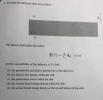 4. Consider the dielectric slab shown below: The electric field within the slab is: E(T) = 2 âz [V/m] and the susceptibility of the dielectric is 2.0, find: (a) the permittivity and relative permittivity of the dielectric. (b) the electric flux density within the slab. (c) the polarization vector within the slab. (d) the volume bound charge density within the slab. (e) the surface bound charge density at the top and bottom of the slab.
The space between the plates of a parallel-plate capacitor, shown below, is filled with two slabs of different dielectric materials
 Problem 5 The space between the plates of a parallel-plate capacitor, shown below, is filled with two slabs of different dielectric materials. The slab at the top has thickness 2d and a relative dielectric constant of er1 = 3 and the one at the bottom has thickness d and a relative dielectric constant of er2 = 2. The capacitor plates have surface area S. a. Assume a total charge of +Q on the top plate and -Q on the bottom plate. Find...
A spherical shell linear dielectric of e inner radius a and outer radius for b is filled with is embedded with a free charge density of ρ(r) = kr.
 A spherical shell linear dielectric of e inner radius a and outer radius for b is filled with is embedded with a free charge density of ρ(r) = kr. (a) Find the electric displacement D in each slab. (b) Find the electric field E in each slab. (c) Find the polarization P in each slab (d) Find the potential difference between the plates (e) Find the location and amount of all bound charge.
2. A sphere of radius R has the dielectric constant e. The net charge on the...
 2. A sphere of radius R has the dielectric constant e. The net charge on the sphere is zero but it has the polarization kr (C/m2) in spherical coordinates (k is a constant with the appropriate units). a) (12 points) Calculate the bound charge density pb (C/m3) and the surface bound charge density ơb (C/m2). b) (15 points) Calculate the E-field for rR and for r>R. Use Coulomb's law with the net bound charge density (volume and surface) as needed....
A thick spherical shell (inner radius a, outer radius b) is made of dielectric material with...
 A thick spherical shell (inner radius a, outer radius b) is made of dielectric material with a "frozen-in" polarization P(r) 0 r<a P(r) ksin(0)/r r a<r<b where k is a constant, r is the distance from the center, and r is the radial unit vector. There is no free charge in the problem 1. Find expressions for all the bound (volume and surface) charge. Interpret with a diagram. 2. Determine the total bound charge. Be aware if the bound charge...
3. Two dielectric materials (material 1 and 2) are combined either in series (Case A) or parallel (Case B) arrangements...
 3. Two dielectric materials (material 1 and 2) are combined either in series (Case A) or parallel (Case B) arrangements as shown in the figure below. The relative permittivity for material one is 10 while the relative permittivity for material two is 3000. A voltage of 100 volts is applied across the entire the top surface while the bottom is grounded (0 Volts) in both cases. The z- direction is up with z-0 representing the bottom ground. Calculate for each...
(1) As shown in the Figure below, a parallel-plate capacitor of plate area A is filled with two laye ers of dielectrics, di and de thick, with permittivities s and s2, respectively. Ignoring the r...
 (1) As shown in the Figure below, a parallel-plate capacitor of plate area A is filled with two laye ers of dielectrics, di and de thick, with permittivities s and s2, respectively. Ignoring the ringe effect at the four edges (assuming rectangular plates), find the fields Ei and E2 in the t dielectric ctrics if a voltage V(assumed positive) is applied to the top plate with regard to the bottom plate. (Note: both magnitudes and directions needed.) (2) Find the...
Problem 1. Electrostatics (1) As shown in the Figure below, a parallel-plate capacitor of plate area A is filled with two layers of dielectrics, ch and d2 thick, with permittivities fringe effect...
 Problem 1. Electrostatics (1) As shown in the Figure below, a parallel-plate capacitor of plate area A is filled with two layers of dielectrics, ch and d2 thick, with permittivities fringe effect at the four edges (assuming rectangular plates), find the fields Ei and Es in the two dielectrics if a voltage V (assumed positive) is applied to the top plate with regard to the bottom plate. (Note: both magnitudes and directions needed.) and a, respectively. Ignoring the (2) Find...
 Please answer the question on this image regarding a
parallel-plate capacitor that is half-filled with
dielectric
Problem 4 (6 points) A parallel-plate capacitor is half-filled with a slab of material of dielectric constant e, as shown in the figure. d/2 a) By what factor is the capacitance increased as a result of the presence of the dielectric? b) If the top and bottom conducting plates of the capacitor have surface charge density to and –o, respectively, identify the location, sign,...
Please answer the question on this image regarding a
parallel-plate capacitor that is half-filled with
dielectric
Problem 4 (6 points) A parallel-plate capacitor is half-filled with a slab of material of dielectric constant e, as shown in the figure. d/2 a) By what factor is the capacitance increased as a result of the presence of the dielectric? b) If the top and bottom conducting plates of the capacitor have surface charge density to and –o, respectively, identify the location, sign,...
 4. Consider the dielectric slab shown below: The electric field within the slab is: E(T) = 2 âz [V/m] and the susceptibility of the dielectric is 2.0, find: (a) the permittivity and relative permittivity of the dielectric. (b) the electric flux density within the slab. (c) the polarization vector within the slab. (d) the volume bound charge density within the slab. (e) the surface bound charge density at the top and bottom of the slab.
 2. A sphere of radius R has the dielectric constant e. The net charge on the sphere is zero but it has the polarization kr (C/m2) in spherical coordinates (k is a constant with the appropriate units). a) (12 points) Calculate the bound charge density pb (C/m3) and the surface bound charge density ơb (C/m2). b) (15 points) Calculate the E-field for rR and for r>R. Use Coulomb's law with the net bound charge density (volume and surface) as needed....
 A thick spherical shell (inner radius a, outer radius b) is made of dielectric material with a "frozen-in" polarization P(r) 0 r<a P(r) ksin(0)/r r a<r<b where k is a constant, r is the distance from the center, and r is the radial unit vector. There is no free charge in the problem 1. Find expressions for all the bound (volume and surface) charge. Interpret with a diagram. 2. Determine the total bound charge. Be aware if the bound charge...
 3. Two dielectric materials (material 1 and 2) are combined either in series (Case A) or parallel (Case B) arrangements as shown in the figure below. The relative permittivity for material one is 10 while the relative permittivity for material two is 3000. A voltage of 100 volts is applied across the entire the top surface while the bottom is grounded (0 Volts) in both cases. The z- direction is up with z-0 representing the bottom ground. Calculate for each...
 (1) As shown in the Figure below, a parallel-plate capacitor of plate area A is filled with two laye ers of dielectrics, di and de thick, with permittivities s and s2, respectively. Ignoring the ringe effect at the four edges (assuming rectangular plates), find the fields Ei and E2 in the t dielectric ctrics if a voltage V(assumed positive) is applied to the top plate with regard to the bottom plate. (Note: both magnitudes and directions needed.) (2) Find the...
 Problem 1. Electrostatics (1) As shown in the Figure below, a parallel-plate capacitor of plate area A is filled with two layers of dielectrics, ch and d2 thick, with permittivities fringe effect at the four edges (assuming rectangular plates), find the fields Ei and Es in the two dielectrics if a voltage V (assumed positive) is applied to the top plate with regard to the bottom plate. (Note: both magnitudes and directions needed.) and a, respectively. Ignoring the (2) Find...
Most questions answered within 3 hours.
-
Where is the error in this code sequence?
String s1 = "Hello";
String s2 = "ello";...
asked 10 months ago -
Financial data for Joel de Paris, Inc., for last year
follow:
Joel de Paris, Inc.
Balance...
asked 10 months ago -
Consider this reaction:
Al2(SO4)3 (aq)+ BaCl3
(aq) Al2Cl6 (aq)- +
3BaSO4(s) . What is the...
asked 10 months ago -
Suppose that Savneet is considering increasing her
recent random sample from 20 car rentals to 40...
asked 10 months ago -
Trucks arrive at an unloading terminal at an average rate of 120
per hour.
Trucks arrive...
asked 10 months ago -
Why are methanol and ethanol completely soluble in water while
octanol is not very little soluble....
asked 10 months ago -
A facilities manager at a university reads in a research report
that the mean amount of...
asked 10 months ago -
When the CuSO4 is rehydrated by adding water to the anhydrous
compound, is this an endothermic...
asked 10 months ago -
A ray of sunlight is passing from diamond into crown glass; the
angle of incidence is...
asked 10 months ago -
A block of mass 0.249 kg is placed on top of a light, vertical
spring of...
asked 10 months ago -
how do the kidneys compensate in the presences of acidosis
a) trigger hyperventilate
b) reserve acid...
asked 10 months ago -
Question 501 pts
The rental rate of capital to the firm increases. Which of the
following...
asked 10 months ago