
Homework Answers
Add Answer to:
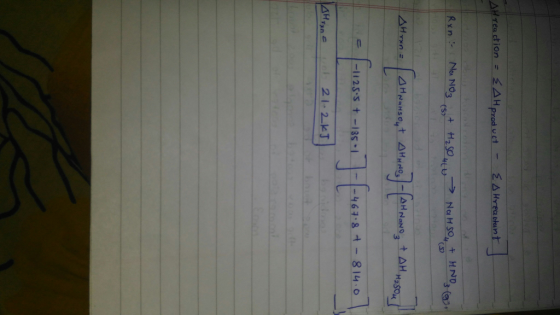
an NaN03 s--467 8 kimo!: MnNaHSO4(s) "-11 25.5 kl mot ?? f H2SO4m)--814.0 kJ/mot the vapors...
*** ** -305.01 -183.9 151.1 NH4NO3 (aq) -339.9 -190.6 259.8 AHºf (kJ/mol) AG°f (kJ/mol) Sº (/mol...
 *** ** -305.01 -183.9 151.1 NH4NO3 (aq) -339.9 -190.6 259.8 AHºf (kJ/mol) AG°f (kJ/mol) Sº (/mol K) 0 205.1 Oxygen 02 (g) O(g) 03 (g) 249.2 231.7 161.1 142.7 163.2 238.9 Phosphorus AH° (kJ/mol) AG°f(kJ/mol) sº (/mol K) Nitrogen AH°(kJ/mol) AG°f(kJ/mol) s° /mol K) N2 (8) 0 191.6 N (g) 472.7 455.6 153.3 NH3 (g) -46.1 -16.5 192.5 NH3 (aq) -80.0 -27.0 111.0 132.0 -79.0 113.0 90.3 86.6 210.8 51.7 66.1 261.8 NH4+ (aq) NO (g) NOCI (9) NO2 (g)...
For the reaction CuS(s) + H2(g) → H2S(g) + Cu(s), AG°f (CuS) = -53.6 kJ/mol AG°f...
 For the reaction CuS(s) + H2(g) → H2S(g) + Cu(s), AG°f (CuS) = -53.6 kJ/mol AG°f (H2S) = -33.6 kJ/mol AHºf (Cus) = -53.1 kJ/mol AHºf (H2S) = - 20.6 kJ/mol Calculate the value of the equilibrium constant (Kp) for this reaction at 298 K.
11) Given the thermochemical equation 4AICl(s)+30-(8 2AbO,(s) + 6Cl(g); AH-529 kJ/mol-rxn find ΔιΗ"for the following reaction....
 11) Given the thermochemical equation 4AICl(s)+30-(8 2AbO,(s) + 6Cl(g); AH-529 kJ/mol-rxn find ΔιΗ"for the following reaction. Also,(s) + Cl2(g)-> a. +88.2 kJ/mol-rxn b. +264.5 kJ/mol-rxn c. +529.0 kJ/mol-rxn d. +176.3 kJ/mol-rxm e. -176.3 kJ/mol-rxn AICI3(s) + O2(g)
6.65 From the enthalpies of reaction H2(8) + F2(8) 2 HF(8) AH = -537 kJ C(s)...
 6.65 From the enthalpies of reaction H2(8) + F2(8) 2 HF(8) AH = -537 kJ C(s) + 2 F2(8) CF4(8) AH = -680 kJ 2 C(s) + 2 H2(8) —— C2H4(8) AH = +52.3 kJ calculate AH for the reaction of ethylene with F2: C2H4(8) + 6 F2(8) — 2 CF4(8) + 4 HF(8)
For the following reaction: 2Na(s) + 2H2O(l) → 2NaOH(s) + H2(g) Compound ΔH°f (kJ mol-1) S°...
For the following reaction: 2Na(s) + 2H2O(l) → 2NaOH(s) + H2(g) Compound ΔH°f (kJ mol-1) S° (J mol-1 K-1) Na (s) 0.00 51.30 H2O (l) -285.83 69.91 NaOH (s) -425.93 64.46 H2 (g) 0.00 130.68 Calculate ΔG°rx (in kJ) at 391.96 K for this reaction. Assume ΔH°f and S° do not vary as a function of temperature.
For the following reaction: 2NaCl(s) + H2SO4(g) → Na2SO4(s) + 2HCl(g) Compound ΔH°f (kJ mol-1)...
For the following reaction: 2NaCl(s) + H2SO4(g) → Na2SO4(s) + 2HCl(g) Compound ΔH°f (kJ mol-1) S° (J mol-1 K-1) NaCl (s) -411.12 72.11 H2SO4 (g) -735.13 298.78 Na2SO4 (s) -1387.1 149.6 HCl (g) -92.31 186.90 Calculate ΔG°rx (in kJ) at 120.21 K for this reaction. Report your answer to two decimal places in standard notation (i.e. 123.45 kJ). Assume ΔH°f and S° do not vary as a function of temperature.
2: Given: 1 S(s) + 2 F2(g) → 1 SF4 (8), AH = -774.9 kJ 2...
 2: Given: 1 S(s) + 2 F2(g) → 1 SF4 (8), AH = -774.9 kJ 2 S (s) + 3 O2(g) → 2 SO 3 (g), AH = -791.44 kJ On the basis of this information, calculate the heat change for the reaction 2 SF4 (8) + 3 O2(g) +2 SO 3 (8) + 4 F2 (g) OD: 758.4 kJ OA: -868.9 kJ OB: 714.0 kJ OC: -714.0 kJ OE: 1505.4 kJ
Determine the inverse Laplace transform of F(s) = s+11 (8-1)(8+3) 3 s-1 2 s+3 o 3...
 Determine the inverse Laplace transform of F(s) = s+11 (8-1)(8+3) 3 s-1 2 s+3 o 3 s-1 5 s +3 o 3 s-1 2 s+3 + 이음 이 - 유 2 S-3 s +3
Given the following data: S(s) + 02(8) -> SO3(g) AH = -395.2 kJ 2SO2(g) + O2(g)...
 Given the following data: S(s) + 02(8) -> SO3(g) AH = -395.2 kJ 2SO2(g) + O2(g) + 2503(g) AH = - 198.2 kJ Calculate AH for the reaction: S(s) + O2(g) SO2(g) +296.1 kJ -494.3 kJ -296.1 kJ 0 -197.0 kJ -593.4 kJ
AH-116.4 kJ/mol 4. Consider the following reaction: NH.NO, (s) N20 (8) + 2 H20 (g) Calculate...
 AH-116.4 kJ/mol 4. Consider the following reaction: NH.NO, (s) N20 (8) + 2 H20 (g) Calculate AGⓇ for the reaction. Substance S” (J/mol K) NH.NO, (3) 151 N:0 (8) 220 H:0 (9) 183 5. The first step in the commercial production of titanium metal is the reaction of Tio: with chlorine an graphite: TiO2 (s) + 2 Cl: (g) + 2C (5) Tici: (1) + 2 CO(g) Calculate AGº for the reaction. Substance AG? (kJ/mol Substance AG® (kJ/mol) C(s) TiCl...
 *** ** -305.01 -183.9 151.1 NH4NO3 (aq) -339.9 -190.6 259.8 AHºf (kJ/mol) AG°f (kJ/mol) Sº (/mol K) 0 205.1 Oxygen 02 (g) O(g) 03 (g) 249.2 231.7 161.1 142.7 163.2 238.9 Phosphorus AH° (kJ/mol) AG°f(kJ/mol) sº (/mol K) Nitrogen AH°(kJ/mol) AG°f(kJ/mol) s° /mol K) N2 (8) 0 191.6 N (g) 472.7 455.6 153.3 NH3 (g) -46.1 -16.5 192.5 NH3 (aq) -80.0 -27.0 111.0 132.0 -79.0 113.0 90.3 86.6 210.8 51.7 66.1 261.8 NH4+ (aq) NO (g) NOCI (9) NO2 (g)...
 For the reaction CuS(s) + H2(g) → H2S(g) + Cu(s), AG°f (CuS) = -53.6 kJ/mol AG°f (H2S) = -33.6 kJ/mol AHºf (Cus) = -53.1 kJ/mol AHºf (H2S) = - 20.6 kJ/mol Calculate the value of the equilibrium constant (Kp) for this reaction at 298 K.
 11) Given the thermochemical equation 4AICl(s)+30-(8 2AbO,(s) + 6Cl(g); AH-529 kJ/mol-rxn find ΔιΗ"for the following reaction. Also,(s) + Cl2(g)-> a. +88.2 kJ/mol-rxn b. +264.5 kJ/mol-rxn c. +529.0 kJ/mol-rxn d. +176.3 kJ/mol-rxm e. -176.3 kJ/mol-rxn AICI3(s) + O2(g)
 6.65 From the enthalpies of reaction H2(8) + F2(8) 2 HF(8) AH = -537 kJ C(s) + 2 F2(8) CF4(8) AH = -680 kJ 2 C(s) + 2 H2(8) —— C2H4(8) AH = +52.3 kJ calculate AH for the reaction of ethylene with F2: C2H4(8) + 6 F2(8) — 2 CF4(8) + 4 HF(8)
 2: Given: 1 S(s) + 2 F2(g) → 1 SF4 (8), AH = -774.9 kJ 2 S (s) + 3 O2(g) → 2 SO 3 (g), AH = -791.44 kJ On the basis of this information, calculate the heat change for the reaction 2 SF4 (8) + 3 O2(g) +2 SO 3 (8) + 4 F2 (g) OD: 758.4 kJ OA: -868.9 kJ OB: 714.0 kJ OC: -714.0 kJ OE: 1505.4 kJ
 Determine the inverse Laplace transform of F(s) = s+11 (8-1)(8+3) 3 s-1 2 s+3 o 3 s-1 5 s +3 o 3 s-1 2 s+3 + 이음 이 - 유 2 S-3 s +3
 Given the following data: S(s) + 02(8) -> SO3(g) AH = -395.2 kJ 2SO2(g) + O2(g) + 2503(g) AH = - 198.2 kJ Calculate AH for the reaction: S(s) + O2(g) SO2(g) +296.1 kJ -494.3 kJ -296.1 kJ 0 -197.0 kJ -593.4 kJ
 AH-116.4 kJ/mol 4. Consider the following reaction: NH.NO, (s) N20 (8) + 2 H20 (g) Calculate AGⓇ for the reaction. Substance S” (J/mol K) NH.NO, (3) 151 N:0 (8) 220 H:0 (9) 183 5. The first step in the commercial production of titanium metal is the reaction of Tio: with chlorine an graphite: TiO2 (s) + 2 Cl: (g) + 2C (5) Tici: (1) + 2 CO(g) Calculate AGº for the reaction. Substance AG? (kJ/mol Substance AG® (kJ/mol) C(s) TiCl...
Most questions answered within 3 hours.
-
Where is the error in this code sequence?
String s1 = "Hello";
String s2 = "ello";...
asked 11 months ago -
Financial data for Joel de Paris, Inc., for last year
follow:
Joel de Paris, Inc.
Balance...
asked 11 months ago -
Consider this reaction:
Al2(SO4)3 (aq)+ BaCl3
(aq) Al2Cl6 (aq)- +
3BaSO4(s) . What is the...
asked 11 months ago -
Suppose that Savneet is considering increasing her
recent random sample from 20 car rentals to 40...
asked 11 months ago -
Trucks arrive at an unloading terminal at an average rate of 120
per hour.
Trucks arrive...
asked 11 months ago -
Why are methanol and ethanol completely soluble in water while
octanol is not very little soluble....
asked 11 months ago -
A facilities manager at a university reads in a research report
that the mean amount of...
asked 11 months ago -
When the CuSO4 is rehydrated by adding water to the anhydrous
compound, is this an endothermic...
asked 11 months ago -
A ray of sunlight is passing from diamond into crown glass; the
angle of incidence is...
asked 11 months ago -
A block of mass 0.249 kg is placed on top of a light, vertical
spring of...
asked 11 months ago -
how do the kidneys compensate in the presences of acidosis
a) trigger hyperventilate
b) reserve acid...
asked 11 months ago -
Question 501 pts
The rental rate of capital to the firm increases. Which of the
following...
asked 11 months ago