Acetylcholine is the substrate for the enzyme acetylcholinesterase.
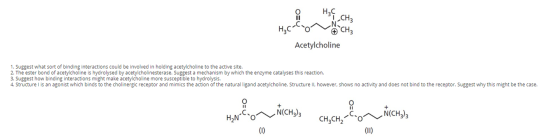
1. Suggest what sort of binding interactions could be involved in holding acetylcholine to the active site.
2. The ester bond of acetylcholine is hydrolysed by acetylcholinesterase. Suggest a mechanism by which the enzyme catalyses this reaction.
3. Suggest how binding interactions might make acetylcholine more susceptible to hydrolysis.
4. Structure I is an agonist which binds to the cholinergic receptor and mimics the action of the natural ligand acetylcholine. Structure II, however, shows no activity and does not bind to the receptor. Suggest why this might be the case.
Homework Answers
Acetylcholinesterase hydrolyse the ester bond of acetylcholine. Acetylcholine also has a cationic part.
1.
So active site must have an anionic part that will take part in ionic interaction with cationic quternery amine, tyrosine or aspartic acid or glutamic acid take part for this kind of interaction. For the ester part (carbonyl group) there must be a hydrogen bonding interaction with oxygen that will enhance electrophilicity of carbonyl group, serine or tyrosine can take part in this kind of interaction.
2.
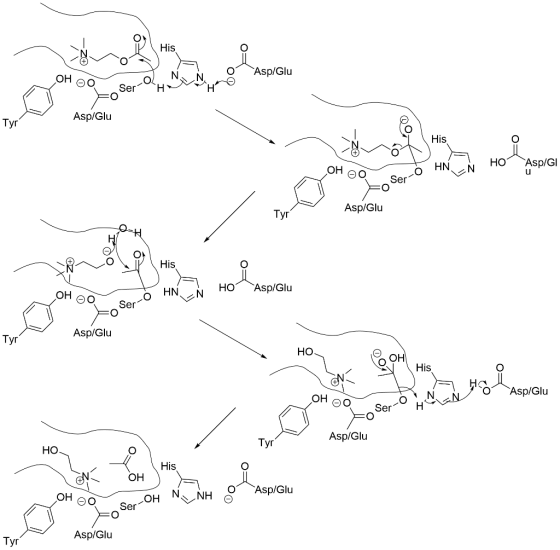
For breaking of ester bond there must be a nucleophilic attack on the carbonyl group and for this kind of reaction serine is the best nucleophile. To deprotonate serine there must be hystidine residue which further associated with a glutamic acid/aspartic acid residue.
glu/asp will abstract H from Hys that will further abstract H from Ser so the anionic Ser attacks carbonyl group and breaking of ester result in acylserine which will be further hydrolysed by residual water as shown by the mechanism below.
3.
If carbonyl group is hydrogen bonded to another residue or ester oxygen is hydogen bonded to another residue such as Hys/Tyr then that will make acetylcholine more succeptible to hydrolyse.
4.
structure (I) is an amine substitution of methyl that is structurally similar to natural ligand and also amine can interact with active side Asp/Glu amino acid. But structure (II) is ethyl substitution of methyl group that increases hydrophobicity of that part of ligand and the space in active cannot accomodate the enhanced length of the substitution So sructure (II) does not bind to receptor.
Add Answer to:
Acetylcholine is the substrate for the enzyme
acetylcholinesterase.
1. Suggest what sort of binding interactions could...
Most questions answered within 3 hours.
-
Where is the error in this code sequence?
String s1 = "Hello";
String s2 = "ello";...
asked 10 months ago -
Financial data for Joel de Paris, Inc., for last year
follow:
Joel de Paris, Inc.
Balance...
asked 10 months ago -
Consider this reaction:
Al2(SO4)3 (aq)+ BaCl3
(aq) Al2Cl6 (aq)- +
3BaSO4(s) . What is the...
asked 10 months ago -
Suppose that Savneet is considering increasing her
recent random sample from 20 car rentals to 40...
asked 10 months ago -
Trucks arrive at an unloading terminal at an average rate of 120
per hour.
Trucks arrive...
asked 10 months ago -
Why are methanol and ethanol completely soluble in water while
octanol is not very little soluble....
asked 10 months ago -
A facilities manager at a university reads in a research report
that the mean amount of...
asked 10 months ago -
When the CuSO4 is rehydrated by adding water to the anhydrous
compound, is this an endothermic...
asked 10 months ago -
A ray of sunlight is passing from diamond into crown glass; the
angle of incidence is...
asked 10 months ago -
A block of mass 0.249 kg is placed on top of a light, vertical
spring of...
asked 10 months ago -
how do the kidneys compensate in the presences of acidosis
a) trigger hyperventilate
b) reserve acid...
asked 10 months ago -
Question 501 pts
The rental rate of capital to the firm increases. Which of the
following...
asked 10 months ago