

Homework Answers
Add Answer to:
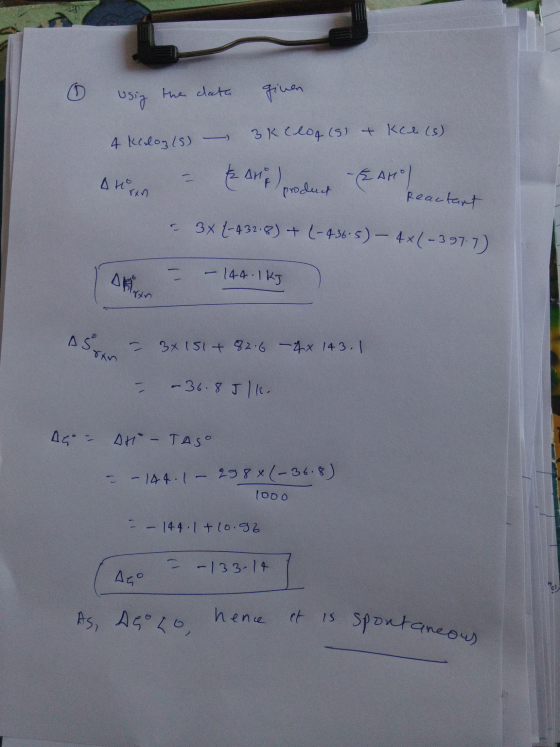
For the following reaction, calculate AHºrn, AS rx, and AGºrxn at 25 °C, and state whether...
Using enthalpies of formation (Appendix C), calculate ΔH ° for the following reaction at 25°C. Also...
 Using enthalpies of formation
(Appendix C), calculate ΔH ° for the following reaction at 25°C.
Also calculate ΔS ° for this reaction from standard entropies at
25°C. Use these values to calculate ΔG ° for the reaction at this
temperature. COCl2(g) + H2O(l ) h CO2(g) + 2HCl(g).
Appendix C Thermodynamic Quantities for Substances and Ions at 25°C Substance or lon AH; (kW/mol) 0 AG: (kJ/mol) 0 S° (J/mol-K) 20.87 ΔΗ, (kJ/mol) -946.3 - 33422 AG; {kj/mol) --859,3 -2793 (J/mol-K)...
Using enthalpies of formation
(Appendix C), calculate ΔH ° for the following reaction at 25°C.
Also calculate ΔS ° for this reaction from standard entropies at
25°C. Use these values to calculate ΔG ° for the reaction at this
temperature. COCl2(g) + H2O(l ) h CO2(g) + 2HCl(g).
Appendix C Thermodynamic Quantities for Substances and Ions at 25°C Substance or lon AH; (kW/mol) 0 AG: (kJ/mol) 0 S° (J/mol-K) 20.87 ΔΗ, (kJ/mol) -946.3 - 33422 AG; {kj/mol) --859,3 -2793 (J/mol-K)...
Calculate the standard free-energy change and the equilibrium constant Kc for the following reaction at 25°C....
 Calculate the standard free-energy change and the equilibrium constant Kc for the following reaction at 25°C. See Appendix C for data. Fe(s) + Cu2+ (aq) = Fe2+ (aq) + Cu(s) Find equilibrium constan + K at 25°C Appendix C Thermodynamic Quantities for Substances and Ions at 25°C Substance or lon AH; (kJ/mol) AG; (kJ/mol (J/mol-K) 20.87 Substance or lon Ba(OH),(s) ΔΗ: (kJ/mol) -946.3 --3342.2 AG (kJ/mol) -859.3 -2793 (J/mol K) 107.1 427 Ba(OH), 8H,O(s) BaSO (8) - 1473.2 -1362.3 132.2...
#6-9 6. Calculate the enthalpy change for the reaction given below, using thermodynamic tables in your...
 #6-9
6. Calculate the enthalpy change for the reaction given below, using thermodynamic tables in your book (Appendix 2): CH(g)+02(B) HO(g) + CO,(g) (not balanced) 7. Calcium carbonate decomposes at high temperature to form carbon dioxide and calcium oxide: CaCO3 CO2+ CaO Using data from the textbook (Apendix 2), determine the heat of reaction. 8. When potassium chloride reacts with oxygen under the right conditions, potassium chlorate is formed: 2 KCI+3 02 2KCIO3 Using data from the textbook (Appendix 2),...
#6-9
6. Calculate the enthalpy change for the reaction given below, using thermodynamic tables in your book (Appendix 2): CH(g)+02(B) HO(g) + CO,(g) (not balanced) 7. Calcium carbonate decomposes at high temperature to form carbon dioxide and calcium oxide: CaCO3 CO2+ CaO Using data from the textbook (Apendix 2), determine the heat of reaction. 8. When potassium chloride reacts with oxygen under the right conditions, potassium chlorate is formed: 2 KCI+3 02 2KCIO3 Using data from the textbook (Appendix 2),...
(7 pts.) Calculate the heat absorbed when 4.20 g of H2 are produced according to the...
 (7 pts.) Calculate the heat absorbed when 4.20 g of H2 are produced according to the following equation. CH3OH (g) → CO(g) + 2 H2(g) AH = 90.2 kJ (7 pts.) When one adds 1.475 kJ of heat energy to a sample of gold, the temperature goes from 12.5 °C to 84.6 °C. Calculate the mass of the sample of gold. Gold has a specific heat capacity of 0.129 J/g.°C. (6 pts.) 10. Write the thermochemical equation for the standard...
 Using enthalpies of formation
(Appendix C), calculate ΔH ° for the following reaction at 25°C.
Also calculate ΔS ° for this reaction from standard entropies at
25°C. Use these values to calculate ΔG ° for the reaction at this
temperature. COCl2(g) + H2O(l ) h CO2(g) + 2HCl(g).
Appendix C Thermodynamic Quantities for Substances and Ions at 25°C Substance or lon AH; (kW/mol) 0 AG: (kJ/mol) 0 S° (J/mol-K) 20.87 ΔΗ, (kJ/mol) -946.3 - 33422 AG; {kj/mol) --859,3 -2793 (J/mol-K)...
Using enthalpies of formation
(Appendix C), calculate ΔH ° for the following reaction at 25°C.
Also calculate ΔS ° for this reaction from standard entropies at
25°C. Use these values to calculate ΔG ° for the reaction at this
temperature. COCl2(g) + H2O(l ) h CO2(g) + 2HCl(g).
Appendix C Thermodynamic Quantities for Substances and Ions at 25°C Substance or lon AH; (kW/mol) 0 AG: (kJ/mol) 0 S° (J/mol-K) 20.87 ΔΗ, (kJ/mol) -946.3 - 33422 AG; {kj/mol) --859,3 -2793 (J/mol-K)...
 Calculate the standard free-energy change and the equilibrium constant Kc for the following reaction at 25°C. See Appendix C for data. Fe(s) + Cu2+ (aq) = Fe2+ (aq) + Cu(s) Find equilibrium constan + K at 25°C Appendix C Thermodynamic Quantities for Substances and Ions at 25°C Substance or lon AH; (kJ/mol) AG; (kJ/mol (J/mol-K) 20.87 Substance or lon Ba(OH),(s) ΔΗ: (kJ/mol) -946.3 --3342.2 AG (kJ/mol) -859.3 -2793 (J/mol K) 107.1 427 Ba(OH), 8H,O(s) BaSO (8) - 1473.2 -1362.3 132.2...
 #6-9
6. Calculate the enthalpy change for the reaction given below, using thermodynamic tables in your book (Appendix 2): CH(g)+02(B) HO(g) + CO,(g) (not balanced) 7. Calcium carbonate decomposes at high temperature to form carbon dioxide and calcium oxide: CaCO3 CO2+ CaO Using data from the textbook (Apendix 2), determine the heat of reaction. 8. When potassium chloride reacts with oxygen under the right conditions, potassium chlorate is formed: 2 KCI+3 02 2KCIO3 Using data from the textbook (Appendix 2),...
#6-9
6. Calculate the enthalpy change for the reaction given below, using thermodynamic tables in your book (Appendix 2): CH(g)+02(B) HO(g) + CO,(g) (not balanced) 7. Calcium carbonate decomposes at high temperature to form carbon dioxide and calcium oxide: CaCO3 CO2+ CaO Using data from the textbook (Apendix 2), determine the heat of reaction. 8. When potassium chloride reacts with oxygen under the right conditions, potassium chlorate is formed: 2 KCI+3 02 2KCIO3 Using data from the textbook (Appendix 2),...
 (7 pts.) Calculate the heat absorbed when 4.20 g of H2 are produced according to the following equation. CH3OH (g) → CO(g) + 2 H2(g) AH = 90.2 kJ (7 pts.) When one adds 1.475 kJ of heat energy to a sample of gold, the temperature goes from 12.5 °C to 84.6 °C. Calculate the mass of the sample of gold. Gold has a specific heat capacity of 0.129 J/g.°C. (6 pts.) 10. Write the thermochemical equation for the standard...
Most questions answered within 3 hours.
-
Where is the error in this code sequence?
String s1 = "Hello";
String s2 = "ello";...
asked 11 months ago -
Financial data for Joel de Paris, Inc., for last year
follow:
Joel de Paris, Inc.
Balance...
asked 11 months ago -
Consider this reaction:
Al2(SO4)3 (aq)+ BaCl3
(aq) Al2Cl6 (aq)- +
3BaSO4(s) . What is the...
asked 11 months ago -
Suppose that Savneet is considering increasing her
recent random sample from 20 car rentals to 40...
asked 11 months ago -
Trucks arrive at an unloading terminal at an average rate of 120
per hour.
Trucks arrive...
asked 11 months ago -
Why are methanol and ethanol completely soluble in water while
octanol is not very little soluble....
asked 11 months ago -
A facilities manager at a university reads in a research report
that the mean amount of...
asked 11 months ago -
When the CuSO4 is rehydrated by adding water to the anhydrous
compound, is this an endothermic...
asked 11 months ago -
A ray of sunlight is passing from diamond into crown glass; the
angle of incidence is...
asked 11 months ago -
A block of mass 0.249 kg is placed on top of a light, vertical
spring of...
asked 11 months ago -
how do the kidneys compensate in the presences of acidosis
a) trigger hyperventilate
b) reserve acid...
asked 11 months ago -
Question 501 pts
The rental rate of capital to the firm increases. Which of the
following...
asked 11 months ago