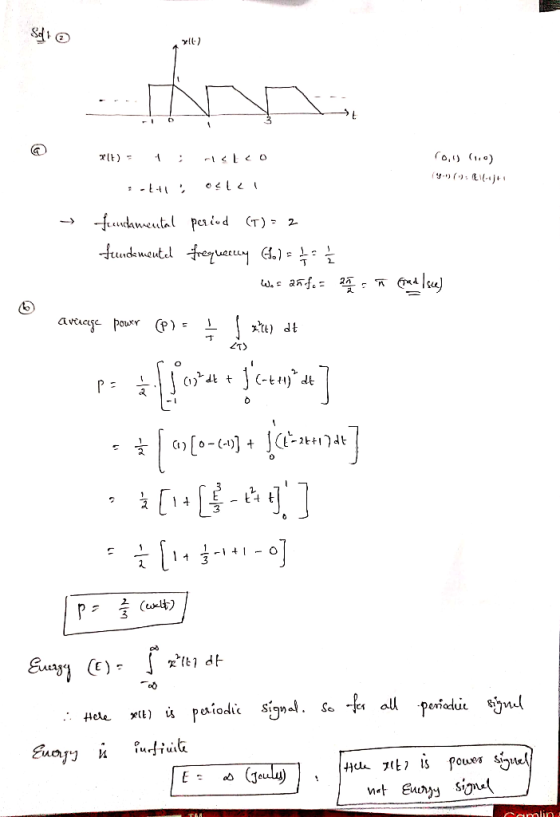
![Question 2 (50 points]: Continuous-Time Signals Given the following continuous-time signal (t). (t) 5t (a) [4%] What is the f](http://img.homeworklib.com/questions/665c2a30-f34c-11eb-a881-6715027536c5.png?x-oss-process=image/resize,w_560)
Homework Answers
![X(t): - 110 -1 72 1 -+1 ; ostei , TPR, tos find the fainer seño coefficientes * x[] = Sou zjemnie tot de Beat x[x]c [ar-j bv](http://img.homeworklib.com/questions/6801d280-f34c-11eb-bbe5-870ea5eb22e0.png?x-oss-process=image/resize,w_560)
![1 - STE 3 Sak - 2 xf3+ + ( eg (1-092) - i (+(12--))] *[k]{ cathys (- como) - ( Hi (serie-»]] – Compare o and ak = centage (1-](http://img.homeworklib.com/questions/6880bf30-f34c-11eb-bead-f1a6b13aacfb.png?x-oss-process=image/resize,w_560)
Add Answer to:
Question 2 (50 points]: Continuous-Time Signals Given the following continuous-time signal (t). (t) 5t (a) [4%]...
2. A continuous-time periodic signal with Fourier series coefficients c^ = and period T, 0.1sec pass...
 2. A continuous-time periodic signal with Fourier series coefficients c^ = and period T, 0.1sec pass through an ideal lowpass filter with cut off frequency =102.5Hz. The resulting signal y, (t) is sampled periodically with T 0.005 sec determine the spectrum of the sequence y(n) = ya(nT)
1. Consider a continuous-time ideal high-pass filter that removes all frequencies below a given cut-off frequency,...
 1. Consider a continuous-time ideal high-pass filter that removes all frequencies below a given cut-off frequency, and allows all frequencies at or above that cut-off frequency to pass through the system unchanged. That is, the filter will keep frequency w if w] 2we and remove frequency w if ww Let the cutoff frequency we have value 2π. (a) Sketch this filter's frequency response H(ju). (b) Let x(t) 4-3 cos(3m) + 6eMt. Find ak, the Fourier series coefficients of x(t) (c)...
(a) Given the following periodic signal a(t) a(t) -0.5 -0.25 0 0.25 0.5 0.75 1 1.25 1.5 i. [2%) Determine the fundamental period T ii. [5%] Derive the Fourier series coefficients of x(t). iii. [396]...
 (a) Given the following periodic signal a(t) a(t) -0.5 -0.25 0 0.25 0.5 0.75 1 1.25 1.5 i. [2%) Determine the fundamental period T ii. [5%] Derive the Fourier series coefficients of x(t). iii. [396] Calculate the total average power of z(t). iv. [5%] If z(t) is passed through a low-pass filter and the power loss of the output signal should be optimized to be less than 5%, what should be the requirement of cutoff frequency of the low-pass filter?...
The following periodic signal is input to an ideal low pass filter of bandwidth 25 KHz. 1. x(t) 2...
 The following periodic signal is input to an ideal low pass filter of bandwidth 25 KHz. 1. x(t) 2 a) Determine the average power of the signal x(t). b) If T 0.1 ms, give the output of the filter as a function of time, y(t) e) Determine the average power of the signal y(t) d) Determine the bandwidth of the signal y(), considered as a baseband signal. e) Now assume that the signal x() (with T-0.1 ms) is instead input...
Q. 2 A continuous time signal x(t) has the Continuous Time Fourier Transform shown in Fig...
 Q. 2 A continuous time signal x(t) has the Continuous Time Fourier Transform shown in Fig 2. Xc() -80007 0 80001 2 (rad/s) Fig 2 According to the sampling theorem, find the maximum allowable sampling period T for this signal. Also plot the Fourier Transforms of the sampled signal X:(j) and X(elo). Label the resulting signals appropriately (both in frequency and amplitude axis). Assuming that the sampling period is increased 1.2 times, what is the new sampling frequency 2? What...
Question 3 (30 points) Consider the signals defined below: *:(t) = cos(2) xz(t) = cos(4+) a)...
 Question 3 (30 points) Consider the signals defined below: *:(t) = cos(2) xz(t) = cos(4+) a) Determine the fundamental period for each signal. b) Determine the fundamental period and fundamental frequency of the signal: y(t) = x;(C)x(0) (t) and x2(c) when the fundamental frequency is c) Determine the Fourier Series coefficients of defined as determined in part (b). d) Using Parseval's relation, determine the power of xy(t) and xy(t) e) Determine and plot the Fourier Series Coefficients of y(t). Show...
2. (12 points) Apply the result from part 1 to determine the response of a lowpass...
 2. (12 points) Apply the result from part 1 to determine the response of a lowpass filter. a) (4 points) Determine the fundamental frequency and non-zero complex exponential Fourier series coeffi- cients of the periodic signal 2π f(t) =-2-5 sin(2nt) + 10 cos(Grt + "") and sketch the Fourier magnitude spectum D versus w and the Fourier phase spectrum LD versus w (b) (2 points) Use Parseval's theorem for the exponential Fourier series to find the power of the signal...
filtering of periodic signals: damental frequency 120 = 1/4 is the Answers: Gk = 0.J, Consider...
 filtering of periodic signals: damental frequency 120 = 1/4 is the Answers: Gk = 0.J, Consider the following problems related to filtering of (a) A periodic signal x(t) of fundamental frequen input of an ideal band-pass filter with the following response the following frequency 11312 3 3/2 1 -37% -21 322 5 3/2 ZH(N2) = 2 -3/2 223 - 0 otherwise ero Fourier series coefficients of x(t) are (92)/ = o otherwise The non-zero Fourie X = X-1 = ),...
The exponential Fourier series of a certain periodic signal is given as f(t) (2+j2) exp(-j300t) +...
 The exponential Fourier series of a certain periodic signal is given as f(t) (2+j2) exp(-j300t) +j2 exp(-j10t) +3 -j2 exp^10t)+ (2-j2) expG300t) a. Find the compact trigonometric Fourier series of f(t). b. Find the bandwidth of the signal c. Find the Fourier Transform of f(t) d. Design a simple low pass filter (RC circuit) that reduces the amplitude of the highest frequency part oft(t) by at least 50%. Write down its H(0) and plot its spectrum. e. Plot the spectrum...
Problem 1: Consider the continuous-time signal r(t) as shown in Figure 1. r(t) Figure 1: A...
 Problem 1: Consider the continuous-time signal r(t) as shown in Figure 1. r(t) Figure 1: A continuous-time signal r(t) (a) Determine the fundamental period and the fundamental angular frequency of r(). 5 (b) Write down the equation for z(0) as the Fourier Series in exponential form and identify (c) Sketch the spectrum of this signal indicating the complex amplitudes and the frequen- points the Fourier Series coefficients. (15 points cies. [10 points
 2. A continuous-time periodic signal with Fourier series coefficients c^ = and period T, 0.1sec pass through an ideal lowpass filter with cut off frequency =102.5Hz. The resulting signal y, (t) is sampled periodically with T 0.005 sec determine the spectrum of the sequence y(n) = ya(nT)
 1. Consider a continuous-time ideal high-pass filter that removes all frequencies below a given cut-off frequency, and allows all frequencies at or above that cut-off frequency to pass through the system unchanged. That is, the filter will keep frequency w if w] 2we and remove frequency w if ww Let the cutoff frequency we have value 2π. (a) Sketch this filter's frequency response H(ju). (b) Let x(t) 4-3 cos(3m) + 6eMt. Find ak, the Fourier series coefficients of x(t) (c)...
 (a) Given the following periodic signal a(t) a(t) -0.5 -0.25 0 0.25 0.5 0.75 1 1.25 1.5 i. [2%) Determine the fundamental period T ii. [5%] Derive the Fourier series coefficients of x(t). iii. [396] Calculate the total average power of z(t). iv. [5%] If z(t) is passed through a low-pass filter and the power loss of the output signal should be optimized to be less than 5%, what should be the requirement of cutoff frequency of the low-pass filter?...
 The following periodic signal is input to an ideal low pass filter of bandwidth 25 KHz. 1. x(t) 2 a) Determine the average power of the signal x(t). b) If T 0.1 ms, give the output of the filter as a function of time, y(t) e) Determine the average power of the signal y(t) d) Determine the bandwidth of the signal y(), considered as a baseband signal. e) Now assume that the signal x() (with T-0.1 ms) is instead input...
 Q. 2 A continuous time signal x(t) has the Continuous Time Fourier Transform shown in Fig 2. Xc() -80007 0 80001 2 (rad/s) Fig 2 According to the sampling theorem, find the maximum allowable sampling period T for this signal. Also plot the Fourier Transforms of the sampled signal X:(j) and X(elo). Label the resulting signals appropriately (both in frequency and amplitude axis). Assuming that the sampling period is increased 1.2 times, what is the new sampling frequency 2? What...
 Question 3 (30 points) Consider the signals defined below: *:(t) = cos(2) xz(t) = cos(4+) a) Determine the fundamental period for each signal. b) Determine the fundamental period and fundamental frequency of the signal: y(t) = x;(C)x(0) (t) and x2(c) when the fundamental frequency is c) Determine the Fourier Series coefficients of defined as determined in part (b). d) Using Parseval's relation, determine the power of xy(t) and xy(t) e) Determine and plot the Fourier Series Coefficients of y(t). Show...
 2. (12 points) Apply the result from part 1 to determine the response of a lowpass filter. a) (4 points) Determine the fundamental frequency and non-zero complex exponential Fourier series coeffi- cients of the periodic signal 2π f(t) =-2-5 sin(2nt) + 10 cos(Grt + "") and sketch the Fourier magnitude spectum D versus w and the Fourier phase spectrum LD versus w (b) (2 points) Use Parseval's theorem for the exponential Fourier series to find the power of the signal...
 filtering of periodic signals: damental frequency 120 = 1/4 is the Answers: Gk = 0.J, Consider the following problems related to filtering of (a) A periodic signal x(t) of fundamental frequen input of an ideal band-pass filter with the following response the following frequency 11312 3 3/2 1 -37% -21 322 5 3/2 ZH(N2) = 2 -3/2 223 - 0 otherwise ero Fourier series coefficients of x(t) are (92)/ = o otherwise The non-zero Fourie X = X-1 = ),...
 The exponential Fourier series of a certain periodic signal is given as f(t) (2+j2) exp(-j300t) +j2 exp(-j10t) +3 -j2 exp^10t)+ (2-j2) expG300t) a. Find the compact trigonometric Fourier series of f(t). b. Find the bandwidth of the signal c. Find the Fourier Transform of f(t) d. Design a simple low pass filter (RC circuit) that reduces the amplitude of the highest frequency part oft(t) by at least 50%. Write down its H(0) and plot its spectrum. e. Plot the spectrum...
 Problem 1: Consider the continuous-time signal r(t) as shown in Figure 1. r(t) Figure 1: A continuous-time signal r(t) (a) Determine the fundamental period and the fundamental angular frequency of r(). 5 (b) Write down the equation for z(0) as the Fourier Series in exponential form and identify (c) Sketch the spectrum of this signal indicating the complex amplitudes and the frequen- points the Fourier Series coefficients. (15 points cies. [10 points
Most questions answered within 3 hours.
-
Where is the error in this code sequence?
String s1 = "Hello";
String s2 = "ello";...
asked 11 months ago -
Financial data for Joel de Paris, Inc., for last year
follow:
Joel de Paris, Inc.
Balance...
asked 11 months ago -
Consider this reaction:
Al2(SO4)3 (aq)+ BaCl3
(aq) Al2Cl6 (aq)- +
3BaSO4(s) . What is the...
asked 11 months ago -
Suppose that Savneet is considering increasing her
recent random sample from 20 car rentals to 40...
asked 11 months ago -
Trucks arrive at an unloading terminal at an average rate of 120
per hour.
Trucks arrive...
asked 11 months ago -
Why are methanol and ethanol completely soluble in water while
octanol is not very little soluble....
asked 11 months ago -
A facilities manager at a university reads in a research report
that the mean amount of...
asked 11 months ago -
When the CuSO4 is rehydrated by adding water to the anhydrous
compound, is this an endothermic...
asked 11 months ago -
A ray of sunlight is passing from diamond into crown glass; the
angle of incidence is...
asked 11 months ago -
A block of mass 0.249 kg is placed on top of a light, vertical
spring of...
asked 11 months ago -
how do the kidneys compensate in the presences of acidosis
a) trigger hyperventilate
b) reserve acid...
asked 11 months ago -
Question 501 pts
The rental rate of capital to the firm increases. Which of the
following...
asked 11 months ago