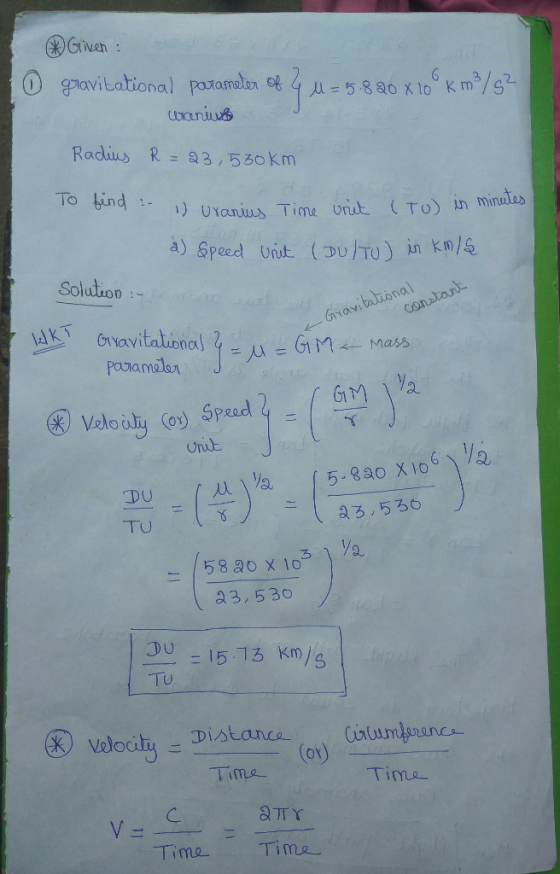
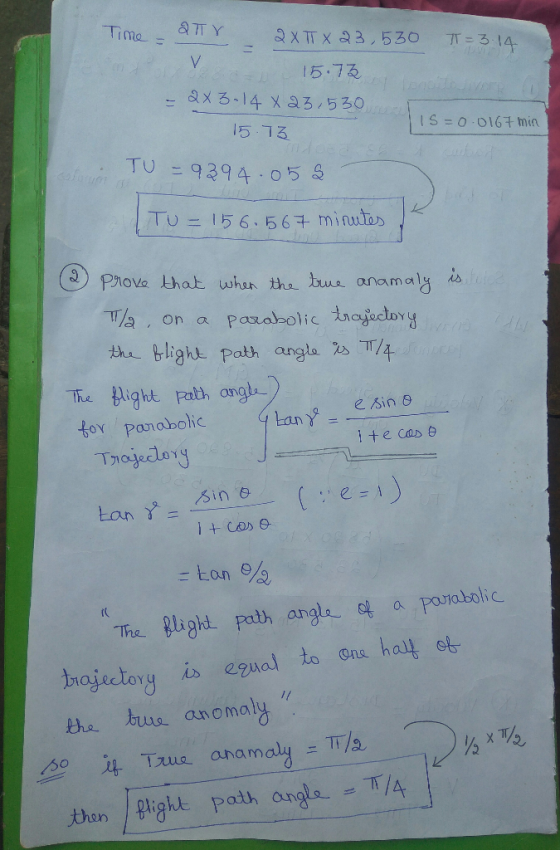
![Problem 1 Parts (a) and (b) are independent] (a) The gravitational parameter of Urans is 5.820x10 kms, and its radius is R-23,530 km. Calculate the Uranus time unit (TU) in minutes and speed unit (DU/TU) in km/s. (b) Prove that when the true anomaly is T/2 on a parabolic trajectory, the flight-path angle is t/4.](http://img.homeworklib.com/questions/a56f07e0-f380-11eb-9ad0-19b4e9d9aea5.png?x-oss-process=image/resize,w_560)
Homework Answers
Add Answer to:
Problem 1 Parts (a) and (b) are independent] (a) The gravitational parameter of Urans is 5.820x10...
Problem 1 Consider a paper airplane that has a rubber band driven propeller. The equations of...
 Problem 1 Consider a paper airplane that has a rubber band driven propeller. The equations of motion for it longitu dinal dynamics can be written as where its state vector is given by the velocity V and the flight path angle y, i.e., xV,E R2, and the control input is given by the thrust u. All of other variables, namely mass m, gravitational acceleration g, lift parameters I, and drag parameter d are fixed constants (a) Let V* > 0...
1). In a uniform circular motion, instantaneous velocity is tangent to the circle a) True b)...
 1). In a uniform circular motion, instantaneous velocity is tangent to the circle a) True b) False c) Can's say 2).In a uniform circular motion, acceleration is normal to the velocity and directed toward the center a) True b) False c) Unknown 3). For a particle of mass 'm' moving with a uniform velocity 'v'in a circle of radius 'r', write the expression for centripetal force (Fc)? 4). If a particle rotates in a circle of radius r = 10...
1).In a uniform circular motion, instantaneous velocity is tangent to the circle a) True b) False...
 1).In a uniform circular motion, instantaneous velocity is tangent to the circle a) True b) False c) Can's say 2).In a uniform circular motion, acceleration is normal to the velocity and directed toward the center a) True b) False c) Unknown 3). For a particle of mass 'm' moving with a uniform velocity 'v' in a circle of radius 'r', write the expression for centripetal force (Fc)? 4). If a particle rotates in a circle of radius r= 10 cm...
Please help! :) Discussion #3 1. Consider the motion of an object that can be treated...
 Please help! :)
Discussion #3 1. Consider the motion of an object that can be treated as a point particle and is traveling counter-clockwise in a circle of radius R. This motion can (and will for the purposes of these discussion activities) be described and analyzed using a Cartesian (x-y) coordinate system with a spatial origin at the center of the particle's circular trajectory (the physical path its motion traces out in space). (a) Draw a diagram of the position...
Please help! :)
Discussion #3 1. Consider the motion of an object that can be treated as a point particle and is traveling counter-clockwise in a circle of radius R. This motion can (and will for the purposes of these discussion activities) be described and analyzed using a Cartesian (x-y) coordinate system with a spatial origin at the center of the particle's circular trajectory (the physical path its motion traces out in space). (a) Draw a diagram of the position...
(1 point) You bicycle along a straight flat road with a safety light attached to one foot. Your b...
 (1 point) You bicycle along a straight flat road with a safety light attached to one foot. Your bike moves at a speed of 30 km/hr and your foot moves in a circle of radius 22 cm centered 32 cm above the ground, making one revolution per second. (a) Find parametric equations for r and y which describe the path traced out by the light, where y is distance (in cm) above the ground and x the horizontal distance (in...
Between figure the acceleration arrow you should draw through each position dot during step 1 sho...
 N3M.12
between figure the acceleration arrow you should draw through each position dot during step 1 should point from the puck's position at that instant toward the table's center, since the Ca string's tension force acts in that direction.] (b) Check your work using the Newton program. N3M.12 In this problem, we will explore the necessary con- t ditions for uniform circular motion. (a) According to chapter N1, an object moving in a circle of radius rat constant speed llexperiences...
N3M.12
between figure the acceleration arrow you should draw through each position dot during step 1 should point from the puck's position at that instant toward the table's center, since the Ca string's tension force acts in that direction.] (b) Check your work using the Newton program. N3M.12 In this problem, we will explore the necessary con- t ditions for uniform circular motion. (a) According to chapter N1, an object moving in a circle of radius rat constant speed llexperiences...
I need help with problem 39 parts b,c,d Unit 7. Work and Energy In Class Packet...
 I need help with problem 39 parts b,c,d
Unit 7. Work and Energy In Class Packet Name: 36. A 2.45 kg rock is dropped from the top of a 15.5 m vertical cliff a. What is the potential energy of the rock relative to the base of the cliff before it is dropped? b. What is the kinetic energy of the rock just before it hits the ground below? c. What is the velocity of the rock at a point...
I need help with problem 39 parts b,c,d
Unit 7. Work and Energy In Class Packet Name: 36. A 2.45 kg rock is dropped from the top of a 15.5 m vertical cliff a. What is the potential energy of the rock relative to the base of the cliff before it is dropped? b. What is the kinetic energy of the rock just before it hits the ground below? c. What is the velocity of the rock at a point...
Please help with Q1 a)b)c). Question 1: In the lectures we considered simple projectile motion. Here we extend the description to include air resistance. For macroscopic objects in air, the dynamics...
 Please help with Q1 a)b)c).
Question 1: In the lectures we considered simple projectile motion. Here we extend the description to include air resistance. For macroscopic objects in air, the dynamics equations including air resistance may be written V and ^- where m is the mass of the object, g is the acceleration due to gravity, y is the vertical direction, C is a dimensionless drag coefficient, A is the cross-sectional area of the object, pa 1.2kg/m3 is the density...
Please help with Q1 a)b)c).
Question 1: In the lectures we considered simple projectile motion. Here we extend the description to include air resistance. For macroscopic objects in air, the dynamics equations including air resistance may be written V and ^- where m is the mass of the object, g is the acceleration due to gravity, y is the vertical direction, C is a dimensionless drag coefficient, A is the cross-sectional area of the object, pa 1.2kg/m3 is the density...
rate 1. True or False? Explain: a. If a car's speedometer is constant, then the car...
 rate 1. True or False? Explain: a. If a car's speedometer is constant, then the car cannot be accelerating. b. Ifan =0 for a moving object, then the object cannot be accelerating. c. The arc length of a space curve depends on the parameterization. d. The curvature of a circle is the same as its radius. e. The normal component of acceleration is a function of both speed and curvature. 2. Projectile Motion: A projectile is launched with an initial...
1. An airplane if flying horizontally at a constant height of 6 km above a fixed observation poin...
 1. An airplane if flying horizontally at a constant height of 6 km above a fixed observation point. At a certain moment the angle of elevation θ is 30° and decreasing and the speed of the plane is 4 km/h. (a) How fast is 0 decreasing at this moment? (b) How fast is the distance between the plane and the observation point is changing at this moment? 2. Trajectory of a particle is described by parametrical equations as t,y P,...
 Problem 1 Consider a paper airplane that has a rubber band driven propeller. The equations of motion for it longitu dinal dynamics can be written as where its state vector is given by the velocity V and the flight path angle y, i.e., xV,E R2, and the control input is given by the thrust u. All of other variables, namely mass m, gravitational acceleration g, lift parameters I, and drag parameter d are fixed constants (a) Let V* > 0...
 1). In a uniform circular motion, instantaneous velocity is tangent to the circle a) True b) False c) Can's say 2).In a uniform circular motion, acceleration is normal to the velocity and directed toward the center a) True b) False c) Unknown 3). For a particle of mass 'm' moving with a uniform velocity 'v'in a circle of radius 'r', write the expression for centripetal force (Fc)? 4). If a particle rotates in a circle of radius r = 10...
 1).In a uniform circular motion, instantaneous velocity is tangent to the circle a) True b) False c) Can's say 2).In a uniform circular motion, acceleration is normal to the velocity and directed toward the center a) True b) False c) Unknown 3). For a particle of mass 'm' moving with a uniform velocity 'v' in a circle of radius 'r', write the expression for centripetal force (Fc)? 4). If a particle rotates in a circle of radius r= 10 cm...
 Please help! :)
Discussion #3 1. Consider the motion of an object that can be treated as a point particle and is traveling counter-clockwise in a circle of radius R. This motion can (and will for the purposes of these discussion activities) be described and analyzed using a Cartesian (x-y) coordinate system with a spatial origin at the center of the particle's circular trajectory (the physical path its motion traces out in space). (a) Draw a diagram of the position...
Please help! :)
Discussion #3 1. Consider the motion of an object that can be treated as a point particle and is traveling counter-clockwise in a circle of radius R. This motion can (and will for the purposes of these discussion activities) be described and analyzed using a Cartesian (x-y) coordinate system with a spatial origin at the center of the particle's circular trajectory (the physical path its motion traces out in space). (a) Draw a diagram of the position...
 (1 point) You bicycle along a straight flat road with a safety light attached to one foot. Your bike moves at a speed of 30 km/hr and your foot moves in a circle of radius 22 cm centered 32 cm above the ground, making one revolution per second. (a) Find parametric equations for r and y which describe the path traced out by the light, where y is distance (in cm) above the ground and x the horizontal distance (in...
 N3M.12
between figure the acceleration arrow you should draw through each position dot during step 1 should point from the puck's position at that instant toward the table's center, since the Ca string's tension force acts in that direction.] (b) Check your work using the Newton program. N3M.12 In this problem, we will explore the necessary con- t ditions for uniform circular motion. (a) According to chapter N1, an object moving in a circle of radius rat constant speed llexperiences...
N3M.12
between figure the acceleration arrow you should draw through each position dot during step 1 should point from the puck's position at that instant toward the table's center, since the Ca string's tension force acts in that direction.] (b) Check your work using the Newton program. N3M.12 In this problem, we will explore the necessary con- t ditions for uniform circular motion. (a) According to chapter N1, an object moving in a circle of radius rat constant speed llexperiences...
 I need help with problem 39 parts b,c,d
Unit 7. Work and Energy In Class Packet Name: 36. A 2.45 kg rock is dropped from the top of a 15.5 m vertical cliff a. What is the potential energy of the rock relative to the base of the cliff before it is dropped? b. What is the kinetic energy of the rock just before it hits the ground below? c. What is the velocity of the rock at a point...
I need help with problem 39 parts b,c,d
Unit 7. Work and Energy In Class Packet Name: 36. A 2.45 kg rock is dropped from the top of a 15.5 m vertical cliff a. What is the potential energy of the rock relative to the base of the cliff before it is dropped? b. What is the kinetic energy of the rock just before it hits the ground below? c. What is the velocity of the rock at a point...
 Please help with Q1 a)b)c).
Question 1: In the lectures we considered simple projectile motion. Here we extend the description to include air resistance. For macroscopic objects in air, the dynamics equations including air resistance may be written V and ^- where m is the mass of the object, g is the acceleration due to gravity, y is the vertical direction, C is a dimensionless drag coefficient, A is the cross-sectional area of the object, pa 1.2kg/m3 is the density...
Please help with Q1 a)b)c).
Question 1: In the lectures we considered simple projectile motion. Here we extend the description to include air resistance. For macroscopic objects in air, the dynamics equations including air resistance may be written V and ^- where m is the mass of the object, g is the acceleration due to gravity, y is the vertical direction, C is a dimensionless drag coefficient, A is the cross-sectional area of the object, pa 1.2kg/m3 is the density...
 rate 1. True or False? Explain: a. If a car's speedometer is constant, then the car cannot be accelerating. b. Ifan =0 for a moving object, then the object cannot be accelerating. c. The arc length of a space curve depends on the parameterization. d. The curvature of a circle is the same as its radius. e. The normal component of acceleration is a function of both speed and curvature. 2. Projectile Motion: A projectile is launched with an initial...
 1. An airplane if flying horizontally at a constant height of 6 km above a fixed observation point. At a certain moment the angle of elevation θ is 30° and decreasing and the speed of the plane is 4 km/h. (a) How fast is 0 decreasing at this moment? (b) How fast is the distance between the plane and the observation point is changing at this moment? 2. Trajectory of a particle is described by parametrical equations as t,y P,...
Most questions answered within 3 hours.
-
Where is the error in this code sequence?
String s1 = "Hello";
String s2 = "ello";...
asked 11 months ago -
Financial data for Joel de Paris, Inc., for last year
follow:
Joel de Paris, Inc.
Balance...
asked 11 months ago -
Consider this reaction:
Al2(SO4)3 (aq)+ BaCl3
(aq) Al2Cl6 (aq)- +
3BaSO4(s) . What is the...
asked 11 months ago -
Suppose that Savneet is considering increasing her
recent random sample from 20 car rentals to 40...
asked 11 months ago -
Trucks arrive at an unloading terminal at an average rate of 120
per hour.
Trucks arrive...
asked 11 months ago -
Why are methanol and ethanol completely soluble in water while
octanol is not very little soluble....
asked 11 months ago -
A facilities manager at a university reads in a research report
that the mean amount of...
asked 11 months ago -
When the CuSO4 is rehydrated by adding water to the anhydrous
compound, is this an endothermic...
asked 11 months ago -
A ray of sunlight is passing from diamond into crown glass; the
angle of incidence is...
asked 11 months ago -
A block of mass 0.249 kg is placed on top of a light, vertical
spring of...
asked 11 months ago -
how do the kidneys compensate in the presences of acidosis
a) trigger hyperventilate
b) reserve acid...
asked 11 months ago -
Question 501 pts
The rental rate of capital to the firm increases. Which of the
following...
asked 11 months ago